Ontario's Plain-English Guide to Custom Home Building📞 705-533-1633 | ☎️ 1-866-868-6606 | ✉️ info@icfhome.ca

Why ICF Homes are the Perfect Match for Geothermal Heating
Ontario
Geothermal
ICF Homes • High-performance match
Why ICF Homes are the Perfect Match for Geothermal Heating
Geothermal is one of the most efficient heating options you can install in Ontario—yet plenty of homeowners still end up disappointed. Not because geothermal “doesn’t work”… but because the home itself leaks heat like a screen door in January. Pair geothermal with an ICF home and the story changes: lower peak loads, steadier indoor temperatures, quieter equipment operation, and a system that finally gets to do what it’s best at—running efficiently for a long time.
APP Introduction
Agree • Promise • Preview
Agree: If you’re spending real money on geothermal, you want real results—comfort, low operating costs, and a system that doesn’t feel like it’s struggling every cold snap.
Promise: This guide explains (in plain English) why ICF + geothermal is a powerhouse combination in Ontario, what design details matter, and how to avoid common sizing and comfort mistakes.
Preview: We’ll cover the “who/what/why/how,” the building-science reason ICF makes geothermal shine, what to prioritize in design and mechanical planning, cost/ROI considerations, and a practical 10-question FAQ at the end.
E-E-A-T credibility line (paste your credentials here): [Insert your experience/credentials here — e.g., “Licensed Ontario custom home builder with 45 years of construction experience and 250+ homes built, specializing in ICF and high-performance mechanical systems.”]
Who This Combination Is For (and Who It Isn’t)
ICF + geothermal is ideal when you’re building in Ontario and you want:
- Long-term ownership value (lower operating costs and durability that ages well)
- High comfort (stable indoor temperatures, fewer drafts, quieter operation)
- Energy efficiency without “babying” the thermostat
- A system that performs in real winters, not just in brochure weather
It may be a weaker fit if you plan to move quickly, can’t accommodate a loop field (or drilling), or your site has constraints that make geothermal unusually expensive. If you’re deciding between geothermal and other systems, this comparison helps frame the decision: Geothermal vs air-source heat pump in Ontario.
What Makes Geothermal “Different” (and Why the House Matters)
Geothermal is basically a heat pump that uses the ground as its heat source/sink instead of outdoor air. That means it can be extremely efficient and stable— but it’s still a heat pump. Heat pumps prefer steady demand over sudden spikes. When demand spikes, you either need more equipment capacity (bigger system), or you lean on backup heat more often. That’s where your building envelope becomes the star of the show.
Three things geothermal likes
- Low heat loss (so the system doesn’t fight a constant uphill battle)
- Stable indoor temperatures (so it can run long, efficient cycles)
- Lower peak loads (so you don’t buy capacity for a few extreme hours per year)
A geothermal system can only be as “cheap to run” as the house is “hard to cool down.”
ICF makes the house hard to cool down—in the best possible way.
For a plain-language overview of heat pumps and efficiency, NRCan is a good baseline reference: NRCan: Heat pumps.
Why ICF Makes Geothermal Perform Better in Ontario
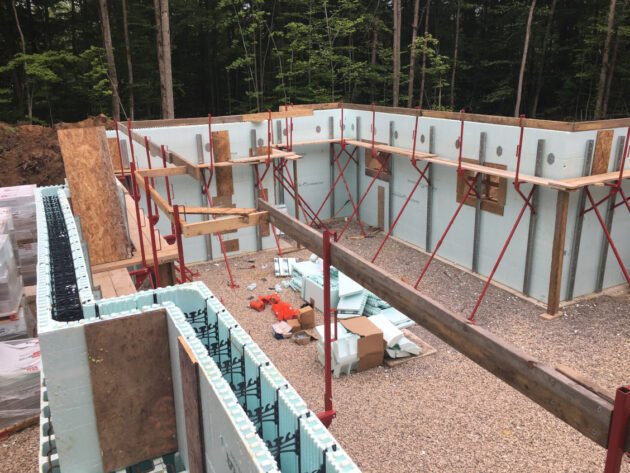
ICF (Insulated Concrete Forms) creates a high-performance wall assembly with continuous insulation, strong air tightness potential, and thermal mass. In Ontario, those three factors directly reduce the “peaks and valleys” that force HVAC systems to work harder.
1) Lower peak load = smaller geothermal system (often)
Peak load is what drives equipment sizing. In a leaky or under-insulated home, peak demand is higher—so you buy more geothermal capacity. In an ICF home, peak demand can drop, which can translate into smaller equipment and/or reduced reliance on backup heat.
2) Air tightness reduces the hidden load nobody budgets for
Air leakage isn’t just “drafty comfort.” It’s also a real heating load that geothermal must cover. Better air tightness helps geothermal run steadier and keeps your indoor humidity more controllable.
3) Thermal mass smooths temperature swings
Thermal mass helps buffer rapid indoor temperature changes—especially during shoulder seasons and windy cold snaps. The result is often a home that feels more even, room-to-room, and less “reactive.”
If you want the bigger picture of why ICF is different from conventional framing, this is a good primer: Benefits of ICF over traditional homes.
Geothermal rewards consistency. ICF produces consistency.
That’s the match.
How to Design an ICF + Geothermal Home (The Practical Blueprint)
The best results come when geothermal is planned as part of a complete comfort and efficiency strategy—not bolted on as an “upgrade.” Here’s how to approach it in a sequence that prevents expensive rework.
Step 1: Do the heat-loss calculation early
Heat-loss is the foundation of HVAC sizing. Don’t guess. Don’t “rule-of-thumb” it. If you want predictable geothermal performance, start here: Heat loss calculation for a new home.
Step 2: Decide your delivery method (ducted air, radiant, or hybrid)
- Ducted geothermal: common, good for cooling, straightforward distribution
- Radiant + geothermal: comfort-focused, excellent for steady heating loads, often paired with buffer tanks
- Hybrid: radiant on main living areas + ducted for cooling/air quality, depending on design goals
If you’re weighing comfort strategies, this overview helps: Best heating system for an ICF home in Ontario.
Step 3: Plan the loop field or vertical drilling around site realities
Geothermal loop planning is where “paper design” meets “dirt reality.” Soil type, access for drilling equipment, landscaping plans, and future additions all matter. Good loop planning avoids expensive surprises later.
Step 4: Build a house that deserves geothermal
This is where ICF shines. Continuous insulation, careful detailing, and good window/door installation protect the investment you’re making in the mechanical system. If you’re building to code (or beyond), keep current requirements and interpretations in mind: Ontario Building Code.
Cost and ROI: Where the Value Actually Shows Up
Geothermal’s upfront cost is higher than many conventional systems, which is why “value” needs to be measured over time. The most important thing to understand is that geothermal economics improve when:
- Your heating load is lower (smaller system, less backup heat use)
- Your home is stable (long run times at high efficiency)
- Your comfort target is high (geothermal excels at steady comfort)
- Energy prices rise (efficiency becomes more valuable over time)
For the Ontario cost conversation, start with these two (interior) references: Geothermal system cost in 2026 (Ontario) and ROI: Can geothermal boost a home’s value?.
The fastest way to make geothermal look “too expensive” is to put it in a home with a high heating load.
The fastest way to make geothermal look brilliant is to pair it with a high-performance envelope—like ICF.
If you want another Ontario geothermal cost angle to compare pricing assumptions, this page is useful: How much does geothermal heating cost in Ontario?
Common Mistakes (That Make Geothermal Feel Underwhelming)
Most “geothermal disappointment” comes from planning mistakes, not from geothermal technology itself. Here are the repeat offenders.
Oversizing: bigger isn’t always better—short cycling can reduce efficiency and comfort.
Undersizing: causes heavy backup heat use and “why is my bill still high?” conversations.
Skipping heat-loss: rule-of-thumb sizing is a gamble, and geothermal is not a cheap gamble.
Poor distribution design: duct layout / radiant zoning can make a great heat source feel mediocre.
Ignoring air tightness: leaks = hidden load = system works harder than it should.
Loop field shortcuts: loop design affects performance and long-term reliability.
Builder truth: geothermal is not a “magic box.” It’s a system.
And the house is half the system.
For deeper ICF + performance education and resources, browse: ICFPro.ca.
How to Talk to a Contractor (So You Get Real Answers)
If you want to sound like someone who knows what they’re doing (and get better answers), ask questions that force clarity:
Ask these 8 questions
- What heat-loss calculation are you using to size the system?
- What indoor design temperature and outdoor design temperature are you using?
- What percentage of backup heat do you expect on design days?
- What distribution method are you recommending and why?
- How is the loop field sized, and what assumptions are baked into it?
- What are your commissioning steps after installation?
- How do you handle humidity and ventilation (ERV/HRV strategy)?
- What maintenance is required and what parts are wear items?
The best geothermal contractors talk about loads, distribution, and commissioning.
If the whole pitch is just a brochure, keep shopping.
People Also Ask: ICF Homes + Geothermal Heating (FAQ)
Click a question to expand the answer. (10 common questions.)
1) Do ICF homes reduce the size needed for a geothermal system?
Often, yes. Because ICF homes can significantly reduce heat loss and peak demand, the required geothermal capacity may be lower than for a comparable wood-framed home with more air leakage and thermal bridging. The only correct way to confirm is a heat-loss calculation, but in practice, improved envelope performance frequently translates into smaller equipment, less backup heat use, and steadier operation.
2) Is geothermal worth it in Ontario if I build with ICF?
This is one of the best situations for geothermal because the envelope helps the system operate efficiently. Geothermal economics improve when the home’s heating load is lower and more stable—exactly what high-performance construction aims to achieve. The “worth it” answer depends on your timeframe, your site constraints for drilling/loops, and your comfort goals, but ICF generally strengthens the geothermal business case rather than weakening it.
3) Does ICF make geothermal more comfortable?
Typically, yes. Comfort is not just air temperature; it’s also surface temperatures, drafts, and how stable the home feels through the day. ICF homes tend to have fewer drafts and more stable indoor conditions, which pairs well with geothermal’s steady, efficient operating style. Many homeowners describe the result as “even” comfort—less temperature swing, fewer hot/cold corners, and quieter system operation.
4) Should geothermal be ducted or radiant in an ICF home?
Both can work. Ducted geothermal is common and supports cooling well, which matters in Ontario summers. Radiant + geothermal can be excellent for comfort, especially because geothermal likes longer, steady cycles. Many high-performance homes use a hybrid strategy depending on layout, cooling needs, and desired comfort. The right answer depends on the heat-loss profile and how you want to condition the home.
5) What’s the biggest mistake people make with geothermal sizing?
Skipping the heat-loss calculation (or using rule-of-thumb sizing) is the biggest mistake. Oversizing can cause short cycling and reduced efficiency; undersizing can lead to heavy backup heat use and disappointment. Geothermal is expensive enough that you want sizing done properly and documented. In an ICF home, assumptions based on conventional construction can also overshoot the real load—so the calculation needs to match the actual envelope.
6) Does an ICF basement help geothermal performance too?
Absolutely. In many Ontario homes, the basement is a major heat-loss and comfort weak spot. A better-insulated, tighter basement reduces overall load and improves comfort in lower levels. Even if the basement is unfinished initially, its performance affects the entire home’s conditioning needs. A strong foundation and wall strategy supports more stable geothermal operation and fewer cold-floor complaints.
7) Can geothermal increase home value in Ontario?
It can, especially in higher-end custom homes and energy-efficient builds where buyers value lower operating costs and premium comfort. However, resale value depends on market awareness, documentation, and whether the system is perceived as reliable and well-installed. Pairing geothermal with a high-performance envelope like ICF can strengthen the “story” because the home feels better, costs less to run, and has a clear durability strategy.
8) Does geothermal work well during Ontario cold snaps?
Geothermal can perform very well in cold weather because it uses ground temperatures that are more stable than outdoor air. But performance in extreme conditions still depends on sizing, loop design, distribution, and how much backup heat is required on design days. In an ICF home, the lower peak load reduces stress on the system and can reduce how often backup heat is needed.
9) Is geothermal noisy compared to other systems?
Many geothermal systems are quiet, but “quiet” is also a function of installation quality and distribution design. Proper duct design, vibration isolation, and thoughtful mechanical room planning make a big difference. Since ICF homes often feel quieter overall (less outside noise intrusion), homeowners sometimes notice mechanical noise more—so design and installation details matter.
10) What should I do first if I’m planning an ICF + geothermal build?
Start with a realistic heat-loss calculation and a clear envelope target (windows, insulation levels, air tightness goals). Next, decide how you want to deliver heat and cooling (ducted, radiant, or hybrid), then plan the geothermal loop field/drilling around the site. The earlier these decisions are made, the fewer compromises you’ll be forced into later—and the better the final performance will be.
Final Word
Geothermal is a premium system. ICF is a premium envelope. Put them together and you get something that’s more than the sum of its parts: comfort that stays steady, operating costs that behave, and equipment that runs the way it was designed to run. If you’re going to invest in geothermal, building the home “tight and right” with ICF is one of the smartest ways to make sure that investment pays you back for decades.
Ontario Build Playbook
Use the arrows (or swipe) — there’s lots more →