Ontario's Plain-English Guide to Custom Home Building📞 705-533-1633 | ☎️ 1-866-868-6606 | ✉️ info@icfhome.ca

Electrical Load & Wire Size Calculator
Breaker sizing (planning)
Wire size starting point
Voltage-drop check (CEC 8-102)
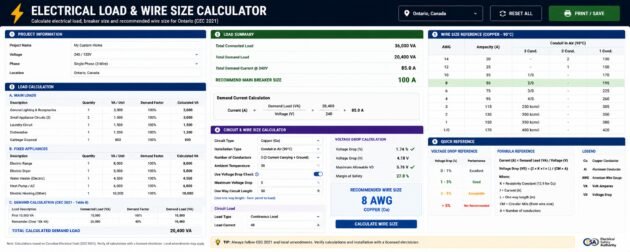
Electrical Load & Wire Size Calculator (Ontario)
Estimate a breaker size, pick a practical starting-point wire size, and check voltage drop on long runs – garage feeders, far receptacles, pumps, and EV charging. It applies the CEC continuous-load factor (125%) and the voltage-drop targets from Canadian Electrical Code Rule 8-102, so you can plan a run before you price the copper. Planning tool only: final conductor sizing must be confirmed against the Ontario Electrical Safety Code and ESA inspection.
1Auto-size or check a wire
2Copper or aluminum
3120 / 240 / 208 V
4Voltage-drop flags
How to
Use it without overthinking it
Auto-size Wire is the fast “what should I start with?” answer. Check a Wire Size is the “will this wire work for this run?” reality check.
- Enter your load as watts or amps, pick voltage (120/240/208), and say whether it is continuous.
- Enter the one-way run length. Long distance is usually where voltage drop takes over.
- Read the flags and breakdown. If the wire grows but the breaker does not, that is voltage drop, not a safety change.
Use cases
What people actually ask
Built for the real planning questions on a build.
- Garage feeder / subpanel (60A / 100A / 125A) – distance and voltage drop usually decide it.
- EV charging – continuous loads change the math fast (the 125% factor is real).
- Pumps and long receptacle runs – voltage drop can cause nuisance issues even when the wire is “code-safe.”
Load & wire size calculator
Planning tool – not a substitute for the Ontario Electrical Safety Code. It does not model derating for bundling, conduit fill, or ambient temperature, so a real install may need a larger conductor than shown.
Auto-size: enter load + length, it recommends wire. Check a wire: pick a wire size, it tells you if it works and what breaker/load it supports.
Load entry
Load value
Voltage
Continuous load?
Tip: if it runs 3+ hours (EV charging, baseboards, some lighting), treat it as continuous. The calculator applies a 125% factor (CEC 8-104) when selected.
One-way length
Length unit
Allowable voltage drop
Conductor material
Recommended minimum
–
Breaker: –
If it recommends a bigger wire on a long run, that is usually voltage drop. The breaker size may stay the same – you are just upsizing the conductor so the equipment behaves properly.
Garage subpanel example: switch to “Check a Wire Size”, set voltage to 240 V, length to 70 ft, then pick the wire you are considering (say #2 AL or #3 CU). The calculator shows the voltage drop and a practical planning max breaker.
Inspectors do not accept “a calculator said so.” This tool helps you make smarter planning decisions early, especially for long runs. Final conductor sizing and breaker selection must be confirmed to the Ontario Electrical Safety Code and ESA inspection requirements – including equipment terminations, wiring method, and derating for bundling, conduit fill, and ambient temperature. When in doubt, hire a licensed electrical contractor (LEC).
Load & wire size: frequently asked questions
Why does it recommend a bigger wire but the same breaker?
Because the breaker is about protection (heat and safety), while upsizing wire on a long run is about performance (voltage drop). Same breaker, bigger wire means the equipment starts easier, motors run happier, and lights stop dimming when something kicks on. Long distance is where voltage drop starts to boss you around.
Should I use 3% or 5% voltage drop?
CEC Rule 8-102 caps voltage drop at 3% for a branch circuit or a feeder, and 5% total from the supply to the point of utilization. For planning, use 3% for a branch and 5% when you are looking at feeder plus branch combined – for example, feeding a subpanel. Unlike the US code, the Canadian voltage-drop rule is mandatory, not just a recommendation.
What is the continuous-load 125% factor?
If a load runs for 3 or more hours (common with EV charging, baseboard heat, and some lighting), it is treated as continuous, and CEC Rule 8-104 has you size for 125% of the current so nothing is on the edge for long-duration heating in the wire and terminations. Tick “continuous” and the calculator applies the 1.25 factor for you.
120 V or 240 V for long runs – does it matter?
A lot. For the same power, 240 V roughly halves the current, which cuts voltage drop and often lets you use a more reasonable wire size. If the load supports 240 V, or you are feeding a subpanel, 240 V is usually the cleaner choice for distance.
Copper or aluminum – why choose aluminum?
Price. On larger feeders, aluminum can save money, but you typically need a larger conductor to carry the same load and control voltage drop. Proper lugs, terminations, and installation details matter a lot more with aluminum, so it is usually a job for a licensed electrician.
What do 60 deg C and 75 deg C terminations mean in real life?
Even if the wire insulation is rated high, the equipment lugs may not be. Some smaller terminations effectively cap you at 60 deg C, which reduces the ampacity you can actually use. In other words, the wire is not always the limit – the connection can be. Match the rating to the weakest point.
Is the length input one-way or round-trip?
Enter the one-way length. The voltage-drop calculation accounts for the return path internally, which is why you see a “2 x” effect in the math.
Why does it say “planning only” – what is missing?
Real installs can require adjustments for bundling, conduit fill, ambient temperature, and special conditions, and the ampacity values here are planning approximations, not the official CEC Table 2 (copper) and Table 4 (aluminum) figures for your exact installation. If any of those conditions apply, the correct conductor can be larger than this starting point. Confirm with the OESC and a licensed electrical contractor.
Disclaimer: this calculator is a planning aid only and uses simplified ampacity and voltage-drop values, not the official Ontario Electrical Safety Code tables. It is not electrical or engineering advice. Final conductor and breaker selection must comply with the OESC (including CEC Rules 8-102 and 8-104, and ampacity Tables 2 and 4) and be verified by a licensed electrical contractor and ESA inspection.
Related calculators and guides
More on heating and efficiency
Sources and further reading
Reviewed and updated October 2026. Costs on this site are Ontario ranges, not quotes; code references are to the Ontario Building Code in force at the date above.
Latest posts
Fresh guides, calculators & real-world advice
More from BuildersOntario – scroll to explore.
Loading latest posts…
Tip: shift + mousewheel works great
Ontario Electrical Construction FAQ (Homeowners & Contractors)
These are the questions that come up constantly during new builds, additions, basement finishes, garages, and service upgrades in Ontario. Answers below are practical “jobsite logic” — and the official rule is always whatever ESA/OESC requires for your exact situation.
1
Do I need an ESA notification/permit for this electrical work (and who files it)?
⌄
1
Do I need an ESA notification/permit for this electrical work (and who files it)?
In Ontario, most electrical work requires an ESA notification and inspection. Typically, the licensed electrical contractor files it. If you’re hiring an electrician, ask for the notification number.
- New circuits, panel changes, service upgrades, garage feeds, basement wiring: usually yes.
- Minor swaps may still have rules depending on what’s being altered.
Best practice: assume it needs ESA unless your electrician confirms otherwise.
2
What are the inspection stages for a new build (trench / service / rough-in / final)?
⌄
2
What are the inspection stages for a new build (trench / service / rough-in / final)?
Most new-build timelines follow a predictable sequence:
- Underground/trench (if you’re burying a feeder).
- Service (meter base / mast / grounding / bonding as applicable).
- Rough-in (wiring installed, before insulation and vapour barrier).
- Final (devices, panel, labeling, cover plates, lights, equipment connected).
Your electrician coordinates the scheduling, but you can plan your build around those checkpoints.
3
What’s the most common reason an ESA inspection fails at rough-in?
⌄
3
What’s the most common reason an ESA inspection fails at rough-in?
Rough-in failures are usually simple “misses,” not dramatic disasters:
- Missing/incorrect protection (nail plates, damaged cable, unsupported runs).
- Box fill issues (too many conductors/devices in a box).
- Wrong cable routing through studs/joists or unprotected penetrations.
- Bonding/grounding not done as required at that stage.
Builder tip: don’t let anyone cover walls until rough-in is signed off.
4
Can a homeowner legally do any electrical work themselves in Ontario, and what are the limitations?
⌄
4
Can a homeowner legally do any electrical work themselves in Ontario, and what are the limitations?
Ontario has strict rules around who can perform electrical work, and ESA has requirements that often make DIY impractical for most real projects.
- Even if some homeowner work is allowed in limited cases, it still must meet code and inspection requirements.
- Insurance and resale implications are real—buyers and insurers may ask for proof of ESA inspection.
Practical advice: for anything beyond very minor tasks, hire a licensed electrical contractor and get an ESA inspection trail.
5
Do I need a separate inspection for underground wiring to a garage/shed (trench inspection)?
⌄
5
Do I need a separate inspection for underground wiring to a garage/shed (trench inspection)?
Yes, underground feeds typically require a trench/underground inspection before backfilling.
- Depth, protection, conduit type, warning tape, transitions, and bonding/grounding details may be checked.
- If you bury it and hope for the best, you may be digging it up again.
6
What needs to be accessible/visible for the final inspection?
⌄
6
What needs to be accessible/visible for the final inspection?
Final inspection goes smoother when everything is visible and complete:
- Panel labeling, breaker types (AFCI/GFCI where required), and panel cover installed.
- All devices installed (switches, receptacles, lights, fans) with cover plates.
- Equipment connected and ready to test (range, dryer, HVAC controls, etc.).
- Access to all areas: attic hatches, crawlspaces, utility rooms, garage, exterior receptacles.
7
Should I choose 100A, 200A, or 400A service for a new home in Ontario?
⌄
7
Should I choose 100A, 200A, or 400A service for a new home in Ontario?
Most modern custom homes land at 200A as the “normal” baseline—especially if you’re adding EV charging, hot tub, electric ranges, or future shop power.
- 100A can work for smaller/simple homes with limited electric loads.
- 200A is common for today’s typical custom home.
- 400A becomes relevant with heavy electric heating, multiple EVs, big shops, or very large homes.
Do a proper load calculation early so you don’t redesign mid-build.
8
How do I know if my panel is full, and what’s the right fix (subpanel vs panel upgrade)?
⌄
8
How do I know if my panel is full, and what’s the right fix (subpanel vs panel upgrade)?
A panel is “functionally full” when you’re out of safe breaker spaces or you’re stacking too many loads into too few circuits.
- Subpanel often makes sense when you need more spaces and your service size is adequate.
- Service/panel upgrade makes sense when the service capacity is the limiting factor.
Don’t let someone solve a capacity problem with a “creative” breaker arrangement. Do it properly.
9
What’s involved in upgrading a service—mast, meter base, grounding, bonding, and timing?
⌄
9
What’s involved in upgrading a service—mast, meter base, grounding, bonding, and timing?
A service upgrade is not just swapping a panel. It can involve:
- Meter base, service entrance, mast, weatherhead and clearances.
- Grounding electrode system and bonding details.
- Utility coordination (temporary disconnect/reconnect).
- ESA inspections at defined stages.
Timing matters: do it early enough that it doesn’t stall drywall/insulation schedules.
10
What size feeder and wire do I need for a garage subpanel 50–150 feet away?
⌄
10
What size feeder and wire do I need for a garage subpanel 50–150 feet away?
This is the classic “long run” question—wire size is driven by two things:
- Ampacity (what breaker size you’re feeding it with).
- Voltage drop (distance—especially long underground runs).
Use the calculator on this page in Check a Wire Size mode to verify a copper/aluminum option at your exact distance and load.
11
How do I size a subpanel for a shop with welder, compressor, heater, EV, etc.?
⌄
11
How do I size a subpanel for a shop with welder, compressor, heater, EV, etc.?
Start by listing the largest loads (welder/EV/heater) and whether they run simultaneously. Then:
- Reserve dedicated circuits for high-demand equipment.
- Leave spare breaker spaces (future-proofing is cheap at rough-in time).
- Don’t forget lighting, receptacles, door openers, and exterior plugs.
Most shop regrets come from undersizing the subpanel and running out of spaces later.
12
Can I install a generator interlock / transfer switch, and what’s required?
⌄
12
Can I install a generator interlock / transfer switch, and what’s required?
Yes, but it must be installed in a code-compliant way that prevents back-feeding the grid and protects line workers.
- Transfer switches/interlocks must be compatible with your panel and installed correctly.
- Generator sizing, neutral/ground bonding, and outdoor inlet details matter.
Bottom line: this is not the place for “YouTube engineering.” Get it inspected.
13
How many receptacles are required per room (spacing rules), and where do people get caught?
⌄
13
How many receptacles are required per room (spacing rules), and where do people get caught?
Spacing rules are intended to avoid extension cords becoming permanent decor. People get caught on:
- Long wall runs with “just one plug” planned.
- Hallways, landings, and small wall sections that still count.
- Furniture layouts: the “required minimum” isn’t always the “practical minimum.”
14
How many kitchen circuits do I need (fridge, microwave, counter plugs, dishwasher, hood fan)?
⌄
14
How many kitchen circuits do I need (fridge, microwave, counter plugs, dishwasher, hood fan)?
Kitchens are the circuit-hog of the house. Plan for:
- Counter receptacle circuits (often multiple).
- Dedicated circuits for dishwasher, microwave, fridge, and any specialty appliances.
- Range/oven requirements (often 240V).
Best practice: plan it like a workshop, not like a 1978 bungalow.
15
Do bathrooms need a dedicated circuit, and what else can share it?
⌄
15
Do bathrooms need a dedicated circuit, and what else can share it?
Bathrooms have special rules because water and electricity are a bad marriage.
- GFCI protection is typically required for bathroom receptacles.
- Dedicated circuits may be required depending on layout, number of bathrooms, and loads.
- Heated floors, towel warmers, and fancy mirrors can complicate things.
16
What’s the best way to plan circuits for an unfinished basement so I don’t regret it later?
⌄
16
What’s the best way to plan circuits for an unfinished basement so I don’t regret it later?
Future-proof it while walls are open:
- Run extra circuits to likely future rooms (bedroom, rec room, kitchenette).
- Plan a mechanical/utility zone (furnace, HRV/ERV, pumps, dehumidifier).
- Consider rough-ins for a future bar or suite (where permitted).
Adding circuits later is always more expensive than doing it now.
17
How do you plan outlets and dedicated circuits for a home office / networking area?
⌄
17
How do you plan outlets and dedicated circuits for a home office / networking area?
Modern homes need “IT closet thinking.” Consider:
- Dedicated circuit for office/tech loads (printers, computers, monitors).
- Surge protection and clean power considerations.
- Low-voltage wiring routes (Ethernet, coax, access points) before insulation.
18
Where is GFCI protection required vs recommended?
⌄
18
Where is GFCI protection required vs recommended?
Anywhere water is involved or likely. GFCI is required in defined locations and strongly recommended in others:
- Bathrooms, kitchens (counter areas), outdoors, garages, unfinished basements are common examples.
- Think “wet hands + electricity” = GFCI territory.
Exact requirements depend on the current OESC and your application.
19
Where is AFCI protection required, and what are the common exceptions/edge cases?
⌄
19
Where is AFCI protection required, and what are the common exceptions/edge cases?
AFCI rules are a frequent source of confusion. In general, many residential branch circuits require AFCI protection, but there are exceptions depending on circuit type and location.
- People get tripped up (pun intended) when adding a circuit and discovering it now needs AFCI.
- Some specialty loads may have different requirements.
When in doubt, assume AFCI is required and confirm with your electrician/ESA inspector.
20
What’s the difference between AFCI breaker, GFCI breaker, and dual-function?
⌄
20
What’s the difference between AFCI breaker, GFCI breaker, and dual-function?
- GFCI: protects people from shock (ground-fault).
- AFCI: helps prevent fires from arcing faults (damaged cords, loose connections).
- Dual-function: does both AFCI + GFCI in one breaker.
Choosing the right one depends on where the circuit is and what it serves.
21
Why do AFCI breakers nuisance trip and how do you troubleshoot it without guessing?
⌄
21
Why do AFCI breakers nuisance trip and how do you troubleshoot it without guessing?
Common causes include:
- Shared neutrals, wiring errors, or poor terminations.
- Problem devices (some motors, older appliances, damaged cords).
- Loose connections that create arcing signals.
Best approach: isolate the circuit systematically (loads off, inspect connections, test devices). Don’t just swap breakers and pray.
22
Should a new home have whole-home surge protection, and where does it go?
⌄
22
Should a new home have whole-home surge protection, and where does it go?
Whole-home surge protection is increasingly common because modern homes are packed with electronics (appliances, controls, heat pumps, smart systems).
- It’s typically installed at the main panel (or service equipment) by your electrician.
- It works best combined with good grounding/bonding practices.
23
When do I need to upsize wire because of voltage drop on long runs?
⌄
23
When do I need to upsize wire because of voltage drop on long runs?
Voltage drop matters most when runs get long or loads get heavy:
- Garage/subpanel feeds, well pumps, far-end bedrooms, long outdoor runs.
- Symptoms: dimming lights, motors struggling to start, nuisance tripping.
Use the calculator on this page to test different distances and wire sizes with a 3% or 5% planning target.
24
Copper vs aluminum feeder: when is aluminum okay, and what special termination practices matter?
⌄
24
Copper vs aluminum feeder: when is aluminum okay, and what special termination practices matter?
Aluminum is common for larger feeders because it’s lower cost, but it requires correct methods:
- Correct lugs/terminations rated for aluminum conductors.
- Proper torque, anti-oxidant paste where required, and correct connector types.
- Good workmanship matters more with aluminum.
25
What’s the correct wire size for EV charger, baseboards, hot tub, range, dryer, A/C?
⌄
25
What’s the correct wire size for EV charger, baseboards, hot tub, range, dryer, A/C?
There isn’t one universal answer—equipment ratings and installation conditions control it. But the sizing process is consistent:
- Use the nameplate rating (amps/watts) and voltage.
- Determine if it’s continuous (often yes for EV/baseboards).
- Select breaker and wire size accordingly, then check voltage drop if the run is long.
For big loads, always size to the manufacturer specs and code requirements.
26
What does “continuous load” mean (the 125% rule) and which residential loads trigger it?
⌄
26
What does “continuous load” mean (the 125% rule) and which residential loads trigger it?
Continuous loads are loads expected to run for extended periods (often 3+ hours). Many heating loads and EV charging fall into this category.
- The circuit must often be sized so the continuous load does not exceed 80% of breaker rating.
- That’s why the planning factor is commonly shown as 125%.
27
In a new build, what wiring method should be used where: NMD90, armoured/AC90, conduit?
⌄
27
In a new build, what wiring method should be used where: NMD90, armoured/AC90, conduit?
Different areas call for different protection levels:
- NMD90 is common for typical residential concealed wiring.
- Armoured cable or conduit is often used where wiring is exposed or subject to damage.
- Garages, unfinished basements, mechanical rooms and outdoors may need more robust methods.
Your electrician chooses based on code and the physical realities of the space.
28
What are the rules for running cable through studs/joists (holes, nail plates, protection)?
⌄
28
What are the rules for running cable through studs/joists (holes, nail plates, protection)?
The intent is to keep wiring protected from nails/screws and structural damage:
- Proper hole placement in framing members (and avoid weak drilling patterns).
- Nail plates where cable is too close to the face of studs.
- Secure supports and avoid sharp edges.
This is one of the areas inspectors look at closely during rough-in.
29
How do you properly bond/ground: water line, gas line, rebar/Ufer, and other metal systems?
⌄
29
How do you properly bond/ground: water line, gas line, rebar/Ufer, and other metal systems?
Bonding and grounding are about safety: ensuring metal systems don’t become energized hazards and that fault current has a safe path.
- Main bonding conductor and grounding electrode system must be done correctly.
- Metal water piping and other conductive systems may require bonding depending on configuration.
- Details vary with service type and building systems.
This is not a place for “close enough.” Get it right and get it inspected.
30
What are the most common causes of flickering lights / dimming when appliances start?
⌄
30
What are the most common causes of flickering lights / dimming when appliances start?
Common causes include:
- Loose neutral or poor terminations (panel, meter, device connections).
- Undersized conductors on long runs (voltage drop).
- Large motor starts (compressors, pumps) causing brief inrush sag.
- Utility-side issues (less common, but possible).
If it’s consistent or getting worse, treat it as a real electrical issue—not a “quirk.”
Note: These answers are general guidance for planning and homeowner understanding. Electrical work in Ontario must comply with the
Ontario Electrical Safety Code and be inspected by ESA where required.