Ontario's Plain-English Guide to Custom Home Building📞 705-533-1633 | ☎️ 1-866-868-6606 | ✉️ info@icfhome.ca

Building a Log Home in Ontario (2026 Guide)
Build Methods · Ontario
Building a Log Home in Ontario: The Honest 2026 Guide
What a log home really costs, how log walls actually pass the energy code, how much they settle, what the upkeep is, and why they are harder to finance and insure — with straight answers to the 40 questions buyers ask most.
The 30-second version: A finished handcrafted log home in Ontario runs about $350–$600+ per square foot — at or above the cost of a stick-frame or ICF home. The log shell is only about one-third of the total budget. Log walls don’t meet the prescriptive energy code on R-value alone, so they pass through energy modelling. They settle for one to three years, need re-staining every 3–7 years, and are harder to mortgage, appraise and insure. Done with open eyes, a log home is a beautiful, durable, lifelong home. Done on assumptions, it’s a string of expensive surprises. This page gives you the open eyes.
What a log home actually costs in Ontario
The single biggest misunderstanding about log homes is the price. People see a log “kit” or “package” price and assume that’s most of the house. It isn’t. Across Canadian log builders, the log shell or package is only about 25–35% of the finished cost — roughly one-third. A useful rule of thumb: your total build lands around 2.5–2.75× the package price.
Finished, move-in-ready cost (Ontario, 2026)
| Type of log home | Finished cost / sq ft (CAD) | Notes |
|---|---|---|
| Handcrafted full-scribe (Scandinavian) | ~$350 (avg) · $300–$600+ | Most labour-intensive; the log premium lives here |
| Milled / machined kit, contractor-finished | ~$300–$450 | Uniform logs, less shell labour |
| Post-and-beam / timber-frame hybrid | ~$300–$500 | Conventional infill walls; easiest to hit energy code |
| For comparison — conventional custom | ~$320–$550 | Stick-frame or ICF custom build, 2026 |
Ranges are directional 2026 Ontario figures from Canadian builders (Coyote Log Homes, Confederation, North American Log Crafters) and our own cost data. Finish level, site and plan swing these numbers hard. A practical floor: it’s difficult to complete any log home under about $400,000 once foundation and finishing are in.
Log shell packages — real 2026 Canadian prices
Shell/package pricing (logs cut, fit, numbered and ready to reassemble) from a Canadian handcrafter, Douglas Fir, before tax and freight:
- Small plans: ~$69,500–$93,000 (1–2 truckloads)
- Mid-size plans: ~$181,900–$273,000
- Large plans: ~$295,000–$428,000 (5–6 truckloads)
- Western Red Cedar adds roughly 15%; a full species/style breakdown is below.
What a log “kit” does NOT include. This is where budgets blow up. A package price almost never covers: building permits · excavation and foundation · freight/shipping (priced per truckload) · crane and professional erection labour · roofing, windows, doors, flooring, cabinets, appliances · interior partition walls · plumbing, electrical, HVAC · insulation and drywall · design/drafting (often 3–5% of budget) · staining/finishing · land, well, septic, driveway and landscaping. Budget a 10–15% contingency on top of your contract price.
Because of all that, log usually costs the same or more than stick-frame or ICF — the money is in the labour-intensive shell, not a cheaper house. If lowest cost per square foot is your goal, that’s worth knowing up front. See our full cost to build a house in Ontario breakdown for the non-shell two-thirds of the budget.
Do log walls meet the Ontario energy code?
Short answer: not on wall R-value alone. Solid softwood is about R-1.25 to R-1.41 per inch, so an 8-inch log wall is roughly R-10 to R-12 (and round logs average less than their nominal thickness at the joints). Ontario’s SB-12 energy requirements for above-grade walls in southern Ontario call for about nominal R-22 / effective R-17 to R-21.4. A bare log wall doesn’t get there.
How log homes legally pass code: through the performance (trade-off) path — whole-building energy modelling in HOT2000. Your log house is modelled against a reference wood-frame house on the prescriptive package; as long as it uses no more annual energy, it complies. Builders “buy back” the wall gap with a better-insulated attic, triple-glazed low-U windows, a higher-efficiency furnace or heat pump, a good HRV, and tight air-sealing. It’s submitted as an Energy Efficiency Design Summary with your permit.
A few Ontario-specific realities: the OBC has a dedicated log section, Part 9, Section 9.37 “Log Construction,” including a settlement-clearance rule (at least 13 mm of movement space per 300 mm of height above every opening). Because tall log walls and big spans often fall outside the Part 9 prescriptive tables, building departments commonly require engineer-stamped structural drawings plus stamped energy documentation. Don’t count on the “thermal mass” of the logs as a code shortcut — there’s no fixed mass credit in the SB-12 tables, and in a cold Ontario winter the mass benefit is modest (more on that below). For the broader permit process, see our Ontario building permit guide and the Ontario Building Code guide.
Settling, checking and the first three years
A log home is a living structure. As the logs dry to equilibrium and compress under load, the walls settle — up to about 3/4 inch per foot of wall height. An 8-foot wall can drop as much as 6 inches, mostly in the first one to two years (two heating seasons). Green logs can keep moving toward equilibrium for up to five years; kiln-dried logs settle far less.
Good log construction engineers around this movement rather than fighting it:
- Screw / settling jacks under posts, adjusted by a pro through the first two heating seasons
- Slip joints and settling space above windows, doors, stairs, chimneys and plumbing runs so nothing binds or cracks
- Checking (lengthwise cracks) is natural drying, not structural failure — but upward-facing checks that collect water should be sealed with backer rod and a flexible check sealant
- Air-sealing between courses with gaskets, splines, backer rod and elastomeric chinking — the wood is airtight, but the joints are where drafts appear, and settling can open them over time
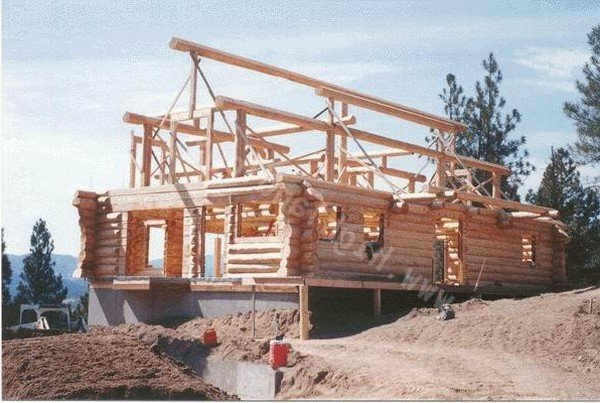
The upside people forget: the shell itself goes up fast — a pre-fit shell can be erected in 2–3 days and weather-tight in about two weeks.
Which wood species should you build with?
| Species | Strengths | Watch-outs |
|---|---|---|
| Western Red Cedar | Natural oils resist rot & insects; checks/shrinks least; low moisture → least settling | The most expensive; oils can resist some stains |
| Northern White Cedar | Highest R (~1.41/in); very rot/insect resistant | Smaller log sizes; regional supply |
| Eastern White Pine | Most common & affordable; easy to source in Ontario | No natural rot/insect resistance (needs borate); high moisture → more settling |
| Douglas Fir | Strongest/densest; often engineer-specified for wall logs and beams | Beetle-susceptible sapwood; premium over pine (~+7%) |
| Red Pine / Spruce | Economical; common in kits; takes stain evenly | Low decay resistance; diligent sealing and preservative needed |
Design rule of thumb from the log-building world: about R-1.5 per inch of log diameter, with a 10-inch minimum diameter for a full-time home (smaller is fine for a seasonal cottage).
Full-scribe vs milled vs D-log vs post-and-beam
Handcrafted full-scribe
Natural, full-diameter logs individually scribed to fit. Tightest fit, most character, very strong. Downsides: the priciest option (assembled twice — once in the yard, once on site), longest build, most settling.
Milled / machined
Uniform-diameter logs with interlocking profiles. Faster, cheaper, more DIY-friendly, and the profiles block air and moisture well. Downside: a more repetitive, uniform look.
D-log
Rounded outside, flat inside face — so you can fur out and drywall interior walls easily. “Double-D” chinkless profiles fit tight. A practical middle ground.
Post-and-beam / hybrid
A log or timber frame with conventional insulated infill walls. The most design flexibility and by far the easiest way to meet strict energy codes — you get the look with a code-standard wall.
Maintenance: the part people underestimate
A log home is not a maintenance-free home. Plan for it and it’s manageable; ignore it and small problems become expensive rot.
- Re-stain every 3–7 years (water-based ~3–5, oil-based ~5–7). South and west walls fade first and may need a maintenance coat every 2–3 years. Budget roughly $2–$5/sq ft for a clean-and-recoat; a full strip and re-stain (media blasting) costs far more.
- Borate treatment on bare wood protects against rot fungi and wood-eating insects — about as toxic to people and pets as table salt.
- Carpenter ants are the classic Ontario cottage-country threat. They nest in moist, decaying wood, so their appearance is really a moisture warning — fix the leak, dry the wood.
- Inspect chinking, caulking and checks once a year and reseal promptly, ideally in late summer/early fall when the wood is dry.
- Design protects the logs: big roof overhangs (24″ minimum, 36″+ on tall or gable walls), covered porches on the sun-exposed sides, gutters and splash blocks that throw water 6–9 feet away, and a foundation that keeps the first log course 18–24 inches above grade.
Realistically, log-specific upkeep runs about $1,500–$3,500 a year on top of the normal home systems every house needs.
Financing, insurance and resale
This is the surprise that costs people deals. Log homes are harder to finance, appraise and insure than a conventional house — not impossible, but you need to plan for it before you fall in love with a design.
Financing: some Canadian lenders simply won’t finance log, rural or non-conventional homes. A custom build uses a construction “draw” mortgage (funds released in stages as milestones are verified by an appraiser), typically needing 20–25% equity, and kit deposits usually come from your own cash before any draw releases. Rural specialists — for example Pillar Financial Services out of Sharbot Lake — are comfortable with off-grid, wood-heat and rural log builds that big banks avoid. Our home construction loans guide walks through how draw mortgages work.
Appraisal: log homes are niche, custom and usually rural, so there are few comparable sales. A low appraisal caps the loan — the bank lends against appraised value, not what you spent — and you cover any gap in cash.
Insurance: fewer carriers write log homes, and premiums tend to run roughly 20–50% higher (an industry rule of thumb, not a regulator figure). The bigger driver is rebuild cost — specialized logs and skilled labour — along with rural distance from a fire hall and any woodstove or alternative heat. Insure to full replacement cost, and expect builder’s-risk coverage to be required before your first construction draw.
Resale: log homes appeal to a narrower, taste-specific buyer pool, and being rural compounds low turnover. There’s no reliable Canadian dataset on how fast they sell or how well they hold value, so treat any “log homes hold their value” claim as anecdotal — the honest point is the mechanism (thin comps, niche buyers), not a hard number.
Are log homes energy efficient in a cold climate?
Here’s the honest version, because the marketing oversells it. Log walls have real thermal mass, and mass genuinely cuts energy use — but mostly in shoulder seasons and summer, when a building “floats” between heating and cooling. The landmark US test-building study found mass walls used less seasonal energy than better-insulated frame walls, yet stated plainly that “no reductions in heating energy attributable to wall mass were observed during the winter heating season.” In deep Ontario cold, the house never floats — so the low nominal R-value of the wall is what you feel on the heating bill.
Put simply: for lowest winter heating cost and airtightness, ICF is the strongest of the three (continuous high effective-R plus interior mass, ~1.0–1.3 ACH50), a well-insulated frame wall (~R-22) is a solid middle, and a log wall needs thicker logs, meticulous air-sealing and better mechanicals to compete on winter heating. What a log home offers in return is comfort and character an R-value can’t capture — the “warm wall” radiant feel of massive wood near room temperature, and natural humidity buffering. If low energy bills are the priority, compare honestly against ICF and stick-frame first. Pairing logs with in-floor radiant heat is a popular way to make a log home feel great in winter.
Pros and cons, honestly
Where log homes win
- Distinctive, warm aesthetic with real emotional pull
- Solid-wood durability — centuries if maintained
- Comfortable “warm-wall” radiant feel and humidity buffering
- Shell erects fast and goes weather-tight quickly
- Decent shoulder-season energy performance with thick logs
- Renewable, natural material; no separate siding cycle
Where they cost you
- Total cost at or above stick-frame and ICF
- Shell is only ~1/3 of the budget — the rest is a normal build
- Low wall R needs energy modelling and better mechanicals
- Settling and checking to engineer around (years 1–3)
- Re-staining every 3–7 years plus annual sealant/pest checks
- Harder and pricier to finance, appraise and insure
- Narrower resale buyer pool; muted winter energy benefit
Who a log home is right for: buyers who love the look, plan to stay long-term, are building in cottage country, will budget for maintenance and a possible cash gap on financing or appraisal, and value comfort and character over the lowest heating bill. Who should look elsewhere: anyone chasing lowest cost per square foot or lowest energy cost (ICF or frame win), anyone wanting near-zero maintenance, or anyone who needs easy conventional financing, appraisal and resale.
Your next step
Pressure-test your log home plan
Log homes reward planning and punish assumptions. Price the whole build, confirm the lot, and compare the wall system before you commit.
Log home FAQ — 40 straight answers
Cost
What does a log home cost per square foot in Ontario?
A finished handcrafted log home averages about $350/sq ft and ranges from roughly $300 to $600+/sq ft. ICF and stick-frame custom builds run about $320–$550/sq ft, so log sits at or above the top of that range.
Why is the log kit only part of the cost?
The log shell or package is only about 25–35% (roughly one-third) of the finished-home cost. The other two-thirds is foundation, mechanicals, trades and finishing — the same as any custom home.
What is NOT included in a log home kit?
Typically: permits, excavation and foundation, freight, crane and erection labour, roofing/windows/doors, plumbing/electrical/HVAC, insulation and drywall, interior partitions, finishes and the land itself.
How much is a log shell package?
Real 2026 Canadian shell packages run about $69,500 for small plans up to roughly $428,000 for large plans (Douglas Fir, before tax and freight). Western Red Cedar adds about 15%.
What’s the cheapest log style?
Round-log chinked (saddle-notch) shell work is the most economical at roughly $60–$70/sq ft of shell labour; full-scribe Scandinavian is the priciest at about $75–$100/sq ft.
Is a milled kit cheaper than handcrafted?
Yes. Machine-milled logs are uniform and far less labour-intensive, so kits cost less per square foot than handcrafted full-scribe — especially if you take on some of the assembly.
What’s the cheapest a log home can realistically cost?
In practice it’s hard to complete any log home in Ontario for under about $400,000 once the foundation and finishing are included.
How much contingency should I budget?
Add 10–15% over your contract price for changes, upgrades and the surprises every custom build produces.
Is a log home cheaper than ICF or stick-frame?
No — it usually costs the same or more. The labour-intensive shell, especially full-scribe, is the premium you pay for the look.
What adds cost unexpectedly?
Freight (multiple truckloads), crane rental, erection labour, design fees (3–5%), and species upgrades such as cedar.
Code & energy
Do log walls meet the Ontario Building Code for energy?
Not on wall R-value alone. An 8-inch log wall is about R-10–12, below the SB-12 above-grade requirement (nominal R-22, effective ~R-17–21.4), so log homes comply through energy modelling instead.
What is the R-value of a log wall?
Roughly R-1.25 to R-1.41 per inch of softwood — about R-8 for a 6-inch wall and R-10–12 for 8 inches. Round logs average less than their nominal thickness.
How do log homes pass code then?
Through whole-building energy modelling in HOT2000, trading off the wall gap with better attic insulation, triple-glazed windows, high-efficiency heating and tight air-sealing so the house matches a reference frame home.
Does thermal mass count toward code?
There’s no fixed “mass credit” number in the SB-12 tables. The mass benefit is captured through the energy model, and in cold Ontario winters it’s modest.
Do I need an engineer?
Often yes. Log homes frequently fall outside the Part 9 prescriptive tables, so building departments commonly require engineer-stamped structural and energy documentation with the permit.
Is there a building-code section for log homes?
Yes — OBC Part 9, Section 9.37 “Log Construction,” which includes a settlement-clearance rule of at least 13 mm of movement space per 300 mm of height above openings.
What is ICC-400?
A US/ANSI standard for designing log structures (stress-grading, thermal and fire provisions). It isn’t directly adopted by the Ontario code but engineers here often reference it.
Settling & construction
How much does a log home settle?
Up to about 3/4 inch per foot of wall height — an 8-foot wall can lose as much as 6 inches, mostly in the first one to two years.
How long does settling take?
Most of it happens within one to two years (two heating seasons). Green logs can keep drying toward equilibrium for up to five years; kiln-dried logs settle much less.
What are screw jacks?
Adjustable jacks placed under posts that a professional lowers as the walls settle, keeping the structure level through the first two heating seasons.
Will my doors and windows still work as it settles?
Yes — if the home is built with slip joints and settling space above each opening so the wall can move without binding the frames.
Are the cracks (checks) in the logs a problem?
Checking is natural wood drying, not structural failure. Upward-facing checks that can collect water should be sealed; downward and side checks are usually left alone.
Green or kiln-dried logs?
Kiln-dried (~18–19% moisture) settles far less and gives tighter joints but costs more. Green logs are easier to hand-craft but settle the most and take years to reach equilibrium.
What’s the difference between full-scribe, milled, D-log and post-and-beam?
Full-scribe is hand-fit natural logs (tightest, priciest); milled is uniform machined logs; D-log has a flat inside face for drywall; post-and-beam is a timber frame with conventional infill walls (easiest to meet energy code).
How are drafts prevented between logs?
With gaskets or foam between courses, backer rod, elastomeric chinking for wide joints and flexible caulk for narrow ones — all of which must stay elastic to move with the logs.
How long does it take to build a log home?
The shell can erect in 2–3 days and be weather-tight in about two weeks, but the full project typically runs 6 months to 2 years (average ~11 months), plus the settling period.
Maintenance
How often do I re-stain a log home?
Every 3–7 years overall; the south and west walls take the most sun and may need a maintenance coat every 2–3 years.
What does re-staining cost?
Roughly $2–$5/sq ft for a maintenance clean-and-coat. A full strip via media blasting costs much more — a high-end example ran about $28.50/sq ft.
What is borate treatment?
A low-toxicity mineral treatment (about as toxic as table salt) that protects logs from wood-eating insects and decay fungi. It has to be applied to bare wood, so stripping comes first.
Are carpenter ants a threat?
Yes — a major Ontario and cottage-country concern. They nest in moist, decaying wood, so their presence is really a signal that you have a moisture problem to fix.
How much is annual maintenance?
Log-specific upkeep commonly runs $1,500–$3,500 a year on top of normal home systems. Deferring it risks costly rot and log replacement.
What design features protect the logs?
Big roof overhangs (24″ minimum, 36″+ on tall or gable walls), covered porches, gutters and splash blocks that move water away, and a foundation that keeps the first log course 18–24 inches above grade.
Why does the finish fail early?
UV breaks down the wood and pigment, then moisture gets in. The number-one cause of short finish life is poor prep — staining wood that’s dirty or above 19% moisture.
Financing, insurance & resale
Are log homes harder to finance?
Yes. Some lenders won’t touch non-conventional or rural homes, and custom builds need staged construction “draw” mortgages with higher equity, often 20–25%.
Why might my appraisal come in low?
Log homes are niche and rural with few comparable sales, so appraisers struggle to value them. A low appraisal caps the loan and can force you to cover the gap in cash.
Are there lenders who specialize in log homes?
Yes — rural specialists (for example Pillar Financial Services in Sharbot Lake) finance off-grid, rural and wood-heat log builds that mainstream banks tend to avoid.
Is insurance more expensive?
Generally yes. Fewer carriers write log homes and premiums run roughly 20–50% higher (an industry rule of thumb), driven mostly by high rebuild cost plus rural, wildfire and woodstove factors.
Do log homes hold their resale value?
They appeal to a narrower, mostly rural buyer pool. There’s no reliable Canadian dataset on days-on-market or value retention, so treat “log homes hold value” claims as anecdotal.
Can I build a log home myself?
Milled kits are the most DIY-friendly, but setting the logs usually needs a crane and a skilled crew, and owner-builds face extra lender scrutiny and draw-verification cash-flow risk.
Energy & comfort
Are log homes energy efficient?
Decent in shoulder seasons and summer thanks to thermal mass, but in a cold Ontario winter the low wall R-value means a higher heating load unless the logs are thick and the home is very well air-sealed.
Log vs ICF for energy — which wins?
ICF wins on winter heating bills and airtightness (continuous high effective-R plus interior mass, ~1.0–1.3 ACH50). Log competes on comfort and character, not lowest energy cost.
Thinking about building with logs — or weighing it against ICF?
Get a straight, no-pressure ballpark on your build before you commit to a wall system.
Get My Ballpark EstimateMore on structure and icf
Sources and further reading
Reviewed and updated October 2026. Costs on this site are Ontario ranges, not quotes; code references are to the Ontario Building Code in force at the date above.