Ontario's Plain-English Guide to Custom Home Building📞 705-533-1633 | ☎️ 1-866-868-6606 | ✉️ info@icfhome.ca

Concrete Calculator
Ontario | 2026
Slabs / footings / walls
Yards + meters + trucks + cost
Concrete Calculator (Ontario, 2026)
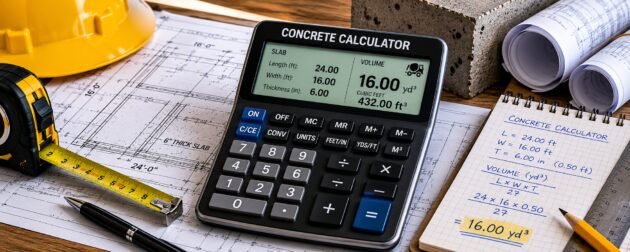
Concrete looks simple right up until you are standing there with a truck booked for 9 AM and someone asks, “So… how many yards is that?” This calculator gives you a fast, reliable estimate of concrete volume for common pours – slabs, footings, walls, columns, curbs, and stairs – plus cubic meters, truck count, and a rough material cost using your actual $/m3 rate. No math on a scrap of plywood required.
Pouring footings or a slab for a new build? See the full budget in our cost to build a house in Ontario guide.
1Volume + trucks
22026 concrete prices
3Waste factor built in
4Right MPa strength
The short answer: 2026 concrete prices in Ontario
Ready-mix concrete in Ontario runs about $175 to $225 per cubic meter delivered in 2026 (most residential pours land near $200/m3 for standard 25 to 32 MPa mix). High-strength mixes add $20 to $45/m3, and air-entrained mix adds roughly $12/m3. Concrete weighs about 150 lbs per cubic foot (around 4,050 lbs per cubic yard), and a standard ready-mix truck holds roughly 8 to 10 cubic yards. Anything under about 5 m3 usually triggers a short-load fee.
$175-$225
Per m3 (delivered, 2026)
~10 yd
Per ready-mix truck
25-32 MPa
Residential strength range
Enter your dimensions below, pick imperial or metric, set a waste factor, and the calculator does the rest. Before you order, double-check three things: thickness (a 4 inch vs 5 inch slab is a big swing), thickened edges (garage door edges, grade beams, haunches add up fast), and access (if the truck cannot reach, you may need a pump – you do not want to find that out at 8:57 AM).
Concrete calculator
Concrete Calculator
Calculate concrete volume, trucks, and rough material cost – fast enough to use while the truck is still on dispatch.
Length
feet
Width
feet
Thickness / Depth
inches
Waste Factor
Typical: 5-10% for slabs, 10-15% for complex shapes
Concrete Price per Cubic Meter
$
2026 Ontario range is about $175-$225/m3 delivered. Use your supplier’s current rate.
Concrete Needed
0.00
cubic yards
Cubic Meters
0.00 m3
Cubic Feet
0.00 ft3
Ready-Mix Concrete
$0
Approximate Weight
0 lbs
Delivery Trucks
0
Measuring guidelines
Always round up when ordering. Better to have a little extra than to run short mid-pour.
Delivery notes
Standard trucks hold about 8 to 10 cubic yards. Under 5 m3 usually adds a short-load fee.
Working time
Concrete sets fast. Have forms, rebar, and crew ready before the truck arrives.
Ontario strength (MPa)
Interior slabs and footings: 25 MPa (about 3,600 psi). Garage floors, driveways, walkways, steps, and all exterior flatwork: 32 MPa (about 4,650 psi) with 5-8% air entrainment – an OBC requirement for freeze-thaw and de-icing salt.
Planning-tool disclaimer: this estimates volume and logistics. Always confirm mix, strength, slump, reinforcement, and placement with your plans, specs, and supplier.
How to use the result (so you do not get burned)
Once you have your volume, the next questions are ordering and logistics. If your pour is spread out or you are working in hot weather, plan placement so you are not fighting set time. If you are near the “one truck vs two trucks” line, plan the pour in sections rather than rushing. And if you are doing footings and slabs as part of a new build, connect the volume to the real budget with our concrete footings cost calculator and ICF cost calculator.
Builder truth: the cheapest concrete mistake is ordering a little extra. The most expensive is running short mid-pour and waiting on a second truck while the first pour starts to set. Round up.
What changes your concrete cost
| Driver | Effect on cost |
|---|---|
| Strength (MPa) | 32 MPa exterior/garage mix adds roughly $20-$45/m3 over a standard 25 MPa interior mix. |
| Air entrainment | Required for exterior flatwork; adds about $12/m3 but prevents freeze-thaw spalling. |
| Short load | Under about 5 m3 adds a short-load surcharge – small pours cost more per m3. |
| Pumping / access | If the truck cannot reach, a concrete pump adds several hundred dollars or more. |
| Waste / over-dig | Over-excavation and thickened edges quietly add volume – that is what the waste factor is for. |
Pouring footings or a slab for a new build?
Concrete is one line on a much bigger new-build budget – and the whole project qualifies for Ontario’s enhanced HST rebate, up to $130,000. It is the easiest six figures to leave on the table, and the window is closing.
Ontario HST Rebate | Deadline April 1, 2027
You Could Lose Up To $106,000 If You Don’t Start Before April 2027
Ontario’s enhanced HST rebate puts up to $130,000 back in a new-home builder’s pocket – but only if your build contract is signed before April 1, 2027. Miss that window and you fall back to the standard $24,000 rebate. On a typical new build, that’s a six-figure swing – so it belongs in your budget from day one.
$0
Contract signed before Apr 1, 2027
$24,000
Signed after the deadline
$900,000
Miss the deadline and you forfeit
$0
Estimate based on Ontario’s 2026 enhanced HST rebate (Bill 114). Final eligibility for a custom / owner-built home is confirmed by a licensed rebate specialist – that’s what the free check is for. Full HST rebate details
Pouring footings or a slab for a custom build?
Get a no-obligation ballpark from an ICF custom-home builder in Simcoe County and Georgian Bay - foundation to finish, mechanicals included. Call 705-533-1633.
Related calculators and guides
- Concrete footings cost calculator - turn footing volume into a real cost.
- ICF cost calculator - insulated concrete forms vs poured walls.
- Foundation types in Ontario - slab vs basement vs ICF.
- Cost to build a house in Ontario - the full 2026 budget picture.
- How to get a building permit in Ontario - what needs inspection.
Frequently asked questions
How much does a cubic yard of concrete cost in Ontario in 2026?
Ready-mix concrete runs about $175 to $225 per cubic meter delivered, which works out to roughly $135 to $172 per cubic yard for material. Most residential pours land near $200/m3 for standard 25 to 32 MPa mix. High-strength and air-entrained mixes cost more, and small pours add a short-load fee.
How do I calculate how much concrete I need?
Multiply length by width by thickness to get cubic feet, then divide by 27 for cubic yards (or use cubic meters directly in metric). Add a waste factor of 5 to 15% for spills, over-excavation, and thickened edges. The calculator above does all of this and also gives you truck count and cost.
How many cubic yards does a concrete truck hold?
A standard ready-mix truck holds about 8 to 10 cubic yards. If your pour is larger, you will need multiple trucks, and you should plan the placement so the first load is not setting while you wait for the second.
What is a short-load fee?
Suppliers charge a surcharge for small orders, usually anything under about 5 cubic meters, because they still send a full truck. If your pour is small, expect to pay more per cubic meter, and weigh ready-mix against bagged concrete - the break-even is often around 0.75 to 1 cubic meter.
What concrete strength (MPa) do I need in Ontario?
Interior slabs and footings are typically 25 MPa (about 3,600 psi). Garage floors, driveways, walkways, steps, and all exterior flatwork require 32 MPa (about 4,650 psi) with 5 to 8% air entrainment - it is an Ontario Building Code requirement for freeze-thaw and de-icing salt exposure.
How much does concrete weigh?
About 150 lbs per cubic foot, or roughly 4,050 lbs per cubic yard (around 2,400 kg per cubic meter). The calculator estimates total weight so you can plan handling and equipment.
How much waste factor should I add?
5 to 10% for simple slabs, and 10 to 15% for complex shapes, footings with over-dig, or anything with lots of edges. It is always cheaper to order a little extra than to run short mid-pour. The calculator lets you set this with a slider.
Do I need a concrete pump?
If the truck cannot back up to the pour, or the pour is elevated or hard to reach, you may need a line or boom pump. Pumping adds a few hundred dollars or more, so confirm access before pour day - this is a common day-of surprise.
How thick should a concrete slab be?
A typical residential slab or patio is 4 inches; driveways and garage floors are often 5 to 6 inches, sometimes thicker with reinforcement for heavier loads. Thickness drives volume directly, so confirm it before ordering - a 4 inch vs 5 inch slab is a big difference in cubic yards.
Is this concrete calculator accurate?
It is accurate for volume, trucks, and a rough material cost based on the rate you enter. It does not include labour, forming, reinforcement, pumping, or finishing, and it cannot see your site. Use it to plan and to sanity-check a quote, then confirm the order with your supplier.
Disclaimer: Figures are 2026 planning ranges and vary by mix, supplier, distance, and pour size. The calculator estimates volume and rough material cost only - not labour, reinforcement, forming, pumping, or finishing. Concrete must meet the Ontario Building Code. This is educational, not professional advice.
More on structure and icf
Sources and further reading
Reviewed and updated October 2026. Costs on this site are Ontario ranges, not quotes; code references are to the Ontario Building Code in force at the date above.
Latest posts
Fresh guides, calculators & real-world advice
More from BuildersOntario - scroll to explore.
Loading latest posts...
Tip: shift + mousewheel works great