Ontario's Plain-English Guide to Custom Home Building📞 705-533-1633 | ☎️ 1-866-868-6606 | ✉️ info@icfhome.ca

Concrete Footings Cost Calculator
Ontario footing budgets
Concrete + rebar + forming + labour + HST
Imperial or metric
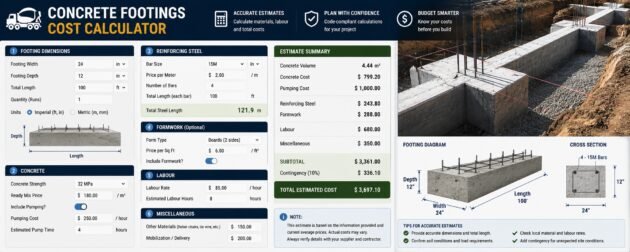
Concrete Footings Cost Calculator (Ontario, 2026)
Footings are not glamorous, but they are the first place a build budget goes sideways. A “simple trench” quietly turns into thicker sections, deeper digs, rebar, forming lumber, pump time, and a concrete crew standing around while someone hunts for a tape measure. This calculator gives you a realistic cost range for footings and pads using current 2026 Ontario pricing, with a clean breakdown of concrete, rebar, forming, labour, and HST.
1Footings + pads
2Concrete strength + pump
3Optional rebar
4Full cost breakdown
Footings cost calculator
Concrete footings
Concrete pads (optional)
Concrete and options
What actually moves a footing price
The concrete itself is often the smallest line on the invoice. Here is what really drives the number, and why two identical footings can cost very differently on two lots.
Volume
Size and depth
Width and depth drive concrete volume fast. Ontario footings usually sit below the frost line (about 1.2 m in the south, deeper north), so depth is set by code, not preference.
Access
Pump or conveyor
If the truck chute cannot reach the trench, you are into pump or conveyor territory ($175 to $300/hr, 4-hour minimum) – a real line item on tight or sloped lots.
Steel
Rebar
Many footings are reinforced. 10M, 15M, or 20M bar, plus ties and chairs, adds up over long runs – and the gauge is set by your engineering, not by what is cheapest.
Labour
Forming and placing
Forming lumber, stakes, and the crew’s time to form, place, and strip is usually the biggest single cost – and it scales with how awkward the site is.
Two fees the sticker price hides: ready-mix suppliers charge a short-load fee (roughly $55 to $100/m3) on small orders under about 3 to 4 m3, plus a delivery charge ($75 to $150 per load). Footing pours are often small, so these matter – the calculator flags when your volume is in short-load territory.
Why footing costs matter more than people think
Your footings are the literal starting line of the build – everything else stacks on top of them. If the footing cost is wrong, your whole early budget is wrong, and it is rarely just concrete volume. Access decides whether you need a pump. Soil conditions affect trench shape, depth, and how much forming is required. Once you add rebar, forming lumber, labour, and HST, the “cheap footing” myth usually disappears fast.
A good footing estimate also lets you compare quotes properly. If one quote is missing pump time or lowballs the rebar, it can look like a bargain until the first change order lands. Use this calculator as a sanity check, then confirm the final footing size and reinforcement with your designer or engineer and your local building department. For how footings fit the wall above them, see our foundation types in Ontario guide.
Want the footings poured right the first time? Talk to a builder who does the whole foundation.
We design and build custom ICF homes across Simcoe County and Georgian Bay, foundation to finish, with our own crew (Georgian Bay Siteworks) for the excavation, footings, and site work. Tell us the plan and we will scope the footings and foundation together. No charge to ask.
Budgeting the whole build behind the footings? Two books that pay for themselves
The footings are one line in a much bigger budget. These plan the land and the permit so you build it right once. Each $29.99, or both for $49.99.
Start here
The Ontario Lot-Buying Bible
Frost depth and soil decide your footings.
$200+ of pro advice$29.99one-time
A 28-page step-by-step that budgets the whole build the way the money flows – land, site, excavation, footings, foundation, hard and soft costs, and a real contingency – so nothing catches you at the footing stage.
- Site-work and foundation cost planners
- The hard-cost / soft-cost / contingency worksheet
- The 10-minute go/no-go lot test and printable scorecard
- Bonus chapters: DIY trades, wells, easements, negotiation
30-day money-back guarantee.
Get the Lot Bible – $29.99 →
Secure checkout – download in 2 minutes – yours forever
Then run the permit
The Ontario Building Permit Bible
Footings and foundations get inspected.
$10,000$29.99one-time
Everything a builder does to run a permit and pass inspections – the order of operations, the complete-application checklist, real 2026 fees, and how to never fail an inspection (the footing and foundation inspection included).
- The complete-application checklist, so the file does not bounce
- The footing and foundation inspection sequence
- Real 2026 permit fees and what triggers them
- How to never fail an inspection – and the costliest mistakes
30-day money-back guarantee.
Get the Permit Bible – $29.99 →
Secure checkout – download in 2 minutes – yours forever
Building the whole thing? Get both Bibles.
Budget the land and the build, then run every permit and inspection without the guesswork.
$59.98 Both for $49.99
Get both Bibles →
Concrete footings cost: frequently asked questions
What dimensions should I enter – finished sizes or trench sizes?
Use the concrete dimensions: the actual width and depth of the finished footing or pad, not the width of the trench. If the trench is wider than the concrete, that extra width is excavation cost, not concrete cost. If you are not sure yet, use the footing sizes from your plans or engineering notes and refine later.
Does this include frost walls or foundation walls?
No. This calculator covers footings and pads only. Foundation walls are a separate and larger cost – more concrete, more forming, more steel, plus waterproofing and insulation. For the wall system above the footing, see our foundation types guide, and use the ICF cost calculator for a full foundation estimate.
What is the 5% waste factor for?
Real sites are not perfect. Trench bottoms are not laser-flat, forms bow a little, and concrete does not come with a pause button. A 5% waste allowance keeps you from being the crew that is short half a yard with the truck already on site. On very rough ground, some crews carry a bit more.
When do I need a pump or conveyor?
Whenever the truck cannot safely back up to the pour and the chute cannot reach. Tight lots, long reaches over the excavation, obstacles, and steep grades are the usual triggers. In Ontario, pump trucks run roughly $175 to $300 per hour with a four-hour minimum, billed separately from the concrete. A conveyor is a lighter-duty option for shorter reaches.
Does rebar always go in footings?
Not always, but many footings are reinforced, and the amount and gauge (10M, 15M, or 20M) are set by your design loads, soil, and engineering – not by what is cheapest. If your drawings call for rebar, tick the box and pick the gauge so it shows up in the estimate. The calculator uses a simple per-length rule plus a waste allowance.
What are the short-load and delivery fees the calculator mentions?
Ready-mix suppliers charge a short-load surcharge (about $55 to $100 per cubic metre) when your order is below their minimum, usually around 3 to 4 cubic metres, plus a delivery charge of roughly $75 to $150 per load. Footing pours are often small, so a small order can carry a surprisingly large surcharge. The calculator flags when your volume is in short-load territory so you can budget for it.
How accurate is the result?
It is a planning estimate built on current 2026 Ontario pricing – excellent for budgeting and comparing scenarios (wider footing, deeper pad, pump versus no pump). Your final price still depends on site access, schedule, supplier minimums, regional labour rates, and engineering details, so confirm with quotes and your building department before you commit.
Why does the same footing cost more on one site than another?
Access, soil, water, and logistics. The concrete can be identical, but the time to form, place, and finish can double. A simple footing on a tight, sloped lot with a pump can cost more than a bigger footing on a wide-open site the truck can drive right up to.
Planning estimate only. Prices are 2026 Ontario averages that vary by supplier, region, and site. This tool is educational, not engineering advice. Confirm footing size, depth, and reinforcement with your designer or engineer and your local building department before you build.
Related guides
More calculators
ICF Cost Calculator
Custom Home Building Calculator
Concrete Calculator
GST Rebate Calculator
Deck Building Calculator
Electrical Load & Wire Size
Roofing Material Calculator
Stair Stringer Calculator
Paint and Primer Calculator
Note: the Snow Loads calculator link was a placeholder pointing back to this page – drop its correct URL in and I will wire it into this row.
More on structure and icf
Reviewed and updated October 2026. Costs on this site are Ontario ranges, not quotes; code references are to the Ontario Building Code in force at the date above.
Latest posts
Fresh guides, calculators & real-world advice
More from BuildersOntario – scroll to explore.
Loading latest posts…
Tip: shift + mousewheel works great