Ontario's Plain-English Guide to Custom Home Building📞 705-533-1633 | ☎️ 1-866-868-6606 | ✉️ info@icfhome.ca

Foundation Types in Ontario: How to Choose Poured Concrete, Block or ICFFoundation Types in Ontario
Ontario – frost, water & budget
Basement vs slab vs crawl vs walkout
Poured concrete vs ICF
Foundation Types in Ontario (2026): concrete block vs poured concrete vs ICF
The foundation is the one part of your home you can never change your mind about later. It carries everything above it, decides whether the space below is dry and comfortable or cold and damp, and in Ontario it has to win a yearly fight with frost. Get the wall system right and you barely think about it for fifty years. Get it wrong and it haunts the whole house.
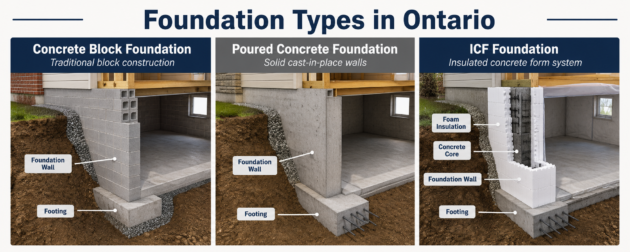
In Ontario, foundation walls are built one of three ways – poured concrete, concrete block, or ICF (insulated concrete forms). This guide compares all three head to head, covers the frost-depth rule that governs them all, and then explains the configurations people often confuse with foundation types (basement, crawl space, slab, walkout).
1Poured vs block vs ICF
2The frost-depth rule
3Basement / slab / crawl = configurations
4What drives the cost
First, the distinction that trips people up
Ask “what foundation should I build?” and two people hear two different questions. The foundation is the structural system – footings plus walls – that carries the house down to solid, frost-free ground. In Ontario that wall is built one of three ways: poured concrete, concrete block, or ICF. Those are the foundation types.
A basement, crawl space, slab-on-grade, or walkout is a configuration – how the foundation is laid out and how much space it creates – not a foundation type. You pick the wall system first, then the configuration that suits your lot. This guide does both, in that order.
The three foundation wall systems used in Ontario
This is the choice that actually defines your foundation – the material the walls are built from:
Most common today
Poured concrete
Reinforced concrete poured into forms to create a solid, monolithic wall. The default for new Ontario homes: strong, fast to build, and with no mortar joints to crack or leak. Once properly damp-proofed or waterproofed and drained, it performs reliably.
Best for: most new builds. Watch: bare concrete has zero insulation – you add it separately (and many homes never add enough), so it can feel cold below grade.
Traditional / modular
Concrete block (CMU)
Stacked, mortared concrete blocks, usually reinforced and grout-filled. Long the standard and still used, especially for certain budgets and builders. Goes up in modular courses rather than one pour.
Best for: some budgets, repairs, and builders set up for it. Watch: more joints and mortar lines mean more potential crack and water paths, so parging and waterproofing really matter – and it is uninsulated on its own.
Energy efficient
ICF (insulated concrete forms)
Reinforced concrete poured inside stay-in-place foam forms – the structure and the insulation in one wall. Strongest thermal performance of the three, no separate insulation step, and excellent on cold, wet, or walkout sites. Typically runs about 5-10% more than poured for the wall itself.
Best for: comfort, finished basements, energy savings, walkouts. Watch: higher upfront cost; careful detailing at sills and walkout transitions. See ICF pros and cons.
Less common
Preserved wood foundation (PWF)
A foundation framed from pressure-treated lumber on a granular base. Permitted in Ontario and occasionally used, but far less common – some buyers and lenders are wary of long-term durability versus concrete.
Best for: niche cases. Watch: resale perception and moisture detailing; most Ontario builders default to concrete or ICF.
The rule that governs all three: get below the frost line
Before you compare types, understand the one thing they all answer to. When the ground freezes, it heaves; when it thaws, it settles. If your footings sit above that freeze-thaw zone, the foundation moves with the seasons and cracks. So every Ontario foundation must either reach below the frost line or be specifically designed and insulated to keep frost away from the footing.
Frost depth varies a lot across the province, which is why a foundation detail that is fine in Niagara is undersized in Sudbury. Rough minimums:
| Region | Typical frost depth (footing minimum) |
|---|---|
| Southern Ontario (Toronto, Hamilton, Niagara) | about 1.2 m (4 ft) |
| Central Ontario (Barrie, Peterborough, Kingston) | 1.2 – 1.4 m |
| Ottawa Valley | 1.4 – 1.5 m |
| Northern Ontario (Sudbury, North Bay) | 1.5 – 1.6 m |
| Far Northern Ontario (Thunder Bay, Timmins) | 1.6 – 1.8 m |
Local soil, water table, and municipality can change these – your building department and the Ontario Building Code set the requirement for your exact site. Always confirm before you dig.
Foundation configurations: how the wall system is laid out
These are not foundation types – they describe the shape of the foundation and how much space it creates. You can build most of them in poured concrete, block, or ICF. Here is what each one is and when it fits:
Most common
Full basement
Walls extend below frost depth, creating a full storey of usable space underground. Built from poured concrete, concrete block, or ICF. The default in most of Ontario because it adds living area, handles frost easily, and houses mechanicals.
Best for: most homes where you want extra space and resale value. Watch: waterproofing and drainage on wet lots; insulation if you want it comfortable.
Lean & efficient
Slab-on-grade
A reinforced concrete slab poured on prepared ground, with thickened, frost-protected edges. No basement. Common for bungalows, accessible designs, and some modern builds.
Best for: single-level living, simpler sites, lower foundation cost. Watch: Ontario’s climate demands careful edge insulation; no below-grade storage; in-slab services must be planned perfectly before the pour.
Middle ground
Crawl space
A shallow, accessible space below the floor – lower than a basement but enough room for services and inspection. Increasingly built insulated (often with ICF) and sealed/conditioned rather than vented.
Best for: cottages, sloped or rocky lots, keeping services off the ground. Watch: a vented, uninsulated crawl space invites moisture and cold floors – build it sealed and insulated.
Sloped lots
Walkout / lookout basement
A full basement on a sloped lot where one side opens to grade with full doors and windows. Turns a basement into bright, above-grade living space.
Best for: hillside and lakeside lots; adding real living space. Watch: more exposed wall, more detailed waterproofing, and unbalanced soil loads that demand proper structural design – an area where ICF’s reinforced concrete shines.
Shallow but smart
Frost-protected shallow foundation (FPSF)
A shallow slab or footing kept safe from frost by strategic rigid insulation instead of deep excavation. Engineered detailing replaces digging to 1.2 m and beyond.
Best for: heated buildings, slab homes, sites where deep digging is costly. Watch: must be designed and insulated correctly for your climate zone – this is not a DIY shortcut.
Cottages & add-ons
Piles, screw piles & sonotubes
Point supports driven or poured below frost rather than a continuous wall. Screw piles, helical piles, and concrete sonotube footings carry decks, additions, cottages, and some prefab structures.
Best for: cottages, decks, additions, difficult access, minimal site disturbance. Watch: no enclosed space below; cold floors unless detailed well; must reach below frost and suit the soil.
The decision most Ontario builds come down to: poured concrete vs ICF
Once you have chosen a basement or crawl space, the real question is the wall system. In Ontario that is usually poured concrete vs ICF (insulated concrete forms) – foam blocks filled with reinforced concrete, where the insulation is built into the wall instead of added later.
Here is the honest cost picture: a bare poured-concrete wall is cheaper for the structural element alone – ICF typically runs maybe 5-10% more for the wall itself. But a bare poured wall is not ready to live behind. To reach the same comfort and performance as ICF, you still have to add exterior or interior insulation, framing, vapour control, and the labour to install all of it. Once you compare like for like – a finished, insulated, comfortable basement – ICF is frequently the better total-cost choice, especially if you plan to finish the space or your lot has moisture to manage.
The short version: poured concrete wins on the sticker price of the bare wall; ICF wins on comfort, energy, and often total cost once you build to the same finished standard. For real Ontario numbers, see our ICF foundation cost guide, the honest ICF pros and cons, and run your own project through the ICF cost calculator.
Ballpark for planning only: a new ICF foundation commonly lands somewhere around $30,000 to $60,000 for a typical home, or roughly $38 to $48 per square foot of finished basement wall in Southern Ontario – higher in the north, on walkouts, or on difficult sites. Confirm with a real quote against your plans and lot.
Not sure which foundation suits your lot? Get a straight answer – and a builder who does it all.
We design and build custom ICF homes across Simcoe County and Georgian Bay, foundation to finish, with our own crew (Georgian Bay Siteworks) for the excavation and footings. Tell us about your lot and we’ll tell you which foundation makes sense and what it costs. No charge to ask.
What drives your foundation cost
- Frost depth and region: deeper footings up north mean more excavation, concrete, and wall height.
- Soil and water table: rock, clay, high groundwater, and poor drainage all add cost and detailing.
- Walkout or slope: exposed walls and unbalanced loads cost more than a flat, fully buried foundation.
- Size and wall height: footprint and how tall the walls run both scale the price.
- Wall system: poured vs block vs ICF, and how insulated and finished you take it.
- Finishing intent: if you will finish the basement, paying for a warm, dry, insulated foundation up front saves money later.
Your foundation is one line in the bigger build budget – see how it fits the whole picture in our cost to build a house in Ontario guide, and check your lot before you commit with our lot buying guide.
How to choose the right foundation for your build
Answer these and the choice usually picks itself:
- Do you want the extra living space and storage? If yes, a full or walkout basement almost always wins on value per dollar.
- Is the lot flat or sloped? A slope points toward a walkout; flat and simple opens the door to slab-on-grade.
- How wet is the site? High water tables and poor drainage favour a well-detailed, insulated wall (where ICF earns its keep) and serious waterproofing.
- Single level or multi-level living? Slab-on-grade suits bungalow and accessible designs; basements suit families wanting more space.
- Will you finish below grade? If so, build the foundation warm and dry from day one rather than fighting it later.
- What does your climate zone demand? The further north, the more frost depth and insulation matter.
Waterproofing is where foundations fail. Whatever type you choose, the leaks start at the predictable spots – sill plates, rim areas, window wells, and walkout transitions. Detailing and drainage matter as much as the wall itself.
Planning the build behind the foundation? Two books that pay for themselves
The foundation choice comes down to the lot and the budget. These plan both, so you build the right one once. Each $29.99, or both for $49.99.
Start here
The Ontario Lot-Buying Bible
The lot decides the foundation.
$200+ of pro advice$29.99one-time
Slope, soil, water table, and frost depth drive both the foundation type and its cost. This 28-page step-by-step budgets the whole build the way the money flows – land, site, foundation, hard and soft costs, and a real contingency.
- Site-work and foundation cost planners
- The hard-cost / soft-cost / contingency worksheet
- The 10-minute go/no-go lot test and printable scorecard
- Bonus chapters: DIY trades, wells, easements, negotiation
30-day money-back guarantee.
Get the Lot Bible – $29.99 →
Secure checkout – download in 2 minutes – yours forever
Then run the permit
The Ontario Building Permit Bible
Footings and foundations get inspected.
$10,000$29.99one-time
Everything a builder does to run a permit and pass inspections – the order of operations, the complete-application checklist, real 2026 fees, and how to never fail an inspection (footing and foundation inspections included).
- The complete-application checklist, so the file doesn’t bounce
- The footing and foundation inspection sequence
- Real 2026 permit fees and what triggers them
- How to never fail an inspection – and the costliest mistakes
30-day money-back guarantee.
Get the Permit Bible – $29.99 →
Secure checkout – download in 2 minutes – yours forever
Building the whole thing? Get both Bibles.
Budget the land and the build, then run every permit without the guesswork.
$59.98 Both for $49.99
Get both Bibles →
Foundation types in Ontario: frequently asked questions
What is the most common foundation type in Ontario?
Poured concrete is the most common foundation wall system in new Ontario homes today. Concrete block has been used for generations and is still around, while ICF is growing fast for its built-in insulation. A “basement” or “slab” is a configuration of the foundation, not a foundation type – you pick the wall system first, then the configuration.
Concrete block vs poured concrete – which is better?
Poured concrete is usually preferred today: it is monolithic with no mortar joints to crack or leak and it goes up fast. Concrete block can perform well when properly reinforced, grout-filled, and waterproofed, but its joints are more maintenance-sensitive over time. Neither is insulated on its own, which is a big part of why ICF has gained ground – it puts the structure and the insulation in a single wall.
How deep does a foundation have to go in Ontario?
Below the frost line, which is roughly 1.2 m (4 ft) in Southern Ontario and deeper as you go north – up to 1.6 to 1.8 m in the far north. The exception is a frost-protected shallow foundation, which uses engineered insulation to stay safe at a shallower depth. Local soil, water table, and municipality all factor in, so your building department and the Ontario Building Code set the requirement for your exact site.
Is ICF worth it for a foundation in Ontario?
Often, yes – especially if you will finish the basement, want better comfort, or have a site where moisture management matters. ICF builds the insulation into the wall, so once you compare a finished, insulated wall to a poured wall brought up to the same standard, the total cost is frequently competitive. It also shines on walkouts and wet lots, where reinforced concrete and continuous insulation earn their keep. See our ICF pros and cons and cost guides for real numbers.
Is slab-on-grade cheaper than a basement?
The foundation itself usually costs less, but you lose the basement’s living space and storage. On a per-square-foot-of-living-space basis a basement is often the better value, because the extra space you get for the incremental foundation cost is some of the cheapest square footage in the whole house. So the right answer depends on whether you want that space, how your lot works, and whether you are building single-level or multi-level.
What is a preserved wood foundation, and is it allowed in Ontario?
A preserved wood foundation (PWF) is a foundation framed from pressure-treated lumber on a granular drainage base rather than concrete or block. It is permitted in Ontario when built to the applicable standard, and it is occasionally used, but it is far less common than concrete or ICF. The main hesitations are long-term durability perception and resale and lending, since some buyers and lenders prefer concrete below grade. Most Ontario builders default to poured concrete or ICF, but a properly built PWF is a recognized option in the right situation.
Disclaimer: frost depths, code requirements, and costs are 2026 planning figures that vary by site, soil, and municipality. This article is educational, not engineering advice. Always confirm requirements with your building department and a qualified designer or engineer before you build.
Related guides
Latest posts
Fresh guides, calculators & real-world advice
More from BuildersOntario – scroll to explore.
Loading latest posts…
Tip: shift + mousewheel works great