Ontario's Plain-English Guide to Custom Home Building📞 705-533-1633 | ☎️ 1-866-868-6606 | ✉️ info@icfhome.ca
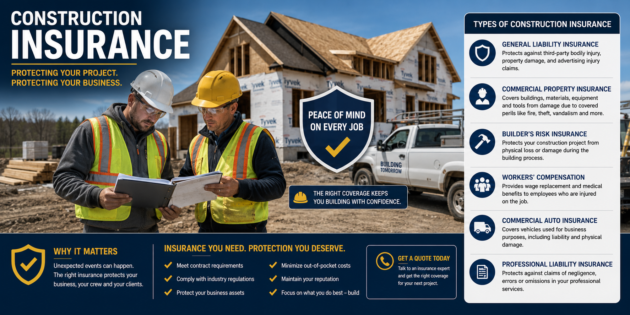
Construction Insurance: It Is Not As Difficult As You Think
Insurance reality check
Builder’s risk + liability + WSIB
Ontario 2026
Construction Insurance in Ontario: Builder’s Risk, Liability, and WSIB – Explained
Insuring a home while it’s being built isn’t optional, even though no single law says “buy this exact policy.” If you’re financing any part of the build, your lender will not advance a dollar without the right coverage in place – and if something goes wrong on a job site with no coverage, the bill can land on you. Here’s what’s actually required in Ontario, who is supposed to carry each policy, what it costs in 2026, and the one decision that makes most of this someone else’s problem.
TL;DR: A new build in Ontario typically needs three things: builder’s risk (course of construction) to protect the structure, general liability to cover third-party injury or damage, and WSIB coverage for the people working on site. In Ontario, WSIB is mandatory for virtually all construction businesses – even one-person operations – since 2013, so “my builder says he doesn’t need it” is usually a red flag, not a saving. Hire a licensed, insured builder and most of this becomes their responsibility, not yours.
Does a home under construction need insurance?
Short answer: yes – and in two ways. First, the structure being built needs protection from fire, wind, theft, and vandalism while it goes up. Second, the people and the public around the site need to be covered if someone gets hurt or a neighbour’s property is damaged. A finished house is easy to insure; a half-built one full of lumber, open framing, and a rotating cast of trades is a different animal, which is why standard homeowner policies often exclude or limit a home that is vacant or under construction.
You may be one of the lucky ones whose insurer extends your existing homeowner’s policy to cover the home during construction, including some protection for materials theft. Do not assume it – call your insurer and get the answer in writing before the first load of lumber arrives. Most people are not covered automatically, which is where the three core policies below come in.
Why lenders care: if you’re financing the build, the bank treats insurance as a condition of funding. No builder’s risk policy, no construction loan advance – it’s that simple. Getting your coverage lined up early is part of keeping the draws (and the jobsite) moving.
The three policies a new build usually needs
For most Ontario custom builds, banks require builder’s risk and general liability, and WSIB applies to anyone with workers on site. Here’s what each one actually does.
1. Builder’s Risk
Also called course of construction. Protects the project itself – fire, lightning, windstorm, hail, theft of materials, vandalism. Lenders require it to cover the loan amount or appraised cost to build. It does not cover liability or personal contents.
2. General Liability
Pays a third party – not you – if someone is hurt or their property is damaged because of the job site. Think a neighbour’s child wandering onto the site. Typically $1M to $2M of coverage; your builder normally carries it.
3. WSIB
Ontario’s workplace coverage for the people building your home. Mandatory for virtually all construction businesses, including one-person operations. If your builder has crew, this is not optional.
Builder’s risk (course of construction): what it covers and what it costs
Builder’s risk insurance is designed specifically for homes while they’re under construction, protecting the project from direct physical damage. A standard policy covers the named perils – fire, lightning, windstorm, hail, vandalism – while a broader “all-risk” form covers everything except what’s specifically excluded. The all-risk form costs more and usually isn’t required to satisfy a lender’s minimum, but it buys peace of mind on a long build.
Lenders generally require the policy to cover at least 100% of the home’s value or the full construction loan amount set on the appraisal – no bank will finance a build without it. As a 2026 ballpark, builder’s risk runs roughly 1% to 4% of the total construction value.
| Build value | Typical builder’s risk premium (1%-4%) |
|---|---|
| $50,000 (small project) | about $500 to $2,000 |
| $500,000 (typical custom home) | about $5,000 to $20,000 over the build, varies widely |
| $800,000+ (larger custom) | scales with value, term, and risk factors |
Premiums depend on construction type, build duration, site security, location, and how the home is heated and protected through winter. A solid, fire-resistant assembly and a well-secured site generally present lower risk. (One reason concrete-based ICF construction appeals to some insurers.)
Who buys it? If the home is built on a lot you already own, it’s usually the homeowner’s job to carry builder’s risk. The builder typically only insures it when the lot is in the builder’s name and title transfers to you at closing. Sort this out in writing before work starts so there’s no coverage gap.
Two books that keep your build (and your money) protected
Insurance protects the structure. These protect your budget and your permit – so the whole build closes smoothly. Each $29.99, or get both below and save.
Budget + money
The Ontario Lot-Buying Bible
Know your all-in number – insurance included.
$200+ of pro advice$29.99one-time
The 28-page step-by-step that budgets your build the way the money actually flows: land, site, hard and soft costs, financing, insurance, HST, allowances, and a real contingency. Printable worksheets so nothing – including coverage – gets forgotten.
- The hard-cost / soft-cost / contingency budgeting worksheet
- Where insurance, financing, and HST fit in your numbers
- The 10-minute go/no-go test and printable scorecard
- Bonus chapters: DIY trades, wells, easements, negotiation
30-day money-back guarantee.
Get the Lot Bible – $29.99 →
Secure checkout – download in 2 minutes – yours forever
Permit + compliance
The Ontario Building Permit Bible
A clean, compliant build that lenders and insurers trust.
$10,000$29.99one-time
Everything a builder does to run a permit – the order of operations, the complete-application checklist, real 2026 fees and development charges, who to hire, and how to never fail an inspection. A documented, compliant build is an insurable, financeable build.
- The complete-application checklist, so the file doesn’t bounce
- Real 2026 permit fees and development charges
- Who to hire, in what order, and what to pay
- How to never fail an inspection – and the costliest mistakes
30-day money-back guarantee.
Get the Permit Bible – $29.99 →
Secure checkout – download in 2 minutes – yours forever
Buying a lot and building on it? Get both Bibles.
The complete journey – budget the land and the build, then run the permit and the paperwork without the guesswork.
Before you buy
The Ontario Lot-Buying Bible
Prove a lot is buildable – and what it will really cost, coverage and all – before you spend a dollar.
$29.99 on its own
+
After you buy
The Ontario Building Permit Bible
Pull your Ontario building permit yourself – the order of operations, the checklist, and how to never fail an inspection.
$29.99 on its own
$59.98 Both for $49.99
Get both Bibles →
General liability: who provides it, you or the builder?
General liability insurance protects against third-party claims – payment goes not to you, but to someone outside the contract who suffers a loss. The classic example: a neighbour’s kids are playing on the site, one falls and breaks a leg. Either you or your builder can carry this, but it should be settled clearly and in writing before work begins.
If the builder provides it, expect a comprehensive general liability policy of $1,000,000 to $2,000,000, or a broad-form liability endorsement. Here’s the part that matters for an owner-builder: you are legally responsible for conduct and damages on your job site and can be sued for negligence. A general contractor solves this through their own liability policy; an owner-builder has to buy a commercial policy, which is often expensive and harder to get.
Ask your builder up front: “Do you carry general liability, and will you show me the certificate?” Some builders can’t afford it or would rather you carried it – and if you don’t ask, guess who’s exposed. Working with a properly insured builder saves you both money and a lot of risk.
WSIB: the part the old advice gets wrong
A lot of older guidance says workers’ compensation is “not required because it’s not the law.” In Ontario, for construction, that’s outdated. Under the Workplace Safety and Insurance Act, WSIB coverage has been mandatory for virtually all businesses in construction since January 2013 – including independent operators, sole proprietors, partners, and executive officers, not just companies with employees. So if your builder has a crew helping build your home, WSIB is required, full stop.
There are narrow exemptions – for example, an independent operator doing certain home-renovation work directly for the homeowner who occupies the home. If a builder genuinely has no workers and subcontracts everything out, they may sign a letter acknowledging they have no employees and aren’t required to carry it. But on a real custom build with trades on site, you want coverage in place.
Why it protects you
- If a worker is injured and there’s no proper coverage, they can potentially pursue both the contractor and the homeowner for damages.
- With a valid WSIB policy in effect, injured workers receive fixed benefits and generally cannot sue – which shields you, too.
- In some cases an owner-builder is treated as the employer, so knowing exactly who is responsible for each person on site is critical.
How to verify it (do this)
- Ask your builder for a WSIB clearance certificate – it confirms their account is in good standing.
- Require the same clearance from any subcontractor before they set foot on site.
- For 2026, WSIB’s average premium rate is about $1.23 per $100 of insurable payroll; non-residential construction is higher.
- Some lenders ask the builder to provide proof – which is one more reason a reputable, insured builder closes your loan faster.
You can confirm a contractor’s standing through the WSIB directly. Never let work proceed without proof of coverage.
Not sure your builder’s coverage actually holds up? Let’s check it before you sign.
We’ll walk through the three policies, tell you who should carry each on your build, and flag what to ask for in writing – builder’s risk limits, the general liability certificate, and WSIB clearance. Quick paid consult: we scope it on a call and send a secure payment link, so you only pay once you know what you’re getting. No charge to ask.
The decision that makes most of this someone else’s problem: hire a licensed builder
In Ontario, every new-home builder and vendor must be licensed by the Home Construction Regulatory Authority (HCRA) – it’s illegal to build or sell a new home without a valid licence. A licensed builder carries the liability and WSIB coverage, runs the permits, and enrolls your home in the Tarion new-home warranty, which protects you against defects after you move in. Most of the insurance burden shifts off your shoulders and onto a professional who does this every week.
Go the owner-builder route and the responsibilities flip back to you: you arrange WSIB and insurance, pull every permit, and contract directly with the trades. Crucially, an owner-built home is not eligible for Tarion warranty coverage – if a structural problem shows up later, there’s no statutory warranty backstop. For some people that trade-off is worth it; for most, hiring a licensed, insured builder is the cleaner, safer path. (More on choosing: who to hire first.)
Quick check before you sign with any builder: Are you HCRA-licensed? Will you provide a certificate of general liability ($1M-$2M)? Do you carry WSIB, and can I see a clearance certificate? Who carries builder’s risk on my build, and for what amount? Is the home enrolled with Tarion? Four questions, and you’ve covered most of what can go wrong.
Ontario HST Rebate | Deadline April 1, 2027
Insurance Is One Soft Cost. The Bigger Money Lever Is the $130,000 HST Rebate
While you’re lining up coverage, don’t miss the single biggest number on a new build. Ontario’s enhanced HST rebate puts up to $130,000 back in a new-home builder’s pocket if your build contract is signed (or your own build started) before April 1, 2027. Miss it and you fall back to the standard $24,000 – a six-figure swing that dwarfs every premium you’ll pay.
$0
Contract signed before Apr 1, 2027
$24,000
Signed after the deadline
$900,000
Miss the deadline and you forfeit
$0
Estimate based on Ontario’s 2026 enhanced HST rebate (Bill 114). Final eligibility for a custom or owner-built home is confirmed by a licensed rebate specialist – that’s what the free check is for. Full HST rebate details
The booklet: "Am I Covered?"
Want the homeowner-friendly walkthrough you can keep on file? Our free booklet answers the most common questions about insuring a home during construction in plain English. Download "Am I Covered?" (PDF) - then bring any questions to the team.
Want a build where the coverage, permits, and warranty are handled for you? Let's build it.
As an HCRA-licensed, Tarion-enrolled, fully insured builder, we carry the liability and WSIB, run the permits, and warranty your home - so you don't spend your build chasing certificates. We design a permit-ready set to your budget and build a high-performance ICF home. Tell us what you're planning.
Related guides and tools
Construction insurance in Ontario: frequently asked questions
Do I legally need insurance to build a home in Ontario?
No single law says you must buy one specific construction insurance policy, but in practice insurance is unavoidable on a real build. If you are financing any part of the project, your lender will require builder's risk coverage as a condition of advancing funds, and no bank will fund a build without it. Separately, WSIB coverage is mandatory under Ontario law for virtually all construction businesses, so the people working on your home are covered. And if a third party is injured on your site or a neighbour's property is damaged, you can be sued for negligence, which is exactly what general liability insurance exists to handle. So while there is no single statute saying buy this policy, the combination of lender requirements, WSIB law, and your own liability exposure means that going without coverage is not a realistic option. The practical answer is that a new build in Ontario needs builder's risk, general liability, and WSIB, and you should confirm in writing who carries each one before work starts.
What is builder's risk insurance and how much does it cost?
Builder's risk insurance, also called course of construction, protects the home itself while it is being built, covering direct physical damage from perils such as fire, lightning, windstorm, hail, theft of materials, and vandalism. A broader all-risk version covers everything except stated exclusions and costs more, though it is usually not required to satisfy a lender's minimum. Lenders generally require the policy to cover at least one hundred percent of the home's value or the full construction loan amount set on the appraisal. As a 2026 ballpark, builder's risk runs roughly one to four percent of the total construction value, so a fifty thousand dollar project might cost five hundred to two thousand dollars to insure, and a larger custom home scales up from there depending on build duration, construction type, site security, and location. It does not provide liability coverage or protect personal belongings, since there typically are not personal possessions on a construction site. On a lot you already own, carrying builder's risk is usually the homeowner's responsibility rather than the builder's.
Is WSIB mandatory for my builder in Ontario?
In most cases, yes. Under Ontario's Workplace Safety and Insurance Act, WSIB coverage has been mandatory for virtually all businesses in construction since January 2013, and the expanded compulsory coverage reaches beyond companies with employees to include independent operators, sole proprietors, partners, and executive officers. So if your builder has any crew helping construct your home, WSIB is required. There are narrow exemptions, such as an independent operator performing certain home-renovation work directly for the homeowner who lives in the home, and a builder who truly has no workers and subcontracts everything may sign a letter confirming they are not required to carry it. On a genuine custom build with trades on site, though, you want coverage in place, because if a worker is injured without proper coverage they can potentially pursue both the contractor and the homeowner for damages. The way to verify it is to ask the builder, and every subcontractor, for a WSIB clearance certificate before any work begins, and to refuse to let work proceed without that proof.
Who provides general liability insurance, me or the builder?
Either party can carry general liability insurance, but it should be settled clearly and in writing before work begins, because it determines who is protected if a third party is hurt or their property is damaged because of the job site. When a reputable builder provides it, you can expect a comprehensive general liability policy of one to two million dollars or a broad-form liability endorsement, and any good builder will usually carry coverage for all potential accidents. The reason this matters so much for an owner-builder is that you are legally responsible for conduct and damages on your own job site and can be sued for negligence. A general contractor solves this through their own commercial liability policy, but an owner-builder has to purchase a commercial policy directly, which is often expensive and harder to obtain. The simplest protection is to ask your builder up front whether they carry general liability and to request the certificate, because a builder who cannot or will not provide it is quietly shifting that exposure onto you.
Does my homeowner's policy cover a house under construction?
Sometimes, but you should never assume it. A minority of homeowners are fortunate enough that their insurer will extend their standard homeowner's policy to cover the home during construction, including some protection against theft of building materials, but many standard policies exclude or sharply limit coverage for a home that is vacant or under construction because the risk profile is so different from a finished, occupied house. A half-built home full of lumber, open framing, and a changing cast of trades is exactly the situation standard policies are not designed for. The only safe approach is to call your insurer before the first load of materials arrives, explain that the home will be under construction, and get the answer in writing, including what is and is not covered and for how long. If your existing policy does not extend, that is precisely the gap builder's risk insurance is meant to fill, so line it up early rather than discovering the exclusion after a loss.
What insurance does an owner-builder need in Ontario?
An owner-builder takes on the responsibilities a licensed builder would normally carry, which makes the insurance picture more demanding. You are responsible for arranging WSIB coverage for the people on your site, obtaining your own general liability insurance, carrying builder's risk on the structure, pulling every municipal permit for each stage of construction, and contracting directly with subcontractors and suppliers. Because you are legally responsible for conduct and damages on the job site, you generally need a commercial general liability policy, which is more expensive and harder to obtain than a contractor's existing coverage. There is also a major consequence that has nothing to do with insurance premiums: an owner-built home is not eligible for warranty coverage under Ontario's New Home Warranties Plan Act, so it will not have Tarion statutory warranty protection. That means if a structural defect appears after the build, there is no warranty backstop. For many people, hiring an HCRA-licensed, insured, Tarion-enrolled builder is the cleaner and safer path precisely because it transfers most of these obligations to a professional.
What should I ask a builder about insurance before I sign?
Four questions cover most of what can go wrong. First, are you licensed by the Home Construction Regulatory Authority, since in Ontario it is illegal to build or sell a new home without an HCRA licence. Second, will you provide a certificate of general liability insurance, typically one to two million dollars, so you can confirm third-party coverage is real and current. Third, do you carry WSIB, and can I see a clearance certificate, which confirms the account is in good standing and protects you from worker-injury claims. Fourth, who carries builder's risk on this build and for what amount, so the structure is protected and your lender's condition is met. It is also worth confirming that the home will be enrolled with Tarion for new-home warranty protection. A reputable, fully insured builder will answer all of these without hesitation and provide the paperwork, and a builder who hesitates or cannot produce certificates is showing you the risk before you have signed anything, which is the best possible time to learn it.
Note: general information, not insurance, legal, or tax advice. Policy requirements, WSIB rules, exemptions, premiums, and licensing obligations vary by situation and change over time. Confirm specifics with a licensed insurance broker, your lender, and the relevant authorities (WSIB, HCRA, Tarion) before you commit.
Latest posts
Fresh guides, calculators & real-world advice
More from BuildersOntario - scroll to explore.
Loading latest posts...
Tip: shift + mousewheel works great
EXPERT TIP: Don’t let price alone determine which company is awarded tthe
project. It is better to get problems resolved before it is too late.
We kniw it is, but wwe are here to tell you that it is
completely possible.
looking for construction insurance for the new home I am building.