Building Curved Wall with Insulated Concrete Forms

ICFs: The Best Thing in Home Building Since Sliced Bread

Building Curved Wall with Insulated Concrete Forms

Why New Home Buyers Are Falling in Love with Insulated Concrete Forms

When you’re building your first home, you want it to be perfect. You dream of a place that’s comfortable year-round, safe for your family, and won’t drain your bank account with sky-high energy bills. But you also worry about making the right choices—especially when it comes to construction methods you might not be familiar with.

If you’ve heard about Insulated Concrete Form (ICF) construction but aren’t sure if it’s right for you, you’re not alone. Many first-time home builders initially hesitate before discovering why ICFs are becoming the new gold standard in quality home construction.

What Are ICFs? (Your Burning Questions Answered)

“What exactly are these ICF things, and won’t my house look like a concrete bunker?”

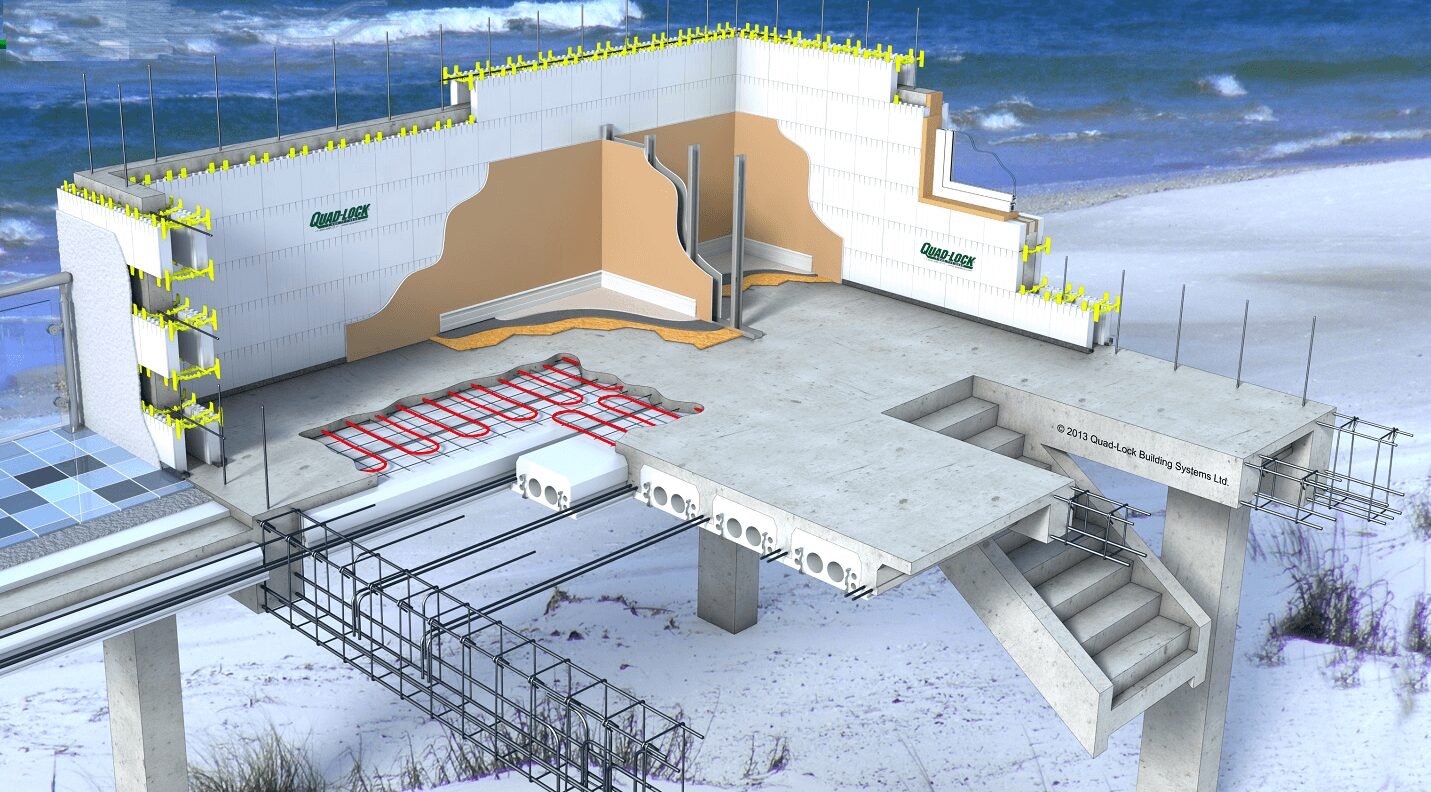
This is typically the first question people ask, and the answer is surprisingly simple. ICFs are foam blocks that lock together like oversized Legos to form the walls of your home. Once assembled, the hollow center is filled with reinforced concrete, creating walls with a solid concrete core sandwiched between two layers of insulating foam.

And no—your home won’t look like a bunker! This is one of the biggest misconceptions about ICF homes. From the outside, an ICF home can be finished with any exterior you want: brick, stone, siding, stucco—anything that matches your vision and neighborhood. Inside, the walls are typically covered with standard drywall. Visitors to your home would never know you’re living in anything different from a traditional house.

“Isn’t concrete cold and uninviting?”

Actually, the opposite is true. The foam insulation on both sides of the concrete creates a surprisingly cozy living environment. Many ICF homeowners describe their homes as having a solid, substantial feel that traditional construction simply can’t match. Doors close with a satisfying solidity, walls don’t vibrate when someone runs up the stairs, and there’s none of the creaking and popping that often occurs in wood-frame houses.

“But What About the Cost?” (The Question Everyone Asks)

Let’s address the elephant in the room right away. Yes, building with ICFs typically costs about 10-15% more upfront than traditional wood-frame construction.

But here’s what experienced homeowners will tell you: focusing solely on initial construction cost misses the bigger financial picture.

The Real Cost Story: Short-Term Investment, Long-Term Savings

Mark and Jennifer Davidson built their ICF home in Colorado three years ago. “Initially, we hesitated at the price difference,” Mark admits. “But when we ran the numbers over a 30-year mortgage, we realized we’d actually save money. Our monthly energy bills are so much lower that they offset the slightly higher mortgage payment.”

The math makes sense when you consider:

  1. Energy savings of 30-70%: Most ICF homeowners report dramatic reductions in heating and cooling costs. For many, this means saving $100-300 per month on utility bills.
  2. Insurance discounts: Many insurance companies offer premium discounts (sometimes 10-25%) for homes built with disaster-resistant features like ICF walls.
  3. Smaller HVAC systems: Because ICF homes require less heating and cooling, you can often install smaller, less expensive HVAC systems.
  4. Lower maintenance costs: Concrete walls don’t rot, warp, or become infested with termites, saving you money on repairs over time.
  5. Higher resale value: As energy costs rise and weather events become more severe, energy-efficient, disaster-resistant homes typically command premium prices when it’s time to sell.

Eric Martinez, a real estate appraiser who specializes in high-performance homes, notes: “More buyers are specifically looking for ICF homes because they understand the long-term value. These homes typically sell faster and for higher prices than comparable conventional homes.”

“Will My House Really Be That Much More Comfortable?”

This is where ICF homes truly shine, and why homeowners become such passionate advocates after living in one.

Temperature Consistency: Say Goodbye to Hot and Cold Spots

Sarah Wilson moved from a conventional home to an ICF home in Collingwood last year. “The difference is incredible,” she says. “In our old house, certain rooms were always too hot or too cold. Now, the temperature is perfectly even throughout. I don’t have to avoid my home office in the afternoon anymore because it overheats, and my kids’ bedrooms stay comfortable all night.”

ICF homes maintain remarkably even temperatures for three reasons:

  1. The continuous insulation on both sides of the wall virtually eliminates thermal bridging.
  2. The concrete core acts as “thermal mass,” absorbing and slowly releasing heat to moderate temperature swings.
  3. ICF walls create an exceptionally airtight envelope, eliminating the drafts that make conventional homes feel uncomfortable.

Noise Reduction: The Unexpected Benefit That Owners Love

“We didn’t realize how noisy our old neighborhood was until we moved into our ICF home,” says Michael Chang, who built his family’s home Noert of Barrie last year. “Now, when a garbage truck or motorcycle goes by, we barely notice. My wife works from home and says her video calls are much more professional now without random background noise.”

The sound attenuation of ICF walls is dramatic. With typical Sound Transmission Class (STC) ratings above 50 (compared to 33-38 for conventional framed walls), ICF construction reduces sound transmission by approximately 70%.

For families with young children, musicians, home theater enthusiasts, or anyone who values peace and quiet, this benefit alone can be worth the investment.

“But What If Something Goes Wrong?” Addressing Construction Concerns

If you’re new to ICF construction, you might worry about finding qualified builders or encountering problems during construction. These are valid concerns that deserve honest answers.

Finding the Right Builder

While ICF construction has been used in North America since the 1970s, not all builders have experience with it. However, the number of ICF-experienced contractors grows every year as demand increases.

When evaluating builders:

  • Ask how many ICF projects they’ve completed
  • Request references from previous ICF homeowners
  • Inquire about their ICF-specific training and certifications
  • View examples of their completed ICF homes

Addressing Common Construction Concerns

New home buyers often worry about specific aspects of ICF construction:

“What about plumbing and electrical work?”

Contrary to what you might think, running utilities through ICF walls is straightforward. Electrical wiring and boxes are typically placed in the foam before concrete is poured, while plumbing is usually run through interior walls or floors, just as in conventional construction.

Joey Pusic, our licensed electrician who has worked on dozens of ICF homes, explains: “Once you understand the process, working with ICFs is actually easier in many ways. The foam is simple to cut and channel for electrical boxes and wiring.”

“Can we make changes or additions later?”

While it’s true that modifying concrete walls requires more planning than cutting into drywall and wood framing, ICF homes can absolutely be renovated or expanded. The key is working with professionals who understand ICF construction.

“What about resale value if ICFs aren’t common in my area?”

As energy codes become stricter and energy costs rise, the market for high-performance homes is growing everywhere. Many real estate agents now specifically highlight energy efficiency and disaster resistance as selling points.

“When we sold our ICF home, we included a year’s worth of utility bills to show prospective buyers the energy savings,” explains Robert Chen. “Once they saw the numbers, the ICF construction became a major selling point rather than a concern.”

Living in an ICF Home: What Owners Wish They’d Known Sooner

Perhaps the most compelling testimonials come from people who have lived in ICF homes for years. Here’s what they consistently say they wish they’d known before making the decision:

“We should have done this sooner.”

This is the most common sentiment among ICF homeowners. Many express regret at not learning about or choosing ICF construction for previous homes.

“The comfort difference is even bigger than we expected.”

While energy savings often drive the initial interest in ICFs, the comfort improvements—even temperatures, quiet interiors, absence of drafts—frequently become the benefits owners appreciate most.

“We sleep better.”

Many ICF homeowners report improved sleep quality, attributing it to the quieter, more temperature-stable environment.

“We worry less.”

In areas prone to severe weather, ICF homeowners consistently report peace of mind during storms, hurricanes, or tornado warnings.

“Our guests always comment on how different our home feels.”

ICF homeowners often find that visitors notice the unusual comfort of their homes even without knowing about the construction method.

Making the Decision: Is an ICF Home Right for You?

As you consider whether ICF construction is the right choice for your new home, ask yourself these questions:

  1. Do you plan to live in this home for at least 5-10 years? The longer you stay, the more you’ll benefit from the energy savings and reduced maintenance costs.
  2. Is energy efficiency important to you? If reducing your environmental footprint and utility bills is a priority, ICFs offer significant advantages.
  3. Do you value comfort and quiet? If consistent temperatures and sound reduction would improve your quality of life, ICFs excel in these areas.
  4. Is your area prone to severe weather? In hurricane, tornado, or wildfire zones, the disaster resistance of ICFs provides valuable peace of mind.
  5. Are you thinking long-term? ICF homes are built to last generations with minimal maintenance, making them ideal for those planning for the future.

Next Steps: Exploring ICF Construction for Your Home

If you’re intrigued by the benefits of ICF construction, here are practical next steps:

  1. Visit an ICF home: Nothing beats experiencing the comfort and quiet firsthand. Many ICF manufacturers can connect you with local homeowners willing to share their experiences.
  2. Talk to ICF-experienced builders: Schedule consultations with builders who have ICF experience to discuss your specific project and get realistic cost estimates.
  3. Compare long-term costs: Work with your builder to calculate not just the initial construction cost, but the projected lifetime cost including energy savings, maintenance, and insurance discounts.
  4. Research manufacturers: Several companies make ICF products, each with slightly different features. Research their offerings to find the best fit for your project.
  5. Consider your climate: While ICFs perform well in all climates, certain features may be more beneficial depending on your local weather patterns.

Conclusion: Building a Home That Works for You

Your new home is more than just an investment—it’s where you’ll live your life, raise your family, and create memories. While ICF construction represents a somewhat higher initial investment, the returns in comfort, energy savings, and peace of mind make it worth considering.

Whether you choose ICF construction or another building method, the key is making an informed decision based on your priorities, budget, and long-term plans. By understanding all your options, you can build a home that truly works for you—not just today, but for years to come.

We’d love to hear your thoughts! Please leave a comment below if you agree, disagree, or have any questions about the topic. If you need additional information or want to continue the conversation, don’t hesitate to contact us. For more insights and how-to guides, feel free to explore the links below or head over to our “The Workbench” page. We look forward to hearing from you!

Quad-Lock Building System

ICF Home Building Sequence:

Quad-Lock Building System

🏠 ICF Home Building: You’ve Got Plans, Permits, and a Dream

Congratulations! You’ve finally gotten your plans and specifications together. The financing is arranged, the homebuilding permits are in hand, and you’ve convinced your significant other that this will, in fact, be fun. What could possibly go wrong? (Don’t answer that.)

You’ve decided which parts of the ICF home building process you’ll take on yourself (go you!) and have hired professionals for the rest. You’re ready to build the home of your dreams—ICF style.

Now comes the part where you juggle more than a caffeinated circus clown: coordinating all your contractors and suppliers in an efficient, sanity-preserving sequence.

But before you break out the hard hat and tool belt, make sure you’ve got inspection schedules from the local building and health departments. Nothing puts a damper on momentum like having to rip out work because it wasn’t inspected first.

Let’s break down the ICF home building sequence, with a touch of humor and a whole lot of practicality.


🚀 Step 1: Get Power and a Potty

First things first: bring in temporary electric service. You’ll need it for tools, lights, and your contractor’s radio (which will play the same classic rock station every single day).

Also, arrange for a portable toilet. Trust us, you don’t want the crew using the nearest bush.


🏛️ Step 2: Stake Your Claim

Have a surveyor stake out the house. This is the ICF home building version of planting your flag on the moon.

Also plan out utilities and a temporary driveway. Concrete trucks don’t appreciate off-roading.


🌳 Step 3: Clear the Jungle

Remove trees, bushes, old swing sets, or ancient lawn gnomes that stand in your way. If your site is a mess, your excavator will become your new best friend.

Cut down the grade if needed, and always ensure there’s access for heavy equipment and concrete trucks. (They are not known for their agility.)


🪜 Step 4: Dig Deep (But Not for Gold)

Time to dig the basement. Once the hole is open, move fast. That open pit will collapse if you give it time. Don’t give it time.

Frame and pour the footings quickly. And get the forms inspected before pouring the concrete. Because do-overs are expensive.


🚰 Step 5: Prep for Utilities

Install sleeves in the foundation for sewer, gas, electric, and phone. It’s a lot easier to do this now than to jackhammer later.

Also, make arrangements for your trenches. (You’ll get to play real-life SimCity with utilities.)


🚫 Step 6: Septic Strategy

If you’re using a septic system, you can install it before the foundation—just don’t dig the basement until it’s almost finished. Because mud wrestling is not a requirement in ICF home building.


📏 Step 7: Drainage Duty

Once the footings are done, lay washed gravel and your perimeter drainage pipe. Don’t wait. Delay here invites moisture, and no one wants a soggy basement.


🚚 Step 8: Delivery Day

Now’s the time to bring in your Insulated Concrete Forms (ICFs), steel rebar, and window bucks. This is the ICF home builder’s version of Christmas morning.


🏰 Step 9: Raise the Walls

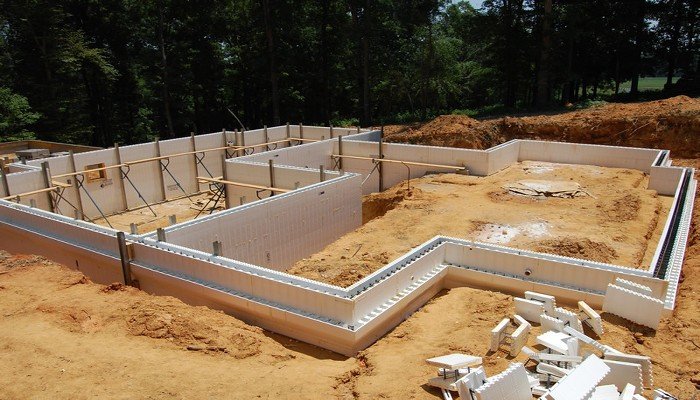
Stack and align the ICF blocks, tie in the rebar, install bucks and bracing, and pour the walls. Watch it all come together like giant Lego bricks—if Lego bricks were filled with concrete and weighed a ton.


🌧️ Step 10: Waterproof and Steel Up

Once the foundation walls are poured and cured, install any required steel beams in the basement. Then waterproof the exterior walls. You want to keep the water out and the cozy in.


🌳 Step 11: First Floor Framing

Install the floor framing and subfloor before you backfill. This braces your ICF walls and keeps them from cracking like your neighbor’s driveway.


💧 Step 12: Backfill Bonanza

After curing and framing, backfill around the foundation. Be gentle—ICF walls are tough, but not invincible.


🛍️ Step 13: Ground Floor Walls

Construct your first-floor walls. Measure twice, cut once, and try not to argue with your framing crew (they have hammers).


🏢 Step 14: Pour Those Walls

If you’re using ICF for the first floor too, it’s time for another concrete pour. Make sure everything’s braced, and double-check for alignment. Concrete waits for no one.


🏗️ Step 15: Raise the Roof (and Walls)

Now frame all walls, ceilings, and the roof. Install 3/4″ subflooring and apply sheathing. Now it’s starting to look like a house!


☁️ Step 16: Roof, Soffit & Fascia

Install the roofing before the weather turns. Follow that up with soffits and fascia. Bonus points if it actually matches your blueprint.


🚪 Step 17: Rough It (Plumbing & Exteriors)

Start rough plumbing. Simultaneously, install windows, doors, and exterior cladding—brick, stone, siding, or a combination of all three if you’re feeling fancy.


🔥 Step 18: Masonry and Ducts

If you’re building a fireplace, now’s the time to lay the brick. At the same time, start running ductwork. And yes, gutters can go on now too.


🔌 Step 19: Rough Electric

Time for wiring. If your electrician hums while working, you’re legally obligated to hum along. It’s in the code. (Not really, but it should be.)


📅 Step 20: Concrete Floors

With the roof on, windows in, and rough plumbing done, you can now pour concrete floors for the basement and garage. Also pour stoops and any A/C pads.


✅ Step 21: Rough Inspections

Before covering anything up, get all rough inspections done. Your inspector will be looking for code compliance—and probably a coffee.


🛋 Step 22: Insulation Station

Install insulation. Some jurisdictions require an inspection before you cover it. Don’t get ahead of yourself here.


🖊️ Step 23: Drywall Drama

Hang, tape, sand, and prime the drywall. This is when your ICF home building project goes from skeleton to skin. And yes, drywall dust gets everywhere.


📃 Step 24: Floors Galore

Install underlayment, ceramic tile, and hardwood flooring. You’re almost there—don’t trip over your excitement.


🏚️ Step 25: Cabinets, Trim, and Bling

Install cabinetry, trims, accessories, and built-in appliances. This is the point where your vision starts becoming a Pinterest board.


🌡️ Step 26: Final Systems

Finish plumbing, electrical fixtures, and install the furnace and A/C. Also hook up phone/internet—how else are you going to post your ICF home building progress on social media?


🌿 Step 27: Rough Landscaping

You can do this during backfill, but now’s also a good time. Install culverts, sidewalks, and the driveway now that most heavy trucks have vacated the scene.


🎨 Step 28: Paint and Inspect

Paint, stain, and schedule final inspections. You’re almost done—just a few brushstrokes and approvals to go.


🌾 Step 29: Final Landscaping

Topsoil, sod, seed—get your yard looking like a cover shot from Better Homes and Gardens. Or at least less like a mud pit.


🏡 Step 30: Floors Part Two & Move-In!

Install carpet, vinyl tile, or any remaining flooring. Then give the place a good cleaning.

At last, it’s time to move in. Pop the champagne (or root beer), you’ve completed your ICF home building journey!


🤔 ICF vs. Stick Frame: Not So Different?

As you can see, ICF home building isn’t drastically different from stick framing. The real difference is in the performance—energy efficiency, strength, and comfort.

Know the sequence, follow the steps, and your ICF home building project will come together like a perfectly choreographed ballet of bricks, beams, and builders.

Now go forth and build like a pro—with maybe a few laughs along the way!

We’d love to hear your thoughts! Please leave a comment below if you agree, disagree, or have any questions about the topic. If you need additional information or want to continue the conversation, don’t hesitate to contact us. And for more insights and how-to guides, feel free to explore the links below or head over to our “The Workbench” page. We look forward to hearing from you!

We Asked AI: What is the Best ICF in Ontario?

Searching for the Best ICF in Ontario? AI’s Answers Will Surprise You (and Maybe Confuse You)

“What is the best ICF in Ontario?” We typed it in, hit enter, and waited with bated breath, expecting a symphony of data-driven brilliance. Instead, we got… well, let’s just say it was a wild ride. From philosophical ramblings about the meaning of “best” to AI chatbots channeling their inner stand-up comedians, the answers were anything but predictable.

Prepare yourselves for a hilarious journey through the digital minds of our robot overlords as they attempt to decipher the concrete jungle of Ontario’s ICF market. Here are the unedited, gloriously chaotic answers.


1. Perplexity AI’s Answer 🤖

Exact Response

“When choosing the best ICF block to build a house in Ontario, several factors should be considered, including availability, ease of installation, and manufacturer support. Based on the available information, here are some top options for ICF blocks in Ontario:

Fox Blocks

  • Excellent Support: Fox Blocks received positive responses in all areas of support, including installation help, training, and engineering support.
  • Availability: They have a network of local dealers and trained installers throughout North America.
  • Code Compliance: Fox Blocks meet and exceed local Canadian codes and create sustainable buildings with superb moisture resistance and energy performance.
  • Easy Installation: Their design facilitates straightforward installation.

Nudura

  • Positive Reviews: Users have reported excellent experiences with Nudura blocks.
  • Distributor Network: Many builders are distributors for Nudura, indicating widespread availability and support.

IntegraSpec ICF

  • Local Supplier: Lanzinger ICF, serving Eastern Ontario, supplies and supports IntegraSpec ICF for various projects.

Considerations for Selection

  • Builder Experience: The type of block isn’t as crucial as finding a competent, experienced ICF builder.
  • Core Size: For residential construction in Ontario, 6″ or 8″ concrete core size blocks are typically used.
  • Below Grade Requirements: Below grade walls must have a minimum 6″ concrete core, with some regions requiring 8″.
  • Wall Height: 6″ forms are limited to approximately 14′ in height, while walls higher than 14′ must use 8″ or larger forms.

Ultimately, the best ICF block for your Ontario house will depend on your specific project requirements, local availability, and the expertise of your chosen builder. It’s advisable to consult with local ICF experts and experienced builders to make the most suitable choice for your particular situation.”

Our Take 😆

Perplexity AI, the Switzerland of chatbots, delivers a response so balanced it could teach yoga. It’s like asking for a restaurant recommendation and getting, “Food exists. Some places serve it. Good luck!” But hey, at least we learned that walls taller than 14 feet need bigger blocks—so if you’re building a castle for your pet moose, take notes.


2. ChatGPT-4’s Answer 🤖

Exact Response

The best Insulated Concrete Form (ICF) brand in Ontario depends on your priorities—whether it’s cost, R-value, availability, engineering features, or ease of installation. Here’s a breakdown of the top ICF brands available in Ontario and their strengths:

Nudura – Best for Professional Contractors 

✅ Pros:

  • High R-value: R-23+ (upgradable with inserts)
  • Durable and strong: High-density foam and reinforced webs
  • Foldable panels: Saves storage space on-site
  • Extensive dealer network in Ontario
  • Full range of accessories (bracing, waterproofing, ties)
  • Proven track record in large-scale and custom home projects

    ❌ Cons:
  • More expensive than some competitors
  • Requires trained installers for best results 💡 Best for: High-end custom homes, large projects, and professionals needing top-tier performance.

Logix ICF – Best for Energy Efficiency & DIYers 

✅ Pros:

  • R-Value: R-25+ with Platinum Series
  • DIY-friendly: Offers training and support
  • Strong and rigid blocks
  • Multiple product lines (XP-1 for commercial, Platinum for efficiency)
  • Widely available in Ontario

    ❌ Cons:
  • Limited fold-flat options (compared to Nudura)
  • Can be pricier than Fox Blocks or Amvic 💡 Best for: Homeowners and builders looking for energy-efficient homes with good support.

Fox Blocks – Best for Affordability & Ease of Use 

✅ Pros:

  • Competitive pricing in Ontario
  • Fully reversible blocks (reduces installation errors)
  • Strong corner design
  • R-Value: R-22+
  • Good availability across Ontario

    ❌ Cons:
  • No fold-flat option (bulky for transport)
  • Limited advanced product line compared to Nudura or Logix 💡 Best for: Cost-conscious builders needing a balance of quality and affordability.

Amvic ICF – Best for Strength & Local Availability 

✅ Pros:

  • High-density EPS foam (2.5 lbs/ft³)
  • R-30+ available with additional inserts
  • Interlocking design prevents separation
  • Good for load-bearing walls
  • Manufactured in Ontario = lower shipping costs

    ❌ Cons:
  • Heavier blocks compared to others
  • Can be overkill for standard residential builds 💡 Best for: Builders prioritizing strength and local manufacturing.

Quad-Lock – Best for High R-Values 

✅ Pros:

  • Super high insulation potential (R-40+)
  • Great for Passive House construction
  • Flexible panel system for custom thickness
  • Easy for complex designs

    ❌ Cons:
  • Expensive
  • Requires additional assembly compared to pre-formed blocks
  • Limited supplier network in Ontario 💡 Best for: Extreme energy efficiency goals and Passive House projects.

Best Overall ICF for Ontario Homes

FeatureBest Brand
Best for ProfessionalsNudura
Best for Energy EfficiencyLogix
Best for AffordabilityFox Blocks
Best for StrengthAmvic
Best for Passive HouseQuad-Lock

My Recommendation If you’re a professional builder looking for reliability and top-tier performance, Nudura is the best option. If you’re a homeowner or DIY builder, Logix ICF offers great support and ease of use. For budget-conscious builds, Fox Blocks is a solid choice.

Our Take 😆

ChatGPT-4 out here drafting ICF Tinder profiles. “Swipe right on Nudura if you’re a pro with deep pockets. Logix? Swipe if you’re a DIYer who owns 17 tool belts. Fox Blocks? The ‘Netflix and Chill’ of ICFs—cheap and easy.” Bonus points for the comparison table that looks like it’s judging a concrete beauty pageant.


3. Clode AI’s Answer 🤖

Exact Response

The best Insulated Concrete Form (ICF) brand in Ontario depends on your priorities—whether it’s cost, R-value, availability, engineering features, or ease of installation. Here’s a breakdown of the top ICF brands available in Ontario and their strengths:

Nudura – Best for Professional Contractors 

✅ Pros:

  • High R-value: R-23+ (upgradable with inserts)
  • Durable and strong: High-density foam and reinforced webs
  • Foldable panels: Saves storage space on-site
  • Extensive dealer network in Ontario
  • Full range of accessories (bracing, waterproofing, ties)
  • Proven track record in large-scale and custom home projects ❌ Cons:
  • More expensive than some competitors
  • Requires trained installers for best results 💡 Best for: High-end custom homes, large projects, and professionals needing top-tier performance.

Logix ICF – Best for Energy Efficiency & DIYers 

✅ Pros:

  • R-Value: R-25+ with Platinum Series
  • DIY-friendly: Offers training and support
  • Strong and rigid blocks
  • Multiple product lines (XP-1 for commercial, Platinum for efficiency)
  • Widely available in Ontario

    ❌ Cons:
  • Limited fold-flat options (compared to Nudura)
  • Can be pricier than Fox Blocks or Amvic 💡 Best for: Homeowners and builders looking for energy-efficient homes with good support.

Fox Blocks – Best for Affordability & Ease of Use 

✅ Pros:

  • Competitive pricing in Ontario
  • Fully reversible blocks (reduces installation errors)
  • Strong corner design
  • R-Value: R-22+
  • Good availability across Ontario

    ❌ Cons:
  • No fold-flat option (bulky for transport)
  • Limited advanced product line compared to Nudura or Logix 💡 Best for: Cost-conscious builders needing a balance of quality and affordability.

Amvic ICF – Best for Strength & Local Availability 

✅ Pros:

  • High-density EPS foam (2.5 lbs/ft³)
  • R-30+ available with additional inserts
  • Interlocking design prevents separation
  • Good for load-bearing walls
  • Manufactured in Ontario = lower shipping costs

    ❌ Cons:
  • Heavier blocks compared to others
  • Can be overkill for standard residential builds 💡 Best for: Builders prioritizing strength and local manufacturing.

Quad-Lock – Best for High R-Values 

✅ Pros:

  • Super high insulation potential (R-40+)
  • Great for Passive House construction
  • Flexible panel system for custom thickness
  • Easy for complex designs

    ❌ Cons:
  • Expensive
  • Requires additional assembly compared to pre-formed blocks
  • Limited supplier network in Ontario 💡 Best for: Extreme energy efficiency goals and Passive House projects.

Best Overall ICF for Ontario Homes

FeatureBest Brand
Best for ProfessionalsNudura
Best for Energy EfficiencyLogix
Best for AffordabilityFox Blocks
Best for StrengthAmvic
Best for Passive HouseQuad-Lock

My Recommendation If you’re a professional builder looking for reliability and top-tier performance, Nudura is the best option. If you’re a homeowner or DIY builder, Logix ICF offers great support and ease of use. For budget-conscious builds, Fox Blocks is a solid choice.

Our Take 😆

Clode AI, the copy-paste champion of 2025! It’s like watching a cover band perform ChatGPT-4’s greatest hits. “Hey, I wrote this song too! …Okay, fine, I changed one lyric.” At least it’s consistent—like that friend who always orders the same thing at Tim Hortons and acts like it’s a personality trait.

Visual Suggestion: Use the same table styling as ChatGPT-4’s section for consistency.


4. Gemini AI’s Answer 🤖

Exact Response

Determining the ‘best’ ICF (Insulated Concrete Form) in Ontario can depend heavily on the specific needs of your project. However, I can provide you with some of the top brands and factors to consider:

Key ICF Brands in Ontario:

Nudura ICF:

  • Known for its flat wall system and high energy efficiency.
  • Strong focus on integrated bracing and LEED compliance.
  • Has a strong distribution network.

Amvic ICF:

  • Features a waffle-grid system, which can reduce concrete usage.
  • Manufactured in Ontario, which can be advantageous.
  • Offers radon mitigation panels.

Fox Blocks ICF:

  • Emphasizes fire resistance.
  • Designed for fast installations with reversible corner blocks.

Element ICF (formerly Logix):

  • Suited for high-rise and multi-family buildings.
  • Utilizes a hybrid post-and-beam system.

Factors to Consider:

  • R-Value: This measures the insulation’s thermal resistance. Higher R-values provide better insulation.
  • Core Design: Different ICF systems have varying core designs (flat wall, waffle-grid, etc.), which can affect concrete usage and structural integrity.
  • Installation: Consider the ease of installation and any specialized training required.
  • Cost: ICF costs can vary depending on the brand and system.
  • Project Type: The best ICF for a residential home may differ from that for a commercial building.
  • Local Suppliers and Support: Having a local supplier can be very helpful. Also look for companies that provide good support and training.

Where to Find More Information:

  • Websites of ICF manufacturers.
  • Local building supply stores.
  • ICF installers and contractors.
  • Sites that provide information on green building, such as Ecohome.

When choosing an ICF, it’s highly recommended to consult with experienced builders and contractors in Ontario who have expertise in ICF construction. They can provide valuable insights and recommendations based on your specific project requirements.

Our Take 😆

Gemini AI, the philosopher of chatbots, delivers a TED Talk on existential ICF choices. “What is the best? Are we merely blocks in the cosmic concrete core of life?” It’s like asking for directions and getting a lecture on the history of roads.


5. GROK Deep Search’s Answer 🤖

Exact Response

Key Points

  • Research suggests Nudura is likely the best ICF in Ontario, based on its high insulation performance and strong market presence.
  • It seems likely that Nudura’s higher R-value (3.63-8.63) and larger block size make it efficient for construction.
  • The evidence leans toward Nudura being preferred, with distributors like Ontario ICF Supply and Fastform ICF carrying it as the top brand.

Overview Insulated Concrete Forms (ICFs) are popular in Ontario for their energy efficiency and durability in construction. Among the various brands, Nudura stands out due to its superior insulation and widespread use in the region. This response explores why Nudura is considered the best, supported by detailed comparisons and local availability.

Market Presence and Performance Nudura is widely distributed in Ontario, with companies like Ontario ICF Supply and Fastform ICF promoting it as the number one ICF brand. Its higher R-value range (3.63-8.63) compared to competitors like Fox Blocks (R-value 2.63) suggests better thermal performance, which is crucial for energy-efficient homes. Additionally, Nudura’s larger block size (96″ x 18″) can reduce waste and speed up installation, making it a practical choice for builders.

Local Preference and Support In Ontario, Nudura’s strong distributor network, including training courses and technical support, enhances its appeal. For instance, Fastform ICF offers Nudura training on February 13, 2025, indicating active support for builders. While Fox Blocks and other brands like AMVIC are also available, Nudura’s prominence in local listings and forums suggests it is more commonly used and preferred.

Survey Note: Detailed Analysis of ICF Brands in Ontario This section provides a comprehensive analysis of Insulated Concrete Forms (ICFs) in Ontario, focusing on identifying the best brand based on performance metrics, market presence, and user feedback. The investigation began by clarifying that ‘ICF’ refers to Insulated Concrete Forms, a construction material used for energy-efficient and durable walls, particularly relevant in Ontario’s building market.

Comparative Analysis of ICF Brands

BrandModelR-ValueFire Rating (Hours)Performance Comment
AmvicAmvic ICF R22223+Cost effective, excellent performance
AmvicAmvic ICF R30303+High performance ICF
BuildBlock Building SystemsBuildBlock2.53-4Radius forms in various arcs
Fox BlocksFox Blocks2.634Field assembled, forms a flat concrete wall
HercuTechHercuWall2.52+Engineered by project, increased R value
IntegraSpec ICFIntegraSpec ICF2.53-4+Continuous furring, compact corner option
Logix Brands Ltd.Logix Pro2.754+Higher insulation, integrates with Logix Pro
Logix Brands Ltd.Logix Platinum2.754+Knockdown Line, integrates with Logix Pro
Nudura Inc.Nudura ICF Series3.63-8.634Achieve higher R-Values
Quad-Lock Building SystemsQuad-Lock Ultra3.134Strong R-28 ICF, full height furring strips

From this table, Nudura stands out with the highest R-value range (3.63-8.63), indicating superior insulation compared to Fox Blocks (R-value 2.63) and others. This is a critical factor for energy efficiency, especially in Ontario’s climate. Additionally, Nudura’s fire rating of 4 hours matches top performers, ensuring safety standards are met.

Market Presence in Ontario Further investigation revealed Nudura’s strong market presence in Ontario. Ontario ICF Supply claims to carry Nudura as the ‘#1 ICF brand on the market,’ and Fastform ICF offers Nudura training courses, with the next session scheduled for February 13, 2025. This indicates active support and adoption by local builders.

In contrast, Fox Blocks, while mentioned in forums like GreenBuildingTalk and Contractor Talk, does not appear as prominently in Ontario-specific distributor listings. For example, Everything ICF is an AMVIC dealer, suggesting other brands have a presence, but Nudura’s distribution network is more extensive.

User Feedback and Forums To gauge user experiences, forums such as GreenBuildingTalk and Contractor Talk were reviewed. Discussions highlighted both Nudura and Fox Blocks positively, with users noting Fox Blocks’ ease of use for DIY projects and Nudura’s strength and durability. However, the lack of recent, Ontario-specific reviews for Fox Blocks compared to Nudura’s consistent mentions in local listings suggests Nudura is more preferred locally.

Conclusion Given Nudura’s higher R-value, larger block size for efficiency, and strong market presence in Ontario, it is considered the best ICF in the region. This conclusion is supported by distributor claims, technical specifications, and local adoption, making it a top choice for builders seeking energy efficiency and durability. While Fox Blocks and other brands like AMVIC are viable, Nudura’s comprehensive advantages align with Ontario’s construction needs as of February 28, 2025.

Key Citations

  • Ontario ICF Supply, Distributor
  • Fastform ICF, Insulated Concrete Form Distributor
  • Insulated Concrete Forms (ICF Blocks) Nudura
  • ICF Comparison Chart ICF Builder Magazine
  • GreenBuildingTalk Green Building Forums
  • Nudura Vs. Fox Blocks (In-Depth Comparison Guide)
  • Nudura vs Fox Blocks – An Unbiased Comparison
  • Everything ICF by Wood Lumber

Our Take 😆

GROK Deep Search didn’t just answer the question—it built a shrine to Nudura and is now leading guided tours. This response is part thesis, part love letter, with citations so thorough they’d make a Wikipedia editor blush.

Visual Suggestion: Style the “Comparative Analysis of ICF Brands” table with borders, bold headers, and color-coded rows. Add a bar chart comparing R-values of top brands for clarity.


Final Thoughts

So, what did we learn from asking AI?

  • Perplexity is the Switzerland of chatbots—neutral, diplomatic, and allergic to commitment.
  • ChatGPT-4 is the overachiever who color-codes their notes.
  • Clode AI is ChatGPT-4’s “copy my homework but change it a little” sibling.
  • Gemini is the philosopher who turns “What’s the best ICF?” into a meditation on the meaning of best.
  • GROK is the hype man for Team Nudura.

At the end of the day, the “best” ICF depends on your project, budget, and whether your builder’s idea of “support” is answering your texts or ghosting you like a bad Tinder date. Choose wisely!, budget, and whether your builder’s idea of “support” is answering your texts or ghosting you like a bad Tinder date. Choose wisely—and maybe send GROK a thank-you card. 🏠✨

ICF-vs-SIPs

ICF vs. SIPs

🏗️ ICF vs. SIPs: A Comprehensive Comparison of Modern Building Systems

The construction industry is evolving rapidly, driven by the need for energy efficiency, resilience, and faster building methods. Among the leading innovations are Insulated Concrete Forms (ICF) and Structural Insulated Panels (SIPs), both designed to enhance thermal performance, reduce construction timelines, and promote sustainable building practices.

Choosing between ICF and SIPs depends on various factors, including climate, budget, and project type. This article explores their differences, advantages, and ideal applications, helping builders, architects, and homeowners make informed decisions.


1. What Are ICF and SIPs?

🧱 ICF (Insulated Concrete Forms)

ICF involves stacking interlocking foam blocks—usually made from expanded polystyrene (EPS)—to form wall structures. These hollow blocks are filled with reinforced concrete, while the foam remains in place as permanent insulation. The result is a solid, monolithic wall system known for its high thermal mass, strength, and durability.

🏠 SIPs (Structural Insulated Panels)

SIPs consist of a rigid foam core (EPS, XPS, or polyurethane) sandwiched between two structural facings, typically oriented strand board (OSB). These panels are factory-manufactured to precise specifications and assembled on-site, ensuring rapid construction and airtight building envelopes.


2. 🔍 Key Differences at a Glance

AspectICFSIPs
Material CompositionFoam blocks filled with reinforced concreteFoam core with OSB/plywood facings
InsulationHigh thermal mass stabilizes indoor temperaturesContinuous foam core reduces thermal bridging
StrengthExtremely durable; resists fire, wind (200+ mph), and pestsStructurally sound but vulnerable to moisture damage
CostHigher upfront costs but long-term energy savingsLower initial costs and reduced labor expenses
Construction TimeLonger due to concrete curing and labor-intensive workFaster assembly with prefabrication
Design FlexibilityLimited by wall thickness but adaptable to curved wallsCustomizable but requires precise planning

3. ✅ Pros and Cons of ICF

🟢 Advantages of ICF

  1. Superior Durability: ICF walls are exceptionally strong, and capable of withstanding hurricanes, earthquakes, and tornadoes. The reinforced concrete core resists fire, pests, and mold.
  2. Energy Efficiency: ICF’s thermal mass stabilizes indoor temperatures, reducing heating and cooling demands by 20–40% compared to traditional construction.
  3. Soundproofing: ICF offers excellent acoustic insulation, with Sound Transmission Class (STC) ratings of 45 to 50+, effectively blocking external noise.
  4. Disaster Resilience: Concrete cores make ICF homes highly resilient against natural disasters, including wildfires and floods.

🔴 Drawbacks of ICF

  1. Higher Costs: ICF can cost 5–10% more than SIPs, primarily due to concrete and labor expenses.
  2. Thicker Walls: ICF walls are typically 12–16 inches thick, reducing interior square footage and complicating retrofits.
  3. Environmental Impact: Concrete production contributes significantly to CO₂ emissions, although ICF’s energy efficiency offsets this over time.

4. 🟩 Pros and Cons of SIPs

🌟 Advantages of SIPs

  1. Speed and Affordability: SIPs arrive prefabricated, reducing construction timelines by 30–50% and cutting labor costs.
  2. Energy Efficiency: SIPs achieve impressive R-values up to R-50, outperforming conventional framing and enhancing airtightness.
  3. Eco-Friendly: SIPs use renewable OSB facings and generate less on-site waste compared to traditional framing.

⚠️ Drawbacks of SIPs

  1. Moisture Sensitivity: OSB facings are vulnerable to mold, rot, and structural degradation if exposed to moisture.
  2. Lower Thermal Mass: SIPs lack the heat-storing capacity of ICF, making them less effective in extreme climate zones.
  3. Design Rigidity: SIPs require precise prefabrication, making post-fabrication changes complex and costly.

5. 💰 Cost Comparison: Upfront vs. Long-Term Savings

Cost CategoryICF (Approx.)SIPs (Approx.)
Material Cost (per sq. ft.)$7 – $10$6 – $15
Labor Cost (per sq. ft.)$14 – $20$8 – $12
Total Installed Cost$35 – $45$19 – $35
Energy Savings (Annually)20% – 40%30% – 50%
Long-Term MaintenanceLow, durable concrete structureModerate, requires moisture control

While ICFs may cost more initially, they offer long-term energy savings and minimal maintenance. SIPs, on the other hand, provide a more affordable upfront solution but require diligent moisture management.


6. 🌎 Which Is Better? It Depends on Your Project

❄️ Climate Considerations

  • ICF: Ideal for extreme climates, including areas with temperature fluctuations, wildfires, hurricanes, or heavy snowfall.
  • SIPs: Best for temperate climates where rapid heating and cooling efficiency are priorities.

🏗️ Project Type

  • ICF: Preferred for multi-story buildings, basements, and disaster-prone areas requiring robust structural integrity.
  • SIPs: Optimal for residential homes, light commercial structures, and projects requiring fast, cost-effective construction.

🔄 Hybrid Approach

Combining ICF walls with SIP roofs can leverage the best of both systems—ICF’s strength and thermal mass alongside SIP’s insulation and speed.


7. 🌿 Environmental Impact: Which Is More Sustainable?

Environmental FactorICFSIPs
Carbon FootprintHigher due to concrete productionLower, especially when using sustainable OSB
Energy EfficiencyHigh, with reduced HVAC relianceHigher R-values but lower thermal mass
Material WasteMinimal due to on-site assemblyLow, with prefabrication reducing waste
RecyclabilityFoam and concrete are difficult to recycleOSB and foam can be recycled or repurposed

While SIPs have a lower embodied carbon footprint, ICFs often compensate through superior long-term energy efficiency.


8. 🌪️ Resilience in Natural Disasters

  • Hurricanes and Tornadoes: ICF walls can withstand winds over 200 mph, making them superior for storm-prone areas.
  • Earthquakes: ICF’s reinforced concrete core offers excellent seismic resilience.
  • Fire Resistance: ICF provides up to a 4-hour fire rating, while SIPs typically offer 1–2 hours depending on the facing material.
  • Flooding: ICF resists water intrusion, while SIPs risk structural damage if submerged.

9. 🕰️ Long-Term Performance and Maintenance

Performance FactorICFSIPs
Lifespan100+ years with minimal maintenance50–70 years, contingent on moisture control
Pest ResistanceExcellent, impervious to termitesVulnerable, especially if OSB is exposed
Maintenance NeedsLow; occasional inspectionModerate; moisture and sealing checks

10. 🎯 Conclusion: Which System Should You Choose?

The ICF vs. SIPs debate doesn’t yield a universal winner—it ultimately depends on project-specific needs, budget, and environmental conditions.

  • Choose ICF if you prioritize:
    • 🛡️ Structural resilience against disasters
    • ❄️ Long-term energy efficiency and low maintenance
    • 🔇 Superior soundproofing and durability
  • Choose SIPs if you prioritize:
    • 🚀 Faster, cost-effective construction
    • 🌡️ High insulation values and airtightness
    • 🌳 Eco-friendly materials with reduced carbon footprint

For those seeking the best of both worlds, a hybrid system—ICF walls with SIP roofs—offers an optimal balance of strength, efficiency, and affordability. You can also check the article on our sister site ICFpro.ca.

ICF-foundation

ICF Foundation Cost

ICF-foundation
ICF Foundation

How To Calculate The Cost Of ICF Foundations in Southern Ontario

Estimating construction costs is as much an art as it is math—especially when we’re talking about custom home building. For some people, “value” means the lowest cost or the highest quality; for others, it’s the intangible elements like comfort, peace of mind, or a stunning design that matter most.

ICF Foundation Basics

However you define “value,” it’s vital to make informed decisions about your foundation. After all, the foundation is the backbone of your new home—if that backbone’s weak, you’ll be dealing with more cracks than a dropped smartphone.

Why ICF Foundations?

In Canada, 90% of basements are built using some type of concrete wall system, usually one of these three:

  1. Concrete blocks
  2. Poured concrete walls
  3. Insulated Concrete Forms (ICFs)

ICFs are polystyrene forms that stack like giant LEGO® blocks (because we all secretly miss building things with LEGO). Steel rebar gets placed inside, and once the forms are assembled, concrete is poured into the hollow core to create sturdy walls. The result is a basement that is durable, fire-resistant, wind-proof, super-insulated, energy-efficient, and even earthquake-friendly.

Perks of Building with ICF

  1. Year-Round Comfort: You’ll enjoy a cool basement in the summer and a cozy one in the winter. It’s like your own personal underground climate station.
  2. Extra Living Space: A finished basement means extra room for anything from a home theater to a yoga studio—without the cost of adding more structure.
  3. Construction-Ready Walls: Since the walls are already insulated, you don’t need extra framing, insulation, or a vapor barrier.
  4. Simplified Trades: One crew can handle most of the work. (No need to juggle bricklayers, waterproofers, framers, and insulation companies.)
  5. Works in Cold Weather: Concrete poured inside an insulated form can cure below freezing. No more waiting around for warmer days.
  6. Faster Build: In many projects, ICF cuts construction time by over 50%. That’s like finishing your puzzle in half the time—only you get a house at the end!

Typical ICF Foundation Cost

Studies show that using ICF for walls adds roughly 10% to the overall purchase price of a typical wood-frame home. But that doesn’t really compare apples to apples—it’s just looking at overall building cost vs. only the foundation. So, how do we figure out the average cost of an ICF foundation specifically?

Doing the Math

Imagine a 2,500 sq. ft. home with about 230 linear feet of wall. If the wall is 8 feet tall, that’s 1,840 square feet of gross wall area. For simplicity, we won’t subtract for windows and doors here—those openings are a trade-off: you lose some wall area, but you gain bucks (the frames around openings) to install.

Typical ICF Cost Breakdown in Southern Ontario

  1. ICF Forms (6″ cavity): $7.00–$9.00 per sq. ft.
  2. Reinforcing Steel: $2.00–$2.50 per sq. ft. (approximately $0.95 per linear foot)
  3. Concrete: $8.00–$10.00 per sq. ft. (around $250 per cubic meter)
  4. Concrete Pump: $1.00 per sq. ft. ($200 per hour plus a per-meter charge)
  5. Miscellaneous: $1.00 per sq. ft. (bracing rental, foam, glue, tie wire, clips, etc.)
  6. Labour: $19.00–$22.00 per sq. ft., depending on corners, wall height, and complexity

When you add it all up, an ICF basement installed on concrete footings will cost around $38–$48 per square foot of completed basement wall in Southern Ontario. For our 1,840 sq. ft. example, that comes to roughly $69,500.

Naturally, this number looks great on paper, but real-world factors—like the complexity of the design—can nudge that cost up or down.

Factors Affecting Your ICF Cost

  • Complexity of the Design: Curved or radius walls, extra corners, or fancy shapes will add labor time and material costs.
  • Concrete Requirements: Thicker blocks or higher local concrete prices can drive costs up.
  • ICF Brand & Delivery: Different manufacturers price their blocks differently, and the shipping distance can affect the bottom line.
  • Installer Expertise: An experienced installer might charge more, but they’ll also work faster and with fewer mistakes. (ICF mistakes can be… well… concrete problems.)
  • Site Accessibility: If you don’t have space to store large quantities of blocks on-site, that can slow progress.
  • Engineering & Permits: Make sure the engineer or architect on the job knows ICF. Otherwise, they might add unnecessary rebar or materials “just to be safe.”

Is ICF a DIY Project?

While some folks claim you can do this yourself on weekends, this isn’t your average birdhouse. In Germany, aspiring concrete workers go through two years of on-the-job training before pouring their own walls. That might be overkill for some, but it underscores the skill required.

A big chunk of the cost in ICF is the expertise in handling concrete properly. Incorrect setup or bracing can result in blowouts (when wet concrete breaks through the forms), leading to costly repairs. So unless you’re super confident in your abilities—and have the time and equipment—hiring an experienced pro is the safest bet.

Is ICF More Expensive Than Other Foundations?

Whether ICF is more expensive than poured concrete walls isn’t a simple yes/no. Prices for labor, materials, and even building methods vary from region to region. Ultimately, it comes down to your local market, your specific design, and how much you value the benefits (better insulation, speed of construction, etc.).

Remember: the lowest price doesn’t always offer the best long-term value. Many times, a well-informed homeowner chooses ICF because they appreciate its superior performance and longevity. If you’re interested in ICF, talk to an experienced installer, go over the options, and weigh the benefits. After all, this is your foundation—literally and figuratively—for years to come.

More on Wikipedia: https://en.wikipedia.org/wiki/Insulating_concrete_form

We’d love to hear your thoughts! Please leave a comment below if you agree, disagree, or have any questions about the topic. If you need additional information or want to continue the conversation, don’t hesitate to contact us. For more insights and how-to guides, feel free to explore the links below or head over to our “The Workbench” page. We look forward to hearing from you!

Truss Uplift

Truss Uplift – Expectations vs. Reality

Truss Uplift
Truss Uplift

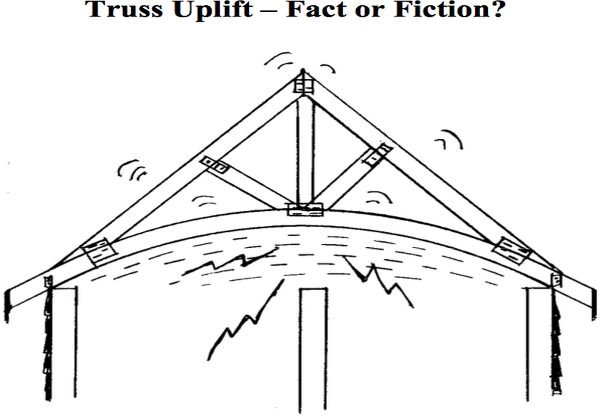
A detachment of the ceiling from the wall is an irritating, but all too common problem. Its principal cause is a natural event called Truss Uplift.

Wikipedia defines truss uplift as an occurrence common in new houses built with roof trusses as opposed to rafters. If a house undergoes truss uplift, the top floor ceilings lift off the interior walls.

Wood is mysterious. When it shrinks, it shrinks more at right angles to the grain, than along the grain. Wood studs in the walls of new homes don’t get shorter; they get thinner in thickness and width.

However, when 2″x4″ studs are connected (butt-ended to each other) in long spans, as in top or bottom chords in conventional roof trusses, they may contract and expand at the rate of 1/2″ to 3/4″ per 40-foot length, depending on its moisture content.

Since the bottom chord has no other direction to move but up, it creates the break at the joints between the wall and the ceiling as it takes drywall with it.

If for some reason, the interior walls are nailed more securely to the truss than the floor, the truss could lift the entire wall. This accounts for gaps you might see at the bottom of your baseboard trim.


Truss-Uplift

Why is it happening?

Most roof trusses consist of a flat horizontal 2″x 4″ dimensional wood member called a bottom chord. The angled portions of the truss are named the top chords.

Field tests show that differential shrinkage between upper and lower members causes the whole truss to bow upward, and if the drywall is attached to the bottom chord too close to the partition, this upwards truss movement will crack the drywall,

The lower chord in your home and many others like yours is probably enclosed with insulation. During the winter, the warmth from the heated ceiling below allows this portion of the truss to stay nice and dry.

Meanwhile, the upper part of the truss is exposed to much moister and air together with the snow load.

Moisture in the attic condenses on the cold top chords, which act like sponges and soak it up to reach an equilibrium with the surrounding air. The idea is that the top chords expand while bottom chords shrink thus causing trusses to arch upward.

[message type=”info”]

Truss uplift cannot be blocked, but its nasty side effects can be controlled by using try the following techniques.

[custom_list style=”list-1″]

  • Float the truss by using brackets with a vertical control slot rather than toe-nailing the truss to the top plate. This will also provide lateral support to the interior wall.
  • Attach clips as a backup for all drywall comer joints involving interior partitions DO NOT reduce the amount of insulation to expose the bottom chord.
  • Ensure that adequate airflow is maintained at the eaves.
  • Float the drywall corners. It is vital that the recommended ceiling float distances of 12 inches and 16 inches (for 1/2″ and 5/8″ drywall respectively) be maintained. For walls, the proper length is 8″ from the ceiling.
  • Careful material handling before construction can also prevent or minimize the truss movement. Arrange for the trusses to be delivered to the site just before they are needed so you don’t have to store them on site. If “on-site” storage is unavoidable, store the trusses upright with bracing or horizontally with adequate blocking.
  • Specify the use of dry lumber. S-Dry graded lumber has a maximum of 19% moisture content and will shrink less.
  • Wherever possible, the truss should span the width rather than the length of the structure. The reason for this is that a shorter truss will not lift as much as a longer one will. If long spans are unavoidable, use mono-pitch trusses. Smaller ones will shrink less.

[/custom_list]

[/message]

How to fix truss uplift:

  • Some people use a crown moulding where the walls meet the ceilings. Molding is fastened to the ceilings but not to the walls. As the ceilings move up, the mouldings move up with them hiding the gap.
  • Some people float the truss by using brackets with a vertical control slot rather than toe-nailing the truss to the top plate.
  • Attach clips as a backup for all drywall comer joints involving interior partitions DO NOT reduce the amount of insulation to expose the bottom chord.
  • Ensure that adequate airflow is maintained at the eaves.
  • Float the drywall corners. It is vital that the recommended ceiling float distances of 12 inches and 16 inches (for 1/2″ and 5/8″ drywall respectively) be maintained. For walls, the proper distance is 8″ from the ceiling.
  • Careful material handling before construction can also prevent or minimize the truss movement. Arrange for the trusses to be delivered to the site just before they are needed so you don’t have to store them on site.
  • If on-site storage is unavoidable, store the trusses upright with bracing or horizontally with adequate blocking.
  • First, specify the use of dry lumber. S-Dry graded lumber has a maximum of 19% moisture content and will shrink less.

More Info: http://www.carsondunlop.com/resources/articles/truss-uplift/

Top 9 Upgrades That Pay Off at Resale

deck-designs13
Upgrades That Pay Off at Resale

If you’re purchasing a home from a new home builder, it’s important to consider which, if any, upgrades you’d like to have installed by your builder.

While it’s important to create the home of your dreams, it’s also important to consider the resale value of you upgrades – in the event you’d like to sell. To help you better understand which upgrades are the best return for retail value; follow these nine upgrades that pay off at resale.

1. Energy Efficiency

When you’re having a home built, it’s easy to overlook the finer details, which can often start within the walls of your home. Taking the time to ensure your home is energy efficient can not only pay off in the event that you sell the home later on; it can offer substantial savings on your utility bills as well.

With energy costs on the rise, it’s important to consider the potential increase in your utilities – while also considering the overall impact the upgrade will have on the resale of your home.

When having your home designed by a new home builder, you’ll have the option to stick with the basic insulation or to purchase an upgrade to spray foam insulation. The spray foam works by expanding between the joists of your walls – offering a more thorough application than fiberglass. This means your house stays warmer in the cold winter months and cooler in the hot, humid days of summer.

2. Granite Countertops

While it was once considered a sign of luxury, granite countertops are becoming a standard feature if custom built homes—with good reason. When you’re deciding on the countertops for the kitchen, many homeowners opt for the cheaper laminate materials, in an attempt to save some money on the purchase price of their home.

By opting for laminate countertops, you might save a few thousand dollars off the initial purchase price (average granite counters sit at $3,500.00) but it’s a decision that may end up costing you more over the long-term.

Over time, the laminate can warp, scratch and chip with repeated use – forcing you to replace them when that happens or when you eventually sell your home. Alternatively, granite is made from stone – producing a solid piece of counter space that is much less likely to scratch or chip.

3. Radiant Floor Heating 

One of the upgrades that pay off at resale is radiant floor heating. Quite a few people have heard of heated floors, especially in the bathrooms – but minimal people realize floor heating is a modern method of heating your entire home. Radiant floor heating works by warming the floor, sending the heat upwards toward the rest of your home – instead of sending the heat out into the air.

While it is a newer method of heating, it’s an energy efficient way that can keep utility costs down. It’s best to install radiant floor heating at the time of home building, making it an innovative product that can increase the value of your home down the road.

4. Whole House Generator

With an increased demand for power, rolling blackouts are becoming more common than ever before. Whether this is due to a winter storm or excessive heat wave – sitting in the dark for days can indeed take a toll. That’s not to mention the impact it can have on your supplies; food, water, quality of life – with the average blackout ranging between 3-7+ days.

Installing a natural gas generator in the home can help your property run power, even during a city-wide blackout. What’s more, opting to install a natural gas generator can improve the value of your home by offering an auxiliary power source.

5. Install an On-Demand Water Heater

Standard water heaters are becoming a thing of the past – especially as more homeowners demand energy efficient properties. That’s why installing an on-demand water heater is increasing in popularity.

Unlike traditional water heaters, on-demand water heaters offer substantial savings on your water and gas utilities. That’s because it only heats the water on a needed basis. That means you’re not going to have water “heating” at 4 am when you’re sound asleep.

6. Upgraded Wiring

The more dependent society becomes, the higher impact our devices will have on our electrical systems. That’s why it’s important to have an optimized electrical panel and wiring throughout your new home. By having a higher circuit throughout the house, you’ll be prepared for the increased demand of technology and offer a higher resale value on your home in the future.

Simply adding extra outlets and ceiling fans to individual rooms can make life much more comfortable without costing a fortune.

7. Grass Irrigation System

Landscaping is one of the key areas that can affect your home’s overall value when you decide to sell. Your front lawn is a central focal point for visitors, family, friends and potential home buyers; needing to be cared for throughout the week. Traditional watering methods can flood your lawn or leave burnt “missed” sections – becoming an eyesore over time.

Having an irrigation system installed can help you maintain your property, without having to sacrifice time and energy. Having an irrigation system can help you improve the overall property appearance and increase the value of the home in the event you want to sell.

8. Gas Line to Deck for Barbecue

Anyone who’s ever barbecued understands the frustration when you run out of fuel half way through cooking your hamburgers. Propane can be a costly fuel for a modest outdoor cook; requiring time and money to maintain. While natural gas does cost money to run, it’s often at a fraction of the price of propane.

You’ll never run out of natural gas while you’re cooking, and it’s a significant improvement to the outdoor living space. Many potential buyers look for added perks like natural gas lines when buying a home – which can help you increase the overall resale value.

9. Overall Kitchen Upgrades

In a room you use every day, it’s important that space is functional and practical. Cabinets are expensive to replace later. Installing high-quality cabinets will improve durability and appeal throughout the years – while continuing to help the resale value of your home when you decide to sell.

Look for key features like soft-close doors, high-quality handles and products that hold an overall cosmetic appeal, as well as both deepening and lengthening cabinets to ceiling height for a sleek, custom look and extra storage.

energy-efficient-upgrades

Closed Cell vs Open Cell Spray Foam Insulation

Closed Cell vs Open Cell Foam Insulation

Closed Cell vs Open Cell Spray Foam Insulation

Closed Cell vs Open Cell Foam Insulation

Before we can go into that we need to start by saying that in the foam insulation industry there are usually two types of foam insulation being used, open-cell and closed-cell.

There are several major differences between the two types, leading to advantages and disadvantages for both, depending on the desired application requirements.

In addition, polyurethane spray foam is an extremely versatile material that is available in a variety of final physical properties and densities, so it is necessary for the end-user to have an understanding of these differences, and to choose the spray foam system that is best suited for the particular application requirements.

Both types of foam are commonly used in most building applications. Some are inappropriate in specific applications. For example, you typically would not use open-cell foam below grade where it could absorb water; this would negate its thermal performance because water is a poor insulator compared to air.

Closed-cell foam would be a good choice where small framing sizes need the greatest R-value per inch possible. Basically, the choice depends on the conditions of each installation. We routinely select from a wide variety of foam systems with varying characteristics, depending on the particular requirements of our clients’ projects.

house-tool-belt

Closed Cell Insulation

Closed-cell polyurethane spray foam is among the most efficient insulating materials commercially available, with Aged R-values commonly around 6.7 per inch and LTTR values between 5.2 – 5.6.

Closed-cell foam incorporates an insulating gas that is retained within the cells (foam “blowing agent”), which leads to the highly efficient insulating properties of the material. In the U.S., insulation is measured in “R-Value” (R= resistance to heat flow), in Canada now, it is measured in LTTR (Long Term Thermal Resistance) and closed-cell polyurethane spray foam has among the highest R-Values of any commercially available insulation.

In addition, the closed-cell nature of this foam provides for a highly effective air barrier, low moisture vapour permeability (often referred to as the “Perm” rating), and excellent resistance to water. The most common foam density for closed-cell polyurethane foam is approximately 2.0 pounds per cubic feet.

Years of research and commercial experience has shown that the 1.9 – 2.5 lb./ft3 density range provides the optimum insulating and strength characteristics for most building applications. Closed-cell polyurethane foams are usually characterized by their rigidity and strength, in addition to the high R-Value. Also, studies show that wall racking strength can by doubled or tripled when closed cell foam is applied.

Clip Art Graphic of a Yellow Residential House Cartoon Character

Open Cell Insulation

Open-cell polyurethane spray foam, on the other hand, is usually found in densities ranging from 0.4 to 1.2 lbs./ft3. One of the advantages that these lower densities provide is a more economical yield, since foam density is directly related to yield (lower density = higher yield). Although the R-value of open-cell foams is slightly more than half that of closed-cell foams, usually around 3.5 per inch, these products can still provide excellent thermal insulating and air barrier properties.

Open cell foam is more permeable to moisture vapour, with perm ratings of approximately 10.0 per 4 – 5 inches thickness (up to 50 perms at one inch). However, the foam allows for a very controlled diffusion of moisture vapour whose consistency can be managed by the builder/architect.

Open cell foams are incredibly effective as a sound barrier, having about twice the sound resistance in normal frequency ranges as closed-cell foam. Other characteristics of open-cell polyurethane foam usually include a softer, “spongier” appearance, as well as lower strength and rigidity than closed-cell foams.

Applications that typically use open-cell foam include residential construction insulation and for sound deadening in media rooms, etc. Closed-cell foam, while also useful in residential construction insulation, is used in a variety of commercial, industrial and residential applications because of the excellent strength and insulating properties described here.

spray foam insulation

All You Ever Wanted To Know about Spray Foam Insulation

Trained applicator applying spray polyurethane foam insulation in wall cavities.

With the increasing cost of energy and a focal point on health and green environmental issues, builders, architects, and other building professionals are recommending insulation materials to add exceptional performance value to construction projects.

Spray foam insulation is still one of the best ways to significantly reduce energy costs not only in new buildings but also when renovating an older home.

What Is Spray Foam Insulation?

Modern spray foam insulation is a two-part mixture composed of isocyanate and polyol resin. These two chemicals come together at the tip of a gun to create polyurethane foam that expands and solidifies in place. It insulates and seals gaps and could be used as vapour and moisture barriers. 

It sticks to concrete, wood, and other surfaces and is sprayed into wall cavities, crawl spaces, onto roof tiles, under basement slabs, around footings, and even around heating equipment.

It is used in new construction as well as for remodeling jobs, where there are existing walls with drywall already in place.

Spray foam insulation can be grouped into two different types: open cell and closed cell.

house-tool-belt

Open-cell spray foam insulation

In open-cell foam, the blowing agent gas is not trapped by the forming cells that are not completely closed but are broken, and the small spaces within the foam are filled with air. Open-cell foams typically weigh in at 0.4 to 0.5 lb./cu. ft. and it is not recommended for outdoor applications.

Open cell is an excellent air barrier but does not provide any water vapour barrier. It is often used for interior walls because it provides sound reduction.

The advantages of open-cell foam include cost-effectiveness and its ability to be applied at any thickness in one single pass.

Closed-cell spray foam insulation

Closed-cell foam incorporates an insulating gas (blowing agent) that is retained within the walls of the cells, which leads to the highly efficient insulating properties of the material. It has a smaller, more compact cell structure with perhaps the highest R-Value per inch available on the market.

Closed-cell foam insulation is much denser than the open cell and ranges in density from 1.7 lb./cu. ft. to 2.0 lb./cu. ft. and is a superb air barrier as well as a water vapour barrier.

Spray Foam R-Value

R-value is the term given to thermal resistance to heat flow. The higher the R-value of an insulation product, the more effective the insulation properties.

For example, blown fiberglass typically has an R-Value of only R-2 to R-3 per inch, depending on compression, density, and moisture.

Today’s spray foam insulation (closed cell) most important attribute is a claimed R-value of 6.0 -7.0 per inch, enabling it to provide more thermal resistance with less material than any other type of commercial insulation material. 

R-value is an important metric for insulation, but it’s not everything. The added benefit, the ability to air seal creating a custom airtight envelope within the building structure is also a significant factor in opting for insulating with spray foam.

Cost Of Spray Foam Insulation

Let’s get down to what everyone wants to know. How much does spray foam insulation cost?

Clip Art Graphic of a Yellow Residential House Cartoon Character

Spray foam insulation cost depends on its type and the amount of the applied spray foam. Also, there is a significant difference in cost when it comes to using spray foam insulation to a new or existing home.

In general, figure the cost of spray foam at 3-5X more than the cost of fibreglass insulation. If everything is cleaned up and ready for the foam, it costs $1.00 to $1.40 per board foot for closed-cell and $0.70 to $1.00 for open-cell foam. A board foot is a volume measure that equals 1ft x 1ft x 1 inch.

The total cost of an insulation project will vary, according to labor charges, the volume of foam layers required, wall thickness, and location. You will need a quote to see what your area rates are.

For a quote in Southern Ontario, you can contact us at 705 533-1633.

Disadvantages

Not all green – Well-insulated homes are eco-friendly, but the insulation itself isn’t. Polyurethane spray foam products may contain soy, vegetable oil or recycled bottles, but they are primarily made of oil or petroleum.

A CBC Marketplace investigation has found that when installed incorrectly, spray foam insulation can result in a strong, unpleasant fishy smell from off-gassing that has driven some people from their homes, some complaining of difficulty breathing and other health problems.

In Ontario, a contractor must be trained, licensed and certified in order to install certain kinds of spray foam insulation.

  • The product’s durability, one of its advantages over other types of insulation, can make it difficult to remove if it has been installed incorrectly.
  • Since UV light degrades the foam, it always needs to be covered.
  • The cost is high compared to fibreglass batts and cellulose
  • If it catches fire, it releases toxic fumes, which can be harmful.
  • Hydrochlorofluorocarbons are used as blowing agents, which is detrimental to the environment.

Mike Holmes Link

Spray Foam Project Estimator and Cost Calculator

The following video describes the process:


ICF Construction

ICF Foundation Cost

ICF Foundation Cost
ICF Foundation Cost? There is no way you can do this with poured concrete walls.

One of the first questions asked when planning a home is “How much will my project cost?” Questions involving pricing, can’t be properly answered simply by information posted on the internet, regardless of how much information is supplied in one article. Same goes for the insulated concrete form (ICF) foundation cost.

[udesign_icon_font name=”fa fa-share” color=”#dd3333″ size=”1.5em”]How Much Does It Cost to Build The Whole Home With Insulated Concrete Forms discussed here!

So, how much does ICF Foundation Cost?

ICF is a premium building system and does cost considerably more than stick construction when costs are compared for above the ground structure. From a foundation cost point of view, it’ll still be cheaper just to pour concrete, but from an insulated foundation perspective the costs are very comparable. Furthermore, for the foundation portion you will find many contractors who say an ICF foundation is less costly than any other conventional poured concrete foundation system.

To dive a little deeper into the subject, we would have to compare apples to apples. In other words, we would have to compare ICF foundation cost and the cost of poured concrete foundation with two sheets of R-12 styrofoam insulation on both sides. Even to someone that is not a building expert, it should be clear that it is much cheaper to build a foundation with ICFs.

On the other hand, if the comparison is ICF foundation and poured basement, a poured concrete wall will cost you approximately $7-$10 per sqft. To finish it, for studs, framing, insulation and vapour barrier you will spend another $5-$7 per square foot.

For the ICFs; concrete, rebar, all the labor to stack, place the rebar, pour the concrete, etc., you are looking at $11 – $18 per square foot of wall space, including windows.  Most likely it will be somewhere in the middle $14-$15 per square foot unless you have curved walls, enormous openings or many angles to the house.

So, you end up spending as much money with a strip form wall as with ICF wall. Concrete block foundation wall construction would be in the same ballpark.

Other advantages of ICF foundation are:

[udesign_icon_font name=”fa fa-arrow-right”] Speed of construction: On projects where time is money one step concrete pouring, framing, insulation and vapour barrier.

[udesign_icon_font name=”fa fa-arrow-right”] Adverse weather conditions construction: You can pour in minus degree weather as concrete cures between two pieces of insulation.

[udesign_icon_font name=”fa fa-arrow-right”] Do it yourself friendly construction: To save money on installation costs, many people undertake to build their foundation themselves.

You should know that ICF’s are not meant for basement construction. They perform the best in super energy efficient, complete ICF house or as basements to SIP and log home construction. But if you are going to finish your basement it is a no-brainer to use ICFs.

The following factors will influence ICF foundation cost:

  • The price of ICF forms – manufacturer, size, supply, shipping, and unloading on site.
  • The price of concrete – supply of and pumping.
  • The price of steel rebar – supply and bending.
  • The Price of window and door buck material- supply and install.
  • The Price of buying or renting bracing and scaffolding –
  • The price of miscellaneous materials: screws, nails, straps, foam, etc.
  • The cost of labour – includes putting up the ICF forms, providing and setting up the bracing, installing bucks, rebar, and any inserts and cleaning up the site.

Adding insulation to your home’s building envelope can be one of the most cost-efficient ways to reduce your heating and cooling bills.

In new construction, investing in the insulation is a smart way to reduce future maintenance costs by reducing the home’s energy consumption. However, because no two buildings are the same, and because there are so many ways to insulate, it can often be confusing to determine what’s best for a particular project.


Ice Damming

The Worst Year For Ice Damming – Now What?

Ice Damming
Ice Damming

Ice and icicles on your roof may be cute, but they can tear off gutters, loosen shingles, and cause water to back up into your house.

As snow continues to pile up on people’s roofs this winter, homeowners are up against more than cold morning commutes. The snow buildup, combined with ice weight, is causing damage, leaks, and the threat of roof collapses.

Though a collapse tends to be the first thing that comes to a homeowner’s mind, they are rare, The real worry is ice dams.

Although sometimes thought of as a problem with roofing or attic ventilation, ice dams are caused by the presence of warm air in the attic, combined with snow on the roof and the right weather conditions.

When heat leaks into the attic, it melts the underside of the snow on the roof, which then flows down the roof surface until it reaches a cold spot (such as the eaves or soffit) where it forms a frozen dam. The ice build-up can back up under the shingles, damaging them and allowing water to leak through the ceilings and walls below.

Clip Art Graphic of a Yellow Residential House Cartoon Character

Shingle roofs are not designed to be waterproof; they’re designed to shed water. Once water has accumulated and had nowhere to go, it finds a way to the home through nail penetrations and behind flashings.

As the weather warms, ice builds up as the warm attic continues to melt snow. As more snow melts due to the warm attic, the water moves toward the gutter and encounters the dam. The ice dam backs the water back up into the house, and the damage begins.

Factors contributing to ice damming:

Anywhere there is
a penetration into the attic space (around wires, plumbing vents, light fixtures, chimneys, knee walls) there is the potential for air leaks. Even homes that are only a few years old may not be adequately sealed. To avoid these types of problems and eliminate most ice dams, attic air leaks must be sealed with caulking or expanding spray foam.

Inadequate insulation, especially near the eaves, is also a contributing cause of ice dams.

Solutions:

Sealing attic air leaks saves energy and is essential to preventing ice dams.

An energy audit with an infrared scan can pinpoint trouble spots.

If snow and ice must be removed, hiring licensed roofing contractors that use steamers is strongly recommended.

What NOT to do:

Installing heating cables will shorten the life of your roof and cost you money to operate.

Removing ice with shovels, chippers, chemicals, or heat can damage shingles, gutters, and other building components—and can be dangerous.

Adding roof vents—including powered vents—will not eliminate ice dams, and often makes the problems worse.

Additional insulation—especially on the top plate of exterior walls—can reduce heat transfer to the roof deck, but insulation alone is insufficient. Typical attic insulation will not stop air leaks or prevent ice dams.

What to do if you already have an ice dam

Ice dams themselves aren’t necessarily a problem. It’s the leaks that do the bulk of the damage. If you can’t detect signs of leakage, either in the soffits on the outside or in the attic or ceilings, you may not have to do anything. Then during warmer weather, apply the prevention strategies we listed earlier.

What to do in an emergency:

If you have leakage from an ice dam and can’t rake the snow off the roof, the best way to get rid of the ice dam is to hire a roofing company to steam it off.

A steamer is like a pressure washer, except that the water is hot. It melts the ice away without damaging the roofing. Chipping the ice off with a hatchet or an ice pick can break or puncture the shingles.

In an emergency situation where water is flowing into through the house structure, making channels through the ice dam allows the water behind the dam to drain off the roof. Hosing with tap water on a warm day will do this job. Work upward from the lower edge of the dam. The channel will become ineffective within days and is only a temporary solution to ice dam damage

straw-bale-house-walls

Straw-Bale Home Construction

straw-bale-house-walls
Straw-Bale House Walls

Straw-bale home construction is a building method that uses bales of straw (commonly: wheat, rice, rye, and oats straw) as structural elements, building insulation, or both.

The first straw-bale structures we know of were built about a hundred years ago by European settlers in the Sand Hills of Nebraska. Having little other means to shelter themselves, they were driven by necessity to improvise.

Using the newly invented steam and horse-powered balers, they baled the grasses that surrounded them, stacked the bales to form walls, and applied mud or cement plasters inside and out.

Some of those homes still exist and are in good shape, as are a few more that were built in Nebraska and Wyoming over the subsequent decades. A revival in straw-bale construction began in Ontario in the 1970s and has now spread all over the world.

What is the straw?

Straw is the plant structure between the root crown and the grain head (hay includes the grain) and is composed of cellulose, hemi-cellulose, lignin and silica. Bales are masses of straw compressed into rectangular blocks that are bound with steel wire or polypropylene twine. (Some bales are enormous wheel or block shapes compressed by larger machines, useful for large-scale agriculture but not for building.)

Bales might be two-string or three-string, of any grain (typically, in North America, wheat, rice, oats, hops, barley or rye), and are not homogeneous; that is, they have some “grain”— different qualities in different directions—based on how the baler works.

The narrow end faces receive the compression of the baler head, which thrusts straw masses in “pulses” into the chamber. These pulses, when compressed, become flakes of about 4 inches (102 mm) in thickness.

Straw Bale Construction Plastering
Straw-Bale Construction Plastering

Thus, a typical bale consists of a series of 4-inch (102 mm) flakes compressed along the long axis.

Because the baler is operating continuously with a series of slightly varying pulses of straw mass, and because it will only cut and tie off a bale at the end of a flake, the bale length will vary by a few inches.

Discussing technical aspects:

The different types of grain straw have varying chemical compositions and inherent strengths, rice straw being perhaps the toughest due to an unusually high silica content. However, the micro properties of straw appear to be far less important than the macro properties of straw bales.

Experience, and some laboratory testing, strongly suggests that moisture content, density and history (the history of bale storage and protection from harvest to construction) are the primary determinants of bale quality.

Moisture content will depend on the circumstances at the time of baling and during subsequent storage and transport; quality control and inspection of a straw-bale job requires the use of a bale moisture meter, available from farm supply houses.

Bale density will vary depending on the type of grain, moisture levels and the degree of compression provided by the baler, but should be at least 7 pounds per cubic foot if intended for use as a load-bearing element.

The size of the bales varies with local custom and prevalent balers, although 23 inches by 46 inches by 16 inches (584 mm by 1168 mm by 406 mm) is more or less standard for three-string bales (two-string bales are much smaller).

Until construction standards are established for straw bales, prudent design and inspection must allow for the actual qualities of the particular bales selected for the given project.

As a practical matter, specifications must be phrased as performance criteria, such as maximum allowable moisture content at the time of erection and minimum density.

History, if not well known, can be checked by visual inspection and smell; it is usually obvious (if not quantifiable) when bales have been left out in the rain.

Straw Bale Finished House
Straw-Bale Finished House

Architecture

There are two basic styles of straw-bale construction.

1.) A load-bearing, also sometimes called Nebraska style, denotes structure in which the weight of roofs and floors above the ground are supported, partly or entirely, by the bales. (The first straw-bale houses were load-bearing, built with nothing but common sense as a guide.)

2.) Post-and-beam straw bale denotes construction in which no weight of roofs or floors above the ground is supported by the bales. Rather, bales are used as infill panels between or around a structural frame, which can be wood, steel, concrete or masonry. This type of construction has become predominant as builders often find it more adaptable and more readily acceptable to building officials, lenders, and insurers.

Despite the obvious differences between these two basic types of structures, there are many qualities common to all straw-bale buildings. Virtually all are plastered straw bale, where “plastered” is used generically to include traditional mud-based plasters, lime and gypsum plasters, shotcrete or gunite (concrete pneumatically shot from a nozzle), cement stucco, and various combinations.

In thinking of plastered straw-bale walls, it is essential to understand that, once plaster is applied directly to either one or both bale surfaces, the structure is now a hybrid of straw and plaster. Effectively, any further loading—snow, people, the wind, earthquakes, etc.—will go mostly or entirely into the plaster skins.

Clip Art Graphic of a Yellow Residential House Cartoon Character

This is because of the relative stiffness, or the relative moduli of elasticity of the two disparate materials. Any plaster is far stiffer than the straw, and will therefore “attract” any subsequent loading, much as a sharp stone in the sand will “attract” the weight on your foot.

When a wet snow or earthquake loads a plastered straw-bale structure, the soft, flexible straw yields, and the brittle plaster “skin” attracts all the stresses.

Unlike in a pure concrete structure, however, where such a failure of a bearing (or shear) concrete wall or column could be both sudden and catastrophic, the failure of the plaster skin would throw any loads back on the straw-bale assembly.

The capacity of the bales to pick up the load yielded by cracked plaster is fairly substantial. Tests conducted in various laboratories over the past ten years have proven that an unplastered wall can carry an appreciable amount of vertical load, as well as some In-plane and out-of-plane shear, and would, therefore, provide a backup against a failure of the plaster skins.

Furthermore, recent tests in Washington and California have revealed the surprising strength, ductility and toughness of plastered walls, even when cracked and subjected to cyclic loading. We are finding that the bale walls when plastered on both sides, behave much more like an integral sandwich panel structure than might be expected.

Sandwich Panel Behavior

The structural model is complex: Rigid inside and outside skins are attached to the comparatively soft straw-bale “masonry” assembly. The skin material can be known, but the thickness will vary appreciably as it fills in the gaps and notches. Most important to the whole package, there is both some shear capacity in the bales and some shear transfer capacity between the bale surfaces and the skins. Though it is essential to see the plaster skins as the primary load-carrying elements, it is nevertheless also important to recognize that the straw bales are still crucial elements of the package. This is analogous to the relationship of the web to flanges in a steel I-beam: The flanges (skins) carry bending loads, but rely on the shear capacity of, and connection to, the web (in this case, the straw-bale assembly). So the assembly consists of strong, brittle, thin “concrete walls” braced by, and somewhat elastically connected by, the straw-bale core.

50 straw-baile-house-plans

There is now enough accumulated testing and anecdotal evidence to make reasonable predictions about the behavior of plastered straw-bale walls under various load conditions. Using data from the Albuquerque out-of-plane tests on plastered and unplastered walls, it would seem that a plastered straw-bale wall is 20 times stiffer than its unplastered counterpart, but still about 600 times less stiff than a true sandwich panel. (Space limitations here preclude a more in-depth analysis, but the data supporting these conclusions, as well as some test result summaries, can be found in Buildings of Earth and Straw by this author.) As more tests are done to investigate straw-bale wall behavior, some usable approximation of wall moment of inertia, such as 1/600 of the wall “pure” sandwich panel moment of inertia, should become apparent.

It should be clear that plaster coatings should always be worked directly into the straw. All testing and experience to date has shown a huge increase of strength from an unplastered to a plastered wall assembly when the plaster skins are bonded to the straw substrate. In areas of heavy snow, temperature extremes or seismic risk, making use of the integrated system also requires reinforcing for the plaster skin, which has no (useful) tensile strength.

That reinforcing can usually be a conventional hexagonal 17 gage stucco mesh, but for particularly heavy loading, may need to be some form of welded wire mesh with a comparatively tight weave such as 2 inches by 2 inches (51 mm by 51 mm) with 14 gage wire. Design and detailing of edge conditions may also be necessary at any boundary considered to transmit loads. Since the bond provided by working the plaster into the straw is more than adequate to hold the plaster in place under load, many, including this author, believe that mesh reinforcing need only be attached well enough to stay in place during plastering. Weaving, stapling or tying stucco netting to or through the bale wall is labor-intensive and of highly uncertain value.

Post-and-beam Straw Bale Home Construction

The structural frame for an infill bale wall can be anything the local codes allow, with detailing as appropriate. Analysis for vertical and lateral loads is conventional, and the bales must simply be supported for their self-weight and out-of-plane loads. With conventionally proportioned buildings, the plastered sandwich panel behavior is more than adequate to resist out-of-plane loads even in Seismic Zone 4, though care must be taken to secure edges and transmit loads to the frame surround.

One advantage of infill straw-bale construction is the introduced option of stacking the bales on edge, thereby reducing wall thickness. Tests have shown that bales on the side have a little load-bearing capacity but have a higher R-value per inch, so the net thermal insulation of an edge-stacked wall is about the same as a flat-stacked wall.

Builders report that plastering is made more difficult because the straw is presented across the face of the exposed wall, as opposed to the end grain exposed in a flat-stacked wall. Notching the straw for conduit is also made problematic because the strings are left exposed when bales are stacked on edge.

house-tool-belt

Load-bearing Straw Bale

A typical foundation detail for a load-bearing straw-bale house on a concrete slab on grade. Bales will sit on treated wood sill plates bolted to the foundation, with pea gravel in between as a capillary break.

All the bales were stacked, and the roof-bearing assemblies were in place and being strapped down by lunch time on the day of the wall-raising for this load-bearing straw-bale house built by the Town of Guadalupe, Arizona.

By midafternoon, all the trusses were in place. By the end of the day of the wall raising, the roof was sheathed and ready to be dried in.

The finished house in Guadalupe, with a typical three-coat stucco finish. It cost less than $50,000 and is a very energy-efficient, 1,120-square-foot (104 m2), three-bedroom dwelling.

Straw_Bale_Library
Straw-Bale Library

In-plane earthquake and wind loads can be carried by the plaster skins, as discussed above. Wind forces have yet to cause any problems in straw-bale projects to date. For example, the Real Goods Solar Living Center in Hopland, California, was struck in December of 1995 with a record windstorm that wreaked havoc up and down California.

That building, was particularly vulnerable at that time, for there was no glazing on the huge south walls facing into the storm winds, and the building’s shell shape collected and focused winds onto the north bale walls (coated with a thin gunite substrate and an earth plaster finish coat), which were completely undamaged and uncracked.

In another case, load-bearing straw-bale walls in Pensacola, Florida, easily survived a powerful hurricane—before they had been plastered. In short, the empirical evidence to date tells us that straw-bale walls of conventional dimensions are not appreciably affected by high winds.

Bracing typically consists of light gage metal straps, steel plate or slender all-thread bolts set diagonally across the surface of the bale wall and protected by the plaster. The diagonals must be designed for calculated forces and adequately fastened to the top plate and foundation. However, because even lightly reinforced cement stucco on straw-bale walls has surprising strength, ductility, and toughness, and as further testing is conducted, reliance on the reinforced plaster/sandwich panel behavior will likely increase in engineering designs.

American Society for Testing and Materials fire tests have been conducted on plastered straw-bale wall assemblies in Albuquerque and California, each of which showed enormous resistance to flame spread and temperature rise.

This is apparent because the bales are typically too dense (lacking in oxygen) to support combustion, and even when unplastered will tend to char on the outside as does a heavy timber beam.

Plastered straw bale structures have survived wildfires where wood buildings burned to the ground and steel melted. Based on this type of field experience and the tests, bale structures have been considered to be at least one-hour fire assemblies (if not better). [Recently, the California Energy Commission assigned an R-value of 30 to a 23-inch (584 mm) plastered straw-bale wall construction based on a state-of-the-art test at Oak Ridge National Laboratory.]

Effectively, fire is not of great concern for the completed structure, but it is of enormous concern during construction. While the walls are going up, a lot of cutting, notching, and reshaping of the bales will invariably leave the site covered with loose straw, which is highly flammable. Common sense dictates that the site is swept clean regularly in this phase, that fire extinguishers or hoses be readily available, and that any welding, cutting, brazing, etc., be done with extreme care. If the design has bales on an edge (with the ties exposed), then the walls are vulnerable to fire until the plaster is applied.

Moisture

Water penetration, as with any other type of construction, is a potential problem. Straw left in a moist, aerobic environment [generally, above 20 percent moisture content and 50°F (10°C)] will support the growth of molds, which leads to decay of the straw. Even for a post-and-beam structure, this can be a problem, as degradation of the straw leaves the plaster unsupported and can release mold spores into the air that may be hazardous to health. For these reasons, moisture issues receive particular attention from straw-bale designers and researchers.

The overwhelming experience with straw-bale buildings is that moisture vapor intrusion is not a problem if the wall can “breathe”; that is if both surfaces are vapor permeable. There have certainly been leaks and degradation failures, but without exception they have been due to outright moisture intrusion, not vapor intrusion.

Although moisture considerations are related to the climate—arid regions will tend to pull moisture out of any wall package, whereas warm or cold humidity presents specific vapor problems—moisture control must largely focus on preventing leaks. In short, and to perhaps oversimplify, it seems that water vapor should be allowed to move in and out of the wall assembly while extra care must be taken to keep liquid water out.

Tops of bale walls, exposed horizontal surfaces (that is, windowsills), and joints with wood frames must be carefully sealed and designed to shed water.

As with fire, the structure is especially vulnerable during construction, as bales and walls can be wetted by rains, appear to dry out, and then develop problems after the wall is completed. Extra effort must be made to store and protect the bales all the way from the field of origin to the completed building.

This leads to the most important, unusual (and seemingly counterintuitive) feature of accepted straw-bale construction: No moisture or vapor barriers should be used except possibly for the first few courses on the outside, window sills and tops of walls to provide protection during construction and backup against a roof leak.

Building permit reviews have commonly generated the requirement to cover the bales with a barrier such as Tyvek or Grade D paper (as is done over studwall sheathing, though the evidence is emerging that even here moisture barriers can trap moisture where it can cause harm), and the argument has been waged many times in many jurisdictions over this subject.

However, experience with straw-bale walls overwhelmingly shows that no barrier should separate the plaster and straw because the straw needs to breathe (transmit water vapor), moisture must not be trapped against the straw/plaster interface, and the structural system depends on a thorough bonding of plaster into the straw.

The bottom of the bale wall must be well separated from the foundation; at the very least, a waterproof barrier should be laid over a supporting concrete surface to halt any wicking moisture from below. Additionally, many builders are laying a 1-inch (25.4 mm) layer of pea gravel between 2-by-4 plates along the inside and outside faces, thereby ensuring that the bales will never be sitting in water.

Pinning

Though they are stacked like masonry, straw bales are comparatively soft and do not behave like bricks. Except where surrounded by a sturdy frame of posts and beams, the bales must be braced or pinned during stacking for stability and alignment.

Internal pinning of the walls (with rebar dowels) has been prescribed in straw-bale codes to date, but is an area of some controversy, for it is not known how much contribution internal pins make to the strength of the finished wall assembly. (Most testing to date has been on pinned walls.) Field reports strongly suggest that exterior pinning (paired rebar or bamboo dowels against the bale surfaces that are tightly connected through the wall with heavy wire) is easier to build and apparently stronger, but much testing is still needed on the subject.

Precompression

A big consideration, also a somewhat unexplored field of study, is the long-term creep deflection of the bale wall. Straw builders have found that an 8-foot (2438 mm) wall can lose ½ to 4 inches (12.7 to 102 mm) of height in a few weeks from its weight and added roof weight. Builders have found, though, that these deflections are drastically reduced if bales are emphatically stomped into place both downward and against adjacent bales.

Knowing that any appreciable settling of the straw will induce unwanted stresses, and possibly cracks, in the rigid plaster skins that are already in place, builders have historically let the loaded walls settle as long as possible before applying plaster.

More recently, however, rather than waiting for the roof weight to compress the bales, some builders have been precompressing the walls mechanically. In earlier buildings, this was accomplished with all-thread rods every 6 feet (1829 mm) or so beside or through the bales, connecting top plates to the foundation and tightened with nuts at the top. Unfortunately, some precompressed walls were found, a year later, to have settled further beneath compression nuts, while others are (so far) performing well.

Others have introduced the use of elastic polyester package strapping or heavy gage (fencing) wire wrapped over the wall and down through the footing, in both cases cinching down the bale assembly to the foundation at close intervals, such as 2 feet (610 mm) on center. In a more elaborate system developed in Canada, stucco mesh sheets on both faces of the bale wall are grabbed from the top with oak bars, tightened upward with car jacks or inflatable bags (which push down on the top plate, compressing the straw) and secured in a taut condition.

All these systems show more promise than the all-thread systems because the tighter spacing allows for some leveling of the wall top by adjusting relative tensions, and because their elasticity (springlike behavior) permits them to maintain some compression on the wall even if it settles. Elastic precompression may also supplant internal pinning, as the compressed bale assembly has superior strength to ordinary (pinned) walls. However, the long-term ability of chicken wire mesh, heavy gage wire or polyester strapping to maintain high tension, as well as their use in this type of construction application, is untested. Anecdotal reports to date are highly positive, but the use of these tensioning systems should be controlled and conservative until there is more of a track record and laboratory testing to verify long-term behavior.

The foundation must keep the bales well above grade, and the roof should provide a wide overhang—the proverbial “good hat and a good pair of shoes.” Roofs are conventional, connecting to the walls via some manner of top plate or bond beam (most commonly a plywood and “two-by” assembly, though many top plate assemblies have been tried).

The top plate serves like the double top plate in a studwall—as a bearing surface, as a tie beam under lateral loading, and as a fastening point for plaster reinforcing. Windows and doors are typically framed wood bucks that either sit on the foundation or “float” in the bale wall and require expanded metal lath strips over paper or bituthene to reinforce the plaster tightly at straw/wood joints. Cabinetry and fixtures are screwed to wooden stakes pounded into the straw, and conduit can be let into grooves carved by chainsaw or “weed wacker” into the straw surface.

SUMMARY

Over the past ten years or so—the dawn of the straw-bale revival—a growing number of people has been building and experimenting with straw bales as construction materials. There now exists a body of testing and anecdotal knowledge about straw-bale structures that, while modest and inexact, gives us some basis for understanding how these buildings work.

No-load-bearing bale structures are relatively straightforward, and structural design of the bales simply involves allowing for self-weight and the lateral pressure on bale panels induced by wind or earthquake. Load-bearing straw-bale buildings in high snow or earthquake areas can tentatively be designed using cement stucco skins (detailed and built for a clear load path from roof to the foundation) to carry live loads.

Backup (or alternate primary) lateral force systems, such as diagonal bracing, must be built into all but the most simple buildings in Seismic Zones 3 and 4. Plastered bale buildings never threatened by heavy snow or earthquake are far less problematic, and a wider, less restrictive range of plasters, foundations, and architectural shapes can be perfectly satisfactory. All straw-bale structures need particular attention to moisture detailing, to fire control during construction and to bale quality.

It is worth noting and emphasizing that there exist many load-bearing straw-bale homes in Nebraska and Wyoming that have peacefully endured almost a century of snowstorms, high winds, temperature extremes and human occupancy without ever having had the backup of rebar pins, precompressing, engineered foundations and other features that have been deemed crucial.

Those houses are out there, uncracked, unrotted, unburnt, possibly as much a testament to the value of common sense in construction and maintenance as to the strength of straw-bale construction. As a methodology for engineered design and building code regulation of plastered straw-bale buildings evolves over the years to come (along with the continued evolution of straw-bale building technology itself), it should continually reflect back on its basis in these impressive examples.


For more of straw-bale house click on video bellow.

R-value-home-energy-loss

Insulation R-Value? – Don’t Forget About Air-Sealing

When we talk about energy efficient building, everyone wants to know about the R-value.

R-value-home-energy-loss

“R-value” (that’s the inverse of the BTUs of heat transferred per hour per across a square foot of surface area per difference in temperature, in degrees Fahrenheit, on either side of the surface, for your science-types) is a measure of how well an insulating material slows the eventual loss of heat through the exterior surfaces of a building.

It is a fundamental law of thermodynamics that all of the heat that we contribute precious fossil fuels to put into a building will eventually leave it, for the same reason a cup of hot coffee left on a table at room temperature will eventually cool off. But, if a building is built with materials that have higher R-values, it will lose that heat more slowly—like putting that coffee in an insulating thermos. To reduce the energy use in buildings, most states in the US (but not all) have minimum building code requirements for how much R-value each portion of a building should have. Green building practices often aim to exceed well those code requirements.

R-value is well and good—but it’s not the whole story, nor even the most important part of the story. Heat transfer comes in multiple forms, and one of the most important strategies for energy efficiency construction comes from paying attention to an entirely different method of heat loss, far too often overlooked in the construction industry.

That’s the heat you lose when the heated air itself migrates outside, through all of the myriad cracks and holes within a building that allow it to escape.

And most buildings, even new ones, are full of holes for air to leak through.

Before—or at least in conjunction with—worrying about the R-value, in green and energy efficient construction we should be quite concerned about a building’s airtightness, as well.

There are two principles of physics that are paramount here:

1. Every unit of air leaking out of a building is replaced by a unit of air coming into that building from somewhere else.

Losing that heated (or cooled) air is bad enough. But what goes out must come in, if this did not happen, the building would be a vacuum. (And if your house were a vacuum, you’d have other, more pressing problems than energy efficiency.) This leads to the second principle:

2. The make-up air coming in will be from the outside, having the same temperature and humidity as outside air.

The systems in your house whose job it is to condition the air – to make it the right temperature and humidity – work by sensing the temperature and humidity of the air in the house. They will turn on whenever there is a large enough presence of air that is not the right temperature or humidity. More air leaking in that needs to be conditioned means more work for those systems, means more energy consumed by those systems to bring your house back to the right temperature again.

How Do We Make a Building More Air-Tight?

By sealing it!  Numerous goops and sealants are out there; available at home improvement stores and waiting for intrepid homeowners to paint, glop, or spray into the cracks and holes in their walls, their attics, their floors. Insulation products such as spray foam insulation are often recommended for new green buildings; because spray foam insulation sticks to the surfaces, it is applied to and seals them. (All other insulation products allow air to pass through them.)  However, you don’t have to use spray foam insulation to make your building air-tight, and simply spray foaming a building is a guarantee of exceptional performance.

With new home construction, green building certification programs certainly recognize the importance of air-sealing. Many have a specific list of common places for air leaks that must be sealed; many even require that the house is tested for air-tightness. Which is a good thing, too, because while any homeowner can find cracks and holes to seal within their attic, some of the holes in a building can only be (easily) sealed while the house is being built before insulation and drywall bury them into obscurity.  If you are building a new home, it can’t hurt to follow the Energy Star for homes Thermal Enclosure Checklist.

A final note is on that vacuum problem I mentioned earlier. Luckily, no matter how methodologically we apply our caulk guns and spray foam nozzles to air-sealing, it would be impossible to turn your house into a vacuum; a building is too complicated and has too many joints and seams. However, it is possible to make a building so air-tight that the air inside becomes stale and polluted.

The solution to this problem is to mechanically bring in fresh air ventilation—taking the uncontrolled situation of air leaking into and out of a building at random and turning it into a precisely controlled situation. We’ll talk more about that in a later post.

In summary, buildings lose heat through multiple mechanisms. Boosting your R-value tackles conduction only while adding air-sealing starts to look at the heat loss associated with moving air. Both of these are crucial to consider in making a building energy efficient.

Leigha Dickens is the Green Building Coordinator and resident building scientist at Deltec Homes, Inc in Asheville, North Carolina. Deltec manufactures round, energy-efficient, high-quality and highly wind-resistant homes. Learn more about green building with Deltec Homes at www.deltechomes.com/green-building/.

Download: “Insulation Comparison Guide.”

Structural Insulated Panels (SIPs)

Structural Insulated Panels (SIPs) – All You Want To Know

Structural Insulated Panels (SIPs)

Structural Insulated Panels (SIPs) represents another choice for builders seeking alternatives for R-30 (or higher) walls for single and multifamily construction.

Although a substantially different system than the more typical ICF construction methods, SIPs can achieve equally impressive results cost-effectively if the nature of the product, its variables, and its limitations are well understood by the designer and the builder.

SIPs are a manufactured “sandwich” panel most commonly utilizing two exterior faces of oriented-strand-board (OSB) encasing a core of expanded polystyrene foam insulation (EPS).

The material used for the outer faces and the foam insulation core can vary depending on the manufacturer and the desired properties of the final wall system. Alternate insulation cores include extruded polystyrene (XPS), polyisocyanurate and polyurethane.

In addition to OSB faces, some manufacturers either specialize in, or offer as options alternatives such as plywood, strawboard, and cement board.

Alternative-Wall-Systems

Panels with interior gypsum board or tongue-and-groove pine boards are also available but are easily damaged during transport and set and must be treated carefully. The overall thickness of the foam core (and thus the R-value achieved) is also variable and is typically available in dimensions closely mimicking traditional framed walls.

Standard foam-core thicknesses are 3-1/2”, 5-1/2”, 7-3/8”, and 9-3/8”.

The overall, nominal R-value of an SIPs wall is a function of its thickness and the type of core insulation used. Typically EPS foam is R-4 per inch, XPS is R-5 per inch, and polyisocyanurate and polyurethane are approximately R-6.5 per inch (the higher R-value cores are correspondingly more expensive).

Building Design and Planning Considerations

SIP’s are, as the name indicates, panels, and as such, they are far more efficient if the building project they are intended for has been specially planned to be panel-friendly.

What this entails is a building design that is simple in form without excessive jogs, bump-outs, non-90 degree angles, and where the envelope openings are planned to coordinate with panel dimensions.

SIPs can be used for virtually any house design, but with a non-panel friendly plan, the amount of waste, internal posts, headers, and structural panel slice lumber will quickly add up diminishing the cost and performance advantage of more optimized design.

The use of standard heights is equally critical in controlling costs and minimizing waste. Since the largest panel is available in 8’ x 24’ (based on the limits of available OSB manufacturing), horizontally placed SIPs have a maximum wall height of 96”.

Correspondingly, vertically placed SIPs have a maximum width of 96”, but can be used full height to achieve 8’, 9’, or even 10’ high walls.

Because of its more brittle nature, cement board SIPs are more limited in dimension than OSB SIPs, with typical sizes of 3’ x 8’, 3 x 9’, and 3’ x 10’ and are therefore always placed vertically.

Structural Insulated Panels (SIPs)
SIPs – Many home designs can be erected in a single day.

For moderate-cost housing with 8’ ceilings, a 24’ long panel provides the best value, with the least waste, splices, and connections.

For taller walls, a 9’ or 10’-tall x 8’-wide panel covers the most area with the fewest pieces. Large panels do have one drawback: a crane is needed to set them due to weight considerations. Small panels can be handset by a crew without a crane.

For most applications, SIPs are pre-cut at the manufacturer’s plant-based on the home plans. These systems are typically automated and linked to in-house CAD departments that will create optimized panel layouts for homes.

Headers, posts, openings, and other features can be installed in the factory prior to shipment. The panels are then sequentially numbered (#1 being the first panel to be set, etc.), and trucked to the job site for assembly.

Many home designs can be erected in a single day. Overly complicated designs will require more time to assemble on-site, more custom site work, and will result in more material waste.

For low-budget projects, uncut stock panels are also available. These can be appropriate for very simple, rectilinear plans where on-site cutting would not be unduly time-consuming.

Site cutting SIPs is not difficult but does require specialized techniques and equipment due to the panel thicknesses and their non-monolithic nature. This is particularly true for thicker panels that are needed for R-30 walls.

Maximum Temperature Exposures.

Although not normally a concern for vertical wall assemblies, SIPs have upper limits for temperature exposure based on both the limitations of the foam cores and on the adhesives used to bond the core to the skins. Above these temperatures, the core may deform diminishing the structural value of the assembly. Standard not-to-exceed temperatures for OSB/EPS SIPs are usually near 160°F.

Different material assemblies will have different limitations and should be confirmed early in the planning stage. The upper-temperature limit can be a critical issue in SIP-roof applications in hot climates, where summertime roof deck temperatures can easily surpass 160°F.

Top and Bottom Plates. Inserted horizontally along the upper and lower edge of the SIP is a minimum of one 2-by plate. The bottom plate is site-installed prior to the panel being set and fastened to the slab or floor deck, with the bottom of the SIP plowed to accept the foam width of the 2-by plate.

The foam-width top plate is installed at the top of the SIP wall assembly and acts to tie the top of the adjacent panels together much like a bond beam. A second full-width cap plate is then installed. Typically a 2-by member, the cap plate is secured to the top surface of the top plate and matches the full SIP thickness overlapping the facers on both sides of the panel (Figure 13). The cap plate overlaps the top plate joints at corners and overlaps non-corner top plate joints by 24”.

Structural Considerations

Structural Insulated Panels use a significantly different structural concept than traditional wood-frame buildings. Whereas wood frame construction is really a refinement of the ancient practice of post-and-beam construction using many small posts instead of a few large ones, SIPs are, in theory, a structural diaphragm capable of supporting a continuous lineal load without the benefit of posts.

The vertical axial loads are instead transmitted uniformly across the top surface of the SIP and transmitted downward through the structural skins. The foam insulation cores act to hold the skins apart and in a constant vertical plane without significant bending.

house-tool-belt

If the skins can be kept braced in the vertical position, the limiting factor becomes the compressive strength of the structural skins. Most manufacturers provide load charts for the prescriptive design of SIP wall systems in typical residential applications.

In reality, SIP homes are a combination of panel-diaphragm loading and concentrated point loading. Each time the continuity of the panel surface is interrupted, such as with a large window opening, or if a point load is imposed from above, the point load will exceed the compressive strength of the area on which it is bearing, and a structural post will be required.

Because structural posts inserted into SIP walls are fully braced with respect to their lesser dimension, the capacity of a given post will be higher in a SIP wall than in standard frame construction.

SIP buildings can achieve exceptional levels of lateral strength and are therefore an excellent fit for rigorous applications such as a hurricane or seismic risk zones.

Even though the basic concept of SIP walls is compatible with high lateral loading, the building design must be configured to take advantage of those strengths. As with any wall system, there is no substitute for advanced planning in achieving the desired result.

Durability and Moisture Considerations

SIP buildings, taken to their most efficient configurations, will rely on the diaphragm action of the interior and exterior facings for most axial loading. This reliance on the structural facings means that, unlike typical frame walls, a built-in vertical load redundancy does not exist.

If the facings are compromised, so is the structural capacity of the entire wall system. For this reason, appropriate material selections and proper detailing for moisture control are paramount.

Bulk water and moisture vapor control are critical considerations especially in climates with a significant rainfall. Drainage planes, weather-resistive barriers, flashings, siding and trim, exterior caulk, and exterior mounted accessories and wall penetrations all require consideration in both planning and execution.

Protection from insects and wood-destroying-organisms is also essential, as it is with typical frame construction. The normal best-practices for both methods are essentially the same including borate treated assemblies in high-risk areas and elevate wood components away from the grade and other moisture collecting surfaces.

Implications for Builders and Trades

Conceptually and physically, a SIP building is considerably different from a conventional frame building, and assembling and finishing a SIP building does require some additional knowledge and skills.

The variance in skills required is small, however, and basic frame construction skills translate easily to SIP construction. With a minimal learning curve, a trained framing crew will be conversant in SIP construction in a few days. Nearly all the materials and tools are the same, and any required new methods, tools, and techniques are variations on familiar tools and skillsets.

Clip Art Graphic of a Yellow Residential House Cartoon Character

Wiring. Installing electrical boxes and running wiring in the exterior walls of SIP homes is significantly different than in standard frame homes. The SIP industry, however, has developed wiring methods that are production-friendly and, with minimal training, easily understood and adopted by the electrical trades.

Typically, 1-1/2” horizontal and vertical wire chases are cored into the foam insulation at the time of panel manufacture. These horizontal chases are placed at 16” for outlets, and 44” for switches.

Vertical chases are placed as required during the panel layout drawings to conform to the requirements of the plan. Major horizontal runs may also be run through the floor framing above or below the SIP wall with local vertical and branch horizontal runs extending to the wall devices.

Plates and dimensional lumber splines must be site-drilled to align with the foam core chases. Electrical boxes are secured to the OSB skins with surface type fasteners with box locations just offset from chases so as to not block chase runs.

The hole cut for the box should be just large enough to receive the box. After wiring, the gap between the box and the OSB skin should be sealed.

Plumbing. Since all plumbing is discouraged in exterior walls, especially in very-high performance homes, no changes to standard practice are required for a home with SIP walls.

Finishing and Siding.

Being continuously sheathed with wood structural panels, a continuous attachment surface is provided for a variety of standard residential sidings and trims. Appropriate siding materials include wood, fiber-cement, and vinyl.

All wood should be back-primed, and the choice of weather-resistive-barrier should be carefully considered to avoid moisture drive and subsequent wetting of the OSB.

Brick veneer assemblies over house wrap are also especially susceptible to vapor drive wetting of the structural sheathing. Weather protective material selections, detailing, and execution of these assemblies are essential.

Code Issues

The inclusion of prescriptive language for SIP buildings in the IRC code is a big step forward for understanding the system for both builders and code officials. Although the 2009 IRC code is new and not universally adopted, it does provide a useful template for understanding what the code officials will look for when inspecting SIP buildings.

Clip Art Graphic of a Yellow Residential House Cartoon Character

Structural panel attachments, fastener spacing, cap plates, cutting and notching, headers and other considerations are addressed and will require the visual inspection for approval. As such these components must be available for visual verification or somehow documented to the satisfaction of the inspector.

Prior to the more widespread adoption of the latest IRC code, additional engineering analysis may be required for more complicated plans or in particular risk zones or jurisdictions.

Cost Considerations

SIP construction can be directly competitive with frame construction, especially when compared to other high-performance R-30 wall systems. The extent of changes required in SIP construction to achieve R-30 is less than the changes required to achieve R-30 in hybrid frame wall systems.

The largest change requires is the thickness of the panel and associated accessories. Thicker panels will require higher shipping costs because they take up more room. Weight is not a significant factor as the largest contributor to weight (the OSB) remains the same.

The larger panels will require some additional increment of time to set, but not a substantial increment. Beyond the learning curve for the electrician, wiring a SIP home is comparable to wiring a frame home, so once trained no additional cost should be anticipated.

The walls of a simple SIP home can be set by a trained crew in a single day. Increasing the wall thickness to 8-1/4” or 10-1/4” will not significantly alter framing time, and, therefore, it will not extensively add to labor costs.

The additional material cost will be incurred due to the additional foam core material utilized and the larger plates and posts.

An approximate installed cost for the 8-1/4” SIP wall, including lumber, sealants, and labor is $6.40 per square foot; a 10-1/4” EPS SIP wall of the same area would cost approximately $7.40 per square foot (LeRoy 2009).

As in all cost examples presented, costs can vary tremendously with the region, material prices, and expertise and builders and trades.

To download “Practical Residential Wall Systems: R-30 and Beyond”  by Robb A. Aldrich, Lois Arena, and William Zoeller, please click here: R#30-and-above


To learn more about SIPs watch this video:

Building With Insulated Concrete Forms

Building With Insulated Concrete Forms

Building With Insulated Concrete Forms

Insulated concrete forms (ICF) is a method of building walls for reinforced concrete ordinarily manufactured with a rigid styrofoam insulation that stays in place as a permanent interior and exterior walls.

9 Things You Should Know Before You Start Building With Insulated Concrete Forms

1. Insulating Concrete Form Walls (in most cases) are wider than your wood framed walls. Because of this most of the outside dimensions on your plans will change by 4 to 6 inches. (Occasionally dimension changes are needed for the front entry door to allow it to fit properly between the thicker walls when building with ICFs).

2. How does the second floor relate to the first? – If they are not directly on top of each other, extra reinforcing of the structure may be required. The most ICF friendly house plans are the ones where floors are on top of each other exactly, due to load bearing points.

Clip Art Graphic of a Yellow Residential House Cartoon Character

3. Dimensions of the length of the concrete walls should be multiples of 8 inches (in most cases). This is due to webs being 8 inches apart from each other, and, therefore, there is less waste when cutting.

4. Windows heights should correspond to the height of the blocks. For example if the ICF block is 16 inches high, window heights should be in multiples of 16 to fit in between the blocks.

5. Look at window sizes. Family rooms often have most of their outside walls covered with windows and small pillars in between the windows. You may have to look at some options that allow for wider columns of concrete between openings.

6. Locations of windows and doors – Are the lintel depths and spans O.K.?

7. Check the tubs. Again, because of the thicker ICF walls, adjustments are required where the bathtub is meant to fit between the two exterior 2 x 4 or 2×6 stud walls.

8. Are there any bay windows? – The thicker ICF walls may make downsizing of the windows necessary.

9. The location of the dryer vent, electrical service, meter locations and any other openings to the outside walls have to be marked on the plans. The location should be decided ahead of time because once the concrete is poured, it is tough to construct the required openings. The location of the Heat Recovery Ventilator also has to be decided ahead of time. Making 8” holes through rebar reinforced concrete is a tough task after the fact.

Clip Art Graphic of a Yellow Residential House Cartoon Character

Building with Insulated Concrete Forms:

When building with Insulating Concrete Forms, an experienced ICF builder, can offer his client options – to construct the entire home from beginning to end, or only to build the shell from ICFs.

Often clients come to us with plans that they have pre-selected. They are concerned whether their plans are suitable for building with ICFs. Can it be built with ICF’s? This is where only an experienced ICF builder can offer reliable advice for all aspects of building ICF homes.

Every home can be built with ICFs, but some styles of homes are better suited, and allow ICFs to perform at their optimum.

Before making the decision to build with ICFs, the homeowner should take the time to review the entire plan of the home with an experienced ICF builder. Together they can match the benefits of ICFs with the plan and the rest of the construction process and materials. A professional can take a quick look at your plans to see if there are any design issues that would result in building with Insulating Concrete Forms to be too expensive or difficult. He can then suggest appropriate changes if required.

Clip Art Graphic of a Yellow Residential House Cartoon Character

It is a fact that most potential ICF customers do quite a bit of research before deciding to build with ICF. We all know the numerous benefits of this type of building – energy efficiency, strength, sound reduction, waterproof, fire resistant, mold resistant, cleaner air, etc. However, if your builder is not experienced, the potential problems and expenses can also be numerous.

Once you know what you are doing, building the walls is the easy part – the hard part is making sure all the “pre-work” and decision making has been done in order not to cause major delays and expenses for the homeowner, and frustration for both the builder and the homeowner!

Read more about: Building with Insulated Concrete Forms Here: Energy-in-ICF-vs-WoodFrame

 Building With Insulated Concrete Forms:

Insulating Concrete Forms

Insulating Concrete Forms – What you need to know

Insulating Concrete Forms (ICF) wall most commonly consist of concrete between polystyrene foam, although other form materials such as polyurethane, recycled wood and cement mixtures exist.

Insulating Concrete Forms
Insulating Concrete Forms Wall

The foam is usually two flat pieces of either expanded polystyrene (EPS, average R-value of 3.8 per inch) or extruded polystyrene (XPS, average R-value of 5 per inch).

If ties (called webs) are needed to hold the forms together, they are either plastic or metal. The forms, in general, fit together with interlocking tongue and groove joints and stack together accordingly. Some manufacturers use a system of “Lego Blocks” to stack separate blocks on top of each other.

The forms themselves come in many shapes and sizes among the different manufacturers.

ICF forms have two distinct variables. These are the form size when looking at the exterior of the form and the cavity shape that the concrete fills.

The three shapes of ICF form units are panel, plank, and block. These are pictured below. Panel forms are the largest units. These are often 4′ x 8′. Plank units run about 1′ x 8′. They arrive on the job site as separate 2-inch-think planks of foam, and the crews snap them into the wall with plastic crosspieces called ties. Block forms are usually the smallest of the three. A common size is 16″ x 4′. 

Panel-Plank-Block-ICF
Panel Plank Block ICF


Differences in the interior cavities determine the shape of the poured concrete.

The most frequent cavities are flat, grid, and post and beam.  See below.

Concrete poured in flat cavities has a uniform cross-sectional thickness. Concrete in grid systems has a differing cross-sectional thickness, with vertical columns and horizontal beams formed 12″ to 16″ o.c.

The space between the columns and beams may or may not be filled with concrete.

Post and beam cavities have vertical columns spaced approximately 48″ o.c., and horizontal beams typically either 4″ or 8″ o.c., without any concrete webbing between the posts and beams.

Flat-Grid-Post-and-Beam-ICF


Flat ICF Wall System:

This system has a solid concrete wall of uniform thickness. This system has a nominal concrete thickness of 4, 6, 8, or 10 inches. The actual thickness of the concrete wall is typically nominal thickness reduced by 1/2 inch. Bracing for the forms and steel reinforcing (rebar) for the concrete is as required by the design engineer or the manufacturer’s technical data.

Waffle-Grid ICF Wall System:

This system has a solid concrete wall of varying thickness. It has a nominal concrete thickness of 6 or 8 inches for horizontal and vertical concrete cores. Maximum spacing of vertical cores is 12″ o.c. Maximum spacing of horizontal cores is 16″ o.c. Webs between the cores have a minimum thickness of 2″. Bracing for the forms and steel reinforcing (rebar) for the concrete is as required by the design engineer or the manufacturer’s technical data.

Screen-Grid ICF Wall System:

This system is often termed “post and beam”. It has a perforated concrete wall of varying thickness. This system has a nominal concrete thickness of 6 or 8 inches for the horizontal and vertical concrete members. Maximum spacing of vertical cores and horizontal cores is 12″ o.c. Unlike waffle-grid ICFs, the screen-grid systems do not have webs. Bracing for the forms and steel reinforcing (rebar) for the concrete is as required by the design engineer or the manufacturer’s technical data.

ICFs from builder perspective:

From a builder perspective, there are many reasons to consider ICF construction. Costs, availability of labor, and familiarity with construction methods are some of the factors when choosing a framing material.

Like conventional wood framing, many ICF homes can be built with a small crew of moderately skilled people. In fact, traditional carpentry contractors may be the most likely subcontractors to have the appropriate tools and skills to install ICF, since an ICF home often has a conventional trussed or rafter type roof, and standard wood or metal interior partitions.

Based upon responses from the demonstration home builders, crews become comfortable with ICF construction by the third home. Once this training period is finished, wall forming can be as fast and as straight forward as any wood framing installation.

Click Here For ICF – Wood Thermal-Imaging-Report

Potential ICF Advantages for Home Purchasers

In addition to the reasons builders might consider ICF construction, there are potential benefits for the homebuyer as well. Desirable features for homeowners that are inherently part of an ICF system include less air leakage, acoustical transmission, and durability.

Less air leakage into the home creates a noticeable increase in the perception of comfort by the homeowner. These homes provide high thermal values and tight construction as an integral part of the structural wall construction process. The continuously poured concrete walls and tightly fitting forms appear to reduce air infiltration considerably.

In addition to advantages of energy efficiency, ICF homes have advantages in structural strength and reduced acoustical transmission. Thicker, heavier walls can reduce the undesirable intrusion of exterior sounds coming into the home.

Concrete construction provides a fire resistant, durable structure requiring less maintenance. The homeowners of the demonstration homes reported appreciating the solid look and feel of their homes. The homes also have a “more finished” look than typical framed homes, since ICFs are covered with 1/2″ gypsum board in the attic and, if applicable, the basement.

You can click here to see all the benefits of ICFs: Green Building Talk

  Benefits of ICFs

Reasons To Choose Blow In Insulation

5 Reasons To Choose Blow In Insulation

Insulating your home is pure and simple the number one way to save money on energy costs. In the old days, floors and walls were lined with just about anything to keep the moisture and cold air out of the home. Renovations have revealed that even old newspapers were found packed into wall and floor boards.

Reasons To Choose Blow In Insulation

Why Chose Blow-In Insulation

Today insulating is a science all its own. There are R-factors assigned to different material and methods of insulating that give homes and buildings an appropriate amount of protection for their geographic region. The higher the R rating, the better insulated the home.

One of the top rated insulations is relatively new to the industry, probably no more than a couple of decades old and that is a blow in insulation.

The Benefits of Blow In Insulation

There are several benefits to blow in insulation over rolls of fiberglass insulation. The benefits include the method of installing it, its energy efficiency and where it can be used. Here are the top 5 reasons to consider using blow in insulation:

1. Blow in insulation is adjustable. Depending on how much material is used, it can create a protection with an R-value of 15-60.

2. Only virgin materials are used to create most blow-in varieties of insulation. This means there a reduced chance of allergies.

3. Blowing the material into the crevices allows for a tighter fit and seal. It can be directed around corners, beams, or wiring that may already be in the walls.

4. Installing blow in insulation is fast. A barrier referred to as a blanket is stapled to all of the 2x4s to keep the material from floating away and adhering where it isn’t wanted. Then a small slit is cut into the blanket. A hose is inserted, and measured amounts of the insulation are blown into place.

5. This type of insulation is extremely energy efficient. As it is blown in it expands and adheres to the surrounding surfaces. It fills even the tiniest of cracks as it does this.

house-tool-belt

The Complete Installation Process After attaching the blanket to the surrounding boards, the small opening cut into it allows the hose to be pointed in all directions around the wall or ceiling. After the material is in place, the blanket’s slit is closed and taped. This blanket does not act as a moisture barrier; it just control the spray. The material itself resists moisture.

Drywall or other wall materials are then installed right over the insulation blanket. In a renovation project, this means that an entire wall would not have to be removed in order to insulate. Take a timeworn home for example. There may be no insulation at all. Instead of removing layers of plaster wall, you could simply make a hole, position the hose and fill the walls will energy-efficient insulation. Then patch the wall and the job is complete.

The blow in insulation is more expensive than traditional insulation. However, experts estimate that energy savings are so great that within 2 to 4 years those costs are recovered.


Brick and Stone Home - Is It More Energy Efficient?

Brick and Stone Home – Is It More Energy Efficient?

How Can Brick And Stone Make Your Home Energy Efficient

A home thatís energy-efficient is healthier and more cost efficient. Energy efficiency modifications in your home can eliminate or at least lessen the poor quality of air thatís brought in by various weather conditions. One way to make your home energy efficient is to pay attention to the building materials and the house design.

Brick and Stone Home - Is It More Energy Efficient?
Brick and Stone Home – Is It More Energy Efficient?

In North America, bricks have long been recognized as commonly chosen building materials. In fact, nearly 40% of the built houses in the said place are constructed using bricks. Because of the campaign to decrease energy consumption in its entire forms, there are building regulations these days that require the newly built houses to be more energy efficient. Well, there are some things you need to know to come up with an informed choice.

Think about the amount of energy that ís usually consumed in your home. Maybe, you’ll be surprised to find out that a large part of the home energy is used up in cooling and heating. Cooking and lighting, even when put together, comprise only a few percent. Hence, anything that can help lessen the cooling and heating bills of your home will be good investment, right? But the question is, do you think it is possible to cut down cooling and heating energy consumption while keeping up a practical thermal comfort inside your home? It is in this case that passive design comes into play.

Passive design handles the energy coming from the sun to improve the houseís cooling and heating in a natural way. There are four major principles in passive design. These are orientation, ventilation insulation, and thermal mass.

Orientation

The huge glass portion in the north part allows the low winter sun in. And to block the high summer sun, simple shading like eaves is applied.

Ventilation

When the crest of summer time has already passed, air is permitted to get in and go out of the house to make it cool in a natural manner. To optimize cross ventilation, the either side of the building or the house have generous openings with almost negligible internal obstructions.

Insulation

The insulation in the wall and ceiling serves as the obstacle to heat transportation. Insulation efficiency can be calculated using its R-value, but it doesnít present the whole issue. Various walls may have the same R-value but may not work the same.

Thermal Mass

Wall materials that are dense and cumbersome, like bricks, suck up the heat and hamper its conveyance through the walls. Through these, temperature changes become moderate, and the heat absorption during summer is significantly hampered. Compared to brick walls, the lightweight materials have very low thermal mass. And because of this thermal mass, brick walls turn out to be more capable of moderating home temperature even if they have similar R-values.

Now come to think of thermal mass and consider brick stone. The first two techniques in the passive design, which are orientation and ventilation, need to be set up into the house. And your home material preference has a major effect on the quantity of thermal mass in a house or building. One of the simplest and most economical ways to put up thermal mass is through bricks. Those bricks that are made from clay contain very high thermal mass. They are available to make your home well ventilated, comfortable and more energy efficient.

There is research proving the idea that Brick stone homes are energy efficient. The said research has revealed that a large part of the heat is bounced back to the outside environment via the brickís exterior panel. Another conclusion that came out is that in the summertime, the temperature inside a home thatís constructed from bricks remained favorable and comfortable in spite of the changing temperature outside.

The US Department of Energy stated that thermal mass stores up the heat by means of converting its temperature. It can be achieved by storing heat coming from a warm room or by means or transforming direct solar radiation into heat. And since brick stone has more thermal mass than other building lightweight materials, it is a very useful element that can be used up in making your home more energy efficient.

To sum up, brick is a very simple and inexpensive technique for putting up thermal mass in your next home. Therefore, a brick stone home is more energy efficient than those that are made from other materials.

Insulating Your House

Insulating Your House

While previous generations may have been content to live in drafty houses, most people now want comfortable, warm houses. A healthy house today is well sealed, well insulated and properly ventilated.

Insulating Your House

A well-insulated house is a bit like dressing for the weather. A wool sweater will keep you warm if the wind is not blowing and it is not raining. On a windy, rainy day, wearing a nylon shell over your wool sweater helps keep you reasonably dry and warm. A house is similar. On the outside, underneath the brick or siding, there is an air barrier that does the same thing as the nylon — it keeps the wind from blowing through. Then there is the insulation (like your sweater) and a vapour barrier, which helps keep moisture away from the house structure where it can do damage.

Signs of Insulation Problems

In the winter

  • walls cold to the touch
  • cold floors
  • high heating costs
  • uneven heating levels within the building
  • mold growing on walls

In the summer

  • uncomfortably hot inside air
  • Significant cooling costs
  • ineffectiveness of air conditioning system
  • mold growing in the basement

Insulation Effectiveness

R-values and their metric equivalent, RSI values, are a way of labelling the effectiveness of insulating materials. The higher the R-value or RSI value, the more resistance the material has to the movement of heat. Insulation products sold in Canada are labelled with R and RSI values. Provincial building codes specify minimum R (or RSI) values for new construction, with different values for various applications. It is important to know what your local building code requires when planning new construction.

Note: The way the insulation is installed plays a large role in its effectiveness. Compressing the insulation, leaving air spaces around the insulation and allowing air movement in the insulation all reduce the actual R-value of the insulation.

Effective Insulation Systems

Effective insulation systems slow the flow of heat and deal with the movement of moisture at a reasonable cost. To do this, they have the following:

  • An air barrier, which prevents the movement of interior or exterior air through the system.
  • Carefully filled cavities, which leave no gaps in or around the insulation and which do not compress the insulation.
  • A minimum of thermal bridges. These are parts of the wall that, with a lower R-value, extend from the warm side to the cold side of the insulation, giving heat an easy escape. The structural members in the wall will often be thermal bridges.
  • A vapour retarder, such as polyethylene sheeting, which prevents moisture from moving from warm interior spaces into a colder building envelope where it could condense.
  • Drying potential, which is the ability of the insulated assembly to release any moisture that gets into the system.

Wall Insulation for New Construction

Typically, this is a wood-frame wall with the potential for insulation in the stud cavity (batts or spray-applied) and on the exterior face of the studs (rigid insulation). See Figure 1. During planning and installation, note the following:

  • The vapour retarder should be at or near the inside surface of the insulation and would most commonly be six mil (0.2 in.) polyethylene sheeting at the inside face of the studs or vapour retardant paint on the finished drywall.
  • The air barrier can be provided by the polyethylene vapour retarder, by the interior drywall or by air-barrier sheeting on the exterior face of the studs. In all cases, the air barrier must be carefully detailed to be continuous at all penetrations.
  • Adding rigid (board-stock) insulation to the outside face of the studs minimizes thermal bridging. Spacing the studs at 610 mm (24 in.) rather than 406 mm (16 in.) where possible will also reduce thermal bridging.

Wall insulation
Figure 1 Effective thermal resistance: R 16.7 (RSI 2.94)

Wall Insulation for Existing Construction

The two most common wall types are wood-frame and solid brick. In a wood-frame wall, insulation (loose fill and some foams) is typically blown into the cavities through holes that have been drilled through the drywall or siding. In solid brick, the largest cavity is usually 25 mm (1 in.) wide, which is not enough for any significant increase in R value. The builder must create a cavity. Often, a new cavity wall is built inside and insulated as a new wall, or board stock and new siding are applied to the exterior. When planning a cavity wall retrofit, remember the following:

  • The cost of getting at and repairing the walls is a significant part of the work and cost of the project.
  • Both air and vapour barriers are required. The interior painted drywall can be both an air and vapour barrier, but details at windows, electrical outlets, floors and other penetrations must be done carefully to reduce air movement through the wall as much as possible. Air movement can lead to mold growth and decay of the walls, as well as loss of insulation efficiency.
  • An insulation must be selected that will completely fill the cavity and not settle. Some insulations, such as foams, can provide sound air barriers themselves.

Attic Insulation

The attic is often the most cost-effective place to add insulation. Usually, a contractor blows loose fill into and over the top of ceiling joists. For the do-it-yourselfer, batts laid sideways on existing insulation are a natural alternative.

  • The air barrier at the ceiling line must be tight to ensure warm moist air from the house does not get into the cold attic and condense in the winter. Check ceiling light fixtures, the tops of interior walls and penetrations such as plumbing stacks for air leakage.
  • Ensure that soffit venting is not blocked by added insulation; baffles may have to be installed.

Basement Insulation

Basement walls are unique because they must handle significant moisture flows from both inside and outside the house. The preferred method, from a building science perspective, is to insulate the wall on the outside with rigid insulation suitable for below-grade installations, such as extruded polystyrene or rigid fibreglass.

The advantages are as follows:

  • Insulating the outside of the basement works well with dampproofing and foundation drainage. Rigid fibreglass or mineral wool acts as a drainage layer, keeping surface and ground water away from the foundation.
  • The basement walls are kept at room temperature, protecting the structure, reducing the risk of interior condensation and increasing comfort.

The disadvantages are the disturbance of landscaping, the need to cover the insulation above grade and the relatively high cost.

Interior insulation can be used. This can be done when finishing the basement by using batt insulation in the stud cavities or by installing extruded polystyrene and strapping on the face of the perimeter walls. If the basement isn’t finished, you can install rolls of polyethylene encapsulated fibreglass over the wall. The advantages of interior installation are cost and ease of construction. The disadvantages of interior installations are as follows:

  • The basement walls are now at the temperature of the soil or the outside. Any moist air moving through the wall from the inside will condense on the wall.
  • Usually, there is a moisture barrier against the foundation wall and a vapour retarder on the room side of the insulation. As a result, the wall has poor drying potential.

Never apply interior insulation to a basement with moisture problems. Fix the moisture entry problems before insulating (see CMHC’s publication A Guide to Fixing Your Damp Basement).

Is it Cost Effective to Insulate?

The right insulation system can save you money, reduce the amount of energy you use and make your home more comfortable. Keep in mind that installation costs (including changes to the framing, cladding, and finishes) are usually the most expensive part of an insulation project. The local climate has an impact on the cost-effectiveness of any insulating project.

Check the cost, heat loss and heat gain of all available options. Review all details to ensure that moisture movement is handled correctly. You can then select the right insulating system. When in doubt, consult a professional.

The Final Analysis

If your home is poorly insulated, it usually pays to upgrade the insulation. If you are building a new home, it makes sense to insulate well now, so you don’t need to retrofit later.

Structural Insulated Panels

Structural Insulated Panels

Advanced emerging building materials, such as structural insulated panels (SIPs), are engineered to provide more durable, energy-efficient homes and commercial buildings. Using SIPs to create a high-performance building envelope is the first step to producing “green” building that is strong, energy efficient, and cost effective.

Structural insulated panels (SIPs) are a high-performance building system for residential and light commercial construction. The panels consist of an insulating foam core sandwiched between two structural facings, typically oriented strand board (OSB).

Structural Insulated Panels

SIPs are manufactured under factory controlled conditions and can be fabricated to fit nearly any building design. The result is a building system that is extremely strong, energy efficient and cost effective. Building with SIPs will save you time, money and labor.

R-Control Structural Insulated Panel (SIPs) Benefits

  • Unlimited Design Possibilities
  • Energy Efficient – 50-70% more energy efficient than stick framing and fiberglass insulation.
  • Green Building Product – Projects earn LEED Credits
  • Fast & Easy Installation – Reduced Labor Time & Costs
  • Reduced Jobsite Waste – Custom Manufactured to Design Requirements
  • Environmentally Friendly & Recyclable
  • Insect Resistant
  • Superior Strength
  • 20-Thermal Warranty

Within the decade, it is estimated that as much as one-third of residential construction will use structural insulated panels or SIPs. These energy-efficient building panels are among the strongest, most versatile construction components available today. Michael Morley presents information about this relatively new technology for the many builders who will be using it within the near future but who know little about it.

Stock SIPs are produced in thicknesses from 4-1/2 in. to 12-1/4 in. and in sizes from 4 ft. by 8 ft. up to 9 ft. by 28 ft. Their R-values range from about R-15 for a 4-1/2-in. EPS or XPS panel to higher than R-32 for a 6-1/2-in. Urethane panel. A 12-1/4-in. EPS panel is rated at R-45.

Custom sizes and configurations are also available from some manufacturers, and virtually any bondable material can be applied as the facing material. The flexibility of the manufacturing process means that custom lengths and skins can be ordered for nearly any application.

 Cost

Many factors come into play when building a home panelized. Because they are engineered and built in a factory, panelized walls (and roof panels) are more expensive initially than buying raw materials for conventional construction.

However, the resulting savings regarding site labor, material waste, and clean-up fees, and shorter construction timeframes offset much, if not all, of the cost of the panels. Structural Insulated Panels may cost more than other panels due to the insulation component, but again that cost is largely offset when compared to adding the insulation on site.

In fact, SIP walls typically carry a much higher insulation factor that would require additional expense to bring a conventionally framed home up to the same energy efficiency of an SIP home.

Other Considerations

While faster to assemble than frame construction, SIPs are initially more expensive and customized details add to the cost. Panel construction is less flexible than frame type, and on-site changes are harder to manage. Electrical and plumbing work may not be easily integrated with the panels, and ventilation systems need to be carefully incorporated. Warranties for materials may not be available if the manufacturer isn’t familiar with panelized construction. Building codes don’t yet contain prescriptive language for SIPs.

Read more: http://www.ehow.com/info_12185594_homemade-sip-wall-panels.html