Ontario's Plain-English Guide to Custom Home Building📞 705-533-1633 | ☎️ 1-866-868-6606 | ✉️ info@icfhome.ca

Insulated Concrete Home – Tougher, Stronger, Longer!

Ontario – ICF construction
Stronger & quieter
Cheap to heat
Concrete Homes in Ontario: Building With Insulated Concrete Forms (ICF)
A concrete home built with insulated concrete forms is stronger, quieter, and dramatically cheaper to heat than a standard stick-frame house – and from the curb, it looks like any other well-built home. After 45+ years building custom homes across Simcoe County and Georgian Bay, we build almost everything in ICF for one honest reason: it is the best-performing wall system we have found for Ontario’s climate. Here is a straight-talk look at what a concrete home actually is, what it costs, and where the money comes back.
1What ICF is
2Why it performs
3Real cost & payback
4Come feel the showhome
The proof we lean on: our super-insulated ICF showhome, with radiant in-floor heat, costs about $100 a month to heat even in the coldest part of an Ontario winter. That is the whole argument for a concrete home in one number. We would rather you come stand in it and feel how quiet and even it is than look at a photo. Book a showhome visit and judge it for yourself.
What is a concrete home?
A concrete home built with insulated concrete forms is not a grey bunker. ICF uses lightweight foam blocks that stack together like oversized interlocking bricks. Steel reinforcing bar goes inside, then the hollow cores are filled with concrete to form a solid, monolithic wall. The foam stays in place permanently, wrapping the concrete in continuous insulation from the footing to the roofline.
From the outside you finish it with brick, stone, stucco, or siding – whatever you like – so it looks like any other quality home. Inside, the thick walls give you deep window sills and a solid, quiet feel. What you do not see is the part that matters: a wall that does not leak heat, does not rot, does not feed a fire, and does not rattle in a storm.
Why a concrete home performs so well
The advantages are not marketing – they come straight from the physics of a continuously insulated, airtight concrete wall.
Energy
Much lower heating & cooling bills
Continuous insulation plus concrete thermal mass means far less energy loss than a stud wall riddled with thermal bridges. Independent testing has measured roughly 40% lower energy use for an ICF wall versus wood frame; most owners land somewhere in the 25% to 50% range on heating and cooling. In Ontario’s climate, that gap compounds every single winter.
Strength
Steel-reinforced, disaster-resistant
A steel-and-concrete wall shrugs off wind, impact, and the flex that cracks drywall. That is why ICF is used where high winds and severe weather are a real concern – and why you get no nail pops and no seasonal drywall cracks, because the structure does not expand and contract like wood.
Fire
Up to a 4-hour fire rating
A standard 6-inch or thicker ICF core carries a 4-hour fire-resistance rating under ASTM E119 testing, and the EPS foam is treated to self-extinguish rather than feed a fire. For a family, that is hours of protection a stud wall cannot offer.
Quiet
Genuinely silent walls
ICF walls typically test around STC 50 or higher, versus roughly 36 to 39 for standard wood-frame walls. Traffic, dogs, mowers, and thunderstorms drop to a whisper. People notice the quiet the moment they walk in.
Health
Cleaner, more stable indoor air
An airtight shell with no stud cavities means far fewer drafts stirring dust, and no hidden pockets for mould, mildew, or pests. Paired with heat-recovery ventilation, a concrete home holds steady temperature and humidity – which families with asthma or allergies feel right away.
Comfort
Even, draft-free warmth
No cold outside walls, no hot-and-cold spots. Combined with radiant in-floor heat, you get warm floors on a January morning and a house that holds its temperature for hours after the heat cycles off.
What does a concrete home cost in Ontario?
Here is the honest version. Building the shell in ICF instead of wood frame usually adds about 5% to 10% to the construction cost – roughly a few dollars per square foot of floor area. It is a real premium, not a rounding error. The reason people pay it is that a big share of that money comes back, and some of it never should have been spent elsewhere.
| Factor | Wood frame | ICF concrete home |
|---|---|---|
| Shell construction cost | Baseline | About 5% to 10% higher |
| Heating & cooling | Baseline | Roughly 25% to 50% lower |
| Wall insulation value | Cavity insulation, thermal bridging | Continuous, no thermal bridging |
| Fire resistance | Combustible framing | Up to 4-hour rated core |
| Sound (STC) | ~36 to 39 | ~50+ |
| Maintenance & durability | Rot, settling, drywall cracks | No rot, minimal movement |
| Typical energy payback | – | Roughly 8 to 12 years, then pure savings |
Ranges are typical Ontario planning figures for comparison, not a quote. Your actual numbers depend on design, size, finishes, and site. Want to price your own build? Try the ICF cost calculator or the custom home building calculator.
The part people miss: because the energy savings show up every month, many owners find the slightly higher mortgage payment is offset – or beaten – by the lower utility bill. The true cost of ownership on a concrete home often lands at or below a comparable wood-frame house.
Concrete homes and Ontario’s building code direction
Ontario’s 2024 Building Code has been in force since January 1, 2025, and the trend is only one way: energy-efficiency requirements keep tightening toward net-zero-ready construction. Builders using wood frame have to keep adding insulation, tighter air sealing, and detailing to keep up. A concrete home built in ICF already clears those bars with room to spare, because continuous insulation and airtightness are built into the wall system rather than bolted on. Building to a higher standard now is cheaper than retrofitting to catch up later.
Design is not a limitation either. A concrete home can be traditional, contemporary, farmhouse, or modern, and the structural strength actually opens up bigger window openings and more open floor plans. See ICF house plans for the range, or compare systems in ICF vs wood frame and ICF vs SIPs.
Thinking about building? Do not go in blind.
Get the free book
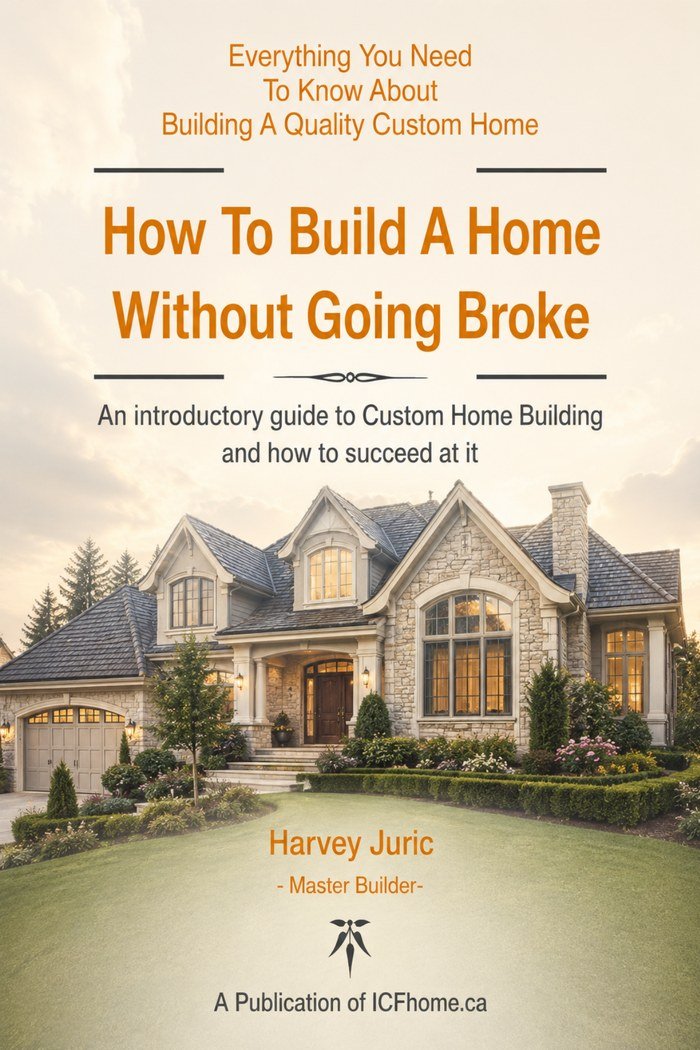
Grab our free book, How to Build a Home Without Going Broke – the costly mistakes most people make, and how to avoid them. Instant PDF to your inbox.
Is a concrete home right for you?
A custom home is the biggest purchase most families ever make. The build is stressful with the wrong crew and genuinely enjoyable with the right one. After decades of watching how ICF homes perform through Ontario winters, our honest opinion is simple: for comfort, energy cost, safety, and durability, there is no better residential wall system available today. The premium is real, but so is the payback – and the quiet, even comfort is something you cannot un-feel once you have stood in it.
The best way to decide is not to read more claims. It is to walk into the showhome, feel the temperature and the silence, and ask us the hard questions about cost. That visit is free, and it is the single most useful thing you can do before you commit.
Planning a custom build in Simcoe County or Georgian Bay?
Book a call
We design and build energy-efficient custom ICF homes across the region. Start with a quick, no-charge conversation – send us your plans, ask for a ballpark, or just book a call. Call 705-533-1633 or reach info@icfhome.ca.
Concrete homes: frequently asked questions
How much more does an ICF concrete home cost than wood frame?
Building the shell in insulated concrete forms typically adds about 5% to 10% to the construction cost of a comparable wood-frame home, which works out to roughly a few dollars per square foot of floor area. It is a genuine premium. Most owners accept it because the energy savings, lower maintenance, and durability return a large share of that money over the life of the home, with a typical energy payback around 8 to 12 years.
How much can a concrete home save on energy bills?
Independent testing has measured roughly 40% lower energy use for an ICF wall compared to wood frame, and most owners see heating and cooling costs fall somewhere in the 25% to 50% range. As a real example, our super-insulated ICF showhome with radiant in-floor heat costs about $100 a month to heat even in the coldest part of an Ontario winter. Your own numbers depend on design, size, and finishes.
Are ICF homes fireproof?
No wall is truly fireproof, but ICF is highly fire-resistant. A standard 6-inch or thicker concrete core carries a 4-hour fire-resistance rating under ASTM E119 testing, and the foam is treated to self-extinguish rather than feed a fire. That gives a family far more protection and time than a combustible stud wall.
Are concrete homes really that much quieter?
Yes, noticeably. ICF walls typically test around STC 50 or higher, versus roughly 36 to 39 for a standard wood-frame wall. Outside noise like traffic, dogs, mowers, and storms drops to a whisper. It is the first thing most people comment on when they walk into an ICF home.
Does a concrete home limit my design choices?
Not at all. A concrete home can be built in any architectural style – traditional, contemporary, farmhouse, or modern – and finished outside with brick, stone, stucco, or siding. The structural strength actually expands your options, allowing larger window openings and more open floor plans than conventional framing easily supports.
Do concrete homes have moisture or mould problems?
When built correctly, they have fewer, not more. There are no stud cavities to trap moisture, and the airtight, continuously insulated wall reduces condensation. Paired with heat-recovery ventilation, an ICF home holds stable humidity and delivers cleaner indoor air. As with any home, proper drainage, waterproofing, and ventilation still have to be done right.
Is ICF worth it in Ontario’s climate?
This is exactly the climate where it pays off. Long, cold winters mean the energy gap between an ICF wall and a stud wall compounds year after year, and Ontario’s building code keeps pushing energy requirements higher. An ICF home already meets or exceeds those standards with room to spare, so you are building to where the code is heading, not chasing it later.
Note: figures here are general Ontario planning ranges, not a quote or a guarantee of your home’s performance. Actual cost and energy use depend on your design, size, finishes, and site. For specifics, talk to a builder and confirm current Ontario Building Code requirements for your project.
Related guides
Latest posts
Fresh guides, calculators & real-world advice
More from BuildersOntario – scroll to explore.
Loading latest posts…
Tip: shift + mousewheel works great