Ontario's Plain-English Guide to Custom Home Building📞 705-533-1633 | ☎️ 1-866-868-6606 | ✉️ info@icfhome.ca

ICF Foundation Cost in Ontario (2026): Real Numbers and How to Compare Quotes
Ontario | 2026 pricing
Wall area vs full package
How to compare quotes
Part of: Insulated Concrete Forms (ICF) in Ontario – the complete guide
ICF Foundation Cost in Ontario (2026): Real Numbers and How to Compare Quotes
If you have started gathering ICF foundation quotes for an Ontario build, you have probably noticed they do not agree with each other – and the gap is not 5 or 10 percent. It is 20, 40, sometimes 60. The reason usually is not that someone is gouging you. It is that one builder is pricing the wall assembly and another is pricing the full foundation package, and the space between those two numbers is where most homeowners overpay or undercount. Below: the real 2026 cost ranges, the line items that quietly drop out of quotes, and a comparison method that prevents the most expensive surprise in residential construction.
12026 wall-area cost
2Why quotes differ
3What’s excluded
4Compare properly
The number you came here for (with the caveat it deserves)
In Ontario in 2026, the ICF wall assembly itself – forms, rebar, bracing, concrete placement, and labour – runs roughly:
$42-$55
Per sq ft of WALL AREA (perimeter x height), wall system only
+$40K-$70K
Typical site cost on top to reach a finished foundation
$8K-$18K
Typical ICF premium over a bare poured wall
That is the wall. Not the foundation. This is exactly where most homeowner budgets quietly go wrong: people anchor on the wall number, then forget that a foundation also needs excavation, footings, waterproofing and drainage, a basement slab, and backfill. Once you add those, the real foundation total is significantly higher than the wall-only number – not because anyone hid anything, but because nobody defined the scope properly before the quotes went out.
The fix is simple but unforgiving: always compare quotes at the full-package level, never wall-only versus full-package. The rest of this guide is how to do that without missing anything. For the broader picture, see our cost to build a house in Ontario guide.
Why your ICF foundation quotes look so wildly different
Most homeowners assume that when three builders quote the same foundation, the numbers should land in the same neighbourhood. They do not. The instinct is to assume someone is overpriced or someone is lowballing. Usually neither is true. What is actually happening: there are two completely different ways to scope an “ICF foundation quote,” and contractors use whichever framing makes their number land more competitively.
Scope A: wall-only
Forms, rebar, bracing, concrete pump and placement, and the labour to stack, steel, brace, and pour. Excavation, footings, waterproofing, drainage, slab, and backfill are someone else’s problem. The number looks small because most of the foundation is not in it.
Scope B: full foundation package
Everything below grade and around the wall: excavation, soil disposal, footings, the ICF wall, waterproofing membrane, drain tile and stone, basement slab, and backfill to final grade. The number looks bigger because it actually is the foundation.
Both are legitimate ways to quote. The damage happens when you compare them side by side without realizing they are different scopes. The cheaper-looking quote is not cheaper – it is smaller. That is a very different thing.
Builder truth: if a quote looks suspiciously good, something expensive is usually missing from the scope – not from the builder’s profit. The cheapest quote is almost always the one missing the most.
What’s in the wall-only number, and what isn’t
Usually included
- ICF forms (blocks or panels) and plastic webs
- Rebar – vertical, horizontal, and corner detailing
- Bracing and alignment system
- Concrete pump, placement, and consolidation
- Labour to stack, steel, brace, and pour the wall
Often excluded (and expensive)
- Excavation, soil disposal, and any imported fill
- Footings – forms, steel, and concrete
- Waterproofing membrane and protection board
- Drain tile, stone, geotextile, and sump discharge
- Basement slab and final backfill to grade
“Often excluded” does not mean cheap. On many sites the excluded items together cost as much as the wall itself – sometimes more on lots with rock, water, or difficult access (see our site and servicing costs for the rural swing). If you do not see these on your quote, that is not a deal – it is a missing scope.
Wall area vs linear foot: which method to insist on
Wall area (perimeter x height): the accurate method
Wall area is perimeter multiplied by wall height. It captures the actual work: more height means more forms, more concrete, more rebar, more bracing, more labour. An 8-foot wall and a 10-foot wall on the same footprint are 25% more wall – and a wall-area quote shows that clearly.
Linear foot: easier to write, easier to hide behind
Linear-foot pricing ignores wall height entirely. The same number applies whether you are getting an 8-foot or a 10-foot wall, which is convenient for a contractor pricing a tall wall and inconvenient for you. If one quote is in linear feet and the other is in wall area, you are not comparing the same thing.
The cleaner ask: “Can you quote this per square foot of wall area, with the wall height clearly stated?” Any experienced ICF contractor knows exactly what that means. If yours does not, that is information too.
Worked example: a common Ontario footprint
Use a footprint Ontario builders see all the time: 30 feet by 50 feet with an 8-foot basement wall. Perimeter is 160 linear feet. Wall area is 160 x 8 = 1,280 square feet of wall.
| At this rate | Wall-only total | What it does NOT include |
|---|---|---|
| $42/sq ft of wall area | 1,280 x $42 = $53,760 | Excavation, footings, waterproofing, drainage, slab, backfill |
| $55/sq ft of wall area | 1,280 x $55 = $70,400 | Excavation, footings, waterproofing, drainage, slab, backfill |
Both are real ICF wall prices in Ontario in 2026. The spread reflects wall height, footprint complexity, access, scheduling, and crew experience. Neither is the foundation – to get there, add the third column, which on a typical site routinely runs another $40,000 to $70,000 depending on conditions, soil, waterproofing strategy, and access. That is why quotes that look 60% apart often are not: one is the wall, one is the full job, and the comparison was rigged by an incomplete scope, not by anyone’s pricing.
The 10 things that actually move your ICF foundation price
Ranked roughly by how often they surprise homeowners. The first four start almost every “but the quote was supposed to be X” conversation.
- 1. Wall height. The fastest multiplier. Every extra foot is more forms, concrete, steel, bracing, and labour. The gap between 8 and 10-foot walls is bigger than people expect.
- 2. Walkouts. More exposed wall, more detailed waterproofing, and complex transitions where the wall meets grade.
- 3. Complex footprint. Corners, jogs, bump-outs, and angles all increase rebar and bracing work. A clean rectangle is the most efficient shape. See foundation types in Ontario.
- 4. Window and door openings. More openings mean more lintel work, bracing, and bucking; large window wells add excavation.
- 5. Engineering and rebar schedule. Soils, loads, or site requirements can push you to a heavier rebar schedule – steel cost and placement time both rise.
- 6. Concrete strength and pour logistics. Pump time, truck access, cold-weather strategy, and the strength spec all affect cost and schedule.
- 7. Site access and staging. Tight lots and long pump-hose runs cut crew efficiency and raise equipment time. A simple drawing can be a hard site.
- 8. Rock, water, or poor soils. Excavation and drainage costs here can dwarf the wall difference. A geotechnical investigation before you budget is worth it.
- 9. Waterproofing level. Dampproofing, full membrane, and comprehensive drainage are three cost tiers, not interchangeable.
- 10. Season and scheduling. Winter pours and peak-season trade demand affect price. The cheapest foundation is sometimes the one that does not push the whole build six weeks.
Building new with ICF? Don’t leave the HST rebate on the table
A new ICF home – foundation included – qualifies for Ontario’s enhanced HST rebate, up to $130,000. It is a big number that rarely shows up next to a foundation quote, and the window is closing.
Ontario HST Rebate | Deadline April 1, 2027
You Could Lose Up To $106,000 If You Don’t Start Before April 2027
Ontario’s enhanced HST rebate puts up to $130,000 back in a new-home builder’s pocket – but only if your build contract is signed before April 1, 2027. Miss that window and you fall back to the standard $24,000 rebate. On a typical ICF build, that’s a six-figure swing – so it belongs in your budget from day one.
$0
Contract signed before Apr 1, 2027
$24,000
Signed after the deadline
$900,000
Miss the deadline and you forfeit
$0
Estimate based on Ontario’s 2026 enhanced HST rebate (Bill 114). Final eligibility for a custom / owner-built home is confirmed by a licensed rebate specialist – that’s what the free check is for. Full HST rebate details
The enhanced HST rebate applies to new home construction. Final eligibility is confirmed by a licensed rebate specialist - use the HST rebate calculator to check your number.
ICF vs poured concrete: the comparison most people make wrong
"Is ICF more expensive than poured concrete?" is the wrong question - it almost always produces the wrong answer, because almost nobody compares the same thing on both sides. Bare wall to bare wall, a plain poured concrete wall is usually lower cost for the structural element alone (roughly $15 to $40 per sq ft). But that bare wall is not ready to live behind. To match an ICF wall's performance you still need exterior rigid insulation, interior framing and batt insulation, vapour control, and the labour to install all of it - none of which is in the bare wall number.
The fair comparison is a finished, insulated, waterproofed, drained, ready-to-build-on foundation system versus the same. Compared properly, the ICF premium shrinks to roughly $8,000 to $18,000 over a conventional wall, and in some configurations it disappears once you factor in reduced HVAC sizing, lower operating costs, and decades of less maintenance. Weigh the full picture in our ICF pros and cons and is an ICF home worth it guides, and if you are still deciding between a basement and slab, read foundation types in Ontario first.
Want a builder's eyes on your ICF foundation quotes?
We have poured ICF foundations across Southern Ontario since 1995. Send your plans and we will tell you what scope each quote is really pricing - and what's missing. Tarion-backed. Call 705-533-1633.
The quote comparison checklist (use this before signing anything)
If two quotes do not line up on every item below, you are not comparing the same job:
- Wall height is identical. A 9-foot wall hiding inside the "cheap" quote is the most common reason quotes look apart when they are not.
- Footings are clearly included or excluded - forms, steel, and concrete, listed by line, not assumed.
- Waterproofing method is specified. "Standard" and "TBD" are not waterproofing systems - ask exactly which membrane.
- Drainage scope is itemized - weeping tile, clean stone, geotextile, sump, and discharge plan, each named.
- Slab scope is defined - base prep, poly, insulation, mesh or rebar, concrete strength.
- Backfill method is spelled out - materials, compaction, and timing, not "we'll backfill it."
A 5-step method to budget without surprises
- 1. Lock the footprint and wall height before pricing anything. Work from a concept plan with a confirmed basement ceiling height. "We'll figure it out later" is how budgets drift $30,000 between design and dirt.
- 2. Separate the scope into six buckets - excavation and disposal, footings, ICF walls, waterproofing and drainage, basement slab, backfill and grading. Then quotes become comparable and surprises become visible before you sign.
- 3. Ask for exclusions in writing. A good quote is a definition, not just a number. Ask "what is specifically not included?" - especially waterproofing, stone quantities, and disposal assumptions.
- 4. Build a contingency that matches site risk. Geotech done and a clean site: 10%. Unknown soils, tight access, or a treed rural lot: 15 to 20%.
- 5. Sort permits early. Read how to get a building permit in Ontario and the permit timeline reality check so timing does not blindside the budget.
Related ICF guides and tools
- Insulated Concrete Forms (ICF): the complete guide - the hub for everything ICF.
- ICF cost calculator - quick wall-area estimate for your dimensions.
- Concrete footings cost calculator - price the footings separately.
- ICF vs wood / stick frame - the broader wall-system comparison.
- ICF pros and cons - performance and durability, not just price.
Frequently asked questions
How much does an ICF foundation cost in Ontario in 2026?
The ICF wall system itself - forms, rebar, bracing, and pour labour - typically runs $42 to $55 per square foot of wall area in Ontario in 2026. Wall area is perimeter multiplied by wall height. That number is the wall assembly only. Your true foundation total adds excavation, footings, waterproofing and drainage, basement slab, and backfill, which can match or exceed the wall cost depending on site conditions.
Is ICF more expensive than a poured concrete foundation?
Bare wall to bare wall, a poured concrete wall is usually lower cost (about $15 to $40 per sq ft). But that is not a fair comparison - ICF includes insulation as part of the wall. A poured wall still needs exterior rigid insulation, interior insulation, and vapour control to reach comparable performance, all of which add cost and labour. Finished foundation to finished foundation, the ICF premium is usually about $8,000 to $18,000, and long-term operating savings close the gap further.
Why are my ICF foundation quotes so far apart?
In most cases, wildly different quotes are a scope problem, not a pricing problem. Confirm both quotes use the same wall height, perimeter, and opening count, then check what each includes for footings, waterproofing, drainage, slab, and backfill. A quote that looks 25% cheaper is almost always missing one of these items. Normalize scope and most quotes get much closer.
What's the best way to estimate ICF foundation cost myself?
Start with wall area - total perimeter multiplied by wall height - to price forms, rebar, concrete, bracing, and labour. Then price the other foundation buckets separately: excavation, footings, waterproofing and drainage, slab, and backfill. If a quote will not itemize these, it is very hard to compare. The ICF cost calculator and footings calculator linked above give scope-by-scope starting points.
What blows ICF foundation budgets most often?
The biggest surprises, in order: wall-height increases late in design, walkout walls not priced correctly, unexpected rock or groundwater during excavation, waterproofing and drainage left vague in the original quote, and site-access problems. A geotech report before finalizing the design is money well spent on any rural or unknown site, and you should lock wall height and footprint before getting quotes.
Does an ICF foundation reduce heating costs?
It can. A well-insulated ICF foundation is part of your thermal envelope, and a warmer basement reduces whole-house heat loss meaningfully in Ontario's climate. The magnitude depends on the rest of the building - above-grade walls, windows, air sealing, and mechanicals. Best results come when the whole envelope is designed as a system.
Can I build an ICF foundation in winter in Ontario?
Yes, but it adds cost and complexity. Frozen soils affect excavation and base prep; cold-weather concrete needs protection, heating, and careful logistics; crew efficiency drops. If winter is the only option, use a builder with genuine cold-weather concrete experience and realistic allowances in the budget from the start.
What should I ask before signing an ICF foundation quote?
Ask for a written scope stating wall height, rebar schedule, concrete strength, and exactly what waterproofing and drainage include. Ask who supplies bracing, how alignment is verified during the pour, and what is included for slab prep and backfill. Ask how they handle surprises - rock, groundwater, access changes. An experienced ICF contractor answers all of this clearly.
ICF foundation only, or full ICF above-grade too?
ICF below grade with conventional wood frame above is the most common hybrid in Ontario - excellent moisture protection, structural durability, and a warmer basement at a lower total cost than full ICF. Full above-grade ICF delivers the complete thermal benefit at a higher upfront cost. For budget-constrained builds, ICF below grade plus wood frame above is a sensible middle path.
Is an ICF foundation worth it for resale in Ontario?
A warm, dry, comfortable basement is a real selling feature even for buyers who have never heard the term ICF. The value shows up as fewer moisture concerns and a higher-quality feel. Appraisers are catching up slowly, so you may not capture full value at resale in every market - for a long-term home, operating savings, comfort, and reduced maintenance are the primary return.
Disclaimer: ICF foundation figures are 2026 planning ranges and vary by wall height, design, site, soil, and access. The wall-area number is the ICF wall assembly only - a finished foundation costs more. This is educational, not a quote.
Latest posts
Fresh guides, calculators & real-world advice
More from BuildersOntario - scroll to explore.
Loading latest posts...
Tip: shift + mousewheel works great
Related guide: New to the method? See what insulated concrete forms (ICFs) are.
Hi i looked over your costing on the icf forms. You’ve given a labour cost of 7.00 psf. Does that cost include the footings. And does a wall over 8 feet high make a difference in the per ft cost.
That cost does not include footings. Yes, tall walls cost a little more. How much? It depends on the installer.
Hello how are you.. I was wondering how much it would cost for 1600sq ft foundation. Just regular corners like 1 big square box.. And i will be doing it myself.. I was trying to find how much the blocks would be here in Canada?
Approximately $25,000. Blocks cost about $4.00 – $5.00 per sq.ft. Fully finished ICF wall starts @ $18.00 per sq.ft. including steel, concrete, and labour.
Do you have an update on cost , when you say square foot are you referring to floor area of a house or wall area?
Linear foot of wall x wall height. I don’t have any experience in this, came here to learn, but above mentions average wall length of a 2500 square foot home is 230 foot, assuming it’s an 8 foot wall that makes 1840 feet. 1840/8 is 230. Hope that helps to clear some things up.
Hi We was looking for the cost of a house using ICF for the house. How much would a 1,000 sq ft with 2 bedrooms and 2 bathrooms open kitchen to living room and finished.
Thank you
Susie K.
It’s not so easy to price the home especially at this time, where prices change week to week. Please read the following articles on pricing a new home: https://buildersontario.com/pricing-new-homes-per-square-foot,
https://buildersontario.com/house-southern-ontario-cost-square-foot, https://buildersontario.com/cost-per-square-foot
Hi. Home will be built in the Calabogie area. Looking for referrals for 48x48x30 (3 sided box)… Looking for 9 foot walls….I calculated just under $20,000. Thanks
Hi, my name is jatinder and running construction co.
I am planning to build a house.
Plz let me know more information abt icf.
Thanks
Struggling to find the name of any mnfctr that could have built the steel beam trusses in my ICF homes roof. Need it for solar load roof calcs.
Any clues/names appreciated.
Thanx,
Steve
Do you have a list of contractors who work with ICF in my area (Sudbury)?
Contact the manufacturer of the ICF you are going to use. They should have a list of approved contractors for your area.
Hi, I want to know the cost of 2500sq home putting up the whole exterior wall all the way to the roof. Approximately how much am I looking for ?
You are looking at about $20 per square foot of wall area.
Hi Carmen, I was wondering if you ended up finding a good contractor. Please let me know your experience if you don’t mind.
Thanks
Hello ADMIN, do you just do foundation walls, if so I would like to email plans for a home I am planning to start excavation in may 2018 in Weston village, Toronto west.
Regards,
Bruno
Sure.
Hello
We are building a 69 x 28’ garage with an 450 sq ft loft/living space over top/centred above the garage. There will be a crawl space under a large portion of the garage. No basement required.
Im looking for some guidance. Is ICF recommended or necessary? In any case, an approximation of cost would be much appreciated.
Lewis
We need much more info to price the project.
Calculated the cost for install of 8′ walls for a 1500sqft home at $18.00 however I am wondering how much I should add for Flat work such as floors and porches? This is for budget purpose only at this stage.
Thank You
After drywall goes onto the exterior walls how do you hang pictures or tvs on the walls? Do you have to anchor them to the cement? What about your plumbing? Where do you run that if needed on exterior wall?
As far as hanging pictures is concerned, there are special brackets you place on the icf wall before drywalling.
For the second part of your question, the following youtube video tells the story: https://www.youtube.com/watch?v=5-UdF_2n16Y
we have a land the size is 164 x 24 feet, we plant to build a 3 storey ( max. 30 feet high) bachelor room for student. if we do ICF Foundation, what is the costs ?
Thanks
Tim
Approximately $20 per sq.ft. of the wall area.
need insulated concreate foundation 24x42x8 in Wasaga Beach
You can call us @ 705 533-1633
Hi, so reading your article above we want to add on an a basement addition to the house. It’s about 393 sq. ft so call it 400. Doing my math at 16.00/ft/sq means $6400.00. Aside from digging the hole which would be additional what else would be required on top of the $6400.00? Weep tiles, drainage etc?
It is calculated by the square foot of a wall area, not floor area. So, your pricing is wrong. Also, your description of a job lacks details. If you want us to price this job for you, we need to see the complete set of plans.
Hello..I am new here in canada I wonder if I found a lot and I want to build a house just foundation with the basics. My husband can do the drywalls, trims, the painting and all other interior job. How much it cost for 1000 sqf.for basement and one floor. With garage
Thank you.
Wow! Without a house plan? It will cost you from $40,000 to $500,000. Please read the articles on our website. House costs and how to price a home are discussed in several of them.
I want to build a house in Canada
1200 feet
hi
What is the best building materials?
What are the best types of houses and the cost
I have an old cottage in Orillia, Approx 1400sq. Wanting to rebuild a new house for the same size, would it be cheaper to have it renovate 80% of the house ( like keeping 1 existing wall)than building a brand new home from scratch.
In my experience, it is always better to start from scratch. It may cost less, not just as construction costs, but also in energy costs in the long run.
Yes, I want to build a new house
Foot costs $ 100
But I want less
Thanks, I live in Ottawa
I want to know the cost of 1200 feet
want to build a 33 x 40 foundation for a new house due to water table it would be about 4′ under ground and 4’above
just looking for an approx. cost
in the Orillia area
You will get rough costs by finding a square footage of a basement wall and multiplying by $20.
Give us a call we can help you out
Hi I am looking to building a 5000 square foot house with 4 car garage. I am sure there is a lot of variables to determine pricing.
I am not sure at this point It I want wood framing or ICF, what would you thing would be the average price to build a house this size? I also want to put wood 2X4 studs in the walls so that It will easier to put up TV’s or hearing pictures.
Would the price also include the flooring and walls inside the house.
Thanks
Manny
Without your building permit plans, I can’t even come close. There is really no “average price for that size”. However, these days prices start at $300.00 per sq.ft. and go up.
Hi , you estimate 20 $ per sq. ft concrete . For what core of ICF . I got for 6′ core . 6 x 2.54 =15.24 cm ,
100/ 15.24=6.56 sq. m , 10.764×6.56 =70.61 sq. ft ,180 / 70.61 =2.55 $ per sq. ft . of 6″ ICF . Am I doing mistake in calculation ? Thank you.
Yes. Please read the article again. Also, since the time the article was written, the price per sq.ft. of finished ICF wall has risen to $20-$25 depending on the complexity of the wall.
Planning on building bunker style house in side of hill. What method of construction and thickness of block would you suggest for walls,and roof. Could you recommend Canadian website ( Canadian building Codes) for research.
I am building a 6 unit townhouse with dimensions 58′ X 170′. There are 2 4′ step down after 2nd and 4th units. Would ICF be an economic choice to use for a frost wall and also would ICF be beneficial for support walls where step downs are or simply poured concrete sufficient? Thanks Gerard
ICF would be an economical choice for all the walls. If you email us the plans, we can give you more info.
The 18.00 psf price you are talking about is for an 8′ high 2500sf basement. Can you think of extra costs (estimates for window and door bucks etc.) if the walls were built on slab and used as the external walls of a one story?
Hello,
Does the ICF product act as a waterproofing membrane on the exterior of the foundation?
No, however, you can use any number of approved waterproofing like
How much is the cost to finish 500sft of crawl space?
Do you come to Brantford? I am adding an addition to my home 12/30 432 sq’
Minus door and windows. Are you interested in my project? If so please send budget quote only. And if not do you have a recommended contractor in my area?
Thanks inadvance
Unfortunately, not. You are a little too far south.
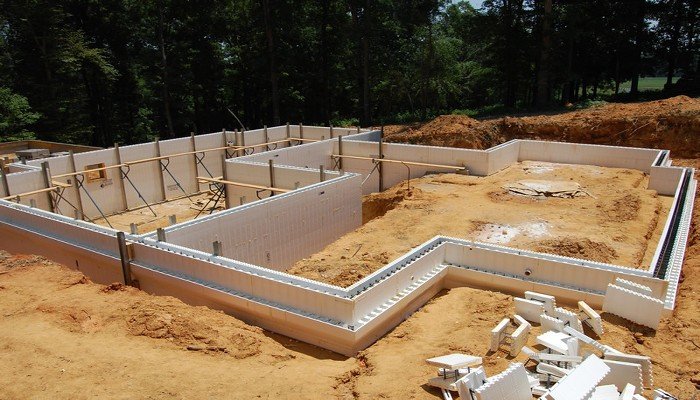
In your opening picture, it looks like a footing built with icf as well, which brand is that? And after all these years do you still recommend a mono pour using that style?
It is not footings. It’s a brick ledge. That was Logix. And yes, we still use that style.
I’m located in Kitchener and wondering if you would be able to work on the project.
Please give us a call.
Hi.
Building a house in eastern Ontario area and have to build a slab on grade with radiant heating.
24” feet below grade to rock. Want to use ICF block.
What Is the minimum height for ICF block can I use? Footings will be 8” high.
Or should I do traditional concrete forms?
Thank you for all this information… however these pricing guides… are they the base costs or does a company have to add on their profit percentage to that?
Hello. Im looking for a quote on a 24×40 garage with a 2 bedroom 1 bathroom apartment above.
Was thinking of going ICF from footings to top plate/trusses.
Basically a rectangle box with 3 garage doors and about 8 windows and 2 man doors. Any helpful advice would be appreciated. Thanks
Given the current climate, in your opinion, would ICF be on par cost wise now with stick built due to the massive rise in the cost of lumber? (Dare I say maybe cheaper?) Or does it still remain more expensive than?
What is the current cost for finished ICF per sq ft.
From $30-$35 per sq. ft.
I’m having a 1100sqft house ( rectangle shape) built. Curious average cost would be for a walk oit basement with ICF vs. Regular poured formed walls.
We appreciate you sharing this detailed breakdown of how much ICF bases typically cost. I found your piece to be very enlightening and helpful because of the way it detailed the many variables that go into determining the final price. Continue your excellent job!
Were you aware that your concrete cost is listed as $20/sq ft in your breakdown?
For just doing the foundation for 2632sqft how much would it cost us
The numbers don’t ad up. $180 m3 is 35 cubic feet. 6″ cavity is 70 sq feet. at $180 a meter is 2,58 a sq feet Not $20. How do you come up with $20 a sg feet . civerage only 10 sq feeet??????
The numbers don’t ad up. $180 m3 is 35 cubic feet. 6″ cavity is 70 sq feet. at $180 a meter is 2,58 a sq feet Not $20. How do you come up with $20 a sg feet . civerage only 10 sq feeet??????
What is the current cost for finished ICF per sq ft.(2024)?
Hi
You said ” The total cost of ICF basement installed on concrete footings will come to around $22.00 – $26.00 per square foot”
Could you please specify what is wall square foot is?
Is the one face for the wall or 2 faces?
Hi to all I been reading all comments from above and at the end of it is still not a clear answer that would clarify what the actual question is , and that would be:
How much would an ICF structure ready to rough ins from the footings to the roof trusses that includes ( basement concrete slab, main & second floor with typical lumber subfloor and partition framing walls ready to drywall and flat roof with plywood sheeting no roof membrane)
The cost per sqf floor including labour and all materials such ,ICF,Concrete,Rebar lumber required etc applied on a Gross Floor Usable Area varies from $115 to $160 per sqf as of 2024 ( Windows /Doors not included ) * Note a similar amount was required since 2020 till now meaning ICF construction costs sat a a mor steady level costs compared with traditional barem concrete foundation plus lumber plus instillation costs as per standard building code requirements that goes more and more updated to meet energy efficiency requirements .
Whoever decides to build a typical 2400 sqf home after Desisign /planing city Fees and development fees,should expect a minimum of$ 276,000 plus Electical/Plumbing/HVAC etc
I hope this clarifies everyone questions when it comes to building an ICF high efficiency home !