Septic Systems – Ontario

Septic System Ontario: What You Need To Know Before Purchasing a Building Lot in Ontario
If your lot doesn’t have municipal sewer, your septic system isn’t a “we’ll figure it out later” item. It’s a lot suitability item. Soil, setbacks, groundwater, and approvals can dictate where your house can go, how big it can be, and what the system will cost to install and maintain.
These aren’t automatic deal-breakers, but they are “slow down and investigate” signs.
- Ground that stays wet or spongey after a dry spell
- Low areas near streams, rivers, or roadside ditches (flood clues)
- Thin topsoil, exposed rock, or obvious shallow bedrock
- Very small usable yard area once house/driveway are considered
- Tight access where heavy equipment can’t stage or turn
If you’re buying rural land, these are worth asking before you get emotionally attached.
- Who is the approval authority here (municipality, health unit, or conservation authority)?
- Where could the leaching bed fit while meeting setbacks and leaving a repair area?
- What soil type do you likely have, and how will it absorb wastewater?
- Will septic constraints limit bedroom count or house placement?
- What are expected operating/maintenance requirements for the system type?
How a Septic System Works (Plain English)
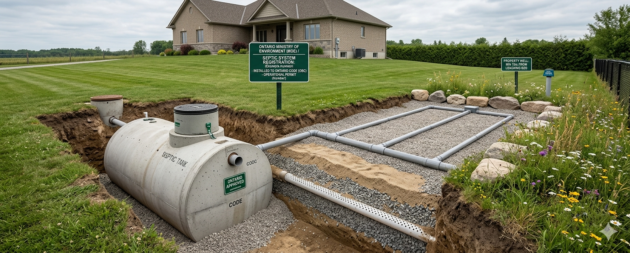
A typical septic system has two main parts: a septic tank (buried) and a leaching bed (also called a drain-field). Wastewater from kitchens, bathrooms, and laundry flows into the tank. Solids settle to the bottom, lighter materials (like fats and soap scum) float and form a scum layer, and the clarified liquid moves out to the leaching bed.
The leaching bed is built using porous materials (often sand and gravel) and a network of pipes that distribute effluent so it can slowly soak into the soil. The soil acts like a filter and treatment zone before water reaches groundwater. That’s why I always say: the tank is the “separator,” but the soil is the real treatment plant.
The most common septic failure I see isn’t “a bad tank.” It’s a system installed on a lot where the soil and water conditions never gave it a fair chance.
When a septic system is installed in unsuitable conditions, it may malfunction by leaking untreated sewage to the surface of the ground or into ditches, or by contaminating groundwater. Aside from being unpleasant and potentially hazardous, remediation can be expensive and disruptive.
Why Soil and Site Conditions Matter in Ontario
Unfortunately, not all soils can absorb wastewater or purify it effectively. Some soils are too tight (heavy clays), some have a high water table, and some are too shallow because bedrock sits close to grade. Any of those can restrict what type of system is permitted, how large the bed must be, and how much site modification is required.
Ontario adds a seasonal twist: spring snowmelt and heavy rains can reveal water behavior you won’t see on a sunny August showing. A lot that looks “fine” during a dry visit can become a wet sponge in April. That’s one reason authorities require proper assessment—because septic design is about worst-case conditions, not best-case selfies.
Reviewing the Lot: Space, Setbacks, and the “Repair Area”
If a septic system is needed, the smartest thing you can do is treat the site plan like a puzzle: house footprint, driveway, well (if needed), septic bed, and a repair area must all fit while meeting required separation distances. The repair area matters because systems don’t last forever, and approvals often assume you have a place to rebuild if the bed fails later.
Here are practical items to check before you purchase:
- Enough usable space? You need room for the home, septic system, and well (if required).
- Flood risk? Land near a stream/river or low areas that could flood can create major septic constraints.
- Wet/swampy signs? Persistent wet areas are a big hint of high water conditions.
- Bedrock interference? Shallow bedrock can limit bed depth and available installation zones.
- Soil investigation: Test pits (often around 5 feet) help determine soil type, layers, and drainage behavior.
- System feasibility: Find out what system types can work on those soils and that site layout.
- Cost estimate: Get a realistic range for the system you’ll need (not the one you wish you needed).
- Operating & maintenance: Ask about pumping schedules and (for advanced systems) required servicing.
- Well separation: Your well and neighbors’ wells should be at least 100 feet from the septic system (verify locally).
- Repair area: Confirm you can reserve land for future replacement/expansion if needed.
Ontario Rules: OBC Part 8 and Who Approves Septic
Part 8 (“Sewage Systems”) of the Ontario Building Code regulates the design, construction, operation, and maintenance of on-site septic systems for most single-family homes. In many areas, the municipal building department examines plans, issues permits, and performs inspections. In some regions, approval responsibilities may be delegated to local conservation authorities or health units. If you’re not sure who the authority is, start with the municipal building department and they’ll redirect you.
Official references (authority links): Ontario Building Code and Ontario Building Code updates.
One practical lesson from years of building: septic approvals aren’t isolated. They can affect bedroom count, house placement, driveway routing, and where you can realistically put features like pools or outbuildings. The earlier you treat septic as a site-planning item, the fewer “surprises” you’ll pay for later.
Capacity: Daily Flow + Soil Absorption = System Size
The two primary elements that drive septic size and complexity in Ontario are: (1) the maximum daily wastewater flow the building could produce and (2) soil/site conditions. Bigger homes (often reflected by bedroom count) typically mean higher daily flow. But soil is the multiplier. Good soil can keep bed size reasonable. Poor soil can force a much larger bed and more imported material.
Here’s the “builder version” of the example: a small one-bedroom home may have a maximum daily flow around 750 litres. If the soils have strong absorption characteristics, the system can be comparatively compact. But a larger five-bedroom home can have a much higher daily flow (often in the 2500-litre range), and if the soils are clay with low absorption, the bed may need far more area and sometimes engineered sand to meet requirements.
It’s almost impossible to price septic accurately without seeing the lot. Septic cost is rarely “tank + bed.” It’s often septic + access + imported material + site restoration.
Cost Drivers: What Makes Septic Systems Expensive (or Reasonable)
People love a clean number. Septic refuses to cooperate—because it’s tied to the land. Still, you can understand what drives costs so you can spot risk before you buy.
Drainage rate and limiting layers determine bed size and whether imported sand is needed.
- Loamy soils often support simpler designs
- Heavy clay can increase bed area and site work
High water tables or wet ground can force alternative approaches and stricter layouts.
- Spring conditions matter
- Site drainage and grading become bigger players
Tight sites turn standard work into custom work (and custom pricing).
- Long runs, narrow paths, soft ground
- Limited staging space increases handling
Septic installation can disturb a big area—especially if imported material is required.
- Grading, seeding, topsoil
- Driveway repairs if routes get damaged
If you want real Ontario ranges and what’s typically included, use this guide on septic system cost in Ontario as your baseline. Then adjust expectations up or down based on your actual lot conditions.
Types of Septic Systems: Conventional vs Advanced Treatment
The kinds of soil and site conditions on the land determine whether the approval authority can issue a permit and what type of septic system is needed. In Ontario, many lots can support a conventional septic system: tank plus trenches/bed installed at typical depths, assuming soils and groundwater are favorable. When allowed, conventional systems are usually the simplest to build and operate.
On soils that are too wet, too shallow, or too restrictive for a conventional system, a modified standard system or an alternative septic system may be used. If a conventional system cannot be used, you should determine both the installation costs and the ongoing maintenance requirements of the alternative system that can be approved for that lot.
Disadvantages: higher purchase and installation cost; ongoing operating costs (electricity, media replacement); more mechanical parts that can fail; and mandatory maintenance requirements that increase annual costs.
Alternative systems are often considered when you’re dealing with lots that can’t accommodate the size of a regular bed, replacing an old failed system, building on hard-to-access lots where transporting materials is difficult, or seeking additional nitrate reduction. The key point is that some soils are not suitable for alternative systems either—so feasibility must be confirmed before you commit to a purchase.
Common Mistakes Lot Buyers Make (And How to Avoid Them)
Most septic horror stories start the same way: “We bought the lot first, then we found out…” Here are the usual mistakes—and the simple fixes.
Fix: make septic feasibility part of your due diligence, not an afterthought.
- Identify a realistic bed location
- Confirm room for a repair area
Fix: ask locals about spring water, walk the lot after rain, and look for clues.
- Snowmelt changes everything
- Dry summer visits can mislead
Fix: budget for site-driven variables—access, imported sand, and restoration.
- Septic is often septic + site
- Access limitations inflate labour
Fix: align house placement, driveway, well, and septic early so nothing fights later.
- Bedroom count can affect approvals
- Driveway slopes affect grading and drainage
Self-Qualify: Are You (and the Lot) Ready for a Septic Build?
This is where you save yourself stress. I like to break readiness into three buckets: lot readiness, design readiness, and budget readiness. If you’re missing any one bucket, you’re not doomed—you just need to fill the gap before you spend more money.
- You’ve confirmed sewer is not available (or is available)
- You have a likely septic bed location and a repair area
- You understand access routes for heavy equipment
- You have an idea of spring/wet-season conditions
- House placement works with septic and well separation
- Bedroom count aligns with realistic septic sizing
- Driveway and grading plan doesn’t fight drainage
- You’re ready for concept-level review before final drawings
- You’ve included a contingency for soil-driven upgrades
- You understand maintenance obligations if advanced treatment is required
- You’re not spending every dollar on the land purchase
- You have a plan for financing timeline and cash flow
If you want a reality-based number (and less guessing), do these early.
- Review financing timing with home construction loans
- Get a sanity-check via a ballpark estimate request
If you already have preliminary drawings, it’s worth getting feedback before you “lock in” a layout that fights your lot. A quick send plans for review step can uncover conflicts early— including septic placement conflicts—when fixes are still easy and inexpensive.
Timeline and Scheduling in Ontario (Weather Is a Real Project Manager)
Septic work is tied to excavation, grading, and site access—so it’s tied to weather. Wet spring conditions can delay test pits and excavation. Freeze-thaw can make the site fragile. And once trades are booked, a small delay can ripple into framing, servicing, and inspections.
The best move is simple: treat septic feasibility as an early task. If you know what system is required and where it can go, the rest of your site plan becomes smoother. You avoid last-minute redesigns, you schedule trades more confidently, and you reduce the odds of paying for rushed decisions.
How Septic Constraints Affect the Rest of Your Build
Septic layout can influence more than you think: where the house sits, how the driveway slopes, where roof water should discharge, and where you can place future features like a pool, workshop, or even a bigger deck. In rural builds, it also affects how you coordinate services and mechanical planning.
If you’re exploring high-performance building approaches (including ICF), it helps to think like a builder: sequencing, site logistics, and how each decision affects the next. This guide to insulated concrete forms is a good overview for that “whole-system” mindset—even if your final structure choice is different.
Make the Purchase Conditional on Septic Approval (Smart Insurance)
If a septic system is required, it’s in your best interest to determine lot suitability before you purchase. In many cases, it’s a good idea to make the purchase conditional upon the issuance of a permit for a particular type of septic system. That protects you from buying a lot that can’t support the home you intend to build—or that forces a system type that blows your budget.
If you want a more comfortable, efficient build overall, the best projects align site planning, structure, and mechanicals early. That’s why we like early feasibility and early planning—because the cheapest fixes happen before construction begins.
Quick Recap (The “Don’t Forget This” List)
- If there’s no sewer, septic feasibility is a lot-buying priority—not a post-purchase surprise.
- Soil and site conditions determine system type, size, and real-world costs.
- Plan for space, setbacks, well separation, and a repair area.
- Ontario seasons matter: spring water and frost affect feasibility and timing.
- Consider making your purchase conditional on septic approval for the intended home.
Educational information only. Septic feasibility, setbacks, and approvals are site-specific. Always confirm requirements with your local approval authority and qualified designers/contractors.
Scroll sideways to see more. Cards stay the same height (no messy uneven rows).

In your article, you stated that household discharge from the kitchen, bathrooms, and laundry room flow directly into the septic tank where the solids are retained and separated from the liquid. My wife called me this morning because she noticed a really bad smell coming from the drain in our sink. Are there certain kinds of septic tanks that need maintenance or pumping more often?
I want to make sure that I get the right kind of septic system. It makes sense that I would want to ensure that I get the right kind of system in the first place! It seems like I would benefit most from an ordinary system.
Derek, what kind of system do you currently have and when was the last time you pumped? It’s tough to say which systems will require less pumps than others since it depends on what is thrown down the drain. No matter which system you have, habitual monitoring and maintenance will always be the most cost efficient and the best route in terms of longevity of the system.
Gentlemen:
Is it possible to convert from a holding tank to a septic system? I believe the tank is a concrete 2500gal capacity.
The tank is in the front yard – there is virtually no backyard.
The property is in Whitchurch-Stouffville area.
Thanks
MJ
Not really. You need at least 25 sq. meters for a leach field.
We are looking to relocate our tile bed to another area on the property. What can we do on top of the old tile bed? Would like to put a garden in but not sure that will be ok on top of an old septic field. All our annual tests have come back showing potable water flowing into the septic field.
Garden is a great idea. You can also put sod over the whole area.
I had a septic inspection done on a home I was buying from a Septic Inspection Company.
They could not locate the septic field…it is under my garage. The tank is under my dining room, a flow test was done for 50 minutes, based on no issue with a flow test, they suggested installing risers for easier access in case a winter pumping was required.
I have since found out…as my entire home smells of septic fumes, and the earth under my dining room and addition smells of septic (breath taking).
that the tank is also too small for the size of the house and there are other non code issues with the tank. Trying to find a company to come and pump it is challenging, found a company but it took 2 guys, there are 2 cement lids weighing about 300 lbs each. The septic company and their insurance company refuse to come good for this poor inspection to say the least…my entire home for 2 years has smelt, it goes from unbearable to moderate. Is the inspection company liable? not sure if I can ask this but it’s been a long go no where road with this company denying responsibility. Thanks for anything you can offer as advise. Yes I have contacted my Municipality and South Nation Conservation(who are more than aware of my situation, as they have been to my home, but refuse to issue work orders. Thanks again
This is like a scene from the horror movie. Are you kidding me? You bought a house built over the septic system??? Call a lawyer. There are too many questions unanswered. Who knew? Did the previous owner sell it knowingly? Did the real estate agent know the situation? Was the inspection company aware and sold you the house anyway?
You need to decommission the old septic and build a new one.
Also, it is unhealthy and forbidden by the health department to live on the top of the tank or the system. Once more, seek legal help. In the meantime, I would stay out of the house.
I’ve contacted local health unit and informed them of illegal waste pumping into ditch. Also told them about the house being built on top of the septic tank. They have had some serious health issues that could be the cause of the gasses you can smell in the house. Local health unit person said he didn’t think that it is illegal to have septic tank under the house. It has been over 3 months and nothing has been done. Is there someone i can contact regarding this issue because we both have a well and I really don’t want this happening this close to my house. Thank you.
Your questions are not very clear;
1. I’ve contacted local health unit and informed them of illegal waste pumping into ditch. Where is this? Who is pumping? Is it your ditch? What kind of waste are they pumping?
2. Also told them about the house being built on top of the septic tank. Are those two different problems? Is it your tank?
3. They have had some serious health issues that could be the cause of the gasses you can smell in the house. Who are they? Are “they” the members of your family? Which house, yours or theirs?
4. Local health unit person said he didn’t think that it is illegal to have septic tank under the house. Answer: That can not be true. No competent septic inspector will tell you that.
5. It has been over 3 months, and nothing has been done. Answer: I do not know what exactly do you want to be done. If someone is building a house next door to you, the house and septic have to go through inspections. If all the inspections pass, it is not your business to stick your nose into their building, unless they somehow influence your property.
6. Is there someone i can contact regarding this issue because we both have a well and I really don’t want this happening this close to my house. Answer: I do not know how far is “this close to my house”? Drilled well in Ontario has to be at least 50 feet away from the septic system, and dug well has to be 100 feet away. If those criteria are met all is good and legal.
Sorry, 1. Neighbors are pumping raw sewage with a grinder pump directly from septic tank their tank which is located under the house, this is un organized township in Ontario. 2. Actually built an addition over septic tank. 3. They have. 4. Very true,I spoke to him in person. 5. Existing tank and field. 6. Theirs is a dug well from many years ago and is nowhere near 100′. In closing, because of what the guy from the health unit told me, that’s why I was asking who else i could contact. They the neighbors seem to pump out the tank during a rain. Thank you.
I am in rural Ontario and have aseptic system, 10 year old house. We see the septic field, a little elevates. And where the septic tank is, there is a post, with an electrical outlet, a plug in attached, and we hear a motor running just a foot past the septic tank, between it and the field. What is that motor? Does it pump the sewage to the field? Is it automatic or run continuous?
Hello, we just built a new cottage with new septic tank provided by the builder. A friend of mine mentioned that there should be an overflow alarm built into the cottage or somewhere to notify us. I have looked everywhere to find out the answer to no avail. Is this an after market option or is this suppose to be supplied when the septic tank was built.
I have a bed that needs to be replaced. It’s been in the same location since 1958. I am told now I have to install a holding tank,because the bed is to close to my dug well witch has also been there since 1958. Is is also about 50′ away. Do I have any legal rights?
No.
I have a 90′ run of pipe from my septic tank to the leaching bed/field. Can I put an above ground pool over part of the pipe? It runs diagonally across my back yard, under a seldom used driveway and into the front yard. We have a sketch from the contractor who installed it but there are no measurements or landmarks indicated so we don’t know precisely where the pipe lies or how deeply it is buried.
Thanks for your help!
Erica
Can I put an above ground pool over part of the pipe? The short answer is no. Placing a pool on top of a leach field can crack or crush the pipes or compact the soil enough to prevent proper drainage.
I have a shore well . How far foes a septic mound have to be from it?
Shore wells are usually dug and not very deep. Rules for dug wells (Ontario) state that they have to be a minimum of 100 feet from the nearest septic system.
I found an Ontario government webite that states that a shore well is a surface water source not a true well.
https://www.ontario.ca/page/highly-vulnerable-water-sources
Hello,
The septic pump at our cottage home seized sometime in February and the tank froze (not sure which happened first). It has just thawed and I am wondering if the tank could be better insulated. Is it possible to do this? I also noticed the pvc pipes running to the septic bed are 1.5 inch – is that an adequate size?
Thanks for your time,
William
I do not quite understand which tank froze? Pump tank or sewage tank. The septic system records should be available in your township or your health dept.
I would like to create a covered concrete patio off the back of my home to replace the existing 15 year old deck built when the house was new. My effluent tanks are very close to the side of the deck now and a new poured pad would also be very close. My question is how close to the tanks am I permitted to build/pour a pad? (I have a 3 tank system with a raised bed)
3 meters.
Was wondering if you need a working Septic to sell a lake front cottage, so long as you disclose and discount price for the repairs needed, can you sell the cottage “ As is”?
Thanks,
Lori
Our tank has a crack in it. Can we simply replace the tank? The field was inspected and it is fine.
Probably. Talk to your township’s septic system inspector. You will need a permit.
Question… I have a fence with post (3ft deep) between the runs (5ft spaces) is that allowed?
no
Can a new weeping bed be put in the same place as the old one.?
Thank you
In most cases, no. Check with your septic inspector.
can’t find this info anywhere.
How far does my contained holding tank have to be located from a creek?
I have a questions about a flow test for the septic field. We had our tank pumped out in the Fall in prep to sell home and to determine if we might need to deal with any issues prior to sale. Everything looked fine at that time and we`ve been experiencing no problems.
In May we had a flow test done for an interested buyer and it failed. When we opened the lid the tank was full of water.
My question is this: This Spring was accompanied by record rainfall, and at the time our ground had been particularly saturated for about 2 months. If the ground conditions are that saturated, can they impair the flow test?
Conditions are much drier now, so we’re debating if we should do another one.
Thank you kindly
You probably have the right reason for the failed flow test. Done at this time, it would probably pass. However, what happens if we have a record rainfall next year and the year after? Do you really want to sell the house with a septic system that can fail at any moment? Try contacting a qualified septic installer in your area.
Is a valid septic inspection required to complete a land transfer of property in Ontario?
No.
Bought a 3 acre property in Norther Ontario on the lake. It’s undeveloped land that I hope to put Tiny Homes and Glamping sites with plumbing. I will start with 5 and add more until I hit 30 sites. Most of the property is on bedrock and almost impossible for a septic bed or buried tank. Am I able to have an above ground storage tank that gets pumped out regularly? I assume that I can pump multiple sites to one tank?
I am curious to the answer for Jeff. Wonder what his options are? Would he use a surface discharge system? If so, how can we get them to agree to one of these over a conventional system?
Good evening.
Will a open bottom ecoflo peat moss system work in soil that is T50?
Thanks for explaining that if you put a septic tank in unsuitable soil it can be expensive to remedy the odor. I have a spot on my property where I have wanted to put a septic tank for years now. I have no idea if the soil there is suitable to not so I’ll have a septic service come out and test it for me.
I bought a two bedroom farmhouse that requires a new septic system (holding tank and field). I’d also like to convert the small insulated barn into guest quarters. Can two buildings share the same septic system in the St Catharines area?
Hi
We currently have a small older cottage that has a holding unit. We would like to upgrade to a septic bed. How far does the bed have to be from the lakefront? We are in the Porcupine and District area in an organized township.
Depending on the township. Most likely 100 feet. Check with them.
Do I need to do anything to continue to use a previously installed (20 years) high quality 2250 litre holding tank (designed for pump out, no septic characteristics, very high industrial-quality pvc) for a small seasonal cottage using an RV style toilet, no dish water or shower, just a hand sink? Would this be a grandfathered installation? The area was an unorganized township absorbed into a town after the tank was installed.
I would like to put an inground pool in my yard. Is the 5m measured from the septic bed to the wall of the pool or to the edge of the concrete around the pool?
hi everyone… so i need replace my leach field.right know he is on hill and every time i used a washer machine or dishwasher when im outside i can feel that bed smell a.but i only have space near of my house .i want know if ido there i will feel that smell or when my kids are playng they will smell
Can a fence be built between the septic tank and the field? We had an old fence that was blown down from a storm. Wondering if it’s safe to do that or if I need to go around the entire field
need a septic tank for my new house
It will located in Lancaster ON
my phone:514-9278768
Thabk you
Yura
I have a question for you;
We just purchased a home on septic, the septic drawing outlines the 4 tanks and the leaching bed but it also has a larger area as a reserve tile bed.
I can not find any information on the reserve portion, is this a required part of the septic system?
Thank you
No.
Thank you for your quick response!
Just to clarify; since it is not a required part of my septic system, am I able to use this area for a patio/ in ground pool? Do I need to keep a designated area as a “reserve bed” for the just in case scenario?
Thank you again!
1. Retaining Wall & Septic Mound
We have a raised septic mound in the backyard. Near the bottom portion of the slope, we are hoping to put an armour stone retaining wall (about 22″ high). How close can this wall be to the closest pipe in the septic field? The mantle is on the other side of the septic system and would not change at all.
2. Deck & Septic Tanks/Piping
We are hoping to put a covered porch on the back of our house and also have a raised septic system in the backyard. The effluent pipe for the septic system runs from the back of the house to the tank. Are we able to straddle the effluent pipe with deck footings?
Are you allowed to hook up your rainwater sump pumps to go through the septic system or should that be pumped out to the front ditch ?
Can your septic pipe be drained into the neighbours back yard thus causing it to be so saturated that it is impossible for them to cut their grass ?
Hello, my wife and I are planning to build a secondary dwelling (in-law suite) which will be connected to our existing septic system. This will increase the amount of daily flow which will potentially require us to upgrade the capacity of our existing septic system.
Question : Will a brand new system be required by default, or can we evaluate with Engineering firms to option to add runs to our existing system to save on cost?
Thanks.
Alex
I appreciated it when you shared that it is great to find out about the right type of septic tank that is suitable for the type of soil at your home. My uncle just mentioned the other day that he is planning to build a house on a plot of land that he recently bought last year. I will suggest to him looking for a reliable service that can help install a septic tank for his new home.
It’s great that you talked about septic systems and their features. Recently, my wife and I decided we want to build our dream house from the ground up. We’ve heard a little about septic systems and how they’re a cost-effective option in the long haul, so we’ll be sure to look into them. Thanks for the information on septic systems and their costs.
It’s good to know that you need to have enough space. My husband and I want to look into getting a septic tank for our home. We’ll make sure to keep these tips in mind once we find a professional that can install a septic tank for our home.
Hello, A residence on the road next to us is cutting away one side of his raised septic bed. It looks like he did it to make a road or pathway to his house. Is it legal to take away a portion of the side of the raised mound?
What are the the fixes if a septic was placed to closed to a drilled well
It was installed with a permit
It’s on of the newer small ones with the filter of bark ontop
Wondering what the minimum lot size is for a septic system? We have had septic with our past two homes but both had acreage. We are currently looking at a 1/2 acre lot and there is no sewer or city water so we would have to install septic and cistern. We’ve always been under the understand you need 1 acre for a septic system. Please advise! 🙂
Check with your neighbours. They must have some kind of septic system. There is no minimum size of the lot. The smallest filter bed can be 5M x 5M. Depending on the size of your house, you can put it on a small lot. You have to have 5M setback from the house, 1.5M for the tank, but it is possible on 1/2 acre.
We are looking to purchase a vacant lot that previously had a community centre on it. There is a current septic and drilled well on the lot (septic installed in 1997, pumped in 2021 and visually inspected) Do you happen to know if its possible to use an older septic with a new residential building? Township will not return our calls.
Was wondering if a permit is required to repair my weeping bed someone drove over and pretty sure pipes are broken
Yes, you need a permit. Contact your septic/building department.
Without septic pumping, the sludge will eventually build up and cause two serious issues. First, the sludge can start to block the drainage from the home and begin to back-up the sewer lines. This will clog sinks and drains and send terrible odors into the home. This is why septic pump is very essential.
Thank you for the great page of information. I’m interested in a 125′ x 125′ cottage lot, but neighbours have commented that no one would be able to build on it because of the size. Would I have to use a holding tank instead of a septic system in order to get both a well and sewage treatment for a future cottage to use? Thanks in advance!
I had a septic installed and inspected. The installer forgot to place the barrier paper above the rock filter before he backfilled. The inspector passed this. According to Ontario building code the barrier paper
is a very important part … without it the life of the septic bed can be reduced. Both the installation and inspection was negligent. Should I be concerned over the missing paper ? Or can I get away without otherwise I’m looking at a lawsuit. It’s only me at this house but who’s to say I won’t sell in the future.
I have a 800 imp gal septic tank at my cottage. It was installed in 1979 and we’ve had no issues. As a matter of fact it’s been under used we were told because we are only there on weekends during the summer. I now want to replace the cottage with 1200 sq ft – 3 bedrooms and the town has informed me that the existing septic bed is not large enough to accommodate the new cottage. This came as a surprise as the leaching bed has 300 lineal feet of 3 inch pipe. What do you suggest?
Thanks for the reminder that it’s important to have measures against flooding when planning to get a septic system installation service. I’d like to know more about how to find a good service like that because I’m thinking about buying a small rural property outside of the city. Being able to build my dream home there will surely require a lot of planning.
I was wondering if you were able to get the info you were looking for. I’m also interested in rural land that used to be a community center but closed for septic issues they couldn’t afford to repair. Did you find out anything?
Distance between septic bed and in ground cistern?
Thanks for sharing this informative article on septic systems in Ontario. As a homeowner, it’s important to have a basic understanding of how septic systems work and how to properly maintain them to avoid any issues down the line. This article provides valuable information and tips that are useful for any homeowner in Ontario. Keep up the good work!