Ontario's Plain-English Guide to Custom Home Building📞 705-533-1633 | ☎️ 1-866-868-6606 | ✉️ info@icfhome.ca
Utilities for a Rural Building Lot in Ontario: Hydro, Internet, Gas & Cell
Rural utilities
Ontario 2026
Hydro · internet · gas · cell
Utilities for a Rural Building Lot in Ontario: Hydro, Internet, Gas & Cell
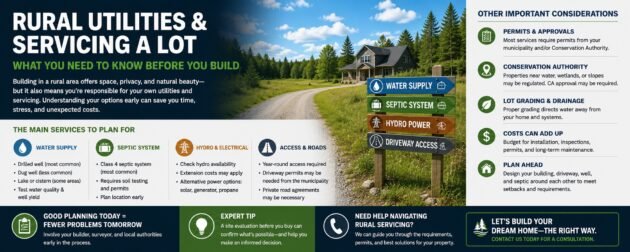
“Services at the road” is one of the most expensive phrases in rural land – because at the road can still mean tens of thousands to get them to the house, and some services simply aren’t there at all. Before you buy a rural lot, find out what’s actually available now (not “planned”), what it costs to connect, and what you’ll pay to run it for the next 40 years. Here’s the plain-English rundown on hydro, heating fuel, internet, cell, and water/wastewater – from 45 years building across Simcoe County and Georgian Bay.
The rule: confirm what’s there now, not “planned”
A listing that says “hydro and gas available” can mean anything from “at the lot line” to “somewhere down the road, eventually.” Get specifics before you fall in love, because the gap between a serviced subdivision lot and a raw rural parcel is where budgets blow up. The five questions:
- Hydro: where’s the nearest pole, and what will a connection actually cost?
- Heating fuel: is natural gas available, or is it propane / electric only?
- Internet: is there cable/fibre/fixed-wireless, or is it Starlink?
- Cell: is there usable signal at the house location, on your carrier?
- Water & wastewater: municipal, or a well and septic you’ll build and maintain?
Hydro: the big connection number
There’s no single “Ontario hydro connection price” – it depends on distance to the nearest pole, terrain, and whether you go overhead or underground. On a simple site, trenching and conduit can land in the low thousands; on a long rural setback with rock, wet ground, or major driveway restoration, it can climb into the tens of thousands.
Overhead vs underground
- Overhead is usually cheaper and faster, and often the right call on rocky or wet lots or where trenching would tear up the driveway.
- Underground looks clean and avoids clearance issues, but you pay for trenching, conduit, bedding, and restoration.
The 40-year cost too
- Rural delivery charges are higher – it costs more to maintain wires to a country lot than to a city block.
- That ongoing cost is part of the picture, not just the one-time connection.
Go deeper: our hydro connection cost guide breaks down what’s included, overhead vs underground, and how to get a real number from your utility before you commit.
The two books that take you from lot to keys
Price the lot’s services before you buy – then pull the permit yourself. Each $29.99, or get both below and save.
Before you buy – start here
The Ontario Lot-Buying Bible
Prove a lot is buildable – before you spend a dollar.
$200+ of pro advice$29.99one-time
The 28-page step-by-step: the invisible site-cost budget (hydro, septic, well, driveway), legal-lot and zoning, conservation limits, financing and the HST rebate – plus printable worksheets and offer-condition clauses.
- The site-cost budgeting worksheet – hydro, well, septic, and more
- The questions to ask before you trust “services available”
- The 10-minute go/no-go test and printable scorecard
- Bonus chapters: DIY trades, wells, easements, negotiation
30-day money-back guarantee.
Get the Lot Bible – $29.99 →
Secure checkout – download in 2 minutes – yours forever
After you buy
The Ontario Building Permit Bible
Pull your permit yourself – without the guesswork.
$10,000$29.99one-time
Everything a builder does to coordinate a permit – the order of operations, the complete-application checklist that keeps it from bouncing, real fees, who to hire, and how to never fail an inspection.
- The complete-application checklist, so the file doesn’t bounce
- Real 2026 permit fees and development charges
- Who to hire to draw it, in what order, and what to pay
- How to never fail an inspection – and the costliest mistakes
30-day money-back guarantee.
Get the Permit Bible – $29.99 →
Secure checkout – download in 2 minutes – yours forever
Buying a lot and building on it? Get both Bibles.
The complete journey – prove the lot is buildable, then pull the permit without the guesswork.
Before you buy
The Ontario Lot-Buying Bible
Prove a lot is buildable – and what it will really cost – before you spend a dollar.
$29.99 on its own
+
After you buy
The Ontario Building Permit Bible
Pull your Ontario building permit yourself – the order of operations, the checklist, and how to never fail an inspection.
$29.99 on its own
$59.98 Both for $49.99
Get both Bibles →
Heating fuel: most rural lots have no natural gas
This one surprises people. Natural gas is common in towns and suburbs, but extending a gas main to a remote lot is usually not economical – so many rural builds run on propane or go electric (often a heat pump). It matters because the fuel decides your heating bill for the next 40 years:
| Heating fuel | Rough annual cost (typical home) | Notes |
|---|---|---|
| Natural gas | ~$700 – $900 / yr | Cheapest to run – but often not available rural. |
| Propane | ~$1,200 – $1,800 / yr | The common rural default; you also need a tank (own or rented). |
| Electric / heat pump | Varies with rates & system | No gas tech or fuel delivery; a modern cold-climate heat pump pairs well with an efficient envelope. |
The builder’s angle: if there’s no natural gas, the smartest move isn’t to panic about propane – it’s to build an envelope that barely needs heating. A super-insulated ICF home cuts the heating load so far that the fuel question gets a lot smaller. Our show home costs about $100 a month to heat at the coldest part of winter, purely because of how it’s built. More on why ICF heats for so little.
Want the real all-in – services included – before you offer?
We’ll ballpark what it takes to service a specific lot: the hydro connection, the heating-fuel reality, well and septic, and the driveway – the costs a listing never shows. Walk into the deal (and the lender) with a number that holds up. Quick paid consult: we scope it on a call and send a secure payment link, so you only pay once you know what you are getting.
Internet & cell: test before you trust the listing
Internet
- In some areas you’ll get cable, fibre, or fixed-wireless – confirm the actual address, not the region.
- Where there’s nothing, Starlink is the rural standby: roughly $70-$140/month depending on plan, unlimited data, no contract, with hardware on a free rental in many areas or about $499 to buy.
- Ontario’s broadband program is expanding rural service – check what’s funded for the area.
Cell signal
- Rural coverage is uneven and varies by carrier – and even room to room.
- Test on site with phones on different carriers (Bell, Rogers, Telus), and check the carriers’ coverage maps for the exact address.
- Good LTE can also mean a cheaper home-internet option than satellite.
If you work from home or need reliable 911: treat internet and cell as a real condition, not an afterthought. “We’ll figure it out” is fine for a weekend cabin and a problem for a primary residence.
Water & wastewater: you build and maintain them
Off municipal services, water and sewer become a well and a septic system you pay to install and maintain – and both are make-or-break feasibility questions, not formalities. Budget the well (a five-figure line item, and you can’t drill it yourself in Ontario) and confirm the septic can be laid out for your bedroom count. These often decide whether a rural lot is buildable at all.
- Well: see septic & well checks – and look up neighbouring well records before you buy.
- Septic: see septic systems Ontario and confirm feasibility early.
No gas at the lot? We build homes that barely need heating.
We design and build energy-efficient ICF homes that shrug off a cold Ontario winter on very little energy – so the rural heating-fuel question stops being scary. We’ll draw the permit-ready set, sort the servicing, and build it, with our own site-work crew getting the lot ready first.
Your rural-utilities due-diligence checklist
- Confirm the nearest hydro pole and the connection cost (overhead vs underground)
- Confirm whether natural gas is available, or it’s propane / electric
- Budget the 40-year heating cost for the available fuel – or plan an efficient envelope
- Confirm internet at the exact address (cable / fibre / fixed-wireless / Starlink)
- Test cell signal on site, on your carrier, at the house location
- Confirm well and septic feasibility – the make-or-break rural questions
- Add it all to your site-cost budget before you waive conditions
Rough it in free: our Land Development Cost Calculator helps you put numbers to the servicing before you commit.
Related guides on this site
Rural lot utilities in Ontario: frequently asked questions
Does “services available” mean the lot is fully serviced?
Not necessarily. “Services available” can mean anything from at the lot line to somewhere down the road eventually, and the cost to bring each service to the house can be substantial. A serviced subdivision lot with water, sewer, hydro, and gas at the road is very different from a raw rural parcel where you may have to pay tens of thousands for hydro and build your own well and septic. Always confirm what is actually available now, at the exact address, and what it will cost to connect, rather than trusting the phrase in a listing. Make servicing part of your conditions and your budget before you commit.
How much does it cost to bring hydro to a rural lot?
There is no single price, because it depends on the distance to the nearest pole, the terrain, and whether the service runs overhead or underground. On a simple site, trenching and conduit can be in the low thousands, but on a long rural setback with rock, wet ground, or significant driveway restoration, it can climb into the tens of thousands. Overhead service is usually cheaper and faster, while underground looks cleaner but adds trenching and restoration costs. Rural delivery charges on your ongoing bill are also higher than in a city. Get a real estimate from your utility for the specific lot before you commit, and budget it as a major site cost.
Is natural gas available on rural Ontario lots?
Often not. Natural gas is common in towns and suburbs, but extending a gas main to a remote lot is usually not economical, so many rural homes run on propane or go electric, frequently with a heat pump. This matters because the fuel sets your heating cost for decades – natural gas is typically the cheapest to run at roughly $700 to $900 a year for a typical home, while propane commonly runs around $1,200 to $1,800 a year and also needs a tank. If there is no gas, the smartest response is usually to build a highly efficient, well-insulated home so the heating load, and the fuel question, both shrink dramatically.
What are my internet options on a rural building lot?
It depends on the exact address. In some rural areas you can get cable, fibre, or fixed-wireless service, so check availability for the specific lot rather than the general region. Where wired options are limited or absent, satellite internet such as Starlink is the common standby, running roughly $70 to $140 a month depending on the plan, with unlimited data, no contract, and hardware available on a free rental in many areas or for about $499 to buy. Ontario also has a broadband expansion program improving rural service, so it is worth checking what is funded for the area. If you will work from home, treat internet as a real condition, not an afterthought.
How do I check cell service before buying rural land?
Test it on site, because rural coverage is uneven and varies not only by carrier but sometimes room to room. Bring phones on different carriers such as Bell, Rogers, and Telus and check the signal at the actual house location, not just at the road, and cross-reference each carrier’s coverage map for the specific address. Coverage that is fine for one provider can be unusable for another. Strong LTE has a bonus: it can give you a cheaper home-internet option than satellite. If reliable cell service matters for work or emergencies, confirm it before you waive conditions rather than hoping it works out.
Do I need a well and septic on a rural lot?
Usually, yes, unless municipal water and sewer reach the lot, which is uncommon on rural parcels. That means you will install and maintain a private well and a septic system, and both are make-or-break feasibility questions rather than formalities. Budget the well as a five-figure line item, and note that in Ontario you cannot legally drill it yourself – it must be done by a licensed well contractor. Confirm septic feasibility for your planned bedroom count early through a real site evaluation, because soils, slope, water table, and setbacks can make or break it. These two items frequently decide whether a rural lot is buildable at all, so check them before you buy.
How do I budget for utilities when buying a rural lot?
Treat utilities as a major part of your site-cost budget, not a rounding error. Confirm and price the hydro connection, decide the heating fuel and budget its long-term cost, confirm internet at the exact address and test cell signal, and price the well and septic. On a rural lot, these site costs together can add tens of thousands before the foundation is even poured, which is exactly why two lots with the same price can cost very different amounts to build on. Put real numbers to each item during your conditions, use a land development cost calculator to rough it in, and walk into the deal and your financing with an all-in number that reflects reality.
Note: general guidance and 2026 planning ranges, not quotes. Connection costs, fuel prices, and service availability vary by lot, utility, and provider, and change over time. Confirm specifics with the utility, providers, and the municipality before you rely on anything here or waive a condition.
Latest posts
Fresh guides, calculators & real-world advice
More from BuildersOntario – scroll to explore.
Loading latest posts…
Tip: shift + mousewheel works great