Ontario's Plain-English Guide to Custom Home Building📞 705-533-1633 | ☎️ 1-866-868-6606 | ✉️ info@icfhome.ca

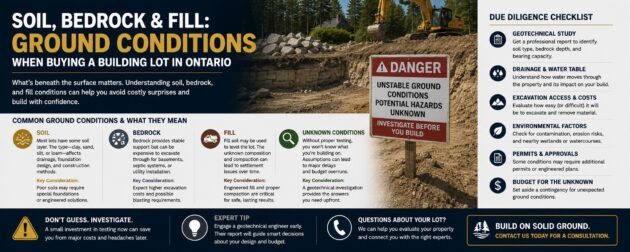
Soil, Bedrock & Fill: Ground Conditions When Buying a Building Lot in Ontario
Soil & ground conditions
Ontario 2026
Clay · bedrock · fill
Soil, Bedrock & Fill: Ground Conditions When Buying a Building Lot in Ontario
When you buy a house, you can see the cracked foundation. When you buy a lot, the ground keeps its secrets – and what’s under the surface decides your foundation type, whether you can have a basement, your septic, and a big chunk of your cost. Ontario lots sit on everything from stiff clay (which swells and shrinks) to shallow bedrock to old fill you shouldn’t build on at all. Here’s how to read the ground, when a geotechnical report is worth it, and how to keep bad soil from becoming a cracked-foundation surprise. From 45 years building across Simcoe County and Georgian Bay.
Why ground conditions decide so much
The soil isn’t a detail you sort out at excavation – it shapes the whole build before you draw a thing:
- Foundation type & cost. Good soil takes a standard footing; clay, fill, or rock can mean engineered footings, deeper excavation, or a different system entirely.
- Basement or not. Shallow bedrock or a high water table can rule out a full basement, or make it expensive.
- Septic. Soils, depth to rock, and the water table are make-or-break for a septic bed (see septic systems Ontario).
- Long-term performance. Fill, clay, groundwater, drainage, and frost are what eventually show up as cracking, leakage, and structural stress in a poorly-planned build.
The soils you’ll meet on Ontario lots
| Ground type | What it means for building | Watch for |
|---|---|---|
| Sand & gravel | Often the friendliest – drains well, good bearing, straightforward footings. | Still confirm depth and the water table. |
| Stiff clay | Common in Ontario and the classic troublemaker – it swells when wet and shrinks when dry, moving footings and slabs. | Expansive movement, drainage, frost; may need engineering. |
| Silt | Can be soft and moisture-sensitive; behaviour varies a lot. | Low bearing in places; water sensitivity. |
| Shallow bedrock / weathered rock | High bearing capacity, but variable rock depth and transitions matter. | Costly excavation/blasting; hard for septic and basements. |
| Fill & organic soils | You generally should not build on uncontrolled fill or organic (peaty) ground. | Removal or engineered solution; the biggest red flag here. |
The clay reality: much of southern Ontario is clay, and clay is moisture-sensitive – it expands wet and shrinks dry, and even small volume changes put pressure on footings and walls. It’s buildable, routinely, but it rewards good drainage, the right footing depth, and sometimes an engineer. It punishes “we’ll figure it out.”
The two books that take you from lot to keys
Know what’s under the lot before you buy – then pull the permit yourself. Each $29.99, or get both below and save.
Before you buy – start here
The Ontario Lot-Buying Bible
Prove a lot is buildable – before you spend a dollar.
$200+ of pro advice$29.99one-time
The 28-page step-by-step: ground conditions and the building envelope, septic and well feasibility, the invisible site-cost budget, legal-lot and zoning, financing and the HST rebate – plus printable worksheets and offer-condition clauses.
- How to read soil clues and when to get a geotechnical report
- The high-water-table and shallow-bedrock chapters
- The 10-minute go/no-go test and printable scorecard
- Bonus chapters: DIY trades, wells, easements, negotiation
30-day money-back guarantee.
Get the Lot Bible – $29.99 →
Secure checkout – download in 2 minutes – yours forever
After you buy
The Ontario Building Permit Bible
Pull your permit yourself – without the guesswork.
$10,000$29.99one-time
Everything a builder does to coordinate a permit – the order of operations, the complete-application checklist that keeps it from bouncing, real fees, who to hire, and how to never fail an inspection.
- The complete-application checklist, so the file doesn’t bounce
- Real 2026 permit fees and development charges
- Who to hire to draw it, in what order, and what to pay
- How to never fail an inspection – and the costliest mistakes
30-day money-back guarantee.
Get the Permit Bible – $29.99 →
Secure checkout – download in 2 minutes – yours forever
Buying a lot and building on it? Get both Bibles.
The complete journey – prove the lot is buildable, then pull the permit without the guesswork.
Before you buy
The Ontario Lot-Buying Bible
Prove a lot is buildable – and what it will really cost – before you spend a dollar.
$29.99 on its own
+
After you buy
The Ontario Building Permit Bible
Pull your Ontario building permit yourself – the order of operations, the checklist, and how to never fail an inspection.
$29.99 on its own
$59.98 Both for $49.99
Get both Bibles →
The geotechnical (soils) report: what it is and what it costs
A geotechnical report is the ground’s medical chart. An engineer drills boreholes or digs test pits, identifies the soil layers and the water table, and tells you what the ground can support and how to found on it. On a residential lot in Ontario, a soils report commonly runs $3,500 to $8,000+, with the higher end for poor soils, groundwater concerns, slopes, retaining walls, or tough access.
When it’s worth it
- Any sign of fill, organic ground, or a high water table
- Slopes, shoreline, or near-water lots
- Variable or unknown soils, or a big/custom home
- When the municipality or your engineer asks for it
What it gives you
- The soil profile and water-table depth
- The bearing capacity and recommended foundation
- Frost and drainage guidance
- The proof a building department wants on a tricky site
Free clues first: before paying for a geotech, you can learn a lot from neighbouring well records (they log the soils and water level drillers hit), the lot’s drainage, and what’s been built nearby. On a tricky or expensive lot, though, a soils report is cheap insurance against a foundation problem.
Not sure what the ground will cost you? Send us the lot.
We’ll read the clues – drainage, neighbouring wells, what’s been built nearby, the slope and water signs – tell you the likely foundation and whether a basement is realistic, flag whether you need a geotech, and ballpark what the ground adds to the build. Quick paid consult: we scope it on a call and send a secure payment link, so you only pay once you know what you are getting. (We’re builders, not geotechnical engineers – we’ll tell you when to bring one in.)
Bedrock, fill & the water table – the three that change the budget
Shallow bedrock
Great bearing, but it gets expensive: blasting or hammering to excavate, harder basements, and septic that may need to be raised or engineered because there’s no soil depth to disperse in. A rocky lot can be beautiful and pricey.
Fill & organics
Uncontrolled fill and peaty/organic ground are the real red flags – you generally can’t found on them as-is. The fix is removal and replacement with engineered fill, or a deep/engineered foundation. Ask whether a lot has been filled.
And the water table ties it all together: high groundwater drives hydrostatic pressure on foundations, can rule out a basement, and pushes up waterproofing, drainage, and grading costs. Wet, clay-heavy ground is the combination that catches the most people. Visit after heavy rain or spring melt and watch where the water sits.
We design foundations for the ground you’ve actually got.
Once the soils are understood, we design the permit-ready set with the right foundation and drainage for the conditions – and build energy-efficient ICF homes whose solid concrete walls and footings handle clay and frost beautifully. One team from the ground up.
Your ground-conditions due-diligence checklist
- Ask the seller and the municipality whether the lot has been filled
- Check neighbouring well records for the soils and water level drillers hit
- Look at drainage and grade – and visit after rain or spring melt
- Watch for exposed rock, wet/soft spots, cattails, and what’s been built nearby
- Confirm septic feasibility – soils and depth to rock are central
- On a tricky or pricey lot, budget a geotechnical report ($3,500-$8,000+)
- Factor any engineered foundation or fill removal into your site-cost budget
Rough it in: the Land Development Cost Calculator helps you put numbers to grading, fill, and site prep before you commit.
Related guides on this site
Soil & ground conditions for a building lot: frequently asked questions
Why do soil conditions matter when buying a building lot?
Because what is under the surface decides your foundation type and cost, whether you can have a basement, how your septic must be designed, and how the home performs over time. Good soil takes a standard footing, while clay, fill, shallow bedrock, or a high water table can mean engineered footings, deeper excavation, a raised or engineered septic system, or no full basement at all. On a vacant lot you cannot see a cracked foundation the way you can in a finished house, so you have to read the ground through clues, records, and sometimes a geotechnical report. Getting this wrong is buried and expensive, so it belongs in your due diligence before you waive conditions.
Is clay soil a problem for building in Ontario?
Clay is buildable and extremely common across southern Ontario, but it is the classic problem soil because it is moisture-sensitive – it expands when wet and shrinks when dry, and even small volume changes put pressure on footings, walls, and slabs. Built well, with proper footing depth, good drainage that moves water away from the house, and engineering where the situation calls for it, clay homes perform fine for decades. Built carelessly, clay shows up later as cracking, sticking doors, and leakage. So clay is not a reason to walk from a lot, but it is a reason to plan the foundation and drainage properly and to budget for doing it right.
How much does a geotechnical / soils report cost in Ontario?
For a typical residential lot in Ontario, a geotechnical or soils report commonly costs in the range of about $3,500 to $8,000 or more. The price depends on how many boreholes or test pits are needed, the drilling access, whether groundwater and poor soils are involved, and whether there are slopes or retaining-wall concerns, all of which make the investigation and engineering review more involved. It is not a small line item, but on a lot with uncertain or poor soils, a high water table, a slope, or a larger custom home, it is inexpensive insurance against a foundation problem – and a building department may require one on a tricky site.
Can you build on shallow bedrock?
Yes, and bedrock offers excellent bearing capacity, but it changes the budget. Excavating shallow rock can require hammering or blasting, which adds cost, and the depth to rock often varies across a lot, so transitions and uneven rock matter. Shallow bedrock also complicates two big things: a full basement may be expensive or impractical, and a septic system may need to be raised or engineered because there is little soil depth to treat and disperse effluent. None of this necessarily makes a rocky lot un-buildable, but you should price the excavation, the foundation approach, and the septic solution before you commit, because a beautiful rocky lot can carry surprising site costs.
Can I build on a lot that has been filled?
Not safely on uncontrolled fill or organic, peaty ground as-is. Random fill settles unevenly and organic soils compress and decompose, both of which cause foundation movement, so you generally cannot found on them without addressing the problem. The fixes are to remove the fill or organic material and replace it with properly compacted engineered fill, or to use a deeper or engineered foundation that bears below the problem layer – and both add cost. The key is to find out before you buy whether a lot has been filled, since it may not be obvious from the surface. Ask the seller and the municipality, and if there is any doubt, a geotechnical investigation will confirm what is down there.
How does the water table affect what I can build?
A high water table, meaning groundwater close to the surface, drives hydrostatic pressure against foundation walls, can crack them or push water into a basement, and often means you cannot have a full basement without significant waterproofing, drainage, and sometimes engineering. It also constrains septic, because the bed needs unsaturated soil depth to treat effluent. Heavy clay makes it worse, since clay drains slowly and holds the pressure. The tells are wet or soft ground, cattails, a low spot that stays green in August, and neighbours whose sump pumps run all spring. Visit the lot after heavy rain or during spring melt, and check neighbouring well records for the static water level before you buy.
How do I check the soil before buying a vacant lot?
Start with the free clues. Look up neighbouring well records, which log the soils and the water level the drillers encountered, study the lot’s drainage and grade, watch for exposed rock, wet or soft spots, and cattails, and look at what has been built nearby and how. Ask the seller and the municipality whether the lot has ever been filled, and confirm septic feasibility, since soils and depth to rock are central to it. If the clues are uncertain or concerning, or the lot is sloped, near water, or destined for a larger home, commission a geotechnical report so an engineer can tell you what the ground can support and how to found on it. Keep firm conditions in your offer until these questions are answered.
Note: general guidance, not engineering advice. Soil behaviour, bearing capacity, and the right foundation turn on the specific lot – confirm with a geotechnical engineer and your building department before you rely on anything here or waive a condition.
More on land and site
Reviewed and updated October 2026. Costs on this site are Ontario ranges, not quotes; code references are to the Ontario Building Code in force at the date above.
Latest posts
Fresh guides, calculators & real-world advice
More from BuildersOntario – scroll to explore.
Loading latest posts…
Tip: shift + mousewheel works great