Ontario's Plain-English Guide to Custom Home Building📞 705-533-1633 | ☎️ 1-866-868-6606 | ✉️ info@icfhome.ca
Will This Lot Give Me Water? Wells on Rural Land in Ontario
Well water
Ontario 2026
Rural lots
Will This Lot Give Me Water? Wells on Rural Land in Ontario
No municipal water means your home drinks from a well – and the single scariest question on a rural lot is whether the ground will actually give you enough good water to live on. A well isn’t a guarantee; it’s a hole you pay to drill before you know what’s down there. Get it right and you have clean water for the life of the home. Get unlucky and you’re staring at a dry hole, a deep redrill, or water that needs serious treatment. Here’s how to gauge a lot’s water before you buy, what a well really costs, and the offer condition that protects you – from 45 years building on rural Simcoe County and Georgian Bay land.
The two things that matter: quantity and quality
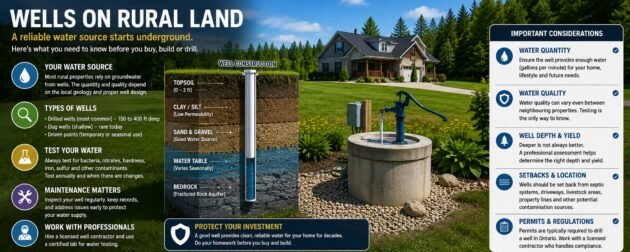
A well has to clear two bars, and a lot can pass one and fail the other. Quantity is whether the well yields enough water, measured in gallons or litres per minute, to run a household reliably through dry spells. Quality is whether that water is safe and pleasant to use, or whether it needs treatment. A lot can have abundant water that smells of sulphur, or beautiful water that barely trickles. You need both – so test for both.
The good news on quality: most rural water issues are treatable. Iron, hardness, sulphur smell, sediment, tannins, and bacteria risk are common and usually solved with the right filtration or treatment. A bad quantity result is the harder problem – you can’t filter water that isn’t there.
How to gauge a lot’s water before you buy
Pull the neighbouring well records
Ontario keeps Water Well Records for drilled wells. Look up wells near the lot to see how deep they had to go, how much water they found, and the water quality. Nearby wells with good yield and clean water are the strongest single signal that your lot will too.
Ask about depth and yield
Depth drives cost and risk. A 100-foot well and a 400-foot well are very different bills. If neighbours are drilling deep or report low yields, budget – and brace – accordingly.
Read the local geology
Aquifers, rock type, and fault lines shape your odds. A quick read of the area’s hydrogeology, or a chat with a local well driller who knows the concession, tells you a lot before a rig ever shows up.
Talk to a local driller
Drillers who work the area know which roads hit water at 80 feet and which fight to 500. Their read on a specific lot is worth more than any general rule.
Put water in your offer
Keep a condition tied to confirming a usable water supply – or to a successful well with an acceptable pump test – so a dry or poor result lets you renegotiate or walk.
The dry-well reality: drilling is a gamble paid up front. If a new well comes up dry, you generally have to abandon it properly and try again – another full bill – unless you choose to keep it for another use. That’s exactly why you gauge the odds and condition your offer before you own the land.
The two books that take you from lot to keys
Check the water before you buy – then pull the permit yourself. Each $29.99, or get both below and save.
Before you buy – start here
The Ontario Lot-Buying Bible
Prove a lot is buildable – before you spend a dollar.
$200+ of pro advice$29.99one-time
The 28-page step-by-step: how to check water and septic feasibility, read the well records, budget the invisible site costs, sort financing and HST, and confirm zoning and legal-lot status – plus printable worksheets and offer-condition clauses.
- The water & septic chapter: gauge a lot before you buy
- The site-cost budgeting worksheet to compare lots all-in
- The 10-minute go/no-go test and printable scorecard
- Bonus chapters: DIY trades, wells, easements, negotiation
30-day money-back guarantee.
Get the Lot Bible – $29.99 →
Secure checkout – download in 2 minutes – yours forever
After you buy
The Ontario Building Permit Bible
Pull your permit yourself – without the guesswork.
$10,000$29.99one-time
Everything a builder does to coordinate a permit – the order of operations, the complete-application checklist that keeps it from bouncing, real fees, who to hire, and how to never fail an inspection.
- The complete-application checklist, so the file doesn’t bounce
- Real 2026 permit fees and development charges
- Who to hire to draw it, in what order, and what to pay
- How to never fail an inspection – and the costliest mistakes
30-day money-back guarantee.
Get the Permit Bible – $29.99 →
Secure checkout – download in 2 minutes – yours forever
Buying a lot and building on it? Get both Bibles.
The complete journey – prove the lot is buildable, then pull the permit without the guesswork.
Before you buy
The Ontario Lot-Buying Bible
Prove a lot is buildable – and what it will really cost – before you spend a dollar.
$29.99 on its own
+
After you buy
The Ontario Building Permit Bible
Pull your Ontario building permit yourself – the order of operations, the checklist, and how to never fail an inspection.
$29.99 on its own
$59.98 Both for $49.99
Get both Bibles →
What a well really costs
The drill bill is only part of it. You’re paying for a complete system that gets clean water into the house, and the total lands in the five figures on most rural lots.
| Piece | Typical 2026 range | Notes |
|---|---|---|
| Drilling a domestic well | about $9,000 – $24,000 | Roughly $45 – $115 per foot; harder rock and more casing push it up. |
| Getting water to the house | add several thousand+ | Pump, pitless adapter, trenching, wiring, pressure tank. |
| Water treatment (if needed) | varies by test result | Iron, hardness, sulphur, bacteria – sized to your water test. |
| The dry-well risk | a second full bill | If it comes up dry, you abandon it and drill again. |
For the full breakdown and the hidden extras, see our deep-dives on well drilling cost in Ontario and the 2026 cost of drilling a well in rural Ontario.
Nervous about water on a rural lot? Send us the address – we’ll check the well records.
Tell us the lot and we’ll pull the nearby well records, read the depth and yield in the area, flag the water-quality issues common on that road, and tell you honestly how the odds look – plus where the well should sit relative to the septic and the house. Quick paid consult: we scope it on a call and send a secure payment link, so you only pay once you know what you’re getting.
Where the well goes matters too
Water isn’t just about whether it’s down there – it’s about where you can legally and safely put the well. A well has to keep its distance from the septic system and other sources of contamination, and it has to fit your driveway, grading, and future plans. The classic mistake is drilling early in the wrong spot, then discovering it conflicts with septic placement or the house location.
Plan the well with the whole site
- Keep required separation from the septic bed and other contamination sources
- Coordinate with the house footprint, driveway, and grading
- You can often drill before the full building permit – but only with a site plan
- Respect setbacks so the well doesn’t block future expansion
Get it tested and recorded
- A licensed driller files the well record and does a pump (yield) test
- Test the water and choose treatment based on the actual results
- Keep the records – they matter for financing, resale, and your own peace of mind
- Re-test water periodically once you’re living there
Water checks out? We’ll site the well, septic, and home as one plan.
We design a permit-ready set that places the well, septic, driveway, and house to all the right separations, draw it, and build the energy-efficient ICF home – with our own site-work crew getting the rural lot ready, well included.
Related guides on this site
Well water on a lot in Ontario: frequently asked questions
How do I know if a rural lot will have water before I buy?
You cannot get a guarantee without drilling, but you can get strong signals. The best single source is the provincial Water Well Records, which document the drilled wells in an area, including how deep they went, how much water they found, and the water quality. Wells near your lot that produce good water in good volume are the strongest indicator that yours will too, while a pattern of deep, low-yield, or problem wells is a warning. Layer on a read of the local geology and aquifers, and a conversation with a well driller who works that concession and knows where water sits, and you will have a realistic picture of your odds. Then protect yourself by keeping a condition in your offer tied to confirming a usable supply, so a poor result lets you renegotiate or walk away rather than owning a lot you cannot live on.
How much does it cost to drill a well in Ontario?
Drilling a domestic well in Ontario commonly runs somewhere in the range of about nine thousand to twenty-four thousand dollars, often quoted at roughly forty-five to one hundred and fifteen dollars per foot, with harder rock, larger diameters, and more casing pushing the price higher. That figure is only the drilling, though. To actually use the water you also pay for the pump, the pitless adapter, trenching and wiring from the well to the house, and a pressure tank, which together add several thousand dollars or more, and you may need water treatment on top depending on your test results. As a result the complete water system on a rural lot typically lands in the five figures. And if a well comes up dry you may face a second full bill to drill again, which is why budgeting a healthy contingency for water is wise on any rural purchase.
What happens if the well comes up dry?
A dry well is the real risk of drilling, because you pay for the attempt whether or not it finds water. If a newly drilled well does not produce, the general expectation in Ontario is that it must be properly abandoned and sealed, unless you as the landowner agree in writing to keep it for another permitted use. Then, if you still need water, you drill again, often deeper or in a different location, which is another full cost. This is exactly why you gauge the odds before buying by checking neighbouring well records and talking to local drillers, and why a water condition in your offer matters so much. If you are buying raw land where water is uncertain, treat the possibility of a second drilling attempt as a real line in your contingency budget rather than a remote worry.
Is well water safe to drink in Ontario?
Well water can be perfectly safe and pleasant, but unlike municipal water it is your responsibility to test and treat it, because no one is doing that for you. Common rural water issues include hardness, iron, a sulphur smell, sediment, tannins, and the risk of bacteria such as coliform or E. coli, and many of these are not visible. The right approach is to test the water, then choose treatment based on the actual results rather than guessing, since the correct filtration or treatment depends on what the test finds. The reassuring part is that most quality problems are treatable with the right system, so a sulphur smell or hard water is usually a solvable nuisance rather than a deal-breaker. Bacterial safety should be confirmed before anyone drinks the water, and the province recommends testing private wells regularly once you are living there, not just at the start.
Can I drill a well before I get my building permit?
In many cases yes, you can drill a well before the full building permit is issued, and some buyers do exactly that to confirm water early. The catch is that you should never drill in isolation, because the bigger risk is not paperwork, it is putting the well in a spot that later conflicts with the septic system, the driveway, final grading, or future expansion. A well has to keep required separation distances from the septic bed and other sources of contamination, so the location is genuinely constrained. The right way to drill early is to do it against a site plan that already respects the setbacks and the servicing layout, ideally with the house, well, and septic positions worked out together. Coordinate with your municipality first, and have your siting decided as part of the whole plan rather than as a standalone gamble on the land.
How far does a well have to be from a septic system?
A well must be kept a safe separation distance from a septic system and from other potential sources of contamination to protect the water you will drink, and the exact required distances are set by regulation and can depend on the type of well and the system. Rather than rely on a single number, the practical point for a buyer is that the well and the septic cannot simply go wherever is convenient, and on a smaller or awkwardly shaped lot fitting both, plus the house, driveway, and grading, to all the required separations can be genuinely tight. This is why siting should be planned for the whole site at once, not piecemeal. When you are assessing a rural lot, it is worth confirming that there is room to place a compliant well and a compliant septic bed along with the home you want, because a lot that cannot fit all three to the required distances is a serious problem dressed up as a small one.
Should I make my offer conditional on water?
On a rural lot without municipal water, yes, protecting yourself on water is one of the most important conditions you can include. Because drilling is paid up front and the result is uncertain, you do not want to be the owner of the land at the moment you discover there is no usable supply. A water condition can be framed around confirming an adequate supply, or around a successful well with an acceptable pump test and water quality, so that a dry hole or a poor result lets you renegotiate the price or walk away rather than absorb the loss. Pair that with your other due-diligence conditions on septic, access, zoning, and title, and keep them all in place until each one is answered in writing. Your lawyer and agent can word the water condition appropriately, but the principle is simple: do not waive water on a verbal reassurance about the neighbour’s well.
Note: general guidance and 2026 planning ranges, not a guarantee of water or a substitute for professional testing. Well yield, depth, quality, and required setbacks vary by lot and are regulated – confirm specifics with a licensed well contractor, the local health unit, and your own water tests before you rely on anything here or waive a condition.
More on land and site
Reviewed and updated October 2026. Costs on this site are Ontario ranges, not quotes; code references are to the Ontario Building Code in force at the date above.
Latest posts
Fresh guides, calculators & real-world advice
More from BuildersOntario – scroll to explore.
Loading latest posts…
Tip: shift + mousewheel works great