Ontario's Plain-English Guide to Custom Home Building📞 705-533-1633 | ☎️ 1-866-868-6606 | ✉️ info@icfhome.ca

Everything Is Fine: Ontario Home Construction (October 2026)
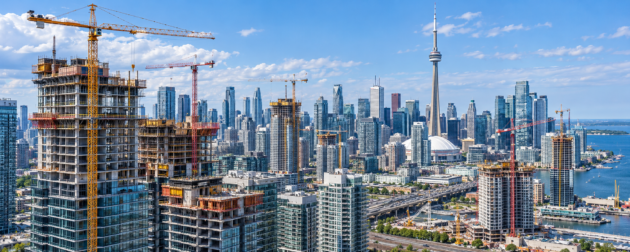
Everything Is Fine
(And Other Hilarious Things About Ontario Home Construction, October 2026 Edition)
Partly satire. All statistics are real. The statistics are the funniest part.
I. The Provincial Bird
If you want to understand Ontario home construction in the fall of 2026, don’t read a spreadsheet. Look up.
The unofficial provincial bird of Ontario is the tower crane: a tall, patient, faintly smug creature that nests for years above major intersections and raises its young on a diet of tarp, diesel, and broken promises. Drive through Toronto, Mississauga, or Ottawa and you will see dozens of them. Each one is holding something up — a building, a sign, or a hope. Increasingly, it is holding up a sign that says “NOW OPENING 2027,” where the 7 is a sticker over a 6, which was a sticker over a 5, which was a sticker over a different 5 from a different year, in what archaeologists will one day classify as the world’s longest-running magic trick: watch closely as this hole in the ground becomes a condo! Any decade now!
The numbers behind the cranes are less whimsical. In August 2026, Ontario housing starts fell to roughly 41,800 units on a seasonally adjusted annualized basis — down about 23 percent from a year earlier, the fourth monthly decline in a row. Multi-unit starts, which is to say the condos, dropped about 31 percent. Meanwhile — and write this down, it becomes important later — single-detached starts rose nearly 10 percent, a second straight year-over-year gain. The condo is face-down in a ditch, and the humble detached house, with its lawn and its driveway and its property taxes that make grown adults weep openly at a TD branch, is having its plucky little moment.
Builders’ group RESCON reported that 2025 condo starts across 34 Ontario municipalities fell 52 percent from the 2021–24 average, ground-oriented starts fell 43 percent, and the slowdown cost 46,562 person-years of employment. Forty-six thousand five hundred sixty-two person-years is not a statistic; that is a small Baltic nation with a pension plan, a flag dispute, and opinions about rye bread. Last year the province’s own Financial Accountability Office put unemployment at 7.8 percent — the highest since 2012, outside the pandemic — and Municipal Affairs Minister Rob Flack conceded that building had come to a “standstill.” A standstill! In an industry whose entire job is motion! That is like your spin instructor announcing the class has achieved stillness. Technically impressive. Economically ominous. Please rate your instructor five stars on the way out.
II. The Condo: A Breakup Story
To understand the condo market — currently lying on the couch in sweatpants, eating ice cream straight from the tub and rewatching a documentary about someone else’s financial ruin for comfort — you must understand pre-construction sales, the beating heart of Ontario’s condo-industrial complex.
The machine works like this: a developer buys land, draws a shimmering glass tower with a yoga studio and a “co-working lounge” (a room with one long table, four power outlets, and the ambient despair of eleven people on competing Zoom calls), sells seventy percent of the units off floor plans before a single shovel touches dirt, uses the deposits to secure financing, and builds the thing. Buyers get in early, everyone gets rich, the crane gets a workout.
Here is how the machine is working now: the buyer examines the floor plan, the price per square foot, the stress test, and the maintenance fees — which now cost more per month than feeding a family of four at Swiss Chalet, including the Festive Special, the chalet dipping sauce, and the guilt — and quietly moves the deposit into a savings account earning four percent. And here is the tragicomic part: that is now a competitive real estate strategy. The money market fund is out-performing a Toronto condo. The condo is losing a footrace to a shoebox that says “GIC” on it. The shoebox is winning by a length.
The result: Toronto pre-construction condo sales hit multi-decade lows in 2025, CMHC projects Ontario’s overall starts will fall to near two-decade lows in 2026, and projects are being delayed or cancelled across the region. CMHC does expect a modest rebound in 2028, which in construction time means “any day now” — the same way “I’ll be there between 8 and 5” means “clear your entire week and one day of the following week, and please don’t make plans in November.”
But before we book the funeral home, look at what the industry is actually doing: finishing things. Developers — an entire profession organized around starting projects — are completing projects. Towers across the GTA are becoming actual buildings with actual walls where the renderings used to be. Sales centres are being converted into coffee shops. The promised “2026 occupancy” is, against all precedent, occurring in 2026. In condo years this is a flight landing early. Applaud the pilots. They are as surprised as you are. The flight attendants have not been briefed.
And the buyer’s strike isn’t madness — it’s math. Condos didn’t get worse; the arithmetic did. When a one-bedroom costs what a detached house costs in Guelph and carries a monthly fee resembling a car payment for a car you don’t get to drive, buyers aren’t being picky. They’re being sane. Sane buyers are terrible for quarterly earnings and wonderful for a market that spent a decade rewarding the exact opposite.
III. The Land of the $257,000 Garage
Now we arrive at the part of the story that makes economists rub their temples and comedians send thank-you cards.
Earlier this year, a four-car garage in Toronto sold for $257,000. Listed at $199,990. Sixteen offers. SIXTEEN. Somewhere out there are sixteen households that lost a bidding war for a garage. Sixteen sets of parents had to look their children in the eye and say, “We didn’t get it. The garage. We lost the garage.” Then they went home to their rented two-bedroom and updated a spreadsheet called GARAGE FUND with a number they now understood to be a child’s fantasy — right next to the tab called DETACHED HOME and the tab called HOPE.
Consider what the garage offers: no bathroom. No kitchen. No “house,” technically, in any sense the dictionary recognizes. And yet the garage needs none of these things, because the garage understands the fundamental truth of Toronto real estate: the house is a rumor. The land is the product. The garage is 1,000 square feet of dirt in a garage costume, and the dirt is what’s holding open house weekend.
This is a proud local tradition. In 2015, a three-bedroom in the Beaches — “extremely poor condition,” “currently not livable,” a hole in the roof, no running water — was shown by flashlight, at your own risk, on the advice of the listing agent. It sold in three days for $1.05 million, $150,000 over asking. “It’s scary looking,” the neighbour told reporters, which is also what the neighbour says about the new price. That teardown is now, presumably, a lovely home. In Toronto, every nightmare is just a butterfly that hasn’t finished its renovation, and every butterfly is listed at $1.4 million, firm, no conditions.
And let us never forget the shed-like bungalow on Euclid Avenue, listed at $999,999 — a price so cheeky it was practically winking — which sold for $800,000 over asking. Eight hundred thousand. Over asking. For a structure that resembled, both structurally and spiritually, the building where your grandfather keeps the lawn darts. Your grandfather has opinions about this. He is not sharing them.
The lesson buried in the absurdity: demand for Ontario land is so durable that a garage with sixteen suitors is, on a long enough timeline, a rational purchase. Somebody is going to live on that dirt eventually. The garage is merely the placeholder with a roof.
IV. Special Bulletin: Everything Is Fixed
📥 Breaking — Province of Ontario — Official
Stop the presses. Put down the spreadsheet. Gather the children.
TORONTO — In a development so stunning that several economists were hospitalized for fainting, the Province of Ontario announced this morning that the housing crisis is over.
All 1.5 million promised homes have been completed. Early. The final house, a charming two-bedroom laneway home in Leslieville, was finished at 9:14 a.m., three weeks ahead of schedule, by a contractor who apologized for the delay and explained that he had “wanted to get it right.” Neighbours described the contractor as “polite” and “clearly fictional.”
Every tower crane in Ontario gently lowered itself to the ground this afternoon and was released into a provincial wildlife reserve near Algonquin Park, where they will live out their days in peace, holding up nothing but the sky.
The Bank of Canada, in an unprecedented joint statement, announced that interest rates are now negative — the bank pays you — and further announced that it is “so sorry” and “should have said yes sooner.” The Governor and the Premier embraced on the steps of Queen’s Park. Both wept. The hug lasted eleven minutes. A junior policy advisor, asked afterward what had changed, said only: “vibes.”
The Eglinton Crosstown opened this morning. It is, by all accounts, nice.
Every garage in Toronto has been converted overnight into a tasteful laneway suite — nobody knows by whom; the elves are refusing interviews — and the sixteen garage-bidding-war families have each been gifted a detached home and a sincere handwritten apology from the housing market itself.
And in the most shocking development of all, the average detached home in the Greater Toronto Area now costs four dollars and a firm handshake, and the handshake is negotiable.
“We simply decided to do the thing we said we would do,” a government spokesperson explained, “and it worked. Turns out it was a morale problem the whole time.”
Economists are calling it the Just Build It, You Cowards Recovery. Nobel Prizes are expected. Parades are scheduled. There is talk of renaming the province “Homerio.”
Just kidding.
None of that happened. The cranes are still up. The sticker still says 2027, and the 7 is doing that thing where it peels at the corner so you can see the 6 underneath, and the 6 is a little see-through so you can see the 5. There was no hug. The Eglinton Crosstown has thoughts. The elves unionized in 2019 and now exclusively build luxury treehouses for tech executives, with a “co-working lounge” (one long branch, profound sadness).
Sorry. We had to. Hope is a muscle; you have to stretch it.
But here’s the strange thing: while you were reading that bulletin — admit it, for one shimmering paragraph you believed it — your shoulders dropped half an inch. That’s the size of the prize. That’s how ready this province is for good news. Now let us tell you some that’s real.
None of that happened. The cranes are still up. The sticker still says 2027, and the 7 is doing that thing where it peels at the corner so you can see the 6 underneath, and the 6 is a little see-through so you can see the 5. There was no hug. The Eglinton Crosstown has thoughts. The elves unionized in 2019 and now exclusively build luxury treehouses for tech executives, with a “co-working lounge” (one long branch, profound sadness).
Sorry. We had to. Hope is a muscle; you have to stretch it.
But here’s the strange thing: while you were reading that bulletin — admit it, for one shimmering paragraph you believed it — your shoulders dropped half an inch. That’s the size of the prize. That’s how ready this province is for good news. Now let us tell you some that’s real.
V. What Actually Happened While You Were Crying
The province’s enhanced HST rebate on new homes is real, and it is live: up to $130,000 in savings on agreements signed between April 1, 2026 and March 31, 2027. One hundred and thirty thousand dollars, or as Toronto agents call it, “one garage, plus a little sign for the garage.” It is the biggest buyer incentive Ontario has produced in years, and it has landed at the precise moment buyers hold actual negotiating power for the first time since the BlackBerry was a status symbol. Price. Upgrades. Parking. Things that were mythical fairy tales in 2021 are now, legally, topics of conversation. You can speak them aloud. In front of a realtor. And the realtor cannot leave.
Ottawa’s Build Canada Homes Act is real too: six direct funding deals worth nearly $300 million already advanced, supporting more than 7,500 homes in Toronto, Ottawa, and beyond, with more in the pipeline. Development-charge deferrals are real. Transit-oriented zoning is real. A billion-dollar municipal fund is being renegotiated with cities — the province calls it rewarding builders, the cities call it rewarding builders but fairly, and the lawyers call it billable hours, which they are billing right now, while you read this, on both sides.
And the Premier is really, truly feuding with the Bank of Canada, explaining that his government is trying to “create the environment” for builders while the central bank “can’t just keep saying no, no, no, no.” Economists call this negotiating tactic “yelling at the weather.” To be fair to the Premier, the strategy has a perfect track record, in that the weather has never once been observed to care — and yet, in a twist nobody saw coming, the weather has recently begun cooperating anyway. Make of that what you will. The Premier is making a lot of it.
Which brings us to the giant spreadsheet in the sky: 1.5 million homes by 2031. In 2024 the province built about 94,000 — roughly 75 percent of the annual pace required. Extrapolate and Ontario crosses the finish line around 2040, nine years late. This sounds bad until you realize that at current savings rates the buyers will have their down payments ready at almost exactly the same time. The whole system arrives at the finish line together, wheezing, in matching foam fingers, and honestly? Shared lateness is a kind of togetherness. Someone will bring a banner. The banner will say 2031. There will be a sticker over the 1.
VI. The Actual Good News, Which Is Not a Joke
The case for optimism is not a coping mechanism. It is a list, and unlike Section IV, every item on it is verifiable.
- Low-rise sales in the Greater Toronto Area have surpassed their ten-year average for five consecutive months. Five. In a row. That is not a blip; that is a trend wearing a blazer. Somewhere a developer is blowing dust off a 2019 subdivision plan and whispering the four most romantic words in the Ontario construction vocabulary: fire up the bulldozer.
- Single-detached construction is up two months running. The market is rotating from the speculative glass-box model toward the humble, lawn-having, fence-disputing house. Painful if you are a condo tower; healthy if you are a province. Economies, like people, benefit from occasionally remembering what they actually need.
- Purpose-built rental construction remains genuinely strong, with rental starts offsetting much of the condo decline. Every crane that finishes a rental tower is a landlord who must now compete for tenants — a beautiful, overdue genre of Canadian comedy after a decade of auditions in the opposite direction. We waited. It is funnier than we hoped.
- Canada needs 108,000 more construction workers over the next ten years, and 21 percent of the current trades workforce is strolling toward retirement. The construction industry is about to become the most employer-desperate institution in the country. If you are twenty-two and weighing a philosophy degree of uncertain market value, accept this free career advice: the province will pay you to learn a trade; the work cannot be outsourced to a server farm; and “person who knows where the load-bearing wall is” has never once been asked to make coffee for an intern. The apprenticeship pipeline is Ontario’s least appreciated stimulus program, and it runs entirely on the tears of everyone who mocked shop class.
- For the first time in years, all three levels of government are pointing in roughly the same direction. Federal money flowing, provincial rebate live, municipalities being bribed, cajoled, and gently blackmailed into approving homes. Governments agreeing on anything is historically rarer than a garage with zero offers, and yet: here we are. Savour this. Take a photo. It may not last.
- Demand has not vanished. It is waiting. Ontario still adds well over 100,000 people a year, and those people do not stop needing roofs because interest rates are being rude. Delayed demand does not disappear; it accumulates — like snow, like laundry, like stickers on the crane sign. Every past Ontario housing downturn has ended the same way: quietly, then suddenly, then with a bidding war for a building with a flashlight hole in its roof. We know how this movie ends. We are just in the slow part in the middle where everyone’s spreadsheet is sad.
VII. A Field Guide to Laughing Through the Next Few Years
Buyers
You have power. Actual power. The era of “best offers by 7 p.m., and do include a letter about your dog” is, for now, a museum exhibit. The HST rebate of up to $130,000 is on the table until March 31, 2027. If you must bid on a garage, bid with your eyes open, your flashlight charged, and a firm ceiling that does not include your children’s RESPs. The garage does not have feelings. You are allowed to walk away from a garage.
Renters
Watch the skyline. Every purpose-built tower that tops off is one more landlord competing for you. Savour this. Bask in it. Frame a photo of a crane. Put it on the fridge. When your lease renewal arrives 14 percent lower than expected, pour yourself something nice and whisper “I told you so” to the crane photo.
The Young and Unskilled
The industry needs you so badly it has stopped being coy. Welding, electrical, HVAC, framing, plumbing — Ontario is about to spend a decade hurling money at anyone who can build a wall that stays a wall. There is an old joke about philosophy majors driving Ubers while tradespeople drive whatever they want, but the statisticians got there first: it’s just called wage data.
Owners of Detached Homes
Congratulations, your asset class is having a renaissance. Use your equity responsibly. Specifically: do not list a garage for $199,990. We are all trying to have a society here. The garage knows what it did.
Everyone
Remember that the crane is not a monument to failure. It is the most honest symbol this province owns — a machine that holds something up, in public, for years, against wind and weather and ridicule, until the thing it holds becomes real. Right now Ontario is holding up a rough couple of years. It will become real too. That is not a metaphor. It is also a metaphor.
VIII. Conclusion: The Garage Will Become a Home
State of the union, October 2, 2026: Ontario is building fewer homes than it should, fewer condos than it did, and more single-detached houses than anyone predicted. The condo crane is now a rare bird. The government is yelling at the weather, and — credit where due — the weather has started flirting back. A garage sold for $257,000 to one of sixteen suitors, and that garage, mark these words, will one day be someone’s starter home, because in this province even the punchlines get rezoned.
The economists say the rebound is modest and scheduled for 2028. The builders say the pipeline is thin. The Premier says the Bank of Canada needs to say yes for once. And the people of Ontario — the bidders, the renters, the tradespeople, the families refreshing listings at 1 a.m. by flashlight — keep doing what they have always done: waiting, saving, and believing, against considerable evidence, that a home is out there with their name on the mailbox.
They are right, of course. Every crane in the sky is a promise with a building permit. Every downturn in this province’s history has ended in a moving truck. And every garage, eventually, becomes something more.
The sign says 2027. Check the sticker.
Epilogue: A Note for the Cranes
To every tower crane still standing over the Ontario skyline: we see you. We know you’re tired. You’ve been up there through three interest rate cycles, two municipal elections, and at least one mayoral race that made national news for reasons nobody can fully reconstruct. You’ve held up renderings, tarps, signs, and — most impressively — our collective patience. Hang on a little longer. The province you’re building for has been through worse, built through worse, and will build through this.
And when the rebound comes — 2028, or whenever the sticker says — you will finally get to do the one thing you were erected to do: come down, gracefully, leaving behind several hundred homes, a yoga studio, a co-working lounge nobody asked for, and a skyline with one more story to tell.
Just kidding about the coming down part.
You’ll be repurposed as the structural support for a splash pad. There’s always another sticker.
Building in Georgian Bay or Simcoe County?
Talk to a builder who has done it 250+ times.
BuildersOntario.com is run by ICFHome.ca — ICF custom-home specialists since 1995. Straight answers on budget, permits, and ICF. No pressure.
Get a Ballpark Estimate →Book a 30-Min Call