Ontario's Plain-English Guide to Custom Home Building📞 705-533-1633 | ☎️ 1-866-868-6606 | ✉️ info@icfhome.ca

Cost of Geothermal Heating in Ontario (2026 Guide): Is It Still Worth It?
Ontario 2026 update
Ground-source heat pump
Real pricing + rebates
Cost of Geothermal Heating in Ontario (2026): Real Pricing, Rebates, and the Don’t-Get-Surprised Checklist
You’re not here for a brochure. You want a real number, a real rebate answer, and a real sense of whether geothermal is worth it on your property. This is written the way builders talk when the tape measure comes out: what it costs, why it costs that, and what to do before you sign anything. Geothermal sounds great – until you see a quote that looks like it includes a free small car.
Quick answer (2026): most Ontario geothermal installs land around $22,000 to $45,000 before rebates, and the loop choice (horizontal vs vertical vs pond) is usually the biggest reason that number moves. Ontario’s Home Renovation Savings program offers ground-source heat pump incentives up to $12,000 (electric/oil/propane/wood homes) or $3,000 for eligible Enbridge Gas customers – and a “without assessment” stream means an energy audit isn’t required for certain rebates. Compare net cost (installed price minus confirmed rebates), not sticker price.
Key takeaways
- You’re paying for a heat pump AND an earth loop field – the loop work drives the quote swings.
- 2026 rebate reality: Home Renovation Savings offers GSHP incentives up to $12,000, or $3,000 for eligible Enbridge Gas customers.
- Big 2026 change: the “without assessment” stream means a home energy audit isn’t required for certain rebates.
- Best first move: run a heat loss calculation before sizing – oversizing costs more and can perform worse.
Geothermal vs air-source, in one line
Air-source is cheaper upfront and faster to install; geothermal often wins on cold-weather stability and long lifecycle value when the site is a good fit. The right call comes from your site, your heat loss, and net cost after rebates – not a slogan. The single most important habit: compare net cost, not sticker price.
The 2026 geothermal landscape in Ontario
Two things have changed. First, the obvious one: labour and material costs have risen, and geothermal is labour-heavy because loop fields require trenching or drilling. Second, and more useful for homeowners, incentives got more straightforward through Ontario’s Home Renovation Savings program, which is designed to reduce friction for common upgrades like heat pumps.
If you read older geothermal content, you’ll see pricing that doesn’t match 2026 reality – that outdated data is why homeowners get whiplash after the first quote. And geothermal isn’t “one product,” it’s a site-built system: a vertical loop in rocky cottage country prices differently than a horizontal loop on a flat rural lot in Simcoe County. Same heat pump brand, different ground, different cost. Start with heat loss, not equipment guessing: the heat loss calculation is the input that makes every quote comparable.
Builder rule: compare net cost, not sticker price. Net cost = installed price minus confirmed rebates. A higher install with a cleaner rebate path can beat a lower sticker that skipped scope.
2026 cost breakdown by loop type
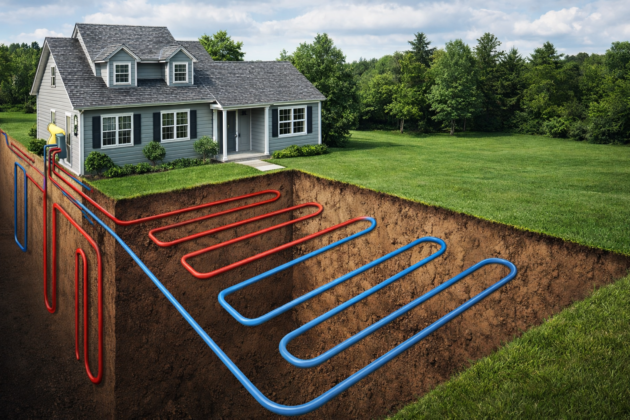
Geothermal pricing swings most on the loop type. The equipment is relatively consistent; the ground work is not. Treat these as Ontario planning ranges – your site moves them.
| System type | Estimated cost (2026, before rebates) | Best for |
|---|---|---|
| Horizontal loop | $22,000 – $32,000 | Large rural lots where trenching is feasible and access is easy |
| Vertical loop | $30,000 – $48,000 | Tight lots, limited trenching space, or where drilling is the practical option |
| Pond / lake loop | $18,000 – $28,000 | Properties with a suitable deep water body and the correct design and approval path |
Usually included in a complete quote
- Heat pump unit and controls
- Loop field install (trenching or drilling) plus header piping
- Flush, fill, and pressure testing (closed loop)
- Electrical and commissioning / start-up
Often excluded – the “surprise money”
- Landscaping and restoration (lawn, driveway, gardens, deck access)
- Ductwork upgrades or hydronic tie-ins
- Backup-heat strategy and controls integration
- Site constraints: access, rock, setbacks, utility congestion
The 2026 factor that changes the net price: rebates
This is where 2026 genuinely improved the geothermal decision. Ontario’s Home Renovation Savings program has a “without assessment” pathway that makes it easier to access heat pump rebates – in plain English, less waiting, less paperwork, and fewer hoops for homeowners who just want to upgrade. A home energy assessment is not required in that stream.
For ground-source heat pumps, the program lists two common scenarios:
- Home heated with electricity, oil, propane, or wood: GSHP incentives listed at $2,000 per ton, up to $12,000.
- Enbridge Gas customers (natural gas primary): GSHP incentive listed at $3,000.
Builder warning: rebates are great, but only when the model qualifies and the paperwork is done correctly. Confirm the exact unit is on the program’s eligible-product list and confirm the program steps before you sign. Details and current amounts are on the official Home Renovation Savings heat pump page.
Comparing geothermal quotes that are thousands apart? Let’s find out why – before you sign.
We’ll run (or review) your heat loss so the system is sized right, tell you which loop type actually fits your site, and read your quotes side by side to spot the missing scope – restoration, ductwork, backup heat, and rebate handling – that makes two quotes look $15,000 apart. Quick paid consult: we scope it on a call and send a secure payment link, so you only pay once you know what you’re getting. No charge to ask.
Geothermal vs air-source heat pumps in Ontario
Every Ontario homeowner asks the same next question: should I just do a cold-climate air-source heat pump instead? Here’s the honest split.
Why air-source wins for many homes
- Lower upfront cost – no loop field to drill or trench
- Faster install for many retrofits
- Good incentives through the same program stream
- Strong performance when sized properly and paired with a decent envelope
Where geothermal still wins
- Cold-weather stability – the ground is steadier than winter air
- Lifecycle value – long ownership can justify the higher upfront cost
- Comfort consistency – fewer capacity swings when designed well
- Longevity – the ground loop can last around 50 years or more, and the heat pump unit often 20 to 25 years with maintenance
A useful authority reference on heat pump durability and general context is NRCan’s heating and cooling with a heat pump, and a homeowner-friendly Ontario comparison is geothermal vs air-source heat pump.
What actually changes your quote (the “why are these two $15,000 apart?” section)
1. Soil, rock, and drilling
Ontario doesn’t hand out identical geology. Vertical drilling is fast in one area and slow (and expensive) in another. In rock-heavy terrain, drilling time, casing, and grouting can dominate the cost – which is why “average” numbers are only a starting range.
2. Drilling vs trenching + access
Horizontal loops are economical on large lots but need room and access. Vertical loops suit tighter sites but the rig still needs access. If the rig has to perform miracles to reach your loop field, your budget will feel the miracle too.
3. Distribution: ducted, radiant, hybrid
Geothermal is a heat source; how you deliver it matters. Undersized or poorly balanced ductwork stays undersized with geothermal. With radiant or hydronics, temperature strategy and buffering matter. Comfort is won in the distribution design.
4. Heat loss (the silent multiplier)
Heat loss determines tonnage, tonnage drives loop size, and loop size drives cost. Contractors who size from “rule of thumb” can accidentally cost you thousands. Do the heat loss first, then design the system – that’s the order.
5. Restoration and finish costs
Loop fields mean disruption. Landscaped yards, interlock, decks, fences, and mature plantings all cost money to restore. That’s not a reason to avoid geothermal – it’s a reason to budget it honestly before you commit.
6. Backup heat and controls
A backup-heat strategy and the controls that tie it all together are real line items – and a common source of “surprise money” when a cheap quote left them out.
Practical rule: buy efficiency (air sealing and insulation) first, then buy equipment size second. A smaller load means a smaller system, a smaller loop field, and a lower cost. The heat loss calculation is what turns that from a slogan into a number.
Putting geothermal in a new build? Get the whole thing right
Geothermal is easiest and cheapest to design into a build, not bolt on later. If this is part of a new home, these two get the budget and permits right. Each $29.99, or get both below and save.
Budget the build
The Ontario Lot-Buying Bible
Where the mechanical budget actually lives.
$200+ of pro advice$29.99one-time
The 28-page step-by-step that budgets a build the way the money flows – land, site, envelope and mechanical choices (geothermal included), financing, HST, and a real contingency. So the heating system is designed in, not squeezed in at the end.
- The hard-cost / soft-cost / contingency budgeting worksheet
- Where envelope + mechanical choices drive comfort and operating cost
- The 10-minute go/no-go test and printable scorecard
- Bonus chapters: DIY trades, wells, easements, negotiation
30-day money-back guarantee.
Get the Lot Bible – $29.99 →
Secure checkout – download in 2 minutes – yours forever
Permit path
The Ontario Building Permit Bible
Because a build with a loop field needs the paperwork.
$10,000$29.99one-time
Everything a builder does to run a permit and coordinate inspections – the order of operations, the complete-application checklist, real 2026 fees, and how the mechanical and site work sequence so nothing bounces.
- The complete-application checklist, so the file doesn’t bounce
- How mechanical and site work fit the inspection sequence
- Real 2026 permit fees and what triggers them
- How to never fail an inspection – and the costliest mistakes
30-day money-back guarantee.
Get the Permit Bible – $29.99 →
Secure checkout – download in 2 minutes – yours forever
Building new with geothermal? Get both Bibles.
Budget the whole build and run the permit – so the loop field and the heat pump are planned in, not bolted on.
Before you buy
The Ontario Lot-Buying Bible
Prove a lot is buildable – and what it will really cost, mechanicals and all – before you spend a dollar.
$29.99 on its own
+
After you buy
The Ontario Building Permit Bible
Pull your Ontario permits yourself – the order of operations, the checklist, and how to never fail an inspection.
$29.99 on its own
$59.98 Both for $49.99
Get both Bibles →
ROI: the simple payback method
Your geothermal ROI isn’t a universal number – it depends on what you’re replacing (electric resistance, oil, propane, natural gas), your heat loss, and your electricity pricing. But there’s a simple method that keeps you out of internet-math trouble:
- Net cost = installed price minus confirmed rebates.
- Annual savings = current annual heating and cooling cost minus estimated geothermal operating cost.
- Payback = net cost divided by annual savings.
Payback improves when you’re replacing higher-cost fuels (electric resistance, oil, propane) and when you reduce heat loss first. And geothermal is easiest to justify when you plan to stay: if you’re moving in three to five years, you may care more about monthly cash flow than long-term lifecycle value. For whole-home comfort context, see the cost of hydronic radiant floor heating and attic insulation cost – the envelope upgrades that shrink the load before you size the system.
How to get accurate quotes (and avoid the cheap-quote trap)
Before you request quotes
- Run a heat loss (or at least provide insulation, air-tightness, and plans).
- Confirm your distribution strategy: ducted vs hydronic/radiant vs hybrid.
- Ask which loop type is proposed and why (horizontal, vertical, or pond).
- Demand scope clarity: restoration, electrical, controls, backup heat, commissioning.
When quotes arrive, compare these
- Loop field scope (length, number of bores, trench length, headering)
- Heat pump model and the capacity basis for sizing
- Controls strategy and backup-heat strategy
- Electrical upgrades, if needed
- Restoration and landscaping scope
- Rebate handling: who files what, and what proof is required
Do those things and quotes become comparable, and “scope surprises” drop dramatically. The homeowners who get burned are almost always the ones who compared a full quote against a quote that quietly left half the job out.
Building new and want geothermal done right from the start? Let’s design it in.
We design and build high-performance ICF custom homes across Simcoe County and Georgian Bay, and we plan the envelope and the mechanical together – so the load is small, the system is sized from a real heat loss, the loop field fits your site, and the rebates are captured. Comfort designed in, not bolted on.
Related guides and tools
Cost of geothermal heating in Ontario: frequently asked questions
What is the average cost of geothermal heating in Ontario in 2026?
A realistic Ontario planning range in 2026 is roughly twenty-two thousand to forty-five thousand dollars before rebates, with vertical drilling on difficult sites sometimes exceeding that. The loop field, meaning horizontal versus vertical versus pond, is usually the biggest driver, followed by heat loss, which sets the system size, then access constraints, and finally distribution upgrades such as ductwork changes or hydronic tie-ins. The reason the range is so wide is that geothermal is a site-built system rather than a single product, so the same heat pump can cost very differently depending on the ground it connects to. The best way to tighten your own estimate is to size the system from a proper heat loss calculation rather than a rule of thumb, and to confirm which loop type your site can actually support before comparing prices, because a quote for the wrong loop type on your lot is not really a quote for your project. Always compare net cost after confirmed rebates, not the sticker price.
What rebates are available for geothermal in Ontario right now?
Ontario’s Home Renovation Savings program lists ground-source heat pump incentives of up to twelve thousand dollars for homes heated with electricity, oil, propane, or wood, calculated on a capacity basis at two thousand dollars per ton, and a three thousand dollar incentive for eligible Enbridge Gas customers whose primary heat is natural gas. These amounts can materially change the net cost of a geothermal project, which is exactly why net cost, meaning installed price minus confirmed rebates, is the number that actually matters when comparing options. The catch is that eligibility and product qualification are specific: the exact heat pump model has to be on the program’s eligible-product list, and the application steps have to be followed correctly, so the safe approach is to confirm both before you sign a contract rather than assuming a unit qualifies. Program amounts and rules can change over time, so the official program pages are the authoritative source, and a contractor who is fluent in the current rebate process and will handle the paperwork is worth more than one who waves vaguely at savings.
Do I need a home energy audit to get the geothermal rebate?
Not necessarily. Home Renovation Savings has a “without assessment” pathway for certain upgrades, which means a home energy assessment is not required in that stream, and this is one of the more meaningful 2026 improvements because it removes the pre-and-post audit friction that older programs required and that slowed a lot of homeowners down. For a single heat pump upgrade in particular, the without-assessment route is designed to make the process faster and simpler. That said, the exact documentation and eligibility rules depend on your specific upgrade and your fuel situation, so you should confirm your path on the official program pages rather than assuming, since not every rebate or every combination of upgrades uses the same stream. The practical takeaway is that the audit barrier that used to deter people is often gone for a straightforward heat pump project, but confirming your own requirements up front still saves surprises, and a good contractor will know which stream applies to your situation.
Is geothermal cheaper to run than a cold-climate air-source heat pump?
Geothermal can have an operating-cost advantage because ground temperatures are far more stable than outdoor air temperatures in winter, so a ground-source system does not lose efficiency the way an air-source unit can during a deep cold snap. That stability is the core reason geothermal is attractive in a cold climate. However, modern cold-climate air-source heat pumps have improved dramatically and perform well in most of Ontario, and they typically cost much less upfront because there is no loop field to drill or trench. So the honest comparison is not simply which technology is more efficient in the abstract, but which one gives you a better net installed cost after rebates combined with a realistic operating-cost estimate for your specific home, based on your heat loss and your local electricity pricing. For a well-sealed, well-insulated home with a good site, geothermal’s running-cost edge can justify the higher upfront cost over long ownership, while for many retrofits the lower upfront cost of air-source wins.
Do I need a big yard for geothermal?
You need more open space for a horizontal loop because it relies on trenching across a loop-field footprint, so large rural lots suit it well. If your lot is smaller, a vertical loop can be the solution because it goes down rather than out, though drilling usually costs more than trenching. And if you happen to have a suitable deep water body, a pond or lake loop can be one of the most cost-effective options of all, provided the design and approvals are done correctly. In Ontario, though, the deciding factor is often not raw yard size but access and restoration: a drilling rig or an excavator needs a way to reach the work area, and a landscaped yard full of interlock, decks, and mature plantings will cost more to restore afterward. So feasibility is really a combination of available space, how the equipment can get in, and how much finished landscaping you will need to repair, which is why an on-site assessment matters more than a general rule about yard size.
Why is vertical geothermal more expensive than horizontal?
Vertical systems usually require drilling deep boreholes, which is specialized work that is highly sensitive to geology, whereas horizontal loops rely mostly on trenching, which is generally cheaper when there is space and easy access. With vertical drilling, rock, the need for casing, the time the rig spends, and the grouting all add cost, and in rock-heavy parts of Ontario those factors can come to dominate the price. Horizontal trenching, by contrast, moves a lot of earth quickly on a suitable lot, so it tends to be the economical choice when the land allows it. Vertical becomes the practical option on tighter lots where there simply is not room to lay out a horizontal field, or where surface conditions make trenching impractical, so the higher cost is really the price of fitting the loop into a constrained site. This is also why two quotes for the same house can differ so much: if one assumes horizontal and one assumes vertical, they are pricing genuinely different amounts of ground work.
Can geothermal heat and cool my home?
Yes. A ground-source heat pump provides both heating and cooling, moving heat into the home in winter and out of it in summer using the same loop field and equipment, which is one of geothermal’s genuine advantages over a heating-only system. How well that heating and cooling actually feels, though, depends heavily on how the home distributes it, meaning the quality and balancing of the ductwork, the zoning, and, in a radiant or hydronic setup, the temperature strategy and controls. A great geothermal unit will not fix poor duct design or an unbalanced distribution system, so the comfort you experience is as much about the distribution as it is about the heat pump itself. That is why distribution planning belongs in the real-cost conversation rather than being treated as an afterthought, and why a serious quote addresses how the heating and cooling will be delivered throughout the house, not just which heat pump is being installed. The equipment is only as good as the system it feeds.
What are the biggest hidden costs in geothermal installations?
The most common hidden costs cluster in three areas. The first is restoration, because loop fields disrupt the yard, and landscaped areas, driveways, decks, and fences all cost money to repair after trenching or drilling. The second is distribution upgrades, since a geothermal heat pump feeding undersized or poorly balanced ductwork, or a radiant system that needs rework, can add significant cost that has nothing to do with the loop or the unit. The third is drilling and trenching surprises, especially rock and difficult access, which can turn a routine loop field into an expensive one. Beyond those, there is a quieter hidden cost that people rarely name, which is oversizing: buying more capacity than the home actually needs because nobody calculated the heat loss. Oversizing raises the upfront cost, enlarges the loop field, and can even hurt performance and comfort. The protection against all of these is the same, which is to insist on a complete, itemized scope and to size the system from a real heat loss rather than a guess.
Is geothermal worth it if I currently heat with natural gas?
It can be, but the case is more nuanced than when you are replacing electric resistance, oil, or propane. With natural gas, the payback depends heavily on the cost spread between electricity and gas, on your home’s heat loss, and on your rebate eligibility, and because gas has generally been an inexpensive fuel in Ontario, the operating-cost savings from switching are usually smaller than they would be against a costly fuel. The Home Renovation Savings program does list a three thousand dollar ground-source incentive for eligible Enbridge Gas customers, which improves the net cost, but that is a smaller incentive than the up-to-twelve-thousand available to homes on electricity, oil, propane, or wood, reflecting the different economics. So if you currently heat with gas, geothermal can still make sense, particularly if you plan to stay in the home long term, you value very stable comfort, and your house is well sealed and well insulated so the load is small, but the decision deserves a careful net-cost and payback calculation rather than an assumption that it will pay for itself quickly.
What should I do before I request geothermal quotes?
Start with a heat loss calculation, because the load it produces is what correctly sizes the system, and sizing from a real number rather than a rule of thumb is the single best way to avoid paying for capacity and loop field you do not need. Next, decide your distribution strategy, meaning whether the home will be ducted, radiant or hydronic, or a hybrid, since that shapes both the design and the cost. Then confirm loop feasibility for your site by checking whether you have space for trenching, access for drilling, or a suitable water body for a pond loop, because that determines which loop type belongs in your quotes. With those three things settled, ask each contractor for a quote that clearly separates the loop field cost, the equipment cost, the distribution tie-in, the electrical work, the restoration, and the commissioning, so that the quotes are genuinely comparable line by line. Doing this homework up front is what turns a confusing pile of wildly different numbers into a clear, apples-to-apples decision, and it dramatically reduces the scope surprises that blow up geothermal budgets.
Note: the price ranges here are Ontario planning estimates for 2026 and vary widely by site, loop type, and distribution – they are not quotes, and rebate amounts and rules change over time. Confirm current pricing with qualified contractors and confirm rebate eligibility and product listing through the official Home Renovation Savings program before you commit.
Latest posts
Fresh guides, calculators & real-world advice
More from BuildersOntario – scroll to explore.
Loading latest posts…
Tip: shift + mousewheel works great

Considering the maintenance cost and other costs, the conventional Force-Air HVAC system seems to be perfect for my job.
Conventional force-air HVAC systems cost about 3,000 3,000,000 per ton of heating or cooling capacity, and geothermal systems start at about $ 5,000 per ton and cost 7 7,500 or ,000 9,000 per ton.
I have yet to be able to get any company to contact me back regarding quoting an installation of a Geothermal system.
Perhaps the reason geothermal is absent in most homes is the fact that there are no companies to provide the service!
Geothermal heating in Ontario can cost $22,000–$48,000 in 2026, depending on loop type and site conditions. Rebates from the Home Renovation Savings program can reduce net costs by up to $12,000, making the investment more feasible. Horizontal, vertical, or pond loops each suit different property types, so sizing and heat-loss calculations are key before committing. If you’re considering geothermal for efficiency, long-term savings, and comfort, go now and get quotes while factoring in rebates and system suitability.
We have a 17 years old ground Source heat pump system and need to repair or replace our geosys heat pump unit (coils) and 80 gal heating system backup/booster hot water tank. How much should it cost to repair or replace the heat pump and replace the heat tank? Is this retrofit project covered by the ON &/or federal rebates?