Ontario's Plain-English Guide to Custom Home Building📞 705-533-1633 | ☎️ 1-866-868-6606 | ✉️ info@icfhome.ca
Cost to Build a Custom Home in Ontario (2026)
Ontario | 2026 | Custom builds
Custom vs spec
Where the money goes
What “Custom” Actually Adds to the Price – and Where Every Dollar Goes
A custom home is not just a bigger or fancier house – it is a one-off, designed and built around your lot, your family, and your choices. That freedom is the whole point, and it is also where the cost lives. The good news is that “custom” does not have to mean “blank cheque.” Once you see where the money actually goes, you can spend it on the things that matter and keep the rest in check.
Here are the real 2026 numbers for a custom home in Ontario, what makes “custom” cost more than a spec build, the budget breakdown most people never see, and how to net out HST so you know your true cost. For the full picture, start with our cost to build a house in Ontario hub.
12026 custom ranges
2Custom vs spec
3Where the budget goes
4HST and your net cost
The short answer: what a custom home costs in 2026
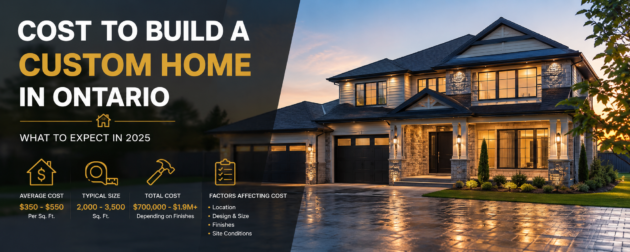
For a professionally built custom home in Ontario in 2026, plan on roughly $375 to $500 per square foot for a mid-range build (structure only, not the land), more in the GTA, and well past $575 – into four figures – for true luxury. In whole-home terms, a 2,500 sq ft mid-range custom build lands around $1.0 to $1.3 million for construction, before land and soft costs.
$375-$500
Mid-range custom, per sq ft
~$1.0-$1.3M
2,500 sq ft mid-range (build only)
$575-$950+
Premium / luxury, per sq ft
Want the per-foot detail by finish level and region? See our cost per square foot to build a house in Ontario guide.
What makes a home “custom” (and why it costs more than a spec build)
A production or spec home is built from a plan the builder has built many times, with set finishes and few decisions left to you. A custom home is designed once, for you – which means more design time, more coordination, more unique details, and more choices. The “custom premium” is not really about granite versus laminate; it is about the cost of one-off design and the freedom to decide everything.
- Design and engineering – your plans are drawn and engineered for your lot, not reused from a catalogue.
- Choice and coordination – every selection is yours, and someone has to price, order, and sequence all of it.
- Site-specific work – the foundation, grading, and servicing are tuned to your exact lot, not a flat subdivision pad.
- Finish freedom – the single biggest lever, because “a little nicer” multiplied across a whole house adds up fast.
The custom mindset: you are buying control – over layout, performance, materials, and how the home lives for decades. Spend on the things you will feel every day (space, light, comfort, the envelope) and stay disciplined on the rest, and a custom home is worth every dollar.
Where the money actually goes in a custom build
Every project is different, but a custom home budget tends to split roughly like this. Finishes are the elastic part – they can swing the whole number:
| Part of the build | Rough share of construction budget |
|---|---|
| Site work & foundation | 10 – 15% |
| Framing, structure & envelope | 20 – 25% |
| Windows, doors & roofing | ~10% |
| Mechanical (HVAC, plumbing, electrical) | ~15% |
| Interior finishes (kitchen, baths, floors, trim) | 25 – 30% |
| Permits, management & soft costs | 10 – 15% |
Illustrative shares for a typical Ontario custom build – your project will vary with design, site, and finish level.
The custom premium: what drives it up, and how to control it
- Finish level – the gap between builder-grade and luxury kitchens and baths is easily a six-figure swing on a larger home. This is where most custom budgets blow up.
- Design complexity – rooflines, angles, tall spaces, and non-rectangular footprints cost more per foot than a simple, efficient design.
- Allowances – if the allowances are low to make the price look good, the difference comes back as change orders. Pressure-test them early.
- Changes mid-build – decisions made after framing (especially after drywall) cost far more. Lock selections early.
- The lot – slope, rock, water table, and servicing all add. See foundation types in Ontario.
The builders who stay on budget are not the ones who spend the least – they are the ones who decide early and change their minds rarely. A clear scope, realistic allowances, and a tight change-order process do more to protect a custom budget than any single cost-cut. See what a good agreement should spell out in our construction contract guide.
The custom cost that hides until closing: HST (and the deadline on it)
A new custom home is subject to 13% HST – a big number that rarely shows up in a per-foot quote. In 2026, Ontario’s enhanced HST rebate can put up to $130,000 back in your pocket. The catch is the deadline.
Miss April 1, 2027 and you could lose up to $106,000
The enhanced rebate maxes out at $130,000 – but only if your build agreement is signed before April 1, 2027. After that it drops back to the old $24,000 rebate. On a typical custom build that is a $106,000 swing in your net cost, so it belongs in your budget from day one.
Estimate based on Ontario’s 2026 enhanced HST rebate (Bill 114). Final eligibility for a custom or owner-built home is confirmed by a licensed rebate specialist – use the HST rebate calculator for your exact number and a free eligibility check.
Custom plus ICF: building it once, building it right
If you are building custom, it is worth getting the part you can never redo – the envelope – right the first time. ICF (insulated concrete forms) builds the insulation into solid, reinforced walls, so a custom ICF home meets the 2026 energy code comfortably and then keeps cutting heating and cooling costs for the life of the home. The shell costs a modest premium per foot; over decades it frequently comes out ahead, and the comfort is immediate. See the ICF cost guide, run the ICF cost calculator, or compare in our cost to build an ICF house guide.
Ready for a real number on your custom build?
Get a no-obligation ballpark from an ICF custom-home builder in Simcoe County and Georgian Bay – design to keys, envelope-first. Call 705-533-1633.
Is a custom home worth it vs buying?
It depends what you are comparing. A resale home is faster and involves fewer decisions, but you live in someone else’s floor plan, with their finishes and their energy performance – and many need immediate renovation spending. A custom home costs more to start, but you control layout, comfort, materials, and operating costs for decades. When you compare total cost to reach the same end result – a home that fits your family and performs the way you want – building often pencils out better than the sticker price suggests.
Related building costs
- Cost to build a house in Ontario – the full picture (this page’s hub).
- Cost per square foot to build a house in Ontario – by finish level and region.
- Cost to build an ICF house in Ontario – ICF vs stick-frame, foot for foot.
- Hidden and soft costs of building a house – the lines people forget.
Frequently asked questions
How much does it cost to build a custom home in Ontario in 2026?
Roughly $375 to $500 per square foot for a mid-range custom build (structure only), higher in the GTA and for luxury finishes. A 2,500 sq ft mid-range custom home lands around $1.0 to $1.3 million for construction, before land and soft costs. Use the calculator for your specific number.
Why is a custom home more expensive than a builder spec home?
A spec home reuses a proven plan and set finishes, spreading design cost across many builds. A custom home is designed once for you, with more engineering, coordination, unique detailing, and choice – and finish freedom that can move the number a lot. You are paying for control and a one-off result.
What is the biggest cost driver in a custom build?
Finish level, by a wide margin. Kitchens, bathrooms, flooring, windows, and trim are where budgets quietly explode. Design complexity and late changes are close behind. Lock selections early and pressure-test your allowances to keep control.
Does a custom home qualify for the HST rebate?
Owner-built and custom homes can qualify for Ontario’s rebates, including the enhanced 2026 rebate worth up to $130,000 if your agreement or construction start falls in the eligible window (before April 1, 2027). Confirm your eligibility with the HST rebate calculator and a specialist.
Disclaimer: Costs are 2026 planning ranges that vary by design, finish, lot, region, and timing. Construction figures exclude land and soft costs unless stated. HST rebate amounts and eligibility depend on your situation and current rules – confirm with a tax professional. This is educational, not a quote.
Latest posts
Fresh guides, calculators & real-world advice
More from BuildersOntario – scroll to explore.
Loading latest posts…
Tip: shift + mousewheel works great