Ontario's Plain-English Guide to Custom Home Building📞 705-533-1633 | ☎️ 1-866-868-6606 | ✉️ info@icfhome.ca
Passive House Builders in Collingwood
Collingwood / Georgian Bay
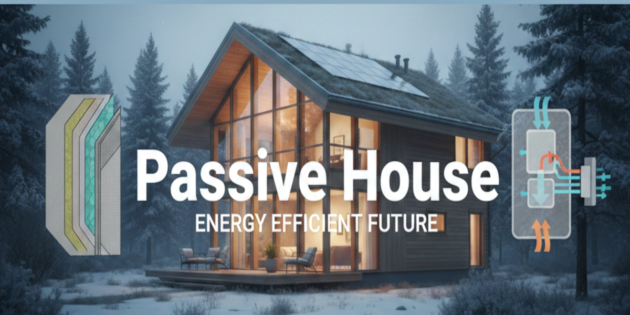
Passive House
Airtight • Quiet • Ultra-Comfort
Passive House Builders in Collingwood: How to Hire the Right Team (and Avoid “Almost Passive”)
If you’re searching “passive house builders Collingwood”, you’re not looking for “a bit better than code.” You’re looking for serious comfort, very low energy use, and a home that stays calm when Georgian Bay weather is doing its usual thing (wind, snow, freeze-thaw… and that one week in July where Ontario pretends it’s Florida). The trick is this: Passive House is less about one magic product and more about a team that can execute details.
Straight Answer
What it is • What to ask
Passive House is a voluntary performance standard. In plain English: a house that needs very little heating/cooling because the envelope is airtight, insulated, thermal-bridge-aware, and paired with balanced ventilation.
What to ask a “Passive House builder” in Collingwood: Have you hit airtightness targets before (with blower door results)? Who is doing the energy modeling? Do you have a written air-barrier plan? How do you handle windows, penetrations, and thermal bridges?
Local reality: In Collingwood, don’t treat permits like an afterthought. The Town’s process commonly starts with zoning compliance (and a zoning certificate may be required for a complete building permit application). Check Collingwood’s zoning certificate info here: Town of Collingwood — Zoning Certificate.
Passive House criteria (the “targets” people talk about) are published by Passive House organizations. A clear overview is here: Passive House Canada — About Passive House.
1) What “Passive House” Actually Means (in Homeowner English)
Passive House (Passivhaus) is a performance standard that focuses on reducing heating and cooling demand so aggressively that comfort becomes the default setting. It’s not a style of house. It’s not a brand. It’s a set of measurable outcomes.
The “big three” targets people reference
- Very low heating demand / load: the building needs little heat because it holds temperature extremely well.
- Exceptional airtightness: measured with a blower door test (this is where “tight” stops being a marketing word and becomes a number).
- Low total primary energy: a cap that encourages efficient systems and appliances.
Builder truth: Passive House is basically a moisture-and-comfort strategy disguised as an energy standard.
Get the air control right, and the rest of the house gets easier to manage.
If you want to see Passive House concepts in builder terms (air sealing, typical leakage points, what actually makes a home “tight”), this pairs nicely: Air sealing an Ontario home (builder reality).
And if you’re early in design, do this sooner than later (it prevents oversized equipment and comfort problems): Heat loss calculation for a new home.
2) How to Choose a Passive House Builder in Collingwood
Here’s the hard truth: lots of builders can build “pretty good.” Passive House asks for “pretty good” everywhere, including the hidden details nobody posts on Instagram. So your hiring process needs to focus on process, not sales lines.
The hiring checklist (use this in your first call)
1) Ask for airtightness results: Not “we build tight,” but actual blower door numbers from past projects.
2) Confirm who models the house: Passive House is typically model-driven (energy + envelope decisions are coordinated early).
3) Demand an air-barrier plan: What is the air barrier? Where is it continuous? How are transitions handled?
4) Ask about window installs: How are windows integrated with the air barrier, water control layer, and insulation?
5) Thermal bridge thinking: Decks, balconies, slab edges, ledgers, steel… how are they handled?
6) Site quality control: Who “owns” the details on site? How are penetrations tracked and sealed?
7) Testing plan: Is there a mid-build blower door (before drywall) so fixes are possible without demolition?
Quick red flags (save yourself time)
- “We’ll worry about airtightness later.” (That’s how you end up with “almost Passive.”)
- No plan for penetrations (HRV ducts, plumbing stacks, electrical, hose bibs, exterior lights… all of it matters).
- They hate details. Passive House is details. If details annoy them, you’re in the wrong room.
In Collingwood specifically, it’s also smart to confirm zoning/permit steps early so the timeline stays predictable. Collingwood provides permit requirements and checklists here: Town of Collingwood — Residential Permits.
3) The Passive House Build Plan: What “Good” Looks Like From Day 1
A Passive House project typically s쳮ds when the team agrees on the sequence early: feasibility → design + modeling → details → procurement → build → test → verify. Miss the sequence and the job turns into expensive improvisation (which is fun in jazz, not so much in construction).
The 80/20 plan that keeps projects on track
Envelope first: Decide insulation levels, air barrier approach, window performance, and thermal bridge strategy up front.
Ventilation plan: Balanced ventilation with heat recovery is typically central—plan duct routes before framing becomes “final.”
Mid-build testing: A blower door test before finishes lets you fix leaks when they’re still accessible.
Simple mechanical: Right-sized systems (often smaller than people expect) deliver better comfort and less short cycling.
Moisture logic: Water control details (flashing, drainage plane, sill details) are non-negotiable—tight homes must also dry correctly.
If you remember one sentence: Passive House isn’t “more stuff.” It’s “the right layers, continuous and verified.”
Want a practical reference point for insulation expectations in Ontario attics (which often becomes part of the Passive House discussion)? See: Ontario attic insulation R-value (2026).
And if you’re comparing envelope systems that make airtightness easier, ICF is commonly part of the conversation: Benefits of ICF over traditional homes. For Collingwood-specific ICF building context: ICF construction in Collingwood.
Mechanical strategy matters too—especially in ultra-tight homes where comfort is about control, not brute force: Best heating system for an ICF home in Ontario.
Next Step: How to Move From “Interested” to “Actually Building”
If you’re serious about building Passive House in Collingwood, the next move is simple: book a feasibility call with a builder (and/or a Passive House designer/consultant), bring a survey if you have it, and confirm the early constraints (zoning/permit pathway, massing, budget drivers, and the envelope approach).
Bring these to the first meeting
- Survey or site plan (even an old one helps as a starting point)
- Any existing drawings (or inspiration plans you like)
- Your “non-negotiables” (noise, comfort, low operating cost, resilience, etc.)
- A willingness to decide the envelope early (that’s where Passive House lives)
A homeowner we worked with wanted “Passive House comfort” for a Collingwood-area build, but the first draft ignored how many penetrations the house actually needed.
We mapped every penetration (HRV, plumbing, electrical, exterior lights, hose bibs) before framing started—and the airtightness work became routine instead of panic.
The best part? The house felt quiet and steady in every season, which is the whole point.
Tip: Passive House done right feels boring—in a good way. No hot/cold rooms. No mystery drafts. Just comfort.
People Also Ask: Passive House Builders Collingwood (FAQ)
Click a question to expand. (Short, practical answers.)
1) Do I need a “certified” Passive House builder, or just a good builder?
The most important thing is a builder with proven airtightness performance and a team that can execute details consistently. Certification is typically tied to the building standard and verification process, not a single trade. Many successful projects combine an experienced high-performance builder with a Passive House designer/consultant who handles modeling and documentation.
2) Is Passive House worth it in Collingwood’s climate?
Many homeowners choose it for comfort: stable temperatures, fewer drafts, and quieter interiors—especially in windy, winter-prone areas. The value isn’t only “energy savings”; it’s also durability and predictability. That said, the best outcome comes from matching the standard to your goals and budget—sometimes “Passive House principles” deliver most of the comfort benefits even without formal certification.
3) What’s the biggest mistake people make when trying to build Passive House?
Treating airtightness like a last-minute product choice instead of a project plan. Airtightness is a sequence (design, details, training, inspection, mid-build testing), not a tube of caulking on closing day. The second biggest mistake is underestimating penetrations and transitions—where layers meet is where performance is either won or lost.
4) Do I still need a building permit in Collingwood for a Passive House?
Yes. Passive House is a voluntary performance target, but the building still follows Ontario permitting rules and the Town’s process. Collingwood’s Building Services section includes checklists and requirements, and zoning compliance steps may be part of a complete application. Start here: Collingwood Residential Permits.
5) Is ICF a good match for Passive House goals?
It can be, especially because ICF assemblies can make airtightness and insulation continuity easier when detailed correctly. But Passive House is system-based: windows, thermal bridges, ventilation, and penetrations still matter a lot. If you’re comparing systems and want a high-performance direction, start with envelope logic first—then pick the wall system that best supports the details and the crew’s experience.
Related tool if you’re planning a high-performance build: Heat Loss Calculator Ontario (2026).