Ontario's Plain-English Guide to Custom Home Building📞 705-533-1633 | ☎️ 1-866-868-6606 | ✉️ info@icfhome.ca

Ontario Deck Railing Height & Guard Requirements 2026: The Code Rules That Trip Up Every DIYer (And Half the Contractors)
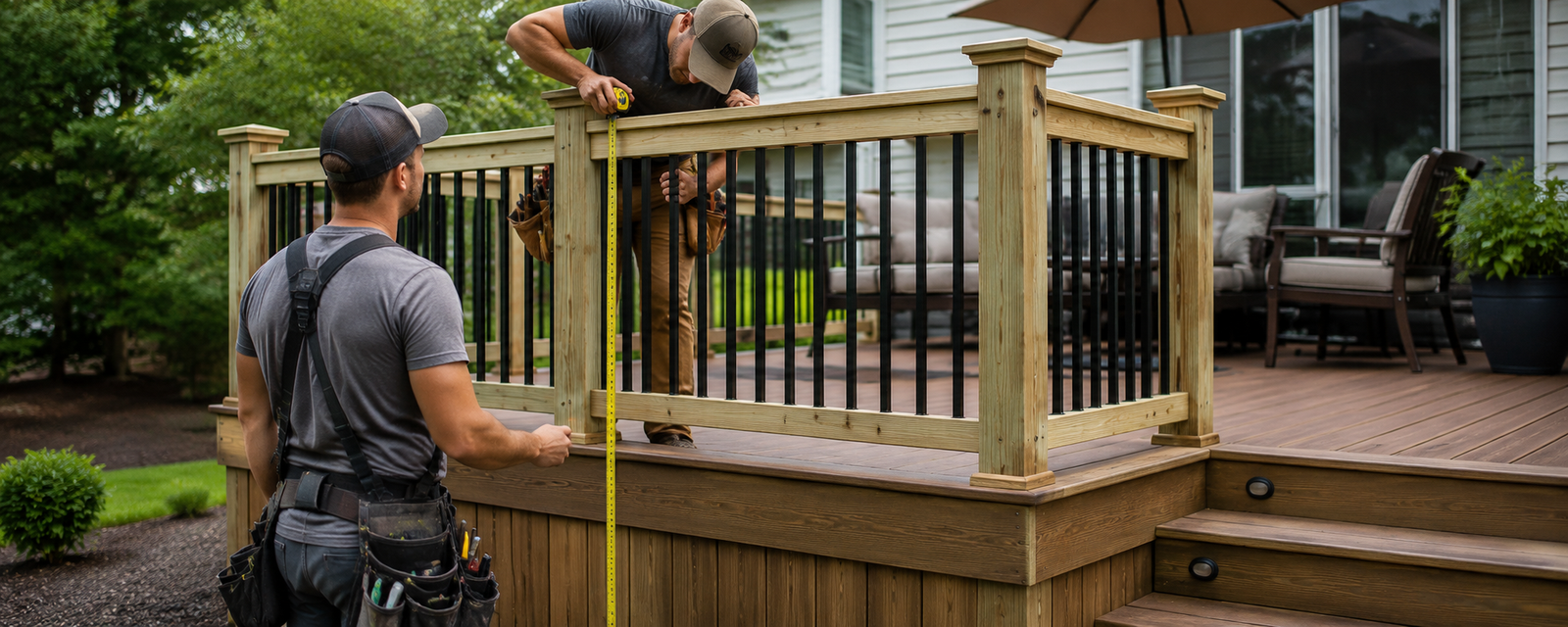
Ontario deck guards and handrails
Deck Railing Height in Ontario: 36″, 42″ and the Rules That Decide Which One
For a typical house deck, the answer is usually 36 inches or 42 inches—but the correct height depends on the drop beside the deck, the finished grade and whether you are talking about a guard or a stair handrail. This guide explains the current Ontario rules in plain English.
The first thing to get straight is the name. The barrier around the open edge of a deck is a guard. A handrail is the graspable rail you hold while using stairs. One assembly can contain both, but the Code treats them as different safety components.
600 mmDifference in elevation that generally triggers a guard
900 mmMinimum guard height in the common 36-inch situation
1,070 mmMinimum guard height in the common 42-inch situation
100 mmLargest sphere that must normally be blocked by openings
When does an Ontario deck need a guard?
A guard is generally required along an open side where the difference in elevation is more than 600 mm between the deck walking surface and the adjacent surface. The Code measurement is not limited to one spot directly below the deck board. It considers the adjacent surface within 1.2 m of the walking surface.
Why this matters on a sloped lot: the ground immediately beside the rim joist may be less than 600 mm below the deck, while the ground a short distance away drops sharply. That nearby slope can still create a guard requirement. Do not use average grade and do not measure only at the easiest corner.
OBC 9.8.8.1How to check the drop properly
1
Start at the finished walking surface
Measure from the top of the completed deck boards—not from the joists, beam or unfinished framing.
2
Check the adjacent surface along the entire open edge
Look at the final ground, patio, stair landing or other surface beside the deck. Check every section, especially corners and slopes.
3
Consider the area within 1.2 m
A steep slope close to the deck can matter even when the grade touching the deck is higher.
4
Use the worst condition
If only one portion exceeds the trigger, protect that open portion. Your building official may require the guard to continue far enough to remove the fall hazard cleanly.
A low deck is not automatically permit-free. A guard may not be required when the elevation difference stays within the Code limit, but municipal permit and zoning rules can still depend on deck area, attachment to the house, setbacks, lot coverage and local procedures.
Is the required deck railing height 36 inches or 42 inches?
For an exterior guard serving one dwelling unit or a house with a secondary suite, the usual rule is:
| Walking surface above finished ground | Minimum guard height | Common description |
|---|---|---|
| Not more than 1,800 mm | 900 mm | About 36 inches |
| More than 1,800 mm | 1,070 mm | About 42 inches |
Guard height is measured vertically from the finished deck surface to the top of the guard. On stairs, guard height is measured from a straight line drawn through the stair nosings to the top of the guard.
Builder’s rule: when the final grade is not complete or the deck is close to 1,800 mm above finished ground, design the guard at 1,070 mm. Six extra inches at the planning stage is cheap. Rebuilding a completed guard is not.
OBC 9.8.8.3When 42 inches may still not be enough
The 900 mm and 1,070 mm rules above describe the normal house-deck situations. Other occupancies, shared exterior areas and unusual locations can require different treatment. Exterior stairs and landings more than 10 m above adjacent ground have a higher guard requirement. This page is written for ordinary Part 9 residential decks—not apartment balconies, assembly occupancies or commercial exits.
Baluster spacing and openings in deck guards
Most required guard openings must prevent a 100 mm diameter sphere from passing through. This applies to openings between balusters and to other openings through the guard.
Use 100 mm—not “four inches”—when laying out the work. Four inches is 101.6 mm. Building to a full four-inch clear gap leaves no tolerance for lumber movement, crooked balusters or measuring error. Set the clear opening below 100 mm.
OBC 9.8.8.5The triangular stair opening
The triangular opening formed by the stair tread, stair riser and the bottom element of a required stair guard must prevent a 150 mm diameter sphere from passing through. This is a separate rule from the normal 100 mm opening limit.
The bottom gap
The space under a bottom rail is an opening through the guard. It must comply with the applicable opening limit. Do not rely on the thickness of the deck board or a decorative trim piece unless the completed assembly is durable, securely attached and still meets the required guard loads.
Can I use horizontal rails or cable railing in Ontario?
The Code requires most guards to be designed so that members, attachments and openings between 140 mm and 900 mm above the protected walking surface do not facilitate climbing.
That is why a typical ladder-like arrangement of horizontal wood rails is a poor choice. Cable railing is not automatically approved simply because the openings look small. The complete system must address:
Geometry
Openings remain within the permitted size.
The arrangement does not create easy footholds in the restricted zone.
The bottom, corners and stair transitions also comply.
Performance
Cable deflection does not create an oversized opening under load.
Posts, rails, anchors and supporting framing resist the required loads.
The building department accepts the tested system or design documentation.
Do not buy a railing kit based only on the words “code compliant.” Ask for documentation identifying the code edition, permitted applications, post spacing, fasteners, substrate and installation details. A product approval does not cover a different layout or improvised attachment.
OBC 9.8.8.6How strong does a residential deck guard have to be?
A guard is a structural safety assembly. It is not enough for it to stand straight or feel solid during installation. For guards within dwelling units and exterior guards serving not more than two dwelling units, the Ontario load table includes:
| Load location | Minimum specified load |
|---|---|
| At the minimum required guard height | 0.5 kN/m or a concentrated 1.0 kN load, whichever creates the critical condition |
| On guard elements, panels or balusters | 0.5 kN applied over a maximum width and height of 300 mm, subject to the Code loading method |
| Vertical load at the top of the guard | 1.5 kN/m |
Why “just through-bolt the post” is not enough
A bolt size by itself does not prove the guard connection works. The load path runs from the top rail into the post, through the connection, into the rim board or joists and finally into the deck structure. A connection can fail by bolt withdrawal, wood splitting, rim-board rotation, crushing, inadequate blocking or weak supporting framing.
Use one of the following:
Prescriptive or tested construction
A municipal standard detail accepted for that deck configuration.
A complete proprietary guard system installed exactly to its tested instructions.
A recognized housing-guard detail applicable to the materials and layout used.
Designed construction
A connection and supporting-frame detail prepared by a qualified designer or engineer.
Blocking and hardware shown on the permit drawings.
No substitution of fasteners or substrates without approval.
Deck stair handrails: different rules from guards
For stairs serving a single dwelling unit, a handrail is generally not required on an exterior stair with no more than three risers. An exterior stair with more than three risers requires a handrail, subject to the applicable stair-width and location rules.
Required handrails are normally 865 mm to 1,070 mm high, measured vertically from the top of the handrail to a line tangent to the stair nosings. They must remain continually graspable and have no obstruction on or above them that breaks the handhold.
A wide flat deck-board cap is not automatically a handrail. It can be part of the guard, but the required stair handrail must provide a continuous graspable surface. Many deck stairs use a separate handrail mounted inside the guard.
OBC 9.8.7.1 OBC 9.8.7.4 OBC 9.8.7.5| Item | Typical Part 9 house-deck rule | Reference |
|---|---|---|
| Guard trigger | More than 600 mm difference in elevation, considering the adjacent surface within 1.2 m | 9.8.8.1 |
| Residential exterior guard, deck not more than 1,800 mm above finished ground | 900 mm minimum | 9.8.8.3 |
| Residential exterior guard, deck more than 1,800 mm above finished ground | 1,070 mm minimum | 9.8.8.3 |
| Normal maximum guard opening | Must prevent passage of a 100 mm sphere | 9.8.8.5 |
| Triangular opening at stair guard | Must prevent passage of a 150 mm sphere | 9.8.8.5 |
| Restricted climbing zone | 140 mm to 900 mm above the protected surface | 9.8.8.6 |
| Required stair handrail height | 865 mm to 1,070 mm in the normal case | 9.8.7.4 |
| Exterior stairs serving a single dwelling unit | No handrail exemption after three risers | 9.8.7.1 |
Will my municipality require a deck permit?
Permit requirements are administered by the local building department. Height is only one factor. Municipalities may consider whether the deck is attached to the house, its area, zoning setbacks, lot coverage, septic location, conservation authority restrictions and other site conditions.
Before ordering material, confirm:
Planning and zoning
Rear, side and shoreline setbacks
Maximum projection and lot coverage
Easements, conservation and septic restrictions
Building permit
Required drawings and site plan
Footings, beams, joists and ledger details
Guard system and post-connection details
See our complete Ontario deck permit guide and confirm the final requirements with your municipality.
Pre-inspection deck guard checklist
Measurements
Final guard height measured from finished surfaces
Every ordinary opening is less than 100 mm clear
Stair triangle blocks a 150 mm sphere
No oversized opening at corners, gates or the house wall
Stair handrail is within the permitted height range
Construction
Posts and rails match the approved drawings or tested system
Correct blocking, anchors, bolts and fasteners are installed
No ladder-like elements in the restricted climbing zone
Handrail remains continuously graspable
Cut ends, holes and field modifications follow manufacturer instructions
Common failure: installing a manufactured railing system with wider post spacing, different fasteners or a different mounting surface than the evaluation or installation manual permits. The product and the installation must match.
Need help with the deck permit?
Use the DIY guide or have a permit-ready drawing set prepared for your project.
The Ontario Deck Bible
A practical guide to the permit process, drawings, framing, footings, stairs, guards and inspections.
$29.99 one-time
- Plain-English Ontario deck requirements
- Permit-submission checklist
- Guard, handrail and stair guidance
- Downloadable reference you can keep
Secure checkout · digital access
Permit-Ready Deck Plans
Site plan, framing plan, elevations, section and details prepared for municipal submission.
$399 up to 500 sq. ft.
- Project-specific drawing set
- Guard and handrail information shown
- Designed for your municipal submission
- Free quote before you commit
Additional charges may apply for larger or complex projects.
Frequently asked questions
When is a guard required on an Ontario deck?
A guard is generally required where the difference in elevation is more than 600 mm between the walking surface and the adjacent surface. The nearby surface within 1.2 m must be considered, which is important on sloped lots.
Is Ontario deck railing supposed to be 36 inches or 42 inches high?
For an exterior guard serving one dwelling unit, the minimum is normally 900 mm—about 36 inches—where the deck walking surface is not more than 1,800 mm above finished ground. Above 1,800 mm, the normal minimum is 1,070 mm—about 42 inches.
Does a deck below 24 inches need a railing?
It may not require a guard when the relevant elevation difference remains at or below 600 mm, but measure the adjacent surface properly, including nearby slopes. A low deck can still be subject to municipal permits, zoning and other approvals.
Can the gap between deck balusters be four inches?
The Code uses a 100 mm sphere test. A full four-inch clear gap is 101.6 mm, so it is safer to lay out balusters with a clear opening below 100 mm.
What is the maximum triangular opening at the bottom of deck stairs?
The triangular opening formed by the stair tread, riser and bottom guard element must prevent a 150 mm diameter sphere from passing through.
Are horizontal deck railings legal in Ontario?
A required guard must not facilitate climbing in the area between 140 mm and 900 mm above the protected surface. A typical ladder-like horizontal arrangement is difficult to justify under that rule. Use a tested or designed system accepted for the proposed application.
Can I install cable railing on my deck?
Only when the complete system meets the opening, climbing, loading, deflection and attachment requirements. Obtain the manufacturer’s Canadian code documentation and confirm acceptance with the building department before purchasing.
Do deck guard posts have to be through-bolted?
There is no single bolt rule that makes every guard connection compliant. The post, hardware, blocking, rim board, joists and supporting structure must form a load path capable of resisting the required guard loads. Follow an accepted detail, tested system or project-specific design.
When does an exterior deck stair need a handrail?
For a stair serving a single dwelling unit, the exemption generally ends when the exterior stair has more than three risers. The required handrail is normally 865 mm to 1,070 mm high and must remain continually graspable.
Does a 2×6 top cap count as a handrail?
Not automatically. A cap can form part of the guard, but a required stair handrail must provide a continuous graspable surface. A separate handrail is often needed on deck stairs.
Continue planning your Ontario deck
Guard details work only when the framing, stairs, footings and permit drawings work with them.
Build a Deck in OntarioComplete planning and construction guide.
Deck Stairs and HandrailsRisers, runs, landings and graspable rails.
Deck FramingJoists, beams, posts and load paths.
Deck FootingsFoundation options and site considerations.
Drawings and InspectionsWhat the municipality wants to see.
Ontario Deck PermitsApprovals, submission and local checks.
Code basis: Ontario Regulation 163/24 currently adopts the National Building Code of Canada 2020, First Printing, together with the Ontario Amendments dated April 21, 2026. The principal residential guard and handrail provisions discussed here are in Division B, Articles 9.8.7.1, 9.8.7.4, 9.8.7.5 and 9.8.8.1 to 9.8.8.6.
Official references: O. Reg. 163/24 · Ontario’s Building Code information.
Disclaimer: This page explains common Part 9 house-deck requirements for general education. It is not a substitute for the complete Building Code, approved permit drawings, product evaluation, engineering or instructions from the authority having jurisdiction. Confirm the current requirements for your property with the local building department before construction.
You note in your section “When is a Guard Required “, “The measurement is taken from the deck surface to the ground directly below the edge. Not the average grade. Not the high point. The point directly below the unprotected edge.” The 2026 Ontario Building code has actually changed this and OBC 9.8.8.1 (1) has added that the guard is required “..where the difference in elevation is more than 600mm between the walking surface and the adjacent surface within 1.2m.” so it is not as you state directly below the unprotected edge (of the deck) but rather and adjacent surface the adjacent surface to be considered extends up to 1.2m from the edge of the unprotected edge. so if the grade slopes away form the deck you must look at the elevation of th egrade up to 1.2m from the edge of the deck. not simply the grade immediately below the unprotected edge.
Good description of the rules. I assume the photo at the top was a failed attempt because of the horizontal climbing bars if nothing else. But I may be wrong???
No, it failed because the guy doing the measuring has two left hands, one of which faces the wrong way, and because his left foot has melted right into the deck. Both of these will cause your deck to fail inspection.