Ontario's Plain-English Guide to Custom Home Building📞 705-533-1633 | ☎️ 1-866-868-6606 | ✉️ info@icfhome.ca
Should I Renovate or Rebuild?
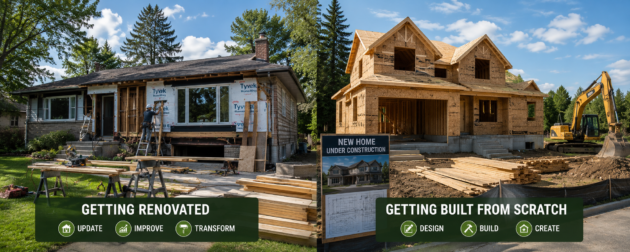
Renovation vs. rebuild
Ontario 2026 costs
10 & 20-year comparison
Should I renovate or rebuild? Ontario calculator 2026
The gut renovation vs. tear-down-and-rebuild question is one of the most expensive decisions a homeowner makes. This calculator models both paths – upfront cost, resulting value, and 20-year financial outcome including energy and maintenance savings – so you can decide with numbers, not gut feel.
How this works: enter your home’s details, desired outcome, and renovation scope. We model the full cost of a deep renovation vs. a new custom build on the same lot – including temporary accommodation, energy savings, maintenance, and estimated value at 10 and 20 years – then show which path makes more financial sense for your situation. Planning estimate only; always get written quotes.
Tell us about your property & goals
Older homes have higher hidden renovation costs.
Approximate heated floor area.
$
What your home would sell for today as-is.
$
Value of the land alone – key to the rebuild math.
More scope = renovation cost approaches rebuild cost.
A new build can be a different size than the existing home.
Affects build cost, appreciation, and resale.
ICF adds about $15,000-$25,000 upfront but saves long-term.
On the fence? Get a real ballpark for both paths and decide with numbers.
We design and build custom ICF homes – and we do additions and renovations – across Simcoe County and Georgian Bay, so we can price both sides honestly. Tell us about your home and we’ll tell you which way the math leans. No charge to ask.
When rebuilding usually wins
The renovation vs. rebuild decision isn’t only financial – but the financials are usually the deciding factor. Here are the situations where a rebuild consistently comes out ahead:
Foundation problems
Failing foundations, significant settling, or water intrusion that requires major structural repair. Once you’re spending $60,000+ on structure, the math shifts to rebuild.
Outdated systems
Knob-and-tube wiring, 60-amp service, galvanized plumbing, asbestos insulation, or failing HVAC. Replacing all systems in an occupied home is expensive and disruptive.
Wrong floor plan
When the layout fundamentally doesn’t work and fixing it means moving load-bearing walls, stairs, or plumbing stacks – costs accelerate quickly.
Wrong size
If you need significantly more space, an addition is often more expensive per square foot than a new build. Rebuilding lets you design the right size from scratch.
Energy performance
Older homes are nearly impossible to bring to modern energy standards through renovation. A new ICF build delivers R-28+ walls; a renovated home rarely exceeds R-14 effective.
Reno cost over 60% of rebuild
When a full renovation costs more than 60% of a new build, you get a new home – with warranty, modern systems, and your exact layout – for a relatively small premium.
When renovating usually wins
Solid structure
Good foundation, solid framing, no major moisture or rot. The bones are worth keeping – cosmetic and mechanical updates can transform the home for far less than a rebuild.
Heritage or zoning
Heritage designation, restrictive zoning, or setback rules that would limit a new build. In some cases the existing home holds legal non-conforming rights a new build couldn’t get.
Character & location
Mature trees, established gardens, unique architecture, or a neighbourhood where new builds look out of place. Sometimes what you have is genuinely worth preserving.
Timeline
If you need to be in the home within 6 months, a deep renovation is usually faster. New custom homes in Ontario take 12-18 months from permit to occupancy.
The ICF rebuild advantage – why it changes the math
A new ICF home delivers energy savings of 40-60% compared to an older conventionally-built home. Over 20 years those savings – combined with lower maintenance, no surprise repair bills on aging systems, and a full Tarion warranty – often close the gap between renovation and rebuild costs entirely. Model it for your home with the ICF 25-year energy savings calculator.
The hidden costs of a deep renovation
The renovation budget homeowners start with is rarely the one they finish with. Here’s why:
- Discovery costs – once walls are open, surprises appear: hidden rot, asbestos, mould, undersized structure, old wiring that can’t be extended. Budget 20-30% contingency on top of any renovation estimate.
- Temporary accommodation – a deep renovation typically takes 6-12 months. Renting elsewhere adds $15,000-$40,000 to the true cost that rarely appears in the estimate.
- Compromise – renovating within an existing structure means compromises on ceiling height, room size, plumbing locations, and structural spans that a new build wouldn’t have.
- Energy-performance ceiling – you can add insulation, new windows, and a heat pump, but you can rarely reach the airtightness and thermal performance of a properly built new home.
- No warranty – a completed renovation doesn’t come with a Tarion warranty. A new home does: 1-year workmanship, 2-year systems, 7-year structural.
For a full breakdown of a new custom-home budget, see the custom home building calculator and the full cost of building in Ontario guide.
Frequently asked questions
What does a full gut renovation cost per square foot in Ontario in 2026?
A full gut renovation – stripping to studs, replacing all mechanical systems (plumbing, electrical, HVAC), new insulation, windows, and finishes – typically runs $200-$350/sq ft in Ontario depending on location, finishes, and what surprises emerge. For a 1,600 sq ft home that’s $320,000-$560,000. At the high end that approaches or exceeds the cost of a new build on the same lot, which is why the rebuild option deserves serious consideration for aging homes with significant work needed.
What does a new custom home cost per square foot in Ontario in 2026?
A new custom home in Ontario runs roughly $250-$400/sq ft for the build itself (excluding land, site work, permits, and development charges) depending on location, complexity, and finishes. ICF construction adds about $15,000-$25,000 but delivers dramatically better energy performance, lower maintenance, and a full Tarion warranty. See the custom home building calculator for a detailed estimate based on your inputs.
Can I stay in my home during a deep renovation?
For a cosmetic renovation, usually yes. For a deep renovation – gut-level work on kitchen, bathrooms, electrical, plumbing, and insulation – the reality is difficult. Dust, noise, no functional kitchen or bathrooms, and safety concerns make it uncomfortable at best and impractical at worst for families with children. Budget for temporary accommodation (typically $1,500-$3,500/month depending on location) as a real cost of the renovation, not an optional extra.
Do I need a permit to tear down and rebuild?
Yes – demolition requires a demolition permit, and the new build requires a full building permit. In some municipalities, zoning rules mean the new build must meet current setback requirements, which could be more restrictive than what the existing home enjoys as a legal non-conforming structure. Always check zoning before committing to a teardown. Our guide to Ontario building permits covers the process.
Is ICF worth it for a new build vs. renovating to improve energy efficiency?
Almost always yes, and this is where the rebuild math gets interesting. A deep renovation that includes new insulation, air sealing, and windows might bring an older home from EnerGuide 45 to about 65. A new ICF build routinely reaches EnerGuide 80-85. The energy-cost difference over 20 years, combined with ICF’s lower maintenance, stronger structure, and full warranty, often more than justifies the new-build premium. Use the ICF energy savings calculator for your home size and fuel type.
How do I know what my lot is worth separately from my house?
The lot value is a critical input in the rebuild decision. The simplest approach is to look at comparable vacant-lot sales in your neighbourhood – what did nearby raw lots sell for in the past 12 months? A local real estate agent or appraiser can help. In the Georgian Bay and Simcoe County area specifically, lot values have risen dramatically and often represent 30-60% of total property value, which significantly improves the rebuild math.
Does a teardown-rebuild qualify for the HST new-home rebate?
Generally yes – a new home built on your lot after a teardown is new construction, so it can qualify for the Ontario and federal new-housing HST rebates, and potentially the enhanced Ontario rebate of up to $130,000 if the timing rules are met. A renovation, even a deep one, usually does not, unless it rises to the level of a “substantial renovation” as defined by the CRA. That rebate difference is one more factor that can favour a rebuild. Check your number with the HST rebate calculator and confirm eligibility with a tax professional.
Related calculators & guides
Whether you renovate or rebuild, these tools help you budget the full picture.
Custom home building calculator
Full all-in budget for a new custom build – structure, mechanical, finishes, soft costs.
buildersontario.com →
ICF 25-year energy savings calculator
Model long-term energy savings of ICF vs. wood frame, including payback period.
buildersontario.com →
Ontario development charges calculator
If you rebuild, DCs apply. Estimate what you’ll owe at permit by municipality.
buildersontario.com →
Ontario building permit cost calculator
Estimate your permit fee for a rebuild or major renovation by municipality.
buildersontario.com →
Heat loss calculation – permit ready
Required for every new-home permit in Ontario. BCIN-stamped CSA F280, 48-hour delivery.
ontarioheatloss.ca →
Additions & renovations – ICFhome.ca
Our renovation and addition services in Simcoe County and Georgian Bay.
icfhome.ca →
Builder’s honest take on renovation vs. rebuild
After 45 years of building in Ontario, we’ve seen both paths up close. The projects that generate the most regret are usually deep renovations of homes that should have been rebuilt – where the homeowner spent $400,000 renovating a 1970s bungalow and ended up with a renovated 1970s bungalow. The projects that generate the most satisfaction are new ICF builds where the homeowner made a clear-eyed decision, budgeted properly, and moved into a home that will perform beautifully for 50 years. If you’re genuinely on the fence, get a ballpark estimate for both – then decide with real numbers in front of you. Get a ballpark estimate →
Disclaimer: this calculator provides estimates for planning and comparison only, based on typical 2025-2026 Ontario construction costs and market assumptions. Actual costs, resale values, and financial outcomes vary significantly based on your specific property, location, scope, contractor, and market conditions. Always get written quotes from qualified contractors before making any financial decision. BuildersOntario.com and ICFhome.ca accept no liability for decisions made based on these estimates.
Latest posts
Fresh guides, calculators & real-world advice
More from BuildersOntario – scroll to explore.
Loading latest posts…
Tip: shift + mousewheel works great