Ontario's Plain-English Guide to Custom Home Building📞 705-533-1633 | ☎️ 1-866-868-6606 | ✉️ info@icfhome.ca
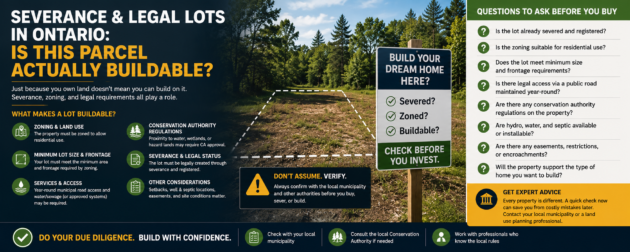
Severance & Legal Lots in Ontario: Is This Parcel Actually Buildable?
Severance & consent
Ontario 2026
Is it a legal lot?
Severance & Legal Lots in Ontario: Is This Parcel Actually Buildable?
Before zoning, before septic, before any of it – the parcel you’re buying has to be a legal lot you’re actually allowed to build on. Buyers rarely think to check this, and it’s one of the quietest, most expensive traps in Ontario land: a “lot” that was never properly created, two parcels that have silently merged into one, or a severance that isn’t finished yet. Here’s how severance (consent) works, how to confirm a parcel is a legal lot of record, and the protections to put in your offer – from 45 years building across Simcoe County and Georgian Bay.
“Legal lot of record” – the thing nobody checks
A legal lot of record is a parcel the law recognizes as a separate, conveyable, buildable lot. It sounds obvious, but “it’s listed for sale” does not guarantee it. A parcel can be marketed as a lot and still not be a legal building lot in the eyes of the municipality – and if it isn’t, you can’t get a building permit on it, full stop.
The trap that ends builds: if a parcel was split off improperly, or relied on a severance that was never completed, or merged with the lot next door under common ownership, you may own land you simply cannot build the home you wanted on. “Future development potential” in a listing is often the tell that the lot status is not settled. Confirming legal-lot status is your lawyer’s job – make it a condition of the offer.
What a severance (consent) actually is
A severance – officially a consent – is the approval to divide one parcel of land into two or more separate lots. It’s governed by Ontario’s Planning Act and decided locally by the municipality’s Committee of Adjustment (or the land division committee). You’ll run into severance in two ways as a buyer:
- You’re buying a lot that’s being severed off a larger property – the seller is creating the new lot for you, and that severance has to be finished before you can build.
- You want to split a property you own (or are buying) to create a building lot – which means applying for consent yourself.
Either way, the key idea is the same: a new lot doesn’t legally exist until the consent is granted, its conditions are met, and the certificate is issued. Until then, it’s a plan, not a parcel.
The two books that take you from lot to keys
Confirm you’re buying a real, buildable lot – then pull the permit yourself. Each $29.99, or get both below and save.
Before you buy – start here
The Ontario Lot-Buying Bible
Prove a lot is buildable – before you spend a dollar.
$200+ of pro advice$29.99one-time
The 28-page step-by-step: legal-lot and severance checks, zoning and the building envelope, the invisible site-cost budget, septic and well feasibility, easements, financing and the HST rebate – plus printable worksheets and offer-condition clauses.
- The legal-lot & title checks to demand before you waive conditions
- Offer-condition clauses, including legal-lot status
- The 10-minute go/no-go test and printable scorecard
- Bonus chapters: DIY trades, wells, easements, negotiation
30-day money-back guarantee.
Get the Lot Bible – $29.99 →
Secure checkout – download in 2 minutes – yours forever
After you buy
The Ontario Building Permit Bible
Pull your permit yourself – without the guesswork.
$10,000$29.99one-time
Everything a builder does to coordinate a permit – the order of operations, the complete-application checklist that keeps it from bouncing, real fees, who to hire, and how to never fail an inspection.
- The complete-application checklist, so the file doesn’t bounce
- Real 2026 permit fees and development charges
- Who to hire to draw it, in what order, and what to pay
- How to never fail an inspection – and the costliest mistakes
30-day money-back guarantee.
Get the Permit Bible – $29.99 →
Secure checkout – download in 2 minutes – yours forever
Buying a lot and building on it? Get both Bibles.
The complete journey – prove the lot is buildable, then pull the permit without the guesswork.
Before you buy
The Ontario Lot-Buying Bible
Prove a lot is buildable – and what it will really cost – before you spend a dollar.
$29.99 on its own
+
After you buy
The Ontario Building Permit Bible
Pull your Ontario building permit yourself – the order of operations, the checklist, and how to never fail an inspection.
$29.99 on its own
$59.98 Both for $49.99
Get both Bibles →
How a severance works in Ontario (the process)
Every municipality runs it slightly differently, but the Planning Act skeleton is consistent:
Pre-application consultation
You usually meet with municipal planning first to discuss the proposal and find out what studies and information they’ll want.
Submit the consent application
The application goes to the Committee of Adjustment (or land division committee), with the prescribed information, fees, and a survey/sketch.
Public notice & circulation
Notice is given (commonly to neighbours within 60 m) at least 14 days before a decision, and the file is circulated to agencies for comment.
The decision
The committee approves (usually with conditions), defers, or refuses. A typical decision lands roughly 2-3 months after a complete application.
Fulfil the conditions
Approvals almost always come with conditions – a reference plan, parkland or development fees, easements, road widening, or technical studies – that must be satisfied.
Certificate issued
Once conditions are met, the consent certificate is issued and the new lot legally exists. It generally must be acted on within 2 years or it lapses.
Buyer translation: if you’re buying a lot being severed off, the deal should be conditional on the severance being completed – the certificate issued and the conditions met – not just “applied for.” A pending severance is a promise, not a parcel, and it can be refused or appealed to the tribunal.
What a severance costs and how long it takes (2026)
| Item | Typical 2026 range | Notes |
|---|---|---|
| All-in cost (most of Ontario) | $5,000 – $15,000+ | Municipal application fees, survey/reference plan, legal, plus any condition costs. Higher in big cities. |
| Survey / reference plan | around $3,000+ | Usually required to define the new lot. |
| Timeline to a decision | ~2-3 months | From a complete application; conditions and the certificate add more. |
| Certificate validity | about 2 years | The consent lapses if the transaction isn’t completed in time. |
| Appeal window | ~20 days | A refusal (or the conditions) can be appealed to the Ontario Land Tribunal. |
Figures vary widely by municipality and by what conditions get attached – confirm current fees with your local planning department.
Not sure the parcel is a real, buildable lot? Send it to us before you sign.
We’ll check whether it reads as a legal lot of record, whether a severance is pending or complete, whether it has proper road access, and whether the home you want actually fits – then tell you go or no-go. The cheapest legal-lot mistake is the one you catch before closing. Quick paid consult: we scope it on a call and send a secure payment link, so you only pay once you know what you are getting.
The two traps that catch buyers most
1. Merger of title
If you own a building lot and the lot beside it (or behind it) under the same name, the two can merge into one parcel in law – and once merged, you may need a fresh severance to ever split them again. People buy “two lots,” plan to build on one and sell the other, and discover the law sees one lot. Your lawyer checks for merger before you count on two parcels.
2. Landlocked / no legal access
A new lot must have proper, legal road access – you generally cannot create or rely on a landlocked parcel. A severance can be refused on access grounds, and a parcel that only touches an unopened road allowance or relies on crossing someone else’s land is a serious problem. See how to read the survey to spot rights-of-way.
Unorganized townships (the north) work differently
In unorganized territory, the approval path isn’t the same – a regional planning board may handle consents instead of a municipal committee, and zoning may be limited or absent. Two things still bite, though: you generally still need a properly created legal lot to convey and finance, and even where building permits aren’t required, Building Code standards still apply to the home you build. “No permit needed” is not “no rules.”
Lot status checks out? We’ll draw the set and build it.
Once the parcel is confirmed as a legal, buildable lot, we design the permit-ready set to fit the envelope, sort the parallel approvals, and can build the whole thing – with our own site-work crew, Georgian Bay Siteworks, getting the lot ready first.
Related guides on this site
Severance & legal lots in Ontario: frequently asked questions
How do I know if a parcel is a legal building lot?
You confirm it through a title and planning review – normally your real estate lawyer’s job – not by trusting the listing. They check that the parcel is a legal lot of record that can be conveyed and built on, that it wasn’t created improperly, that it hasn’t merged with an adjacent lot under common ownership, and that it has legal road access. The municipality’s planning department can confirm whether a lot is recognized and whether a severance was ever completed. Make confirming legal-lot status a written condition of your offer, because if the parcel isn’t a legal building lot, you cannot get a building permit on it.
What is a land severance (consent) in Ontario?
A severance, officially a consent, is the planning approval to divide one parcel of land into two or more separate lots. It’s governed by the Planning Act and decided locally by the Committee of Adjustment or a land division committee. The process runs from a pre-application consultation, to a formal application with a survey, to public notice, to a decision that usually comes with conditions, and finally to a certificate once those conditions are met. Only when the certificate is issued does the new lot legally exist – until then it’s a proposal, not a parcel you can build on or get clean financing for.
How long does a severance take and what does it cost?
A decision typically takes about two to three months from a complete application, and then satisfying the conditions and getting the certificate issued adds more time on top. Costs vary widely by municipality, but a straightforward Ontario severance commonly runs in the range of $5,000 to $15,000 or more once you include the municipal application fees, a survey or reference plan (often around $3,000), legal fees, and any condition costs such as fees or studies. Big cities run higher. Confirm the current fees with your local planning department, since they change and differ across municipalities.
I’m buying a lot being severed off a bigger property – what should I watch?
Make your purchase conditional on the severance being completed, not merely applied for – meaning the consent is granted, all conditions are satisfied, and the certificate is issued. A pending severance can be refused, conditioned in ways that cost money, or appealed, and the consent lapses if it isn’t acted on in time (generally two years). You also want to confirm the new lot will have legal road access and meet zoning for the home you intend to build. Your lawyer should review the consent and its conditions before you waive conditions, so you’re not buying a parcel that doesn’t legally exist yet.
What is merger of title and why does it matter?
Merger of title happens when two abutting parcels come into the same ownership and, under the Planning Act, are treated in law as a single lot. It often surprises people who buy two adjacent lots expecting to build on one and sell or build on the other, only to learn the law now sees one parcel – and re-separating them requires a fresh severance. It can also happen accidentally over the years through how properties were bought and held. Before you rely on having two separate buildable lots, have your lawyer confirm they haven’t merged, because the assumption that “two deeds means two lots” is not always true.
Can a lot be landlocked, and can I still build on it?
A lot can be landlocked, and it’s a serious problem. A new lot generally can’t be created without proper legal road access, and a severance can be refused on access grounds. If a parcel only abuts an unopened road allowance, or relies on crossing a neighbour’s land without a registered right-of-way, you may not be able to get an entrance approved or a building permit issued, and financing gets difficult too. If access depends on a right-of-way, your lawyer needs to confirm it’s properly registered and adequate. Reading the survey carefully is the first place these access problems show up.
Do severance rules apply in unorganized townships?
The approval path is different in unorganized territory – a regional planning board may handle consents rather than a municipal Committee of Adjustment, and local zoning may be limited or absent. But you still generally need a properly created legal lot to convey and finance the property, so the legal-lot question does not disappear. And importantly, even in areas where a building permit isn’t required, Building Code standards still apply to the home you construct. Treat “no permit needed” as a process difference, not a green light to skip due diligence on lot status, access, and how the home must be built.
Note: general guidance, not legal advice. Severance, consent, and legal-lot questions turn on the Planning Act, your municipality, and your specific title – confirm with your lawyer and the local planning department before you rely on anything here or waive a condition.
Latest posts
Fresh guides, calculators & real-world advice
More from BuildersOntario – scroll to explore.
Loading latest posts…
Tip: shift + mousewheel works great