Ontario's Plain-English Guide to Custom Home Building📞 705-533-1633 | ☎️ 1-866-868-6606 | ✉️ info@icfhome.ca
Road Access, Private Roads & Landlocked Lots in Ontario: Can You Build?
Road access
Ontario 2026
Private roads & landlocked lots
Road Access, Private Roads & Landlocked Lots in Ontario: Can You Build?
“There’s a road right there” is not the same as “I have legal, year-round access I can build on.” Access is one of the quietest deal-killers in Ontario land – and one of the most expensive to fix after you own it. A lot reached only by an unopened road allowance, a private road with no agreement, or a path across a neighbour’s land can be hard or impossible to get a building permit and a driveway on, and a nightmare to finance and insure. Here’s how road access actually works, what to confirm before you buy, and the traps that strand good lots. From 45 years building across Simcoe County and Georgian Bay.
Why access decides whether a lot is buildable
Access is not a detail you sort out later – it’s a gatekeeper, like zoning and septic. If you cannot legally and safely get to the lot year-round, three things break at once:
- The building permit. Municipalities generally won’t permit a build on a lot without proper legal access and an approvable entrance.
- The driveway. Concrete trucks, pumps, and deliveries need a real, approved entrance – and you may need an entrance permit from the road authority.
- Financing & insurance. Lenders and insurers treat a lot with no year-round, municipally maintained access as higher risk – which can shrink your options and raise costs.
The trap: a lot can look perfectly accessible on a sunny day in July and still have no legal, maintained, year-round access. Confirm the road status before you make an offer – this is one of the first things to check, not the last.
The four kinds of access (know which one you’re buying)
| Access type | What it means | Build-ability |
|---|---|---|
| Municipal / county / provincial road | A public road the authority owns, maintains, and plows. You apply for an entrance permit where the driveway meets it. | Best case – usually straightforward. |
| Private road (with agreement) | A road owned and maintained by the owners it serves, ideally under a registered road/maintenance agreement that spells out who pays and who plows. | Workable – confirm the agreement and winter maintenance. |
| Unopened road allowance | A surveyed road the municipality owns but never built or “assumed.” It often can’t legally be driven without municipal approval and construction to standard. | Risky – may need a license agreement or to be opened/closed at your cost. |
| Right-of-way / landlocked | The lot has no public road frontage and is reached across someone else’s land, ideally via a registered right-of-way. | Serious – needs a properly registered ROW; financing is hard. |
The two books that take you from lot to keys
Make sure you can actually get to and build on the lot – then pull the permit yourself. Each $29.99, or get both below and save.
Before you buy – start here
The Ontario Lot-Buying Bible
Prove a lot is buildable – before you spend a dollar.
$200+ of pro advice$29.99one-time
The 28-page step-by-step: access and driveway checks, legal-lot and zoning, the invisible site-cost budget, septic and well feasibility, easements, financing and the HST rebate – plus printable worksheets and offer-condition clauses.
- The access & road-status checks to make before you offer
- Offer-condition clauses, including legal year-round access
- The 10-minute go/no-go test and printable scorecard
- Bonus chapters: DIY trades, wells, easements, negotiation
30-day money-back guarantee.
Get the Lot Bible – $29.99 →
Secure checkout – download in 2 minutes – yours forever
After you buy
The Ontario Building Permit Bible
Pull your permit yourself – without the guesswork.
$10,000$29.99one-time
Everything a builder does to coordinate a permit – the order of operations, the complete-application checklist that keeps it from bouncing, real fees, who to hire, and how to never fail an inspection.
- The complete-application checklist, so the file doesn’t bounce
- Real 2026 permit fees and development charges
- Who to hire to draw it, in what order, and what to pay
- How to never fail an inspection – and the costliest mistakes
30-day money-back guarantee.
Get the Permit Bible – $29.99 →
Secure checkout – download in 2 minutes – yours forever
Buying a lot and building on it? Get both Bibles.
The complete journey – prove the lot is buildable, then pull the permit without the guesswork.
Before you buy
The Ontario Lot-Buying Bible
Prove a lot is buildable – and what it will really cost – before you spend a dollar.
$29.99 on its own
+
After you buy
The Ontario Building Permit Bible
Pull your Ontario building permit yourself – the order of operations, the checklist, and how to never fail an inspection.
$29.99 on its own
$59.98 Both for $49.99
Get both Bibles →
The unopened road allowance trap
An unopened road allowance is a strip the municipality owns – it was surveyed as a future road but never built or formally “assumed.” It looks like access on a map. In reality, most unopened allowances can’t legally be driven without municipal approval, and using one for vehicle access usually requires it to be constructed and maintained to municipal standards – at your cost.
What you may run into:
- A roads license agreement. Some municipalities require owners who reach their property over an unopened allowance to sign a license agreement that manages liability and maintenance.
- Opening or closing/buying it. Getting an allowance opened, or formally closed and sold to you, is an application process with appraisal, a reference plan, surveyor and legal fees – and it can take 12 to 18 months and real money.
- No guarantee. The municipality doesn’t have to open it or sell it to you.
Bottom line: “access is by road allowance” is a yellow-to-red flag. Treat it as a serious due-diligence item, price the cost and time to resolve it, and make it a condition – or a negotiation chip – before you commit.
Private roads & rights-of-way – the fine print that matters
Private roads
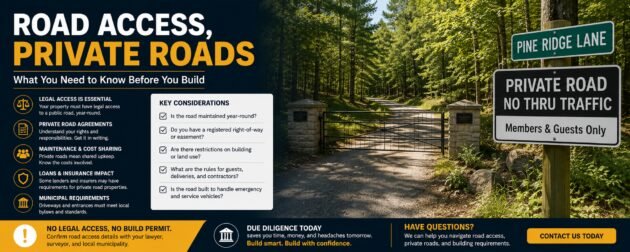
- Who owns it, and is there a registered road/maintenance agreement?
- Who plows and grades it, and what does it cost you each year?
- Is it built well enough for fire trucks, concrete trucks, and movers?
- Is access protected year-round, or seasonal only?
Rights-of-way / landlocked
- Is there a registered right-of-way on title – not just “we’ve always used it”?
- Is it wide enough and worded to allow a driveway, services, and construction?
- Ontario’s Road Access Act limits arbitrary closing of an access road, but it is not a substitute for a proper registered ROW.
- Prescriptive (long-use) claims are hard to rely on – get it in writing.
Read the survey: rights-of-way and road allowances show up on the plan. Our guide on how to read an Ontario survey shows you where to look – and your lawyer confirms what’s actually registered on title.
Not sure you can legally get to (and build on) the lot? Send it to us.
We’ll check the road status – municipal, private, unopened allowance, or right-of-way – flag whether a driveway entrance can be approved, and tell you whether it’s a green light, a negotiation chip, or a walk. The cheapest access mistake is the one you catch before closing. Quick paid consult: we scope it on a call and send a secure payment link, so you only pay once you know what you are getting.
The driveway & entrance permit
Even with good legal access, the driveway has its own approval. The road authority controls where an entrance can go, based on sightlines, spacing, grade, and the ditch or culvert. You may need an entrance permit, and a long, steep, or culvert-dependent approach can be a real line item in your site budget. Sort the likely entrance location early, because it can dictate where the house and septic can sit.
- Ask the road authority where an entrance can be approved on this lot.
- Budget the culvert, grading, and length – see the land development cost calculator.
- Confirm winter maintenance and turning room for emergency and delivery vehicles.
Access checks out? We’ll build the driveway and the home.
Our site-work crew, Georgian Bay Siteworks, handles the entrance, culvert, driveway, and grading – and we design the permit-ready set and build the home. One team from the road to the keys.
Access conditions worth putting in your offer
- Confirmation of legal, year-round access to the lot (your lawyer reviews title and road status)
- If access is by right-of-way: a properly registered ROW adequate for a driveway, services, and construction
- If access is by unopened road allowance or private road: the agreement, license, or opening cost identified and acceptable
- Confirmation an entrance/driveway can be approved by the road authority
- Satisfactory financing and insurance given the access type
Wording is your lawyer’s and agent’s job – this is the protection you want them to build in.
Related guides on this site
Road access & landlocked lots in Ontario: frequently asked questions
Can you build on a lot with no legal road access in Ontario?
Generally no – not until the access problem is solved. Municipalities typically won’t issue a building permit, and the road authority won’t approve a driveway entrance, on a lot without proper legal access. If the lot is landlocked, you usually need a properly registered right-of-way across the neighbouring land, or you need to acquire or open access. Lenders and insurers also treat no-access or seasonal-only-access lots as higher risk. So while a landlocked lot can sometimes be made buildable, it is a serious, potentially expensive problem to confirm and resolve before you buy, not after.
What is an unopened road allowance, and can I use it for access?
An unopened road allowance is a strip of land the municipality owns that was surveyed as a future road but never actually built or formally assumed. It can look like access on a map, but in most cases it cannot legally be driven without municipal approval, and using it for vehicle access usually requires constructing and maintaining it to municipal standards at your cost. Some municipalities require a roads license agreement for owners who reach their property this way. Getting an allowance opened, or formally closed and sold to you, is an application process that can take 12 to 18 months and cost real money, with no guarantee the municipality will agree.
What’s the difference between a public road and a private road?
A public road is owned and maintained by a municipality, county, or the province – they plow it, grade it, and you apply for an entrance permit where your driveway meets it. A private road is owned and maintained by the people it serves, and the key question is whether there’s a registered road or maintenance agreement that spells out who pays, who plows, and how decisions get made. A private road can be perfectly workable to build on, but you want the agreement in hand and confirmation that it’s maintained year-round and built well enough for fire trucks, concrete trucks, and movers.
Do I need a right-of-way, and does a verbal one count?
If your lot is reached across someone else’s land, you need a right-of-way that is properly registered on title – a verbal arrangement or “we’ve always used it” does not give you reliable, financeable access. The registered ROW should be worded and wide enough to allow a driveway, the services you’ll run, and construction traffic, not just foot or occasional vehicle use. Ontario’s Road Access Act limits the arbitrary closing of an established access road, but it is not a substitute for a registered right-of-way. Have your lawyer confirm exactly what is registered before you rely on it.
Will a lender finance a lot with private or seasonal access?
It’s harder. Lenders prefer lots with legal, year-round access on a municipally maintained road, and they treat private roads, unopened road allowances, seasonal-only access, and landlocked parcels as higher risk – which can mean a larger down payment, fewer lenders willing to participate, or in some cases no conventional financing at all. Insurance can be affected too. None of this necessarily makes a lot un-financeable, but it narrows your options and can raise your costs, so confirm the access type early and talk to a mortgage broker who handles rural and land lending before you commit.
Do I need an entrance permit for a driveway?
Usually, yes. The road authority – municipal, county, or provincial – controls where a driveway entrance can connect to the road, based on sightlines, spacing from other entrances, grade, and the ditch or culvert, and you typically need an entrance permit. The approved entrance location can actually dictate where the house and septic can go, so it’s worth confirming early rather than assuming you can put the driveway wherever you like. A long, steep, or culvert-dependent approach can also add real cost, so factor the entrance and driveway into your site budget from the start.
What does the Road Access Act do?
Ontario’s Road Access Act is a law that limits the arbitrary closing of a private or access road, and it provides a process to deal with disputes where a property’s only vehicle access runs over a road on someone else’s land. In practical terms, it offers some protection against a neighbour simply blocking an established access road without going through a proper process. However, it is not a substitute for having your own properly registered right-of-way, and it doesn’t by itself guarantee you can build. Treat it as a backstop, and still confirm your access is legally secured and registered before you buy.
Note: general guidance, not legal advice. Road status, access rights, and entrance approvals turn on your title, your municipality, and the road authority – confirm with your lawyer and the relevant authority before you rely on anything here or waive a condition.
More on land and site
Reviewed and updated October 2026. Costs on this site are Ontario ranges, not quotes; code references are to the Ontario Building Code in force at the date above.
Latest posts
Fresh guides, calculators & real-world advice
More from BuildersOntario – scroll to explore.
Loading latest posts…
Tip: shift + mousewheel works great