Ontario's Plain-English Guide to Custom Home Building📞 705-533-1633 | ☎️ 1-866-868-6606 | ✉️ info@icfhome.ca
Do You Pay HST When You Buy Vacant Land in Ontario?
HST & vacant land
Ontario 2026
Taxable or exempt?
Do You Pay HST When You Buy Vacant Land in Ontario?
Short answer: sometimes. Many vacant-land purchases from a private individual are HST-exempt – but several common situations make the sale taxable, and the 13% can land on the buyer. On a $200,000 lot that’s $26,000 you didn’t budget for, so it’s worth knowing which side of the line your deal falls on before you sign. Here’s when HST applies, when it doesn’t, who has to pay it, and the good news that even if you do pay it, you may get much of it back when you build. We build homes across Simcoe County and Georgian Bay – we are not accountants, so treat this as a plain-English map and confirm the details with yours.
The general rule (and the big exception)
HST on a land sale turns on who is selling and why – not on the buyer. The starting point under the federal rules (the Excise Tax Act) is:
For the income tax side of a land sale, capital gain or business income and which carrying costs you can add to the cost, see tax on vacant land in Canada.
Usually exempt: most sales of vacant land by an individual are HST-exempt when the land was held for personal use – for example, a parcel a family kept for personal enjoyment, or a sale to a relative (or former spouse / common-law partner) for their personal use.
Usually taxable: HST generally applies when the land was used in a business, when it’s sold by a builder or developer (think a serviced subdivision lot), or when a parcel has been subdivided into more than two parts – the severed pieces are taxable unless sold to a relative for personal use.
These are the broad strokes from the CRA’s guidance on sales of vacant land by individuals. The exact treatment depends on the specific facts, so it’s a lawyer-and-accountant question, not a guess.
Taxable vs exempt – the common scenarios
| The situation | HST? | Why |
|---|---|---|
| Individual sells personal-use land they kept for years | Usually exempt | Personal-use property sold by an individual. |
| Sale to a relative for their personal use | Usually exempt | Specific personal-use exemption. |
| Owner subdivides into 2 parts and sells one | Often exempt | Subdivision into no more than two parts can stay exempt. |
| Owner subdivides into more than 2 parts and sells the pieces | Usually taxable | Severed parts are taxable (unless to a relative for personal use). |
| Land used in a business / by a GST-HST registrant | Usually taxable | Sold in the course of a commercial activity. |
| New serviced lot bought from a developer/builder | Taxable | Sold by a builder in the course of business – the buyer pays HST. |
Simplified for planning – the line can be finer than a table. Your lawyer and accountant confirm which row your deal actually sits on.
The two books that take you from lot to keys
Buy the right lot with the tax and costs mapped, then pull the permit yourself. Each $29.99, or get both below and save.
Before you buy – start here
The Ontario Lot-Buying Bible
Prove a lot is buildable – before you spend a dollar.
$200+ of pro advice$29.99one-time
The 28-page step-by-step: financing, HST and the new-home rebate, the invisible site-cost budget, legal-lot and zoning, septic and well feasibility, easements – plus printable worksheets and offer-condition clauses.
- The financing chapter: down payments, draws, HST and the rebate
- The site-cost budgeting worksheet (the real all-in number)
- The 10-minute go/no-go test and printable scorecard
- Bonus chapters: DIY trades, wells, easements, negotiation
30-day money-back guarantee.
Get the Lot Bible – $29.99 →
Secure checkout – download in 2 minutes – yours forever
After you buy
The Ontario Building Permit Bible
Pull your permit yourself – without the guesswork.
$10,000$29.99one-time
Everything a builder does to coordinate a permit – the order of operations, the complete-application checklist that keeps it from bouncing, real fees, who to hire, and how to never fail an inspection.
- The complete-application checklist, so the file doesn’t bounce
- Real 2026 permit fees and development charges
- Who to hire to draw it, in what order, and what to pay
- How to never fail an inspection – and the costliest mistakes
30-day money-back guarantee.
Get the Permit Bible – $29.99 →
Secure checkout – download in 2 minutes – yours forever
Buying a lot and building on it? Get both Bibles.
The complete journey – prove the lot is buildable, then pull the permit without the guesswork.
Before you buy
The Ontario Lot-Buying Bible
Prove a lot is buildable – and what it will really cost – before you spend a dollar.
$29.99 on its own
+
After you buy
The Ontario Building Permit Bible
Pull your Ontario building permit yourself – the order of operations, the checklist, and how to never fail an inspection.
$29.99 on its own
$59.98 Both for $49.99
Get both Bibles →
Who actually pays and remits the HST?
When a land sale is taxable, the question of who hands the money to the CRA matters:
- The vendor (seller) normally collects and remits the HST – so on a taxable sale, the buyer typically pays it as part of the deal.
- If the buyer is a GST/HST registrant (for example, buying through a registered business), the buyer usually self-assesses and remits the HST directly to the CRA on their return, rather than paying it to the seller.
Read the agreement carefully: whether the price is “plus HST” or “HST included” is a real-money clause. A purchase price that turns out to be “plus HST” can add 13% you didn’t plan for. Have your lawyer confirm the HST treatment and how the agreement words it before you waive conditions.
Planning to build? Let us map the true all-in – so the tax and the rebate are part of the plan.
We’ll ballpark the build-ready cost of a specific lot – land, site costs, and the build – and flag the HST and rebate questions to take to your accountant, so nothing surprises you at closing or at the end. Quick paid consult: we scope it on a call and send a secure payment link, so you only pay once you know what you are getting.
The good news: you may get the HST back when you build
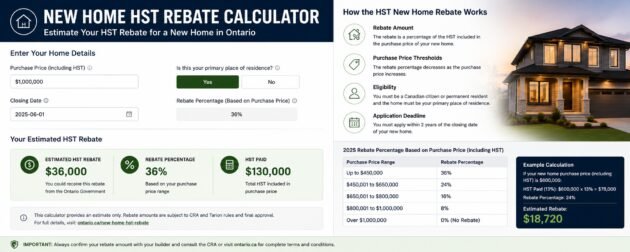
Even if you do pay HST – on the land, on the build, or both – Ontario’s new housing rebate programs can return a large chunk of it on a qualifying new or owner-built home. The enhanced 2026 rebate can be worth up to $130,000 on qualifying homes, and a first-time buyer may also recover a portion of the federal GST. The amount you can claim can even depend on whether you paid HST on the land, so it’s worth setting up correctly from day one rather than scrambling at the end.
Do this early: get your accountant and lawyer to map the HST on the land and the rebate on the build together, so it’s one coordinated plan. Start with our New Home HST Rebate Calculator for a planning estimate, then confirm eligibility and amounts with a professional.
Rebate rules depend on timing, ownership, home value, and use, and the programs change – the numbers here are for orientation, not a promise. Confirm current eligibility and amounts with your accountant.
Ready to build once the lot’s sorted? We’ll draw the set and build it.
We design the permit-ready set, sort the parallel approvals, and build the home – and we’ll make sure the rebate is part of the plan from day one, not an afterthought at the end.
Before you sign: a quick HST checklist
- Ask who the seller is and how they held the land – individual personal use, business, or developer
- Ask whether the parcel was subdivided, and into how many parts
- Confirm whether the agreement says “plus HST” or “HST included”
- If a registrant is involved, sort out self-assessment with your accountant
- Map the new-home rebate on the build at the same time
- Get your lawyer and accountant to confirm it all before you waive conditions
Related guides on this site
HST on vacant land in Ontario: frequently asked questions
Do you pay HST when you buy vacant land in Ontario?
Sometimes. Many sales of vacant land by an individual who held it for personal use are HST-exempt, so no HST applies. But the sale is generally taxable when the land was used in a business, when it’s sold by a builder or developer (such as a new serviced subdivision lot), or when a parcel has been subdivided into more than two parts, in which case the severed pieces are usually taxable unless sold to a relative for personal use. Because it turns on who’s selling and why, you can’t tell from the listing alone – have your lawyer and accountant confirm the HST treatment before you sign.
When is a vacant land sale HST-exempt?
The most common exemption is a sale of personal-use land by an individual – for example, a parcel a family kept for their own enjoyment, or a sale to a relative (or a former spouse or common-law partner) for that person’s personal use. A subdivision into no more than two parts can also stay exempt in many cases. The key themes are that the seller is an individual, the land was held for personal use rather than business, and the land wasn’t carved into many pieces for sale. These are general rules from the CRA’s guidance, and the specifics of your situation decide it, so confirm with a professional.
When is HST charged on land?
HST generally applies when the land is sold in the course of a business or commercial activity – including land sold by a builder or developer, such as a new serviced building lot – or when the seller has subdivided a parcel into more than two parts and is selling the severed portions (unless a portion is sold to a relative for their personal use). Land held and used in a business, or by a GST/HST registrant as part of commercial activity, is also typically taxable. In these cases the 13% HST is real money on top of the land price, so identify it early and budget for it.
Who pays the HST on a taxable land sale, the buyer or the seller?
On a taxable sale the vendor normally collects the HST from the buyer and remits it to the CRA, so in practice the buyer pays it as part of the transaction. There’s an important exception: if the buyer is a GST/HST registrant – for instance, purchasing through a registered business – the buyer usually self-assesses and remits the HST directly to the CRA on their own return rather than paying it to the seller. Either way, it’s the buyer’s money, so whether the agreement says the price is plus HST or HST included matters a great deal. Have your lawyer confirm how it’s worded.
How much is HST on a building lot?
When it applies, HST in Ontario is 13% of the purchase price, so on a $200,000 taxable lot that’s roughly $26,000 on top – which is exactly why it’s worth confirming whether your purchase is taxable before you commit. If the sale is exempt, there’s no HST on the land at all. And remember the other side of the ledger: if you do pay HST and then build a qualifying home, the new housing rebate can return a substantial part of the HST you pay, so the net cost can be lower than the sticker shock suggests. Run the numbers with your accountant.
Can I get the HST back when I build a home?
Often a large part of it, yes. Ontario’s new housing rebate programs are designed to return much of the HST on a qualifying new or owner-built home, and the enhanced 2026 rebate can be worth up to $130,000 on qualifying homes, with first-time buyers able to recover a portion of the federal GST as well. The amount you can claim can even depend on whether you paid HST on the land, which is why it pays to plan the land HST and the build rebate together from the start. Use our HST rebate calculator for a planning estimate, then confirm your eligibility and the exact amount with your accountant, since the rules depend on your situation and change over time.
Do I pay HST buying a new serviced lot from a developer?
Generally yes. A new serviced building lot sold by a builder or developer is sold in the course of business, which makes it a taxable supply, so HST normally applies and the buyer pays it. This is different from buying a raw, personal-use parcel from a private individual, which is often exempt. When you’re buying from a developer, assume HST is in play, check whether the quoted price is plus HST or HST included, and factor the 13% into your budget and financing. Then look at the new housing rebate on the home you build, which can offset a meaningful part of the HST. Confirm the specifics with your lawyer and accountant.
Note: general information, not tax or legal advice – we build homes, we are not accountants or lawyers. HST treatment turns on the specific facts of your transaction and current CRA rules, which change. Confirm everything with your lawyer and accountant before you rely on it or waive a condition.
Latest posts
Fresh guides, calculators & real-world advice
More from BuildersOntario – scroll to explore.
Loading latest posts…
Tip: shift + mousewheel works great