Ontario's Plain-English Guide to Custom Home Building📞 705-533-1633 | ☎️ 1-866-868-6606 | ✉️ info@icfhome.ca
Serviced Lot vs Raw Rural Land in Ontario: Which Should You Buy?
Serviced vs rural
Ontario 2026
Which lot to buy
Serviced Lot vs Raw Rural Land in Ontario: Which Should You Buy?
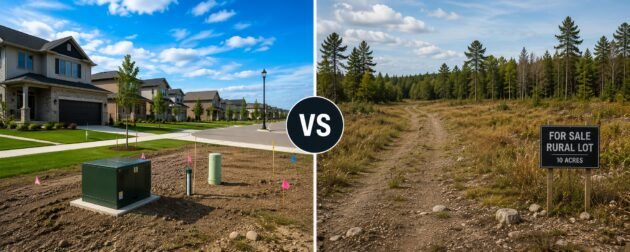
A tidy subdivision lot with services at the road, or a few private acres in the country? It’s the first big fork in the building journey, and the right answer is rarely the cheaper sticker price. A serviced lot costs more to buy but is simpler, faster, and easier to finance. Raw rural land is cheaper up front but carries five-figure site costs, a bigger down payment, a longer timeline, and a lot more due diligence – in exchange for space, privacy, and control. Here’s an honest, builder’s-eye comparison to help you choose – from 45 years building both across Simcoe County and Georgian Bay.
The honest comparison
Neither is “better” universally – it depends on your budget, timeline, risk tolerance, and how much you value privacy and control. Here’s the side-by-side:
| Serviced subdivision lot | Raw rural land | |
|---|---|---|
| Purchase price | Higher – you’re paying for the servicing the developer did. | Lower – sometimes much lower for the land itself. |
| Site costs to build-ready | Smaller – water/sewer/hydro at the road (still confirm the cost to the house). | Big – well, septic, hydro extension, driveway, clearing, grading can run $60K-$200K. |
| Financing / down payment | Easier – serviced lots can need around 20-30% down. | Harder – raw land often needs 35-50% down and a broker or private lender. |
| HST | Usually taxable – a developer sells in the course of business, so HST applies. | Often exempt for personal-use land from an individual (confirm). |
| Approvals & timeline | Simpler and faster – servicing and address are established. | Slower – septic, well, access, conservation, and studies. Raw land can take 1-3 years to break ground. |
| Rules | Tighter – subdivision design control, possible builder restrictions, covenants. | Looser – more freedom in what and how you build (within zoning). |
| Privacy & control | Neighbours close; less acreage. | Space, privacy, and control – the reason people go rural. |
The builder’s takeaway: compare lots on all-in build-ready cost, not sticker price. A “cheap” rural lot and a “pricey” serviced lot can land in the same place once you add the well, septic, hydro, and driveway – and sometimes the cheap one ends up costing more.
The two books that take you from lot to keys
Pick the right lot for your plan and budget – then pull the permit yourself. Each $29.99, or get both below and save.
Before you buy – start here
The Ontario Lot-Buying Bible
Prove a lot is buildable – before you spend a dollar.
$200+ of pro advice$29.99one-time
The 28-page step-by-step: the invisible site-cost budget, financing and HST, septic and well feasibility, zoning and approvals, legal-lot status – plus printable worksheets and offer-condition clauses for whichever lot you choose.
- The site-cost budgeting worksheet to compare lots all-in
- The financing chapter: serviced vs raw land down payments
- The 10-minute go/no-go test and printable scorecard
- Bonus chapters: DIY trades, wells, easements, negotiation
30-day money-back guarantee.
Get the Lot Bible – $29.99 →
Secure checkout – download in 2 minutes – yours forever
After you buy
The Ontario Building Permit Bible
Pull your permit yourself – without the guesswork.
$10,000$29.99one-time
Everything a builder does to coordinate a permit – the order of operations, the complete-application checklist that keeps it from bouncing, real fees, who to hire, and how to never fail an inspection.
- The complete-application checklist, so the file doesn’t bounce
- Real 2026 permit fees and development charges
- Who to hire to draw it, in what order, and what to pay
- How to never fail an inspection – and the costliest mistakes
30-day money-back guarantee.
Get the Permit Bible – $29.99 →
Secure checkout – download in 2 minutes – yours forever
Buying a lot and building on it? Get both Bibles.
The complete journey – prove the lot is buildable, then pull the permit without the guesswork.
Before you buy
The Ontario Lot-Buying Bible
Prove a lot is buildable – and what it will really cost – before you spend a dollar.
$29.99 on its own
+
After you buy
The Ontario Building Permit Bible
Pull your Ontario building permit yourself – the order of operations, the checklist, and how to never fail an inspection.
$29.99 on its own
$59.98 Both for $49.99
Get both Bibles →
Serviced subdivision lot: the trade-offs
What you get
- Water, sewer, hydro – usually gas and internet – at the road
- Simpler, faster approvals and a known servicing path
- Easier financing and a lower down payment
- An established address and a quicker route to breaking ground
What to watch
- HST usually applies – confirm “plus HST” vs “included” (see HST on land)
- Development charges can be significant (see DC calculator)
- Subdivision design control, builder restrictions, or covenants
- Still confirm the cost to bring services to the house, not just the road
Torn between two lots? Send us both – we’ll price the all-in.
We’ll ballpark the true build-ready cost of each option – the serviced lot and the rural one – including the site costs a listing never shows, so you can compare them honestly and pick with your eyes open. Quick paid consult: we scope it on a call and send a secure payment link, so you only pay once you know what you are getting.
Raw rural land: the trade-offs
What you get
- Space, privacy, and real control over your home and site
- A lower purchase price – sometimes dramatically lower
- Freedom in what and how you build (within zoning)
- The lifestyle a lot of people are actually after
What it really costs
- Big site costs: well, septic, hydro extension, driveway, clearing, grading
- Harder financing – 35-50% down (see vacant-land mortgages)
- More due diligence: legal-lot, access, septic feasibility, conservation
- A longer timeline – raw land can take 1-3 years to break ground
The classic rural mistake: falling for the low purchase price and never pricing the site work. Two rural lots at the same price can be $80K apart once you make them build-ready – so do the lot math before you fall in love.
So which should you buy?
Choose serviced if
You want simpler, faster, and more predictable; you’d rather pay more up front than manage well/septic/hydro and a long approvals process; financing room is tight; and you’re comfortable with subdivision rules and closer neighbours.
Choose rural if
Space, privacy, and control matter most; you can carry the larger down payment and the five-figure site costs; you’re patient with a longer timeline; and you’ll do (or pay for) proper due diligence.
Either way
Compare on all-in build-ready cost, run the buildability checklist, and keep firm conditions in your offer until every “maybe” is a written “yes.”
Decided? We design and build on both kinds of lot.
Whether it’s a tidy serviced lot or a few raw acres, we draw the permit-ready set, sort the servicing and approvals, and build an energy-efficient ICF home – with our own site-work crew getting a rural lot ready first.
Related guides on this site
Serviced lot vs rural land in Ontario: frequently asked questions
Is it cheaper to buy a serviced lot or raw rural land?
Raw rural land almost always has a lower purchase price, sometimes dramatically lower, but the all-in cost to make it build-ready can erase that gap. A serviced subdivision lot costs more up front because the developer has already extended water, sewer, and hydro to the road, whereas a raw rural parcel may need a well, a septic system, a hydro extension, a long driveway, clearing, and grading, which together can run from tens of thousands into well over a hundred thousand dollars. The honest way to compare is on all-in build-ready cost, not sticker price, because a cheap rural lot and a pricier serviced lot can end up costing about the same to build on, and sometimes the cheap one costs more.
Is financing different for a serviced lot vs rural land?
Yes, noticeably. Serviced lots are easier to finance and can require a smaller down payment, often in the range of about 20 to 30 percent, because the lender sees lower risk on land that already has services and an established address. Raw or rural land is riskier collateral, so it commonly needs a much larger down payment, often 35 to 50 percent, a higher interest rate, and sometimes a mortgage broker or a private or alternative lender because many banks avoid bare rural land. If you are stretching to make the numbers work, the serviced lot’s easier financing can be the deciding factor, so talk to a broker about both options before you commit.
Do I pay HST on a serviced subdivision lot?
Usually yes. A new serviced building lot sold by a builder or developer is sold in the course of business, which makes it a taxable supply, so HST normally applies and the buyer pays the 13 percent on top of the price. This is different from buying a raw, personal-use parcel from a private individual, which is often HST-exempt. When you are buying from a developer, assume HST is in play, check whether the quoted price is plus HST or HST included, and factor it into your budget and financing. The good news is that the new housing rebate on the home you build can offset a meaningful part of the HST, so plan the land tax and the rebate together with your accountant.
How much longer does a rural build take than a serviced lot?
A serviced subdivision lot can move comparatively quickly because the servicing path and the address are established and the approvals are more predictable. Raw rural land takes longer, often considerably, because you have to confirm and arrange septic, a well, road access, and possibly conservation-authority approvals and technical studies, and any required severance or variance adds months of its own. As a rough guide, developing raw land can take roughly one to three years from purchase to breaking ground, while a more straightforward, already-improved lot can allow construction to start within about six to eighteen months. If timing matters to you, build the realistic approvals timeline into your decision, not just the purchase price.
What are the downsides of a serviced subdivision lot?
The main trade-offs are cost, rules, and space. You pay more up front for the servicing the developer provided, HST usually applies, and development charges can be significant. Subdivisions also often come with design control, architectural guidelines, possible builder restrictions, and covenants that limit what and how you build, so you have less freedom than on rural land. And you get less space and closer neighbours than a country lot. None of this makes a serviced lot a bad choice, since it buys simplicity, speed, and easier financing, but you should read the subdivision rules and confirm the development charges and the cost to bring services to the house before you commit, not just to the road.
What due diligence does raw rural land need that a serviced lot doesn’t?
A lot more. On raw rural land you have to confirm septic feasibility for your bedroom count, a well’s yield and water quality, legal year-round road access and an approvable driveway, the hydro connection cost, conservation-authority and floodplain limits, soil and ground conditions, and the legal-lot or severance status of the parcel – all things a serviced subdivision lot has largely settled. You also carry the bigger site-cost budget and a longer approvals timeline. This is exactly why a rural purchase should stay conditional until each item is answered in writing, and why pricing the all-in build-ready cost early is essential. A serviced lot front-loads that work into a higher purchase price, while rural land hands it to you as homework.
Which is the better choice, serviced or rural?
Neither is universally better – it comes down to your priorities. A serviced subdivision lot is the better fit if you value simplicity, speed, predictable costs, and easier financing, and you are comfortable with subdivision rules and closer neighbours. Raw rural land is the better fit if space, privacy, and control matter most, you can carry the larger down payment and the five-figure site costs, and you are patient with a longer timeline and more due diligence. The smart move is to compare specific options on all-in build-ready cost rather than purchase price, run the buildability checklist on each, and keep firm conditions in your offer until everything checks out. Then choose the one that matches your budget, timeline, and lifestyle.
Note: general guidance and 2026 planning ranges, not quotes or financial advice. Costs, financing, HST, and timelines vary by lot, lender, and municipality – confirm specifics with the relevant professionals before you rely on anything here or waive a condition.
More on land and site
Reviewed and updated October 2026. Costs on this site are Ontario ranges, not quotes; code references are to the Ontario Building Code in force at the date above.
Latest posts
Fresh guides, calculators & real-world advice
More from BuildersOntario – scroll to explore.
Loading latest posts…
Tip: shift + mousewheel works great