Ontario's Plain-English Guide to Custom Home Building📞 705-533-1633 | ☎️ 1-866-868-6606 | ✉️ info@icfhome.ca
Prefab Homes in Ontario 2026: Real Costs, Real Timelines, and the Stuff Sales Brochures “Forget”
Updated for 2026
Modular, panelized, kit
Costs, timelines, permits, site work
Prefab Homes in Ontario 2026: Real Costs, Real Timelines, and What the Brochures Leave Out
Prefab homes can be a smart move in Ontario – especially when trades are booked solid and the weather is doing its usual Ontario thing. But if you’re here because someone promised half the time and half the cost, let’s gently set that brochure down on the table and show you where the real money and real delays actually hide. Spoiler: prefab doesn’t delete costs, it moves them – and sometimes it creates brand-new ones (hello, crane day).
Weighing prefab against solid-wood construction? See our honest guide to building a log home in Ontario — what it really costs, how log walls meet the energy code, settling and long-term upkeep.
TL;DR: “Prefab” covers modular, panelized, and kit homes, and none of them skip Ontario’s permits, foundation, site work, or servicing. There are always two budgets: the factory budget (what the manufacturer sells you) and the site budget (everything needed to legally place, connect, finish, and live in it). Compare total move-in cost, not factory price. And because a prefab is still a new home, it can qualify for the enhanced HST rebate of up to $130,000 if contracted before the April 1, 2027 deadline.
First: “prefab” means three different things in Ontario
In Ontario, “prefab” is a catch-all that gets used for everything from a true modular home to a panelized kit to something that looks suspiciously like a cottage shed that got promoted to “executive housing.” Before you fall in love with a floor plan, know exactly which one you’re buying.
Modular
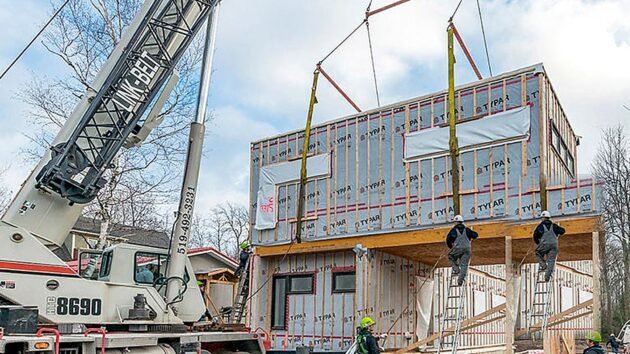
Big chunks of the house – rooms or sections – are built in a factory, shipped to your lot, and set with a crane onto a foundation. This is what most people mean by “prefab home.”
Panelized
The factory builds wall, roof, and sometimes floor panels. Assembly on site is faster than traditional framing, but it’s still very much an on-site build.
Pre-cut kits
Materials cut to length and delivered. Saves some waste and layout time, but still needs a competent crew and real supervision to become a house.
Builder’s rule: “manufactured” housing often gets mixed into the conversation and is regulated and labelled differently. Don’t assume “factory-built” automatically means “same as a custom home.” Ask exactly what you’re buying: modules, panels, a kit – or a marketing word. For a clean apples-to-apples benchmark, anchor to a real all-in number first: the full cost of building in Ontario.
The biggest 2026 myth: “prefab is always cheaper”
Prefab can be cheaper in specific situations. It can also be the exact same cost as site-built, and occasionally it lands higher – especially when site conditions are tricky. The trouble is that prefab quotes are often presented like a car ad: a shiny base number, then a long list of “options” that are basically required if you want a house that feels like a house. The honest way to think about it is that there are two budgets, not one.
| Factory (manufacturer) budget | Site (your lot) budget – often not included |
|---|---|
| Modules or panels and factory finishes, to the level you paid for | Driveway access, staging area, delivery routing, and crane-day logistics |
| Standard specs (often basic unless upgraded) | Excavation, foundation or slab, drainage, backfill, and grading |
| Plant quality program and inspections (if certified) | On-site connections: plumbing, electrical service, HVAC completion, HRV/ERV |
| Some interior completion (varies by product) | Porches, decks, steps, exterior flatwork, landscaping, and often the garage |
| Delivery sometimes included, sometimes not | Permits, engineering, surveys, septic and well if rural, utility trenching, restoration |
Translation: prefab mainly moves some costs into a factory line item and occasionally adds new ones. Factories are businesses, not charities with nail guns – any labour savings from controlled conditions often shows up as a healthier margin for the manufacturer, unless you negotiate specs, delivery, and completion scope like a hawk. If a quote looks dramatically lower than everything else in Ontario in 2026, that usually means scope is missing, not that magic was discovered.
What actually drives prefab cost in Ontario (with real 2026 numbers)
If two people buy the same modular model, one can finish with a “that was painless” story and the other with a thousand-yard stare and a spreadsheet of surprise invoices. The difference is rarely the house – it’s the lot, the scope, and the assumptions. Here’s where the money actually goes, using the same regional figures we use on our build-cost pages:
| Site-budget item | Typical 2026 range (Simcoe / Georgian Bay) | Included in a prefab quote? |
|---|---|---|
| Foundation / slab + excavation | tens of thousands, site-dependent | Usually not – and modular demands it be dead-on |
| Well (rural) | $9,000 to $24,000 | Almost never |
| Septic (rural) | $22,000 to $38,000 | Almost never |
| Delivery + crane day | a mini-project of its own | Sometimes; “sometimes” is doing heavy lifting |
| Site work + servicing | $20,000 to $100,000+ | No |
| Finishes above “base” | the silent budget-buster | Only to the level you paid for |
Crane day is not “a fee”
It’s a mini-project: route planning, escorts if needed, staging space, safe lifting, weather windows, and sometimes road restrictions. A tight, wooded, steep, soft, or remote lot turns crane day into a military operation, with invoices to match.
Modular is not forgiving
Site-built framing tolerates tiny corrections as you go. Modular can’t – you’re dropping a finished box onto a foundation that must be dead-on for layout and elevation. If the foundation is off, you don’t massage it, you pay to fix it.
The two site-cost items that swing prefab budgets hardest are the foundation choice and rural servicing. Prefab doesn’t remove those – it just arrives after you’ve already paid them. More on both: septic systems on a lot and well water on a lot.
Comparing a prefab quote to building? Let’s put both on a true total-move-in basis.
We’ll take your prefab quote apart, add the site and servicing costs it leaves out, and line it up against a site-built custom home for your exact lot – so you’re comparing move-in numbers, not a factory price against a full build. If a site-built ICF home turns out to be the better call for your plan and climate, we can build that too. Quick paid consult: we scope it on a call and send a secure payment link, so you only pay once you know what you’re getting. No charge to ask.
Timeline truth: prefab can be faster, but it’s not a teleportation device
Prefab is often faster on the framing-to-drywall stretch because the factory works while you do site prep. But Ontario schedules still have gates you can’t skip: design finalization, engineering, permits, utilities, septic approvals if applicable, and inspections. Modular shortens some of the messy on-site time – it does not eliminate the boring paperwork time, and boring paperwork time is still time.
| Phase | What happens | Where delays show up |
|---|---|---|
| 1. Design + scope lock-in | Finalize plan, specs, options, structural assumptions | Indecision – later changes are expensive |
| 2. Permits + approvals | Municipal review, grading/site plan, septic/well steps | Missing documents, revisions, regional backlogs |
| 3. Site work + foundation | Access, excavation, foundation, drainage, backfill | Weather, rock, groundwater, soft soils |
| 4. Factory build | Modules or panels built under the plant process | Supplier lead times, spec changes, scheduling |
| 5. Delivery + set day | Transport and crane placement | Weather and site readiness |
| 6. Site completion | Connections, finish work, exterior, inspections | Trade availability, deficiencies, touch-ups |
Important: prefab forces decisions early. If you like changing your mind every second Tuesday, stick-built might be kinder to your blood pressure. A realistic expectation is that prefab trims weeks to a couple of months off a typical site-built schedule when planning is tight and the site is straightforward – and gives most of it back if approvals drag or the site is complex.
The book that prices the half of a prefab project the brochure ignores
Prefab contracts cover the factory. This covers the lot – the site and servicing costs that decide whether prefab is actually cheaper. Each $29.99, or get both below and save.
The site budget
The Ontario Lot-Buying Bible
The move-in number a prefab quote won’t show you.
$200+ of pro advice$29.99one-time
The 28-page step-by-step that budgets the whole project the way the money actually flows – land, site work, foundation, well, septic, servicing, financing, HST, and a real contingency. Exactly the site budget a factory quote leaves off. Printable worksheets included.
- The site-budget and total-move-in worksheet
- Well, septic, and site-work cost planners
- The 10-minute go/no-go test and printable scorecard
- Bonus chapters: DIY trades, wells, easements, negotiation
30-day money-back guarantee.
Get the Lot Bible – $29.99 →
Secure checkout – download in 2 minutes – yours forever
The permit path
The Ontario Building Permit Bible
Because prefab still needs permits and inspections.
$10,000$29.99one-time
Everything a builder does to run a permit – the order of operations, the complete-application checklist, real 2026 fees, and how factory documentation and on-site inspections fit together. So the compliance path is clear before you sign.
- The complete-application checklist, so the file doesn’t bounce
- How factory vs on-site scope gets inspected and documented
- Real 2026 permit fees and development charges
- How to never fail an inspection – and the costliest mistakes
30-day money-back guarantee.
Get the Permit Bible – $29.99 →
Secure checkout – download in 2 minutes – yours forever
Buying a lot and putting a home on it? Get both Bibles.
Budget the land and the whole project, then run the permit – prefab or site-built – without the guesswork.
Before you buy
The Ontario Lot-Buying Bible
Prove a lot is buildable – and what it will really cost, move-in and all – before you spend a dollar.
$29.99 on its own
+
After you buy
The Ontario Building Permit Bible
Pull your Ontario permits yourself – the order of operations, the checklist, and how to never fail an inspection.
$29.99 on its own
$59.98 Both for $49.99
Get both Bibles →
Permits, inspections, design, and financing – the parts prefab can’t skip
A prefab or modular home in Ontario still must comply with the Building Code and still needs permits and inspections. Because some components are built off-site, the pathway often relies on factory documentation, labels, and certified processes, so ask early: “How does your product demonstrate code compliance, and what documents will my municipality want?” Work backwards from your municipality – some have a clear internal process for factory-built projects and some are still building their playbook. Either way, get in writing a scope list that states what is completed in the factory versus on-site, and how each portion is inspected and signed off. Your municipality does not approve houses on vibes and good intentions. (Baseline: how to obtain a building permit in Ontario.)
On design, prefab shines when the plan is clean, efficient, and repeatable – rooms stacking neatly, a rectangular-ish footprint, a defined catalog, and speed valued over total customization. It fights you on big spans, walls of glass, complex rooflines, cantilevers, and structural gymnastics, where stick-built usually wins – along with truly custom plans, tight or complicated sites, and the freedom to change things mid-build. And energy performance is math, not a vibe: the wins come from a tight air barrier, a real insulation strategy, good windows, controlled ventilation, and properly sized mechanicals, regardless of where the box was built. (Sanity-check operating cost early: heat loss calculation for a new home.)
Financing feels backwards, too. Site-built money flows gradually with progress; modular front-loads the factory work, so payment schedules often ask for bigger chunks earlier, while the bank still wants to fund on milestones and security. The fix is planning, not panic – have the lender conversation before you sign a purchase agreement, and ask “how do you fund factory-built work, and what documents do you need from the manufacturer to release draws?” (More: construction financing.)
Ontario HST Rebate | Deadline April 1, 2027
A Prefab Is Still a New Home – So It Can Qualify for Up To $130,000
People chase a few thousand in factory savings and miss the biggest number of all. Ontario’s enhanced HST rebate puts up to $130,000 back in a new-home builder’s pocket if the build contract is signed (or your own build started) before April 1, 2027 – and a modular or panelized home is a new home. Miss the deadline and you fall back to the standard $24,000.
$0
Contract signed before Apr 1, 2027
$24,000
Signed after the deadline
$900,000
Miss the deadline and you forfeit
$0
Estimate based on Ontario’s 2026 enhanced HST rebate (Bill 114). Final eligibility for a custom, modular, or owner-built home is confirmed by a licensed rebate specialist – that’s what the free check is for. Full HST rebate details
What is NOT included in most prefab contracts (read this twice)
If one section saves homeowners the most money and sanity, it's this one. Most prefab contracts focus on the factory deliverable, but your real move-in scope is bigger - usually much bigger.
Commonly missing
- Land purchase, legal costs, surveys
- Soil tests, grading plans, site-plan requirements
- Tree clearing, driveway, culverts, access roads
- Excavation, foundation, drainage, backfill, rough grading
- Septic and/or well (common on rural lots)
- Utility trenching and long service runs
Forgotten until late
- Porches, decks, exterior stairs, landings, railings
- Garage (many packages exclude it or treat it as separate)
- Exterior flatwork: patios, walkways, driveways
- Final HVAC commissioning and on-site connections
- Interior touch-ups after transport (normal to need them)
- Taxes and project insurance, depending on the deal
Bottom line: for a true apples-to-apples comparison, compare total move-in cost, not factory price. And if you're weighing foundation options while someone pushes "simple, cheap, fast," get a serious baseline first - the full cost of building lays out what a real foundation and site package costs in Ontario versus a bare-minimum approach.
Red flags: how people get hurt in prefab deals
- Vague scope. If you can't tell who does what, you will pay twice for something - guaranteed.
- Too-good pricing. A low number usually means excluded finishes, excluded site work, or unrealistic allowances.
- No clear compliance path. "We've done this before" is not the same as documentation your municipality will accept.
- Deposit pressure. If the deal relies on urgency instead of clarity, that's not a deal, it's a trap.
- Unclear warranty responsibilities. Who handles callbacks - factory, installer, or "someone else"?
Builder's truth: a good prefab project feels boring on paper, because everything is defined. Confusion is the expensive part.
Want the predictability of prefab with the quality and freedom of custom? Talk to a site-builder.
We design and build high-performance ICF custom homes across Simcoe County and Georgian Bay - a tight envelope built for our winters, a truly custom plan, and one team from drawings through inspection. If prefab is genuinely the better fit for your project, we'll tell you that too. Either way, you get a straight answer.
Related guides and tools
Prefab homes in Ontario: frequently asked questions (2026)
Are prefab and modular homes legal permanent homes in Ontario?
Yes, when they are designed, built, and installed to the required standards and permitted properly. In Ontario your municipality still expects Building Code compliance, documentation, and on-site inspections for the parts completed on your lot, so factory-built is not a shortcut around permits, it is a different construction pathway. A true modular or panelized home, set on a proper permanent foundation and finished to code, is every bit as much a permanent home as a stick-built one, and it is treated that way for occupancy, financing, and resale. The key is clarity on what is completed in the factory versus what is completed on-site, and on how each portion is inspected and signed off, because that documentation trail is what lets the building department approve the home. Where people run into trouble is not the legality of prefab itself, it is discovering late that the compliance paperwork is thin or the on-site scope was never clearly assigned, which turns a legal, permittable home into a scramble.
How much cheaper is a prefab home in Ontario in 2026?
Sometimes it is cheaper, often it is similar, and occasionally it is more, and the honest answer depends almost entirely on your site costs and how complete the factory package really is. The factory price is only half the picture, because the site budget - access, excavation, foundation, drainage, well and septic on a rural lot, utility runs, and all the finishing scope that makes a house livable - can add tens of thousands of dollars, and in our region servicing alone runs roughly nine to twenty-four thousand for a well and twenty-two to thirty-eight thousand for a septic system before you touch the foundation. Many prefab quotes look cheaper precisely because they exclude those move-in items, along with porches, stairs, exterior flatwork, better finishes, and sometimes key mechanical completion. The only comparison that means anything is total move-in cost against total move-in cost, factory scope plus site scope, and when you build that full picture the dramatic savings a brochure implies usually shrink to something modest or disappear.
What is the fastest realistic timeline for prefab in Ontario?
Prefab can shorten the on-site build portion because the factory works in parallel with your site prep, but it does not skip the gates every Ontario build faces: design finalization, engineering, permits, and often utility and septic steps. A realistic expectation is that prefab may trim weeks to a couple of months off a typical site-built schedule when the planning is tight and the site is straightforward, mainly by compressing the framing-to-drywall stretch. The catch is that if approvals drag, documents are missing, or the site is complex with rock, groundwater, or difficult access, those same bottlenecks absorb the time savings and you end up on a schedule that looks a lot like a conventional build. Prefab also forces decisions earlier than stick-built, because changes after the factory starts are expensive, so the speed advantage rewards people who can lock their plan and specs and punishes people who like to keep tinkering. Treat prefab as a way to remove weather risk and parallelize work, not as a teleportation device.
What is the biggest hidden cost in prefab projects?
Site work, almost every time. Delivery and crane day can be significant, and on a tight or remote lot the crane day becomes a real mini-project with routing, staging, and lifting logistics, but the largest budget swing is usually the ground itself: excavation, foundation accuracy, drainage, backfill, utility runs, well and septic, and the finishing scope that was never in the factory contract. The reason these feel hidden is psychological, because they do not feel like part of buying the house even though they are exactly what makes the house legal and livable, so a buyer anchored on the factory price experiences them as a series of unwelcome surprises rather than as the second half of the real budget. Modular adds one more wrinkle, because the foundation has to be dead-on for the set, so any correction is a paid fix rather than an on-the-fly adjustment. The protection is to demand a complete scope map up front - factory scope plus site scope equals move-in scope - so nothing arrives as a surprise invoice.
Does a prefab or modular home qualify for the Ontario HST new-home rebate?
Generally yes, because a modular or panelized home built as a new residential home is still a new home for tax purposes, and Ontario's enhanced HST rebate can return a substantial amount on a qualifying new build if the contract is signed or your own build is started before the April 1, 2027 deadline, worth up to one hundred and thirty thousand dollars at the top before it phases down, compared with the standard rebate of around twenty-four thousand. That is a far bigger number than the few thousand dollars people often chase in factory savings, which is exactly why it belongs in the comparison from the start rather than as an afterthought at tax time. Eligibility depends on the specifics - who owns the land, how the contract is structured, whether it is a custom, owner-built, or purchased new home, and the timing relative to the deadline - so the rebate is confirmed by a licensed specialist rather than assumed. The practical point is that ignoring the rebate can cost you more than any prefab-versus-site-built price difference, so confirm your eligibility early and factor the net number into your decision.
Can prefab homes go on a slab-on-grade in Ontario?
Often yes, but it depends on the product, the mechanical approach, and how the modules or panels are designed to be connected and serviced. Some modular approaches historically leaned toward basements or crawlspaces because they make routing plumbing, electrical, and HVAC connections between and beneath modules easier, but many modern designs work well on slab-on-grade when the servicing is planned early. The risk is not the slab itself, it is making sure the mechanical, electrical, and plumbing connections are laid out before the set and that the foundation tolerances are correct, because a modular set is unforgiving of a foundation that is out of level or off on layout. Slab-on-grade can also pair nicely with in-floor radiant heat and a tight envelope, which suits our climate, but the decision should be made with the manufacturer's connection details in hand rather than assumed. As with everything prefab, the slab is fine when the plan behaves and expensive when the connections were an afterthought.
Do prefab homes hold resale value in Ontario?
Resale value is driven far more by location, layout, finishes, energy performance, and overall quality than by whether the home was built in a factory or framed on-site, so a well-designed, well-finished, code-compliant modular home on a proper foundation generally holds value like any comparable house. The caveat is perception, because some buyers and even some agents confuse true modular homes with mobile or manufactured housing, which occupy a different market, so in certain areas a modular home can face a perception discount that has nothing to do with its actual construction. The best protection is to build a home that reads unmistakably as a solid, permanent Ontario home - a good foundation, a good envelope, quality finishes, properly sized mechanicals, and a clean documentation trail that reassures a future buyer and their lender. Do that and the factory origin becomes a footnote. Cut corners on finishes or foundation to hit a low headline price and you create exactly the resale drag people fear, whether the home was built in a plant or on the lot.
Note: general information for planning, not legal, tax, or engineering advice. Prefab product types, code-compliance pathways, municipal processes, financing, and HST eligibility vary by situation and change over time - confirm the specifics with your municipality, lender, and a licensed rebate specialist before you commit.
So, is a prefab home a good idea for you?
If your plan is efficient, your site is straightforward, and you want a predictable build with fewer weather headaches, prefab can be a smart play. If you want a one-of-a-kind custom design, big spans, major glass, or you expect to change your mind mid-build, stick-built may actually be the calmer - and sometimes cheaper - path. The winning move in 2026 is simple: compare total move-in cost, demand a clear scope map, confirm your HST rebate eligibility, and don't sign anything until the permit and compliance pathway is understood.
More on structure and icf
Reviewed and updated October 2026. Costs on this site are Ontario ranges, not quotes; code references are to the Ontario Building Code in force at the date above.
Latest posts
Fresh guides, calculators & real-world advice
More from BuildersOntario - scroll to explore.
Loading latest posts...
Tip: shift + mousewheel works great
Have you seen the new steel frame modular home builder?
Unique in that they are the only csa certified modular home builder that manufactures steel free homes in the factory at pricing below wood frame homes
You’ll be cursing every time you go to hang something on a stud.
Drill a small “pilot hole” before installing the screw.
That’s why you buy “monkey hooks”. Check them out at Home Depot.
Steel frame homes benefits include the ability to find a stud much easier than a wood stud using a stud finder. Dont use a nail, use a tek screw, avaialble in sizes from 1/2″ to 3 1/2″ for larger items you need to hang on the wall.
The benefits are many, a good place to start at
https://shop.greenterrahomes.com/pages/benefits
Be careful of hidden fees Tina.
Great article and agree with most points except the “flexibility of the design”. There might be limitations by certain builders, but these wouldn’t be technical limitations but more of service/offering. I’ve worked with most major companies you have listed here and most offered a complete custom build. We designed our own 3000 sqft home, provided the floor plan to the builder, they made one very minor adjustment and created blueprints based on those.
Also disagree about the module size restriction impacting the room sizes. Not really clear about the connection here. Yes, there is a module size limit for transport purposes which will impact the number of modules that have to be transported, and in turn will impact the cost of transport, but you can have very large rooms regardless. Our house is complex and is made up of 7 modules, and it has both small and quite large rooms. It is further complicated by the fact that it is a 2-story addition to an older 1-story building, which required additional on-site work to cut-into the existing structure to connect to the new structure with a complete overhaul of all existing services. The modular build aspect of this was never a limitation.
Hi Tom,
can you tell me which company built your house. We are considering a modular home company but was unsure about the quality and overall quality and constructions
Hi Tom,
I have done some research on modular homes as well and agree with you, very well said. Which manufacturer did you use, that can make a bog difference. Can you please advise. Thanks.
Hi Sue,
Which manufacturer have you considered so far? Would you like to consider same manufacturer as we are considering?
Dear Mediator,
Can you please see if you can get us some responses? Thanks for your kind help.
Thanks for sharing amazing metal building site . Its provide actually good suggestion .So thanks for sharing.
So, have we managed to scare everyone off?
Nope.
Steel builder maybe wasn’t a great suggestion lol
https://www.ctvnews.ca/canada/tiny-homes-maker-under-investigation-by-canada-border-services-police-sources-1.4293137
Too bad, seemed like such a good option. I’m looking for a ‘green’ solution for a simple home.
I appreciated it when you shared that it is important to choose wisely your prefabricated building manufacturer. In this way, you can ensure that you are getting something that is made from high-quality materials. I would like to think if a company needs to acquire a prefabricated building, it should consider getting it from a reliable supplier.
If a pre-fab house is sent to the U.S.A from Ontario, is it cover under the free trade agreement so no duty or taxes are paid ?
I didn’t know that thousands of prehab homes were made each year. My wife and I want to move into a smaller home. I’ll have to consider getting a contractor to draw up the specifications.
Be very careful, we have a prefab and in the winter, every morning, I have to wipe the windows because they are full of water and ice. I have contacted the seller and they tell me to turn on the air changer/that it is too damp in the house. The thing is that the humidity in the house is about 30% and the norm is more like 40% to 50% otherwise it can affect your health. And the company that sells the air changers tells me not to use the air changer when it is colder then -20 which is most of the winter, because it is too cold for the machine and it will run in defrost mode all the time. What am I supposed to do with that. I am fed up!
What company did you buy from. The HRV is supposed to be on low 24 7 365 days a year stated by building code. Tell me what company and I may be able to tell you why windows are sweating so much.
Keep in mined I know one modular home manufacturer who doesn’t even have a licensed electrician or plumber on staff. But there homes are CSA certified, so I will leave it upto readers to figure out the quality from that. Also base flooring is very cheap kitchens are an issue although they say they are quality kitchens. One company in Ontario the marriage floor joints are not properly levelled leaving a hump or hollow when you step on it. The door frame and Trump are usually mdf. Not te mention with cheap materials they are way more than conventional building. Light fixtures are very cheap at the base price not much better on upgrade. Also no inspection by any inspector like stick built on site. Buyer beware
Is this site operated by those modular home companies posted above. I put a real comment in and it doesn’t appear????
My prefab home was built in 1989 and we took possession of it in 2010. While we’ve had critters in the house and walls before (comes with living in the country), this winter, we’ve had squirrels living and running around in the extra space between the main floor and the second floor. How do I gain access to that area to get rid of them without tearing up either the floor or ceiling? (They seem to be coming in up the fireplace, then they mostly run along tops the walls.)
Any advice would be greatly appreciated!
Prefab homes all information needed