Ontario's Plain-English Guide to Custom Home Building📞 705-533-1633 | ☎️ 1-866-868-6606 | ✉️ info@icfhome.ca

Composite vs Wood Decking Ontario (2026): Which Is Best?
Builder Guide · Decking Materials
Composite vs Wood Decking Ontario (2026): Cost, Lifespan & Best Pick
The composite vs wood decking decision sets your budget, your weekends, and how the deck looks in ten years. Use the finder for a recommendation, then compare pressure-treated, cedar, composite, and PVC side by side on real Ontario cost, maintenance, and lifespan.
Your decking choice is the one everyone has an opinion on — and the one you live with the longest. Pressure-treated, cedar, composite, and PVC each trade off price, upkeep, looks, and lifespan differently in Ontario’s freeze-thaw climate. Below we settle the composite vs wood question and answer the nine material questions homeowners ask most. This page is part of our complete guide to building a deck in Ontario.
Composite vs wood: which decking for Ontario?
Answer three quick questions for a recommendation, then compare the details below.
Decking material finder
A planning starting point — always follow your decking manufacturer’s installation and span requirements.
1. What matters most for budget?
Lowest upfront
Balanced
Best long-term value
2. How much maintenance will you actually do?
I’ll stain / seal it
A little
None, ever
3. What look do you want?
Natural wood
Modern & uniform
Premium
Some “Shop” links are affiliate links — if you buy through them we may earn a small commission, at no extra cost to you.
Composite vs pressure-treated for Ontario weather — which?
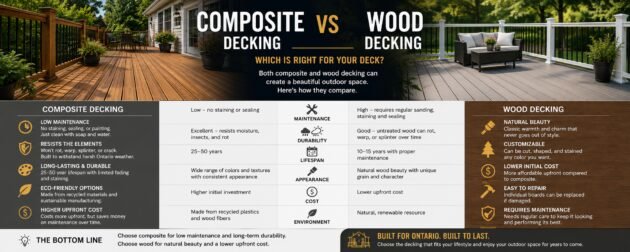
Both survive Ontario’s freeze-thaw, but they trade off. Pressure-treated is cheapest and easy to work, but it warps and needs staining every 1–2 years. Composite costs more upfront, won’t splinter, holds its colour, and skips the staining. Keeping the deck long-term and hate maintenance? Composite usually wins. Tight budget? PT.
Two ways to handle the permit (we’ll do the heavy part)
DIY with an instant PDF, or hand us the drawings. Either way, you skip the guesswork.
Best value
$1,500 designer value
The Ontario Deck Bible
Your deck permit, filed by Sunday.
No specialist, no waiting room — just follow the steps.
$1,500$29.99 one-timeSave $1,470
Everything a designer does — for the price of a coffee run.
- File your own permit in a weekend — no specialist
- Board choice, fasteners & joist spacing done right
- Whether it’s your first deck or your fiftieth — you need this
- One coffee-run price vs a $1,500 designer
30-day money-back guarantee
Get instant access — $29.99 →
Secure checkout · download in 2 minutes · yours forever
Done-for-you
Permit-Ready Deck Plans
Still need to sort the permit? We’ll do the paperwork.
Skip the building-department runaround. Grab the DIY report, or let us draw the plans.
$399 flat, up to 500 sq ftFraction of a designer
+ $0.75/sq ft over 500 sq ft
- The full set your city wants: site plan, framing, elevation, section, details
- Joist spacing set for your decking board
- We handle the heavy part — you just submit and build
- Drawn by a BCIN-registered designer with 15 years’ experience
Free quote · no obligation
Get my free plans quote →
Most decks: a fixed price back within 1 business day
Every decking material compared
Cedar vs PT vs composite vs PVC — pros, cons & lifespan
Roughly, by upfront board cost and lifespan: pressure-treated about $3–5/sq ft and 15–20 years; cedar $5–8 and 15–25 years; composite $6–12 and 25–30+ years; PVC $9–15 and 30+ years. Wood is cheaper but needs sealing; composite and PVC cost more but skip the upkeep.
| Material | Board cost | Maintenance | Lifespan | Best for | |
|---|---|---|---|---|---|
| Pressure-treated | ~$3–5/sq ft | Stain/seal every 1–2 yrs | 15–20 yrs | Tight budgets | Shop → |
| Cedar | ~$5–8/sq ft | Seal every 1–2 yrs | 15–25 yrs | Natural look | Shop → |
| Composite | ~$6–12/sq ft | Wash only | 25–30+ yrs | Low upkeep | Shop → |
| PVC / premium | ~$9–15/sq ft | None | 30+ yrs | Premium & lakefront | Shop → |
Board cost is material only — installed deck cost is higher; see the cost to build a deck guide. Whatever you pick, keep it looking new with the deck maintenance guide.
Does composite get too hot to walk on barefoot?
It can. Dark composite boards in full sun get hotter than wood and can be uncomfortable barefoot. If your deck faces south with no shade, choose a lighter colour or a line engineered to stay cooler, and sample-test a board on a hot day before you commit to a dark one.
Composite regrets — fading, mould, or warping?
Modern composite is good, not magic. Cheaper, older, or uncapped boards can fade, grow mould in damp shade, or scratch. Capped composite resists all three far better. Buy a quality capped line, keep it clean, and give it airflow and drainage underneath to avoid the common regrets.
First 2 questions free
Will your board and frame pass inspection?
Composite joist spacing, fasteners, and gaps all have rules. Ask the OBC Code Navigator any Ontario deck question and confirm the details before you buy a single board.
Check your build free →Wood: cupping, gaps and stain
My new PT boards shrank, cupped or gapped — what went wrong?
New pressure-treated lumber is usually wet from the treatment, so it shrinks, cups, and gaps as it dries — that’s normal. Install it reasonably tight (it shrinks apart on its own), lay boards bark-side up so they cup away from water, fasten well, and let it dry out before you stain.
How big a gap between deck boards?
Gap wet PT boards tight (about a 1/8 inch, a nail’s thickness) since they shrink as they dry; gap dry boards and composite about 1/8–1/4 inch for drainage and expansion. Always follow the composite manufacturer’s exact spacing — end gaps for composite are often larger for thermal movement.
Best stain for a wood deck, and how often?
For PT and cedar, use a penetrating semi-transparent stain — it wears away instead of peeling like film-forming products. Refresh every 1–2 years, sooner on south-facing or lakefront decks. Let new pressure-treated lumber dry for weeks to months before the first coat.
Staining is the bulk of a wood deck’s upkeep — the full routine, plus winter and cleaning tips, is in our deck maintenance guide. Shop deck stain →
Fastening and framing for your boards
Hidden fasteners vs screws — which?
Hidden clips give a clean, screw-free surface and are common with grooved composite; face-screwing is faster, cheaper, and easy to repair. Both pass code. Match the system to your board — many composites are designed for hidden fasteners — and use the manufacturer’s recommended clips.
- Hidden clips — clean look, no surface screws; best with grooved composite/PVC boards.
- Face screws — cheaper and faster; easiest to lift a board later for a repair.
- Match the metal — whatever the method, use treated-lumber-rated stainless or coated fasteners.
What screws are safe for PT lumber?
Use only hot-dip galvanized or stainless fasteners rated for treated lumber. Modern PT is corrosive to plain steel and standard zinc, which rust fast and stain the wood. For composite, use the manufacturer’s colour-matched screws or hidden-clip screws — also stainless or specially coated.
Can I put composite on a PT frame? What joist spacing?
Yes — composite decking goes on a standard pressure-treated frame; the frame is the structure, the composite is just the surface. The catch is joist spacing: many composite boards require 12-inch on-centre joists (especially diagonal layouts) as a warranty rule. Confirm the spacing before you frame.
That 12-inch requirement changes your whole framing layout, so settle your board first, then size the structure with the framing & spans guide.
Tie it together: price your boards into the full build with the cost to build a deck guide, match the railing to your decking, keep it new with maintenance, and if you’d rather hire it out, see hiring a deck builder.
Frequently asked questions
Composite vs pressure-treated decking for Ontario weather – which?
Both survive the freeze-thaw, but trade off. Pressure-treated is cheapest and easy to work but warps and needs staining every 1-2 years. Composite costs more upfront, won’t splinter, holds colour, and skips staining. For long-term, low-maintenance decks composite usually wins; on a tight budget, PT.
Cedar vs PT vs composite vs PVC – lifespan and cost?
By board cost and lifespan: pressure-treated about $3-5/sq ft and 15-20 years; cedar $5-8 and 15-25 years; composite $6-12 and 25-30+ years; PVC $9-15 and 30+ years. Wood is cheaper but needs sealing; composite and PVC cost more but skip the upkeep.
Does composite decking get too hot to walk on barefoot?
It can. Dark composite boards in full sun get hotter than wood. If your deck faces south with no shade, choose a lighter colour or a line engineered to stay cooler, and sample-test a board on a hot day before you commit to a dark one.
Do people regret composite – fading, mould, warping?
Cheaper, older, or uncapped boards can fade, grow mould in damp shade, or scratch. Capped composite resists all three far better. Buy a quality capped line, keep it clean, and give it airflow and drainage underneath to avoid the common regrets.
My new PT boards shrank, cupped or gapped – what went wrong?
New pressure-treated lumber is usually wet from treatment, so it shrinks, cups, and gaps as it dries – that’s normal. Install it reasonably tight, lay boards bark-side up so they cup away from water, fasten well, and let it dry out before you stain.
How big a gap between deck boards?
Gap wet PT boards tight (about 1/8 inch) since they shrink as they dry; gap dry boards and composite about 1/8-1/4 inch for drainage and expansion. Always follow the composite manufacturer’s exact spacing – end gaps for composite are often larger for thermal movement.
Hidden fasteners or screws for decking?
Hidden clips give a clean, screw-free surface and suit grooved composite; face-screwing is faster, cheaper, and easy to repair. Both pass code. Match the system to your board and use the manufacturer’s recommended clips, in treated-lumber-rated stainless or coated metal.
What screws are safe for pressure-treated lumber?
Only hot-dip galvanized or stainless fasteners rated for treated lumber. Modern PT is corrosive to plain steel and standard zinc, which rust fast and stain the wood. For composite, use the manufacturer’s colour-matched or hidden-clip screws, also stainless or coated.
Can I put composite decking on a PT frame, and what joist spacing?
Yes – composite goes on a standard pressure-treated frame; the frame is structure, the composite is the surface. The catch is spacing: many composite boards require 12-inch on-centre joists, especially diagonal layouts, as a warranty rule. Confirm the spacing before you frame.
Disclaimer: General guidance for Ontario homeowners; board costs, lifespans, and product behaviour vary by brand, grade, colour, exposure, and installer. Always follow the decking manufacturer’s installation, fastener, and joist-spacing requirements, and confirm local building requirements. This is not engineering advice.
Related reading
More deck guides, calculators & advice
More from BuildersOntario — scroll to explore.
Loading latest posts…
Tip: shift + mousewheel works great