Ontario's Plain-English Guide to Custom Home Building📞 705-533-1633 | ☎️ 1-866-868-6606 | ✉️ info@icfhome.ca
Easements & Rights-of-Way: The Lines on a Lot You Can’t Build On
Easements
Ontario 2026
Before you buy
Easements & Rights-of-Way: The Lines on a Lot You Can’t Build On
You can own a piece of land and still not be allowed to build on part of it. An easement is a legal right that lets someone else – a utility, the municipality, or a neighbour – use a strip of your property, and within that strip your ability to build, dig, fence, or even landscape is limited. Buyers find out the hard way: one Oakville couple was ordered to tear out a pool and pay $40,000 in costs after building over a utility easement. Here’s how easements and rights-of-way work in Ontario, how they shrink your buildable land, and exactly how to find them before you buy – from 45 years building across Simcoe County and Georgian Bay.
What an easement actually is
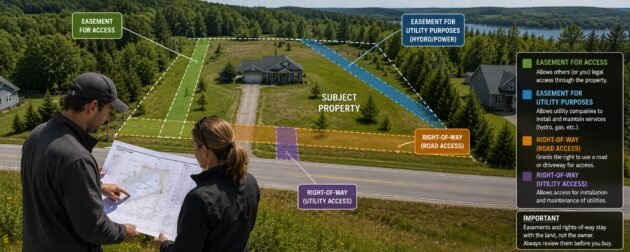
An easement is a registered right for a third party to use part of your land for a specific purpose – most often running and maintaining services like hydro, gas, water, sewer, or telecom. The key thing buyers miss: you still own the land, but you don’t fully control it. The utility or party that holds the easement can enter the strip to access and maintain their infrastructure, and you can’t block or build over it.
The practical effect: an easement carves a no-build strip out of your lot. It comes off your buildable envelope just like a setback does – so a lot that looks big enough can lose the exact spot you wanted the house, garage, or septic.
The kinds of easements you’ll run into
| Type | What it is | Why it matters to a builder |
|---|---|---|
| Utility easement | Hydro, gas, water, sewer, or telecom right to run and service lines across the lot. | The most common. Creates a no-build strip; can’t fence, pave, or plant deeply over it. |
| Right-of-way | A right for someone to pass over your land – e.g. a shared driveway or access to a back lot. | You must keep it clear and passable; it can run right through where you’d build or park. |
| Easement of necessity | Access granted because a landlocked parcel has no other way in or out. | Common on rural and severed lots; ties to legal access. |
| Prescriptive easement | A right earned through long, open, uninterrupted use – not registered, but legally real. | The hidden one. A neighbour’s decades-old driveway use can bind the land. |
| Conservation / drainage | Rights tied to drainage, stormwater, or a conservation authority over part of the lot. | Can overlap floodplain and regulated-area limits; restricts grading and structures. |
What an easement stops you doing
Inside the easement, you generally can’t put anything that blocks access or that the holder would have to remove to do their work. That usually rules out:
Off the table on the strip
- The house, garage, addition, or any permanent structure
- Sheds, pools, hot tubs, decks, and large foundations
- Fences across the easement, retaining walls
- Deep landscaping – hedges, big trees, raised beds
Usually still okay (confirm)
- Lawn and shallow, easily-moved planting
- Driveway crossings, in some cases, with permission
- Use of the surface that doesn’t obstruct access
- Anything the easement holder signs off on in writing
The $40,000 lesson: The Ontario Court of Appeal ordered two Oakville homeowners to remove a swimming pool built on a utility easement and pay $40,000 in costs. The easement holder can compel removal of anything on the strip – so “we’ll just build over it” is one of the most expensive assumptions in real estate.
The two books that take you from lot to keys
Spot the easements before you buy – then pull the permit yourself. Each $29.99, or get both below and save.
Before you buy – start here
The Ontario Lot-Buying Bible
Prove a lot is buildable – before you spend a dollar.
$200+ of pro advice$29.99one-time
The 28-page step-by-step: how to read title and find easements, work out the buildable envelope, budget the invisible site costs, sort financing and HST, and confirm legal-lot status – plus printable worksheets and offer-condition clauses.
- The easements chapter: find them on title before you commit
- The site-cost budgeting worksheet to compare lots all-in
- The 10-minute go/no-go test and printable scorecard
- Bonus chapters: DIY trades, wells, zoning, negotiation
30-day money-back guarantee.
Get the Lot Bible – $29.99 →
Secure checkout – download in 2 minutes – yours forever
After you buy
The Ontario Building Permit Bible
Pull your permit yourself – without the guesswork.
$10,000$29.99one-time
Everything a builder does to coordinate a permit – the order of operations, the complete-application checklist that keeps it from bouncing, real fees, who to hire, and how to never fail an inspection.
- The complete-application checklist, so the file doesn’t bounce
- Real 2026 permit fees and development charges
- Who to hire to draw it, in what order, and what to pay
- How to never fail an inspection – and the costliest mistakes
30-day money-back guarantee.
Get the Permit Bible – $29.99 →
Secure checkout – download in 2 minutes – yours forever
Buying a lot and building on it? Get both Bibles.
The complete journey – prove the lot is buildable, then pull the permit without the guesswork.
Before you buy
The Ontario Lot-Buying Bible
Prove a lot is buildable – and what it will really cost – before you spend a dollar.
$29.99 on its own
+
After you buy
The Ontario Building Permit Bible
Pull your Ontario building permit yourself – the order of operations, the checklist, and how to never fail an inspection.
$29.99 on its own
$59.98 Both for $49.99
Get both Bibles →
How to find easements before you buy
Order a title search
Your lawyer searches title and pulls the registered easements, rights-of-way, and restrictive covenants on the parcel. This is the single most important step – do it before conditions come off.
Get a current survey (SRPR)
A surveyor’s Real Property Report shows where the easements physically sit on the lot, so you can see whether they cross your building area, not just that they exist on paper.
Walk the lot for unregistered use
Look for worn paths, a neighbour’s driveway crossing the corner, hydro poles, or utility boxes. Long-standing use can create a prescriptive easement that won’t show on a clean title.
Lean on the purchase agreement
The standard OREA agreement lets your lawyer object to easements found by the requisition date – though it carves out minor easements for ordinary utilities. Understand exactly what binds the title before you commit.
Re-draw your envelope
Subtract the easement strips along with the setbacks, then confirm your home, garage, septic, and driveway still fit. If they don’t, renegotiate, relocate, or walk.
Worried an easement guts the lot? Send us the parcel – we’ll map it against your build.
Give us the address (and the survey or title if you have them) and we’ll show you where the easements and rights-of-way fall, whether they hit your house, garage, or septic, and what’s still buildable – before you remove conditions. Quick paid consult: we scope it on a call and send a secure payment link, so you only pay once you know what you’re getting.
Can you remove or work around an easement?
Sometimes – but don’t count on it
- An easement can be released if the holder formally agrees to give it up
- Some utilities will grant written permission for limited surface uses
- A relocation may be possible – at your cost, with the holder’s consent
- Releases and relocations take time and money, and can be refused
The safe assumption
- Treat a registered easement as permanent when you budget and design
- Design the home to sit clear of the strip from day one
- Never waive a buyability condition on a verbal “they’ll let you build there”
- Get any permission in writing, on title, before you rely on it
Easements mapped? We’ll design the home to fit clear of them.
We draw a permit-ready set that keeps the house, garage, and septic off every easement strip, sort the approvals, and build the energy-efficient ICF home – with our own site-work crew getting the lot ready.
Related guides on this site
Easements and rights-of-way in Ontario: frequently asked questions
Can I build on an easement on my property?
Generally no, not within the easement itself. Even though you own the land under an easement, the party that holds it has the legal right to access and use that strip, so you cannot place anything there that would obstruct them or that they might have to remove to do their work. In practice that rules out the house, a garage, an addition, a shed, a pool, a deck on footings, retaining walls, fences across the strip, and deep landscaping such as hedges and large trees. Lawns and shallow, easily moved plantings are often tolerated, and a utility may grant written permission for a limited surface use like a driveway crossing, but you should never assume that. The safe approach is to treat the easement as a permanent no-build strip and design your home to sit clear of it from the very start.
How do I find out if a lot has an easement before I buy?
You confirm easements through a title search done by your lawyer, ideally before your conditions come off. The search pulls the registered easements, rights-of-way, and restrictive covenants that affect the parcel. Pair that with a current surveyor’s Real Property Report, which shows where those easements physically sit on the ground so you can see whether they cross the area where you want to build, rather than just knowing they exist on paper. It is also worth walking the lot yourself to look for signs of use that may not be registered, such as a worn path, a neighbour’s driveway clipping a corner, or utility poles and boxes, because long-standing use can create a prescriptive easement. The standard purchase agreement lets your lawyer object to easements found by the requisition date, so understand exactly what binds the title before you firmly commit.
What is the difference between an easement and a right-of-way?
A right-of-way is a particular kind of easement. An easement is the broad legal concept, a registered right for someone else to use part of your land for a defined purpose, such as a utility running and maintaining its lines. A right-of-way is the specific type that gives a person the right to pass over your land, for example a shared driveway or access to a parcel behind yours. So all rights-of-way are easements, but not all easements are rights-of-way. For a builder, the practical effect is similar: both create a strip you must keep clear and cannot build over, and both come off your usable, buildable area. The label matters less than knowing precisely where the right sits on the lot and what it allows the holder to do, which is why the title search and the survey together are what you really need.
What is a prescriptive easement and why is it risky?
A prescriptive easement is a right that someone earns through long, open, continuous, uninterrupted, and non-permissive use of part of your land, rather than through a registered agreement. In Ontario the courts have continued to apply a roughly twenty-year threshold for this kind of claim, and recent appeal decisions have both upheld the test and recognized such an easement over a shared driveway where the use began before the land moved into the land titles system. The risk for a buyer is that this kind of right may not appear on a clean title, so a neighbour’s decades-old use of your driveway, lane, or yard can quietly bind the land you are about to purchase. That is why walking the lot and looking for established patterns of use matters, and why a lawyer should investigate anything that looks like long-standing use before you commit.
Does an easement lower a property’s value?
It can, though the size of the effect depends on the easement. A small, unobtrusive utility easement running along a back or side boundary, where no one was going to build anyway, often has little impact on value or use. A large or awkwardly placed easement is different, particularly one that crosses the prime building area, a waterfront, or a feature part of the lot, because it can limit what and where you can build and may be visually intrusive. Factors such as the easement’s size and location, the type of right involved, and how much it sterilizes otherwise usable land all influence the impact. For a buyer planning to build, the real question is not just resale value but whether the easement removes the spot you needed for the house, garage, or septic. Map it against your plan before you decide what the lot is worth to you.
Can an easement be removed or relocated?
Sometimes, but you should not count on it. An easement can be released if the party that holds it formally agrees to give it up, and in some cases a utility will consent to relocate its infrastructure or grant written permission for a limited surface use, typically at the property owner’s expense. However, releases and relocations take time and money, require the holder’s cooperation, and can simply be refused, especially where active infrastructure is involved. Because of that, the prudent approach when you are buying and budgeting is to treat a registered easement as permanent, design the home to sit clear of the strip, and never waive a condition based on a verbal assurance that you will be allowed to build there. If permission or a release is genuinely available, get it in writing and registered on title before you rely on it.
Who is responsible for maintaining an easement area?
It depends on the type of easement and what its terms say, so this is another reason to read the actual document rather than assume. With a utility easement, the utility is generally responsible for its own equipment and for restoring the area after it works there, while the landowner usually maintains the surface, for example by mowing the lawn over it, as long as that does not obstruct access. With a shared right-of-way such as a mutual driveway, the responsibility for upkeep and cost-sharing is ideally set out in a written agreement, and disputes are common where it is not. As the landowner you still own the soil and are expected to keep the area clear and passable, but you cannot interfere with the holder’s rights. When an easement affects a lot you are buying, have your lawyer review its exact terms so you know who pays for what before you take title.
Note: general guidance, not legal advice. Easements, rights-of-way, and prescriptive claims turn on the specific document and facts – have a real estate lawyer review title and the survey for your lot before you rely on anything here or waive a condition.
More on land and site
Reviewed and updated October 2026. Costs on this site are Ontario ranges, not quotes; code references are to the Ontario Building Code in force at the date above.
Latest posts
Fresh guides, calculators & real-world advice
More from BuildersOntario – scroll to explore.
Loading latest posts…
Tip: shift + mousewheel works great