Ontario's Plain-English Guide to Custom Home Building📞 705-533-1633 | ☎️ 1-866-868-6606 | ✉️ info@icfhome.ca
Floodplain & Conservation-Authority Land: The Permit on Top of the Permit
Floodplain & CA land
Ontario 2026
Before you buy
Floodplain & Conservation-Authority Land: The Permit on Top of the Permit
Some of the prettiest lots in our region sit near a river, a wetland, or the Georgian Bay shoreline – and that beauty comes with a second gatekeeper most buyers never see coming. On regulated land, your local Conservation Authority has its own permit power, on top of the municipality, and it can restrict where you build, how you grade, or whether you can build at all. People have bought waterfront and riverside lots only to be refused. Here’s how floodplain and conservation-authority regulation works in Ontario, how to check a lot before you buy, and what it means for your build – from 45 years working with the authorities across Simcoe County and Georgian Bay.
The gatekeeper most buyers miss
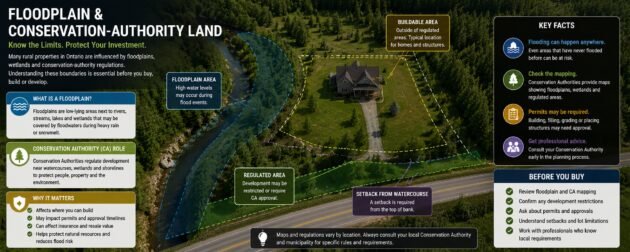
Across Ontario, Conservation Authorities review development near rivers, streams, ponds, wetlands, floodplains, and shorelines to protect people and property from flooding, erosion, and unstable ground. If your lot falls in one of these regulated areas, you generally need a permit from the authority – separate from, and in addition to, your municipal building permit. In our region that’s typically the Nottawasaga Valley Conservation Authority (NVCA) or a neighbouring authority, depending on the watershed.
Why it catches people: the listing says “residential,” the zoning may even allow a house, and the municipality is happy – but the Conservation Authority is a separate approval with its own rules. A lot can clear every other test and still be blocked at the water’s edge.
What the authority regulates
Under Section 28 of the Conservation Authorities Act – now administered through Ontario Regulation 41/24 and Part VI of the Act, in effect since April 1, 2024 – an authority can regulate development where flooding, erosion, dynamic beaches, pollution, or the conservation of land may be affected. In practice that means:
Where it applies
- Floodplains and river or stream valleys
- Wetlands and the land around them
- The Georgian Bay and lake shorelines
- Steep slopes and erosion-hazard land
- An allowance of land beyond each of these features
What it controls
- Building, structures, and additions in the regulated area
- Grading, filling, and altering the land
- Work that changes or interferes with a watercourse or wetland
- How far a building must sit back from the hazard
- Whether a build is allowed there at all
They really can say no. Conservation Authority refusals have been upheld by the courts – in one well-known case the Court of Appeal backed an authority’s refusal of a home in a floodplain. A regulated lot is not a guaranteed building lot. Treat the authority’s sign-off as a condition you must confirm, not a formality.
The two books that take you from lot to keys
Clear the conservation hurdle before you buy – then pull the permit yourself. Each $29.99, or get both below and save.
Before you buy – start here
The Ontario Lot-Buying Bible
Prove a lot is buildable – before you spend a dollar.
$200+ of pro advice$29.99one-time
The 28-page step-by-step: how to spot regulated and floodplain land, check water and septic feasibility, budget the invisible site costs, sort financing and HST, and confirm zoning and legal-lot status – plus printable worksheets and offer-condition clauses.
- The hazard-land chapter: floodplain, wetland, shoreline checks
- The site-cost budgeting worksheet to compare lots all-in
- The 10-minute go/no-go test and printable scorecard
- Bonus chapters: DIY trades, wells, easements, negotiation
30-day money-back guarantee.
Get the Lot Bible – $29.99 →
Secure checkout – download in 2 minutes – yours forever
After you buy
The Ontario Building Permit Bible
Pull your permit yourself – without the guesswork.
$10,000$29.99one-time
Everything a builder does to coordinate a permit – the order of operations, the complete-application checklist that keeps it from bouncing, real fees, who to hire, and how to never fail an inspection.
- The complete-application checklist, so the file doesn’t bounce
- Real 2026 permit fees and development charges
- Who to hire to draw it, in what order, and what to pay
- How to never fail an inspection – and the costliest mistakes
30-day money-back guarantee.
Get the Permit Bible – $29.99 →
Secure checkout – download in 2 minutes – yours forever
Buying a lot and building on it? Get both Bibles.
The complete journey – prove the lot is buildable, then pull the permit without the guesswork.
Before you buy
The Ontario Lot-Buying Bible
Prove a lot is buildable – and what it will really cost – before you spend a dollar.
$29.99 on its own
+
After you buy
The Ontario Building Permit Bible
Pull your Ontario building permit yourself – the order of operations, the checklist, and how to never fail an inspection.
$29.99 on its own
$59.98 Both for $49.99
Get both Bibles →
How to check a lot before you buy
Look it up on the authority’s map
Most authorities publish an interactive property/regulation map. Search the address to see if any part of the lot is in a regulated area, floodplain, or wetland. NVCA, for example, has an interactive property map for exactly this.
Call the Conservation Authority
Maps show the general picture; the staff give you the real answer. Submit a general inquiry describing what you want to build and ask whether a permit is needed and whether your plan is feasible.
Ask where the buildable area is
Even a regulated lot often has a developable portion. Find out where the authority would allow a house, how far back from the hazard, and what studies they’d want.
Budget the extra studies and time
Regulated lots can require things like a geotechnical or slope-stability study, floodproofing, or an environmental report – plus a longer approval timeline. Price that in.
Make the offer conditional
Keep a condition tied to confirming the lot is buildable to the authority’s satisfaction, and don’t waive it until you have that in writing.
Lot near water or a wetland? Send us the address – we’ll check if it’s regulated.
Tell us the lot and we’ll check whether it falls in a Conservation Authority regulated area or floodplain, what that likely means for where you can build and the setbacks, which studies the authority tends to want, and how the odds look – before you remove conditions. Quick paid consult: we scope it on a call and send a secure payment link, so you only pay once you know what you’re getting.
What regulation means for your build
It’s not always a “no”
- Many regulated lots are still buildable – with the right siting and design
- The authority may approve a house set back from the hazard
- Floodproofing or a raised building elevation can be part of the answer
- The key is designing with the authority from the start
But plan for the realities
- Extra permit, extra studies, extra time and cost
- Limits on grading, filling, and altering the land near the feature
- A smaller usable footprint once setbacks are applied
- Possible refusal where the hazard is too great – which can hit resale and financing
The takeaway: a regulated lot can be a wonderful place to build – we’ve done it many times – but only if you confirm what’s allowed before you buy and design to the authority’s rules, rather than discovering them after closing.
Regulated lot, green light to build? We’ll design to the authority’s rules.
We design a permit-ready set that respects the floodplain, setbacks, and any floodproofing the authority wants, coordinate the Section 28 permit alongside the municipal one, and build the energy-efficient ICF home – with our own site-work crew getting the lot ready.
Related guides on this site
Floodplain & conservation-authority land in Ontario: frequently asked questions
Can I build a house on a lot in a floodplain in Ontario?
Sometimes, but not as a given, and never without the Conservation Authority’s involvement. Land in a floodplain is treated as hazardous land and falls under the authority’s regulation, so building there requires their permit in addition to your municipal building permit. Depending on where the lot sits in the floodplain and how severe the flood and erosion risk is, the authority may approve a home set back from the hazard, possibly with floodproofing or a raised building elevation, or it may refuse the build entirely where the risk is too great. Conservation Authority refusals of floodplain homes have been upheld by the courts, so this is a real possibility, not a formality. The safe approach is to confirm with the authority exactly what, if anything, they will allow on that specific lot before you buy, rather than assuming a floodplain lot is automatically a building lot.
How do I find out if a lot is in a regulated or floodplain area?
Start with your local Conservation Authority, since they administer the regulated areas in their watershed. Most publish an interactive property or regulation map where you can search the lot’s address and see whether any part of it falls within a floodplain, wetland, shoreline, or other regulated area, and the Nottawasaga Valley Conservation Authority, for example, offers exactly this kind of tool. The map gives you the general picture, but the reliable answer comes from contacting the authority directly, describing what you want to build, and asking whether a permit is required and whether your plan is feasible on that lot. It is also worth asking the municipality, since planning staff often know which properties carry hazard constraints. Do this checking before you remove conditions, because regulation can affect not just where you build but whether you can build at all.
What is a Section 28 permit?
Section 28 refers to the part of Ontario’s Conservation Authorities Act that gives Conservation Authorities the power to regulate development in and around natural hazards such as floodplains, wetlands, watercourses, shorelines, and unstable slopes. A Section 28 permit, now administered through Ontario Regulation 41/24 and Part VI of the Act, which came into effect on April 1, 2024, is the approval you need from the authority to build, place a structure, grade or fill land, or alter a watercourse within a regulated area. It is separate from your municipal building permit, and you generally need both. The authority assesses whether your proposed work could affect flooding, erosion, dynamic beaches, pollution, or the conservation of land, and it can approve, approve with conditions, or refuse. If a lot you are considering is in a regulated area, factor the Section 28 process, its studies, and its timeline into your plans.
Does a conservation authority always refuse development on regulated land?
No. Being in a regulated area does not automatically mean you cannot build, and many regulated lots are developed successfully every year with the right siting and design. The authority’s job is to manage risk, so on a given lot they may approve a house positioned away from the hazard, sometimes with measures like floodproofing, a raised elevation, or limits on grading and fill near the feature. What they will not do is wave through a build that sits in a high-risk location or worsens flooding or erosion, and in those cases they can and do refuse. The outcome depends heavily on the specific lot, the feature involved, and how the project is designed. That is why the smart move is to engage the authority early, find out where and how they would allow a building, and design to those rules, rather than buying first and hoping for approval afterward.
What extra costs come with a regulated or floodplain lot?
Beyond the usual cost of building, a regulated lot typically adds a few things. There is the Conservation Authority permit itself and the review process that goes with it, and the authority often requires supporting studies, which can include a geotechnical or slope-stability assessment, a floodplain or hydraulic analysis, an environmental or natural-heritage report, or a floodproofing design, depending on the hazard. These studies cost money and take time, and the approval timeline is generally longer than a straightforward lot. There may also be design measures, such as raising the building or special foundations, that add construction cost, plus limits on how much of the lot you can use once setbacks from the hazard are applied. Finally, a hazard designation can affect financing and resale. None of this necessarily makes a regulated lot a bad buy, but you should price these realities in before you commit rather than be surprised by them later.
Is buying a floodplain or regulated lot a bad idea?
Not necessarily. Some of the most desirable lots in our region are near water or other natural features, and they can be wonderful places to build a home. The risk is not the regulation itself but buying blind, because a regulated lot carries the possibility of refusal, extra studies, a smaller buildable area, higher cost, and a longer timeline, and occasionally an outright inability to build. The way to buy one wisely is to do your homework first: confirm with the Conservation Authority whether and where they would allow a build, understand the conditions and studies they would require, budget the added cost and time, and keep your offer conditional until you have answers in writing. Done that way, a regulated lot can be a great purchase. Done blindly, it can be a very expensive mistake, which is the whole reason to check before you buy rather than after.
Who is my conservation authority in the Georgian Bay and Simcoe County area?
It depends on the watershed your lot sits in, because Conservation Authorities are organized by watershed rather than by municipality. Across much of Simcoe County and the southern Georgian Bay area, the Nottawasaga Valley Conservation Authority, or NVCA, is the relevant authority, and it reviews development near rivers, streams, wetlands, floodplains, and the Georgian Bay shoreline in its jurisdiction. Neighbouring areas fall under other authorities depending on which river system and shoreline they drain to, so the correct authority for a specific lot is determined by its location. The simplest way to confirm is to look the property up on the authority’s mapping tool or call them, and they will tell you whether the lot is in their jurisdiction and whether any part of it is regulated. If you are not sure which authority applies, the municipality can usually point you to the right one.
Note: general guidance, not legal advice or an approval. Regulated areas, floodplain limits, required studies, and what an authority will permit vary by lot and watershed and are decided by the relevant Conservation Authority – confirm with them and a qualified professional before you rely on anything here or waive a condition.
More on land and site
Reviewed and updated October 2026. Costs on this site are Ontario ranges, not quotes; code references are to the Ontario Building Code in force at the date above.
Latest posts
Fresh guides, calculators & real-world advice
More from BuildersOntario – scroll to explore.
Loading latest posts…
Tip: shift + mousewheel works great