
Heated Garage Slab Cost Ontario: The Part of the Garage Budget People Always Underestimate
The Garage Floor Is Cheap Right Up Until You Decide You Want It Warm
This is the part of the garage budget people regularly underestimate. They price the structure, the doors, the siding, maybe even the windows if they are feeling fancy, and then they treat the slab like it is just a flat piece of concrete with a good attitude. It is not. And once you decide you want a heated garage slab in Ontario, that floor stops being “just the slab” and starts becoming a system.
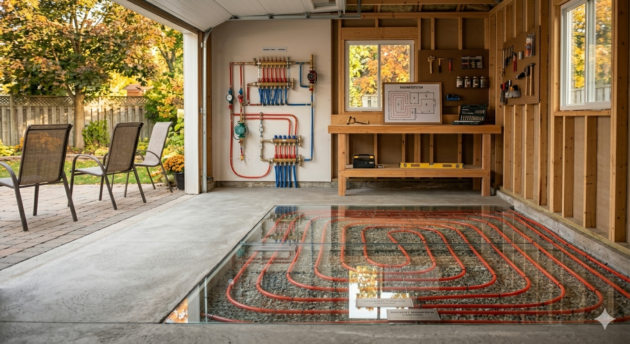
A radiant garage slab can be one of the best upgrades you make. It dries slush, keeps tools happier, makes winter projects actually tolerable, and turns the garage from a cold storage box into real usable square footage. But the cost is not just tubing in concrete. It is excavation, stone base, compaction, insulation, vapour barrier, tubing layout, manifold, controls, concrete placement, and whatever heat source is feeding the loop.
If you are trying to understand heated garage slab cost in Ontario, the honest answer is this: the tubing itself is not usually what shocks people. It is everything around it. The prep, the insulation, the design, the mechanical tie-in, and the fact that a warm slab punishes sloppy work forever.
What people budget for
- Concrete truck
- Rebar or mesh
- A nice smooth finish
- Maybe a floor drain
What they forget
- Excavation and stone base
- Rigid insulation and edge detailing
- Tubing, manifold, and controls
- Heat source and design coordination
What makes it worth it
Real year-round use. Warm tools, dry floors, better comfort, fewer freeze-thaw headaches, and a garage that feels like part of the property instead of the cold punishment wing.
What a heated garage slab actually includes
A radiant slab is not one product. It is a stack of decisions that all have to cooperate. At the bottom, you have excavation and base preparation. Then you need compacted stone, insulation, vapour protection, reinforcing, tubing layout, concrete placement, and the hydronic side that makes the whole thing warm. If any one of those pieces is handled poorly, the slab may still exist, but it will not perform the way you imagined while standing in the garage in February dreaming big.
This is especially important in Ontario because a garage slab is dealing with cold weather, wet vehicles, salt, freeze-thaw conditions, and sometimes a workshop use that pushes the space well beyond “a place where the lawnmower feels ignored.”
If you are pricing a whole detached garage as well, start with Detached Garage Cost Ontario. The heated slab is only one line of the project, but it is one of the lines that can quietly move the total more than people expect.
Excavation and stone base: the part under the slab still matters
Homeowners love visible upgrades. Excavation is not visible, which is why it gets disrespected. But the slab is only as good as what is under it. If the excavation is shallow, the subgrade soft, or the stone base poorly compacted, you are already building problems into the floor before the tubing even arrives.
On a typical heated garage slab, you may be looking at excavation, removal of unsuitable material, supply and compaction of crushed stone, and grading that gives you a clean, stable platform. On some sites that is simple. On others it turns into rock, wet ground, access trouble, or imported fill. Those conditions change cost quickly.
This is why site work matters so much. A clean lot with easy access is one thing. A tight Georgian Bay or rural Ontario site is another. If site conditions are part of the story, pages like Excavation Services Georgian Bay help explain why the slab budget sometimes gets beaten up before the concrete crew even shows up.
Builder truth: radiant tubing does not fix a bad base. A warm slab that settles is still a bad slab, just more comfortable while it disappoints you.
Insulation is where the slab stops heating the earth for free
If you are paying to heat a slab, you want the heat moving upward into the garage, not downward into Ontario. That means insulation matters. Under-slab rigid insulation and perimeter edge insulation are not decorative extras. They are part of what makes radiant worth doing.
Cheapening out here is one of the classic mistakes. People spend money on tubing and controls, then hesitate when insulation comes up, as if the slab will somehow become disciplined and only warm the part of physics they prefer. It will not.
Insulation cost varies with thickness, product choice, slab design, and edge detailing, but this line item is one of the main reasons a heated slab costs more than a standard garage floor. It is also one of the main reasons the finished system feels good instead of merely expensive.
If you want the builder-side case for doing it properly, Radiant Heated Garage Slab Ontario is worth a read.
Tubing, layout, and spacing: this is where comfort gets designed
The radiant tubing is the part everyone pictures first, but it is not just a matter of “throw some loops in there.” Tube spacing, loop length, zoning, slab thickness, insulation below, and the intended use of the garage all matter. A lightly warmed two-car garage for keeping cars dry is not the same as a workshop where someone wants to spend eight hours building cabinetry in January.
A tighter tube layout generally improves output and floor temperature consistency, but it also adds material and labour. Bigger garages, workshops, or spaces expected to hold higher temperatures tend to need more thought here, not less.
That is why proper design is worth paying for. Pages like Radiant Floor Heating Design Ontario and Radiant Slab Design Ontario matter because a slab is not the place to improvise your way into cold corners and striped floors.
Manifold, controls, pumps, and heat source: the stuff people forget to include
A warm slab needs more than tubing. It needs a way to distribute water properly, balance circuits, control temperature, and connect to a heat source. That might mean a manifold, actuators, mixing strategy, circulators, thermostats, relays, or integration with a boiler, combi unit, or other hydronic source.
This is where a lot of “slab cost” conversations get slippery. Some quotes include the tubing in the floor but not the mechanical equipment feeding it. Others include the whole radiant package. Others assume the heat source already exists and has spare capacity. Those are very different numbers, which is why comparing radiant slab quotes without reading scope is a wonderful way to confuse yourself.
| Component | What it does | Why it affects price |
|---|---|---|
| Manifold | Distributes water to each loop | Size, quality, and number of circuits matter |
| Controls | Manage temperature and operation | Simple on/off is cheaper than smarter zoning |
| Pumps / mixing | Move and temper water properly | Needed for stable, safe slab temperatures |
| Heat source tie-in | Actually makes the slab warm | May be minor or major depending on the project |
Concrete placement costs more when the slab has to behave nicely around tubing
Pouring a radiant slab is not identical to pouring a plain garage floor. The crew has to work around tubing, protect layout, keep elevations honest, and avoid turning a heating system into abstract art with boots and tools. That extra care shows up in labour, coordination, and sometimes in the reinforcement and slab detailing.
Then there is finishing, curing, control joints, saw cuts, and crack management. A heated slab can be a beautiful upgrade, but it is not forgiving if the concrete work is treated casually. If the slab cracks badly, curls, or gets damaged around penetrations, nobody will be standing there admiring how inexpensive it was.
In other words, radiant slabs are not just “normal concrete plus pipe.” They are concrete jobs that demand more discipline.
Typical Ontario cost breakdown for a heated garage slab
These are planning ranges, not universal prices. Actual costs move with site conditions, slab size, insulation thickness, loop layout, equipment scope, and local labour. But for budgeting purposes, this kind of breakdown gets people much closer to reality than pretending the slab is just concrete with ambition.
| Cost item | Typical planning range | What moves it up |
|---|---|---|
| Excavation and base prep | $4 to $10+ / sq. ft. | Rock, wet soil, poor access, extra fill, heavier base requirements |
| Rigid insulation / edge insulation | $2 to $5+ / sq. ft. | Thicker foam, higher-performance edges, detailing around doors and perimeter |
| Tubing and fastening | $2.50 to $5.50+ / sq. ft. | Tighter spacing, more loops, higher tubing density |
| Manifold / controls / pump components | $1,500 to $4,500+ | More zones, smarter controls, longer runs, equipment tie-in complexity |
| Concrete and finishing | $8 to $16+ / sq. ft. | Thicker slab, reinforcement changes, difficult pours, finishing quality |
| Design and heat source coordination | $500 to several thousand | New boiler/combi, larger workshop loads, full hydronic integration |
On many projects, the “radiant add-on” above a basic slab ends up being less shocking than the total slab system once excavation, insulation, mechanical, and concrete are counted properly. That is why homeowners often underestimate it. They are not missing one item. They are missing a whole chain of them.
Why it is still one of the best garage upgrades you can buy
Even with the added cost, radiant heat in a garage slab is one of those upgrades people rarely regret when they actually use the space. The floor dries faster. Snow and slush do not linger the same way. Tools, finishes, and stored materials live in a more stable environment. And if the garage becomes a workshop, hobby space, or serious year-round utility area, the comfort difference is not subtle.
A homeowner we worked with originally planned a plain slab and a unit heater later. After walking through how they actually wanted to use the garage — winter projects, storage, boots drying, occasional vehicle work — the radiant slab made a lot more sense. More money up front, yes. But also a better garage every cold month after that.
That is the key question: are you building a parking box, or are you building space you will actually live with and use? If it is the second one, radiant starts looking less like a luxury and more like good planning.
Where heated slabs make the most sense
- Detached garages used year-round where comfort and dry floors matter.
- Workshops where people stand for hours and want steady heat, not blasts of hot air.
- Garage suites or future conversions where the slab is part of a more serious building strategy. See Garage Suite Ontario.
- Higher-end builds where long-term use matters more than shaving every upfront dollar.
If your garage is part of a larger project and you want a builder familiar with that type of work, see Detached Garage Builder Simcoe County or Heated Workshop Builder Simcoe County.
What people forget when comparing heated and unheated garage slabs
They compare the wrong things. A plain slab is not competing with a radiant slab. A plain slab plus future regret, cold toes, damp floor, loud unit heater, and a garage that never quite feels right is competing with a radiant slab.
There is also the sequencing problem. Doing radiant from the start is far easier than deciding later that the freezing garage was a design flaw. Once the concrete is poured, most cheap “maybe later” ideas become very expensive “should have done it then” stories.
If permits are part of your planning, do not forget the garage itself still lives inside a normal permit process. For the broader context, see Detached Garage Permit Ontario.
Plain-English version: radiant is much easier to do before the slab is poured than after you have spent two winters pretending the garage is “fine.”
FAQ: Heated Garage Slab Cost Ontario
How much more does a heated garage slab cost than a regular slab?
On many Ontario projects, the radiant feature alone often adds roughly $10 to $22+ per square foot over a basic slab, but the full difference depends on insulation, tubing density, controls, manifold setup, and the heat source connection. Site work can widen the gap even more.
Is the tubing itself the expensive part?
Not usually. Tubing matters, but homeowners often underestimate the surrounding costs more than the tubing itself. Base prep, rigid insulation, concrete coordination, controls, pumps, and equipment tie-in are what really flesh out the budget.
Do I need insulation under a heated garage slab?
In practical terms, yes, if you want the system to make sense. Under-slab and perimeter insulation help keep heat moving into the garage rather than bleeding into the ground. Skipping insulation is one of the fastest ways to make radiant look less impressive and more expensive to run.
Is a radiant slab better than a unit heater in a garage?
They do different things. A radiant slab gives steady, quiet, floor-level comfort and dries wet floors well. A unit heater can warm air faster, but it does not create the same warm-floor feel. For workshops and year-round use, many people prefer radiant once they have lived with it.
Can I install tubing now and hook it up later?
Yes, some people do a radiant-ready slab by placing insulation and tubing during the pour, then connecting it later. That can be smart planning. But it still needs proper design and layout now, because once the concrete is in, your second chance gets expensive quickly.
When is a heated garage slab most worth the money?
It makes the most sense when the garage is more than basic car storage. If you plan to work in it, store temperature-sensitive items, use it through winter, or build a higher-end property where comfort matters, radiant is often one of the best upgrades in the whole garage package.
The honest conclusion
A heated garage slab in Ontario is not the cheapest way to build a floor. It is one of the smartest ways to build a garage you will actually enjoy using. The trick is budgeting it honestly. Not as “concrete plus a little tubing,” but as a full slab system with proper excavation, insulation, hydronic layout, controls, and concrete work that all have to cooperate.
If you are only pricing the shell, it will look expensive. If you are pricing long-term comfort and year-round function, it starts looking a lot more reasonable. That is why people underestimate it on the way in and love it on the way out.