
ICF Bracing Rental Rates Ontario
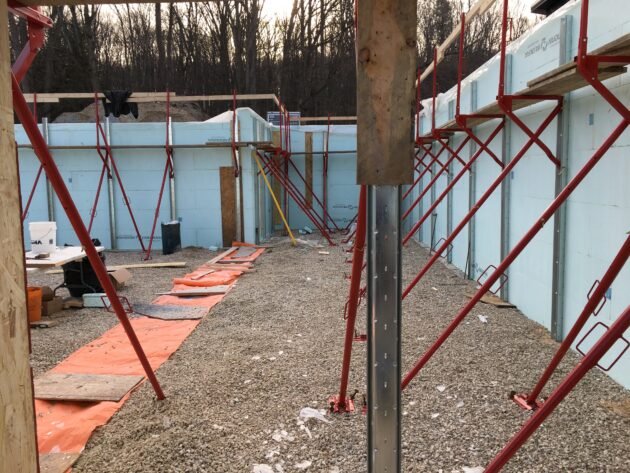
ICF Bracing Rental Rates in Ontario: Real Weekly Costs (and What Changes the Price)
Bracing is one of those ICF line-items that looks small… right up until you don’t have it, your walls aren’t straight, and “quick fix” turns into “why is my drywall guy now a sculptor?”
This is a practical Ontario guide to ICF bracing rental rates, what’s usually included in a rack, what add-ons push the cost up, and how to estimate how many braces you actually need for a typical foundation or tall wall.
What ICF bracing rental typically costs in Ontario (real published examples)
Rental pricing varies by region, availability, and what comes with the system (platforms, guardrails, stakes, turnbuckles, tall-wall extensions, etc.). But we do have Ontario suppliers that publish clear weekly/monthly numbers.
| System / Package | Published Ontario example | What that works out to |
|---|---|---|
| 10′ Giraffe bracing (rack of 24) | Lake Side Stone (Ontario) lists $450/week and $1350/month for a set of 24. :contentReference[oaicite:0]{index=0} | About $18.75 per brace per week (rack pricing), before delivery/tax. |
| 10′ Plumwall bracing (rack of 24) | Lake Side Stone (Ontario) lists $500/week and $1500/month for a set of 24. :contentReference[oaicite:1]{index=1} | About $20.83 per brace per week (rack pricing), before delivery/tax. |
| Giraffe bracing (per brace pricing) | RV Construction (Ontario) lists $15 per brace per week (plus tax). :contentReference[oaicite:2]{index=2} | Per-brace pricing is handy when you need “a few more,” or when rack sizes don’t fit your job cleanly. |
| Plumwall tall wall extensions | Lake Side Stone (Ontario) lists $360/week per rack for a 14′ kit (24 extension kits) and $400/week per rack for a 24′ kit. :contentReference[oaicite:3]{index=3} | Tall-wall kits can be a separate rental line item — don’t assume they’re included in the “brace rack” price. |
Quick takeaway: For common Ontario rack rentals (24 braces), you’re often in the ballpark of $450–$500 per week for 10′ systems, plus delivery and tax. :contentReference[oaicite:4]{index=4}
Why bracing rental prices jump around (even within Ontario)
Homeowners often assume bracing is like a ladder: “It’s a ladder. How different can it be?” Bracing is more like a temporary scaffolding + alignment + safety system that needs to survive a pour day — and survive it accurately.
1) What’s included in the rack
Some rentals are a bare-bones “braces only.” Others include a full set of components that make the system usable and safe: platforms, guardrail posts, stakes, pins, and adjustment hardware. For example, Lake Side Stone describes a 24-brace set that includes straightbacks, turnbuckle-style diagonal braces, platform brackets, guardrail posts, stakes, and locking pins. :contentReference[oaicite:5]{index=5}
2) Delivery, pickup, and “we’re not driving that far for free”
Many suppliers can deliver — but it’s usually an added cost. Lake Side Stone notes delivery can be arranged at additional cost and that they service Ontario. :contentReference[oaicite:6]{index=6} RV Construction also references delivery or pickup options. :contentReference[oaicite:7]{index=7}
3) Timing: week vs month vs “please don’t keep my braces all summer”
Rack pricing often rewards longer rentals. Lake Side Stone’s month rates are 3x the week rates (not 4x), which is basically the supplier saying: “Keep them longer and we’ll be reasonable.” :contentReference[oaicite:8]{index=8}
4) Tall walls, walkouts, and multi-lift pours
If you have tall wall sections, walkouts, or step-downs, the bracing plan changes. You may need tall-wall kits (extensions), additional stakes, more platforms, or a different staging plan. Lake Side Stone lists separate tall-wall kit rental pricing. :contentReference[oaicite:9]{index=9}
How many braces do you need? (Simple estimating that actually works)
Brace spacing depends on the system, wall height, wind exposure, site constraints, and what your installer is comfortable with. I’m not going to pretend there’s one magic spacing number that fits every job. But we can give you a practical planning range so you can sanity-check quotes.
Fast Planning Rule of Thumb
For typical residential ICF foundation walls, many crews plan bracing roughly every 5–6 feet along straight runs, then add more around corners, openings, and tricky transitions.
| Wall perimeter | Spacing | Approx braces |
|---|---|---|
| 160 ft | 6 ft | ~27 braces |
| 160 ft | 5 ft | ~32 braces |
| 220 ft | 6 ft | ~37 braces |
| 220 ft | 5 ft | ~44 braces |
Then add a buffer (often 10–20%) for corners, awkward geometry, and the “we should’ve ordered a few more” moment.
What this means for rental cost
Using Ontario published examples, a 24-brace rack is often $450–$500/week. :contentReference[oaicite:10]{index=10} If your job needs ~30–40 braces, you’re usually into:
- 1 rack + a few singles (if available), or
- 2 racks (if you want comfortable coverage)
Reality check: If someone’s quote includes “bracing rental $0,” it’s not free — it’s either buried, missing, or they own it.
Related reading
Renting vs buying bracing in Ontario (when each makes sense)
If you’re a homeowner building one house, renting is usually the cleanest path. If you’re a builder doing repeated ICF work, buying can pay off — but only if you have storage, maintenance discipline, and enough jobs to keep the bracing working.
Renting makes sense when…
- You’re building a single project (or very occasional ICF work).
- You want predictable costs and no storage headaches.
- You want a complete system (platforms, rails, stakes) without chasing missing parts.
- You’re in a region where renting is easy and availability is good.
Buying makes sense when…
- You build ICF regularly and rent costs add up quickly.
- You can store bracing properly and keep it organized (missing hardware is “death by a thousand small costs”).
- You have trained crews who set it up correctly and safely.
There are also alternative bracing approaches (like horizontal systems) that focus on cost efficiency. Fab-Form describes its Zont bracing as being significantly lower cost than vertical bracing systems. :contentReference[oaicite:11]{index=11} That doesn’t automatically make it “better” for every job — it’s a different approach with different tradeoffs — but it’s worth knowing your options exist.
Hidden costs that show up on bracing rentals (ask these up front)
Most of the “surprise” costs aren’t scams — they’re misunderstandings. Here are the questions that prevent them:
- Is delivery included? Many suppliers list delivery as an additional cost or optional add-on. :contentReference[oaicite:12]{index=12}
- Is there a damage deposit? Often yes, especially for large racks and tall-wall kits.
- What’s the billing minimum? Some rentals are weekly minimums even if you “only need it for 3 days.”
- What happens if weather delays the pour? In Ontario, this is not a theoretical question.
- Are tall-wall extensions included? Lake Side Stone lists tall-wall kits separately. :contentReference[oaicite:13]{index=13}
- Missing hardware fee? Pins, stakes, guardrail posts… they grow legs on busy sites.
Builder honesty moment: The fastest way to burn money is rework. Bracing isn’t glamorous, but straight walls and smooth pour day execution are where budgets survive.
Safety + compliance note (because bracing is also a work platform)
Bracing systems often include platforms/rails that function like scaffolding, and they’re used during pour day — which means safety and competent setup matter. Your installer should be able to explain their setup plan, who is responsible for inspection, and how the pour will be controlled.
And yes, building code still matters around the whole project. For official Ontario references, start here: Ontario Building Code (Ontario.ca).
Quick sample budgets (so you can sanity-check quotes)
These are not “your exact price” — they’re planning examples using published Ontario rates for common rack rentals. :contentReference[oaicite:14]{index=14}
| Project scenario | Likely bracing quantity | Typical rental setup | Planning range |
|---|---|---|---|
| Typical bungalow foundation (simple rectangle) | ~24–32 braces | 1 rack (24) + a few singles, or 2 racks for comfort | ~$450–$1,000/week + delivery/tax :contentReference[oaicite:15]{index=15} |
| Large footprint + many corners | ~36–50 braces | 2 racks (48) + possible extras | ~$900–$1,500/week + delivery/tax :contentReference[oaicite:16]{index=16} |
| Tall wall / walkout sections | Brace count similar + extensions | Racks + tall-wall kits | Add $360–$400/week per extension rack :contentReference[oaicite:17]{index=17} |
Where to go next (if you’re pricing the whole foundation)
Bracing is one part of the foundation cost picture. If you’re pulling together a real budget, these help you connect the dots:
- ICF Foundation Cost in Ontario
- The Best ICF Brands in Ontario
- How to Obtain a Building Permit in Ontario
And if you want more ICF-specific comfort and performance education from a builder’s perspective, visit ICFhome.ca.
Ontario bracing rental examples referenced above include Lake Side Stone’s posted pricing and RV Construction’s per-brace weekly rate: Lake Side Stone ICF Bracing Rental :contentReference[oaicite:18]{index=18} and RV Construction (ICF Bracing Rental). :contentReference[oaicite:19]{index=19}
Scroll sideways to see more. Cards stay the same height (no messy uneven rows).