Ontario's Plain-English Guide to Custom Home Building📞 705-533-1633 | ☎️ 1-866-868-6606 | ✉️ info@icfhome.ca

10 ICF Installation Mistakes We Learned From 250+ Ontario Projects
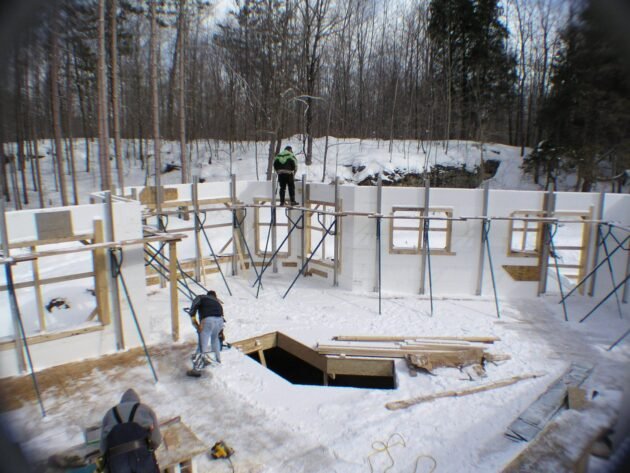
ICF construction
250+ Ontario projects
Lessons from the pump truck
Stacking ICF Blocks Is Easy. Pouring Them Is Where Experience Starts To Matter!
We built our first ICF home in Ontario in 1995 and have worked on more than 250 ICF homes and foundations since. Some of what we know came from training, engineers and manufacturers. The rest came from standing beside a concrete pump thinking: well, we are never doing THAT again.
The short version: brace the outside corners and never aim the hose into them. Pour in lifts of about three feet. Tape the top of the blocks, and cover it in winter. Order an extra metre of concrete. Straighten the wall while the concrete is still wet. Plan every hole before the truck arrives. And have the whole crew know the plan before the pump shows up.
Let Me Be Honest About ICF First
Insulated concrete forms are a fantastic building system. We have been building with them for more than 30 years because we believe in them.
But there is one thing everybody should understand. Stacking the blocks is the easy part. When you have nine feet of wet concrete coming down a pump hose, the wall does not care how many YouTube videos you watched.
Here are ten lessons we learned in the field. Most of them we paid for.
1. Outside Corners Are The First Place I Look
You learn very quickly where an ICF wall is most likely to get into trouble. Outside corners. They are the weakest spots during the pour.
Think about what is happening. You have a pump hose up on the wall, maybe nine feet in the air, and several hundred pounds of wet concrete dropping into the form. That concrete has momentum. If the crew dumps it straight into an outside corner that has not been properly reinforced and braced, the corner can let go.
And when an ICF corner lets go, your afternoon changes in a hurry. Instead of pouring a house, you have four guys with shovels digging wet concrete out of the footing while the pump truck sits there, the concrete trucks sit there, the clock runs, and everybody looks at everybody else. Nobody is particularly happy, and it gets expensive fast.
After you have dealt with that once, you become very interested in corner bracing.
Rule of thumb
Brace outside corners properly, and do not point the pump hose straight down into the corner. Come at it from both sides and let the concrete flow in. One manufacturer's training tells crews to stay at least three feet back from a corner until the wall is nearly full. There is no prize for finding out how much pressure an ICF corner can take.
2. Pour In Lifts Of About Three Feet
One of the biggest mistakes inexperienced crews make is trying to fill the wall too quickly. They see a nine-foot wall and think: let's fill nine feet of wall. No.
We work in lifts of about three feet. Go around the building and place a reasonable lift. Come around again. And again. Most block makers call for three to four feet, and we stay near the low end.
- You reduce the pressure against the forms.
- You have time to watch the wall and make corrections.
- You can consolidate the concrete properly.
- You do not suddenly discover that eight or nine feet of concrete pressure is trying to open a corner.
A concrete pump can deliver concrete far faster than you need it. The pump operator does not control the pour. The ICF crew controls the pour.
So slow down. The extra twenty minutes for another trip around the house is a lot cheaper than two hours shovelling concrete out of a footing. There is more on how the day should run on our pour day and curing page.
3. Protect The Top Of The Blocks With Tape
This sounds like a very small detail. It isn't.
When you pour an ICF wall, concrete gets everywhere. It splashes, it drips, and it finds every little groove on top of the forms. If another course of ICF is going on later, all those little interlocking dimples have to be clean. You have two choices.
| Choice A | Choice B |
|---|---|
| Spend $10 or $20 on tape and cover the exposed top of the blocks before the pour. | Spend an hour or two afterward picking hardened concrete out of every dimple so the next course fits. |
We have tried both. Buy the tape.
This is one of those lessons where being cheap costs more money. Taping the top takes minutes. Cleaning hardened concrete out of hundreds of little interlocks is the kind of work that makes grown men reconsider their career choices.
4. In Winter, Cover The Top Of The Wall
Ontario construction does not stop because it is January. A lot of houses get built in winter, and the top of an ICF wall is very good at collecting things you do not want in the interlock. Snow. Ice. Freezing rain.
Leave the top exposed and you may come back to find every little indentation full of frozen water. Now you have another choice.
| Choice A | Choice B |
|---|---|
| Put plastic over the top of the wall when you finish the pour. | Come back later with scrapers, hammers, heat and bad language. |
Again, plastic is cheaper. The rule is simple: if another course is going on later, protect the top. It is much easier to keep ice out of an ICF connection than to chisel it out afterward.
5. Vibrating The Wall Is A Three-Person Job
Concrete has to be consolidated. But vibrating an ICF wall properly is not a matter of sticking a vibrator into the concrete and leaving it there.
We like three people on it. One operates and guides the vibrator. Another handles the shaft, raising and lowering it. The third watches the wall, the concrete placement and the crew.
Our basic technique is quickly in, slowly out. Get the vibrator down to the bottom of the lift fast, then bring it back up slowly so the trapped air can follow it out. Do not leave it sitting at the bottom. You are not making a milkshake. We want to consolidate the concrete, not turn the whole form into liquid, and a vibrator parked in one spot piles pressure on the forms.
Follow your block manufacturer's instructions on this one. ICF Builder Magazine has a good plain-language piece on concrete consolidation in ICF walls if you want the testing behind it.
6. Keep The Vibrator Out Of The Corners
Corners already take enough punishment during an ICF pour. Don't make their life harder.
We do not like vibrating directly inside an outside corner. Come at the corner from the walls on each side, consolidate toward it, and let the concrete move in.
Remember that vibration makes concrete behave more like a liquid for a moment. That is exactly what you want for consolidation. It is also exactly what you do not want to overdo at the weakest part of the form. A vibrator is a tool. It isn't a weapon.
7. Don't Try To Save $250 By Ordering The Exact Amount Of Concrete
This one is simple. Always order extra concrete. On a normal house we want about one extra cubic metre on hand.
Yes, concrete costs money. Running out of concrete costs considerably more. Imagine you are six inches from the top of the wall and the pump goes empty. Somebody calls the plant, and the plant says, “No problem, we'll send another truck.” Wonderful. Except the truck might arrive 45 minutes later. Or an hour. Or longer.
Meanwhile the concrete already in your wall is setting, and in July that happens surprisingly quickly. Now instead of one continuous placement you have a cold joint, all because you tried to save the price of one metre of concrete. That is false economy.
If you have a little left over, find somewhere useful for it. Pour a pad. Fill something. Make a very expensive lawn ornament. I don't care. Just don't run out halfway up an ICF wall.
8. Straighten The Wall While The Concrete Is Wet
Good ICF bracing is not only there to stop the wall from falling over. It is there so you can control and straighten the wall during the pour.
Before the pour we set the wall, check the corners and make sure the bracing is doing its job. Then, on long walls, we deliberately pull the middle of the wall about two inches inward.
That may sound strange, but experience teaches you why. Once the wall is full, it is much easier to push the middle out to the string line than to discover it has bowed outward and try to pull several tons of wet concrete back toward you.
We watch the wall through the whole pour. When it is finished, and while the concrete is still workable, we put the string line on it and use the adjustable braces to bring the wall exactly where we want it. Push it out to the line. Don't wait until tomorrow and try to figure out how to pull it back.
Who your friends are
String lines are your friend. Levels are your friend. Adjustable braces are your friend. The next morning is not your friend.
If a wood-framed wall is a little out of plumb, there are things you can do. If a reinforced concrete wall has cured with a bow in it, your options become considerably less entertaining. Concrete is very cooperative for a short period of time. Take advantage of it.
9. Plan Every Hole Before You Pour
There is a phrase we have heard many times on construction sites: “We'll drill it later.”
Sometimes you have to. But coring a six-inch reinforced concrete wall is a funny way to install something that could have been a $10 piece of pipe before the pour. Before the concrete arrives, think about:
- water service, sewer and sump discharge;
- electrical service, conduits and the generator conduit;
- propane or gas;
- HRV, furnace and other mechanical penetrations;
- hose bibs;
- beam pockets, floor connections and deck connections;
- anything else that has to pass through the wall.
Put sleeves in wherever practical, and coordinate with the trades. We have separate pages on wiring an ICF house and plumbing an ICF house that cover what each trade needs from you before the pour.
Concrete is a wonderful building material. It is considerably less wonderful when somebody tells you afterward, “We forgot a four-inch pipe over there.”
10. Experience Shows Up Before The Pump Arrives
Most serious ICF problems do not begin when the concrete truck arrives. They begin earlier. Bad footing. Poor layout. Wrong rebar or missing reinforcement. Loose window bucks. Not enough bracing. Missing sleeves. Wrong concrete. No vibrator, no tape, no plastic. Not enough people.
And my favourite: not enough concrete.
By the time the pump arrives, the crew should already know what is going to happen:
- Who controls the hose, and who vibrates?
- Who watches the corners and the openings?
- Who checks the wall?
- Where does the pump start, and which direction are we going?
- How high is each lift?
- What happens if a form starts moving?
Good ICF crews are not standing around inventing the plan while the first truck is unloading.
ICF Is Easy, Until The Concrete Arrives
I have heard ICF described as giant Lego, and there is some truth to that. The blocks are easy enough to stack, which is why so many people ask whether ICF is a do-it-yourself job. But Lego does not normally contain nine feet of wet concrete. That is the difference.
The real skill in ICF is knowing what wet concrete is going to do before it does it. After 250 projects you look at a wall differently. You look at the corners, the openings and the bracing. You look at where the concrete has to flow, at the steel, at the top of the forms and at the weather.
And you look at the concrete ticket and quietly ask: did we order an extra metre?
Experience is often nothing more mysterious than remembering all the expensive lessons from the previous jobs.
The Best ICF Lesson We Ever Learned
Preventing a problem is almost always cheaper than fixing one.
- Ten dollars of tape beats cleaning concrete out of hundreds of dimples.
- A sheet of plastic beats chiselling ice.
- Another brace beats cleaning up a blown corner.
- Another cubic metre of concrete beats waiting for a truck while your wall sets.
- An experienced crew beats learning all of these lessons for the first time on your house.
That last one is probably the most important lesson of all.
Planning An ICF Project In Ontario?
We keep independent tools and guides here so you can understand ICF construction before you ask anybody for a quotation.
ICF cost calculatorWork out a preliminary Ontario budget for your walls or foundation.
ICF vs. wood frameThe payback math, and where each system makes sense.
ICF home builder directoryFind experienced Ontario ICF contractors.
OBC Code NavigatorLook up the Ontario Building Code Parts, Sections and Articles that apply.
No online calculator, article or AI tool replaces project drawings, engineering, the Ontario Building Code, the manufacturer's installation instructions or an experienced ICF contractor. But the more you know before construction begins, the fewer expensive surprises you are likely to have after the concrete truck arrives.
Who Wrote This
This was written by the builder behind BuildersOntario.com. He has been building homes since 1979 and working with insulated concrete forms since 1995. Through ICFhome.ca and ICFPro.ca, he and his crews have completed more than 250 ICF homes and foundations in Ontario.
After more than three decades he still believes ICF is one of the best residential building systems available. He also still buys the extra metre of concrete.
Building in Georgian Bay or Simcoe County?
Talk to a builder who has done it 300-plus times.
BuildersOntario.com is run by ICFHome.ca - ICF custom-home specialists since 1995. Straight answers on budget, permits, and ICF. No pressure.
Get a Ballpark Estimate →Book a 30-Min Call