Ontario's Plain-English Guide to Custom Home Building📞 705-533-1633 | ☎️ 1-866-868-6606 | ✉️ info@icfhome.ca
Buying a Waterfront Lot in Ontario
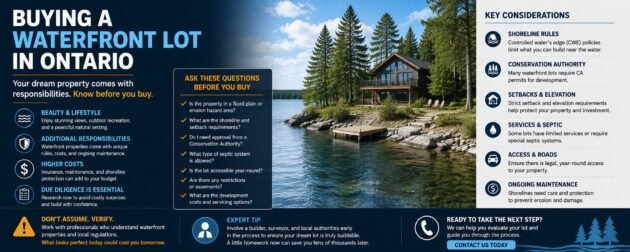
Waterfront lots
Georgian Bay & cottage country
Before you fall for the view
Buying a Waterfront Lot in Ontario: What to Check Before You Build
A waterfront lot is the dream – and the single trickiest kind of land to build on in Ontario. The view sells itself; the rules underneath it do not. You might not actually own the shoreline. The water setback, the septic, the conservation authority, and the road allowance can shrink your buildable area to a fraction of the lot. And shoreline work – even a dock or a bit of “tidying” – usually needs permits. Here’s exactly what to check before you fall in love, from a builder who has put homes on Georgian Bay shoreline for 45 years.
First question: do you actually own the shoreline?
It sounds absurd, but on many Ontario lakes and rivers there’s a shoreline road allowance – a roughly 66-foot reserve between the “waterfront” lot and the water, held by the Crown or the municipality. If one sits in front of your lot, you don’t own the shore, and you may not get the riparian rights (the water’s-edge rights, including the right to a dock) that people assume come with waterfront.
The check that protects you: confirm by survey and title review whether your lot actually touches the water or stops at a road allowance. Many newer lots already include the allowance (the developer had to buy it), but plenty of older ones don’t – and closing/buying a shoreline road allowance is its own application, cost, and wait. Make “does this lot include the shoreline?” a written condition.
The setbacks that shrink your buildable area
On a waterfront lot, the usable building area isn’t the lot – it’s what’s left after the water setback, the septic, the well, and any road allowance all take their share. It adds up fast:
| Constraint | Typical effect | Notes |
|---|---|---|
| Setback from the high-water mark | Often 20-30 m for the house, deck, and septic | Varies by township and zone – some waterfront zones require 30 m. This alone can push the house well back from the water. |
| Septic setbacks | Bed set back from water, well, and buildings | Wells and septics also have setbacks from each other – the leaching bed needs real, compliant space. |
| Shoreline road allowance | ~66 ft you may not own | If present and not yet acquired, it sits between you and the water. |
| Conservation / hazard limits | Erosion, flood, dynamic-beach areas | Can restrict where (or whether) you build near the water. |
Builder reality: a generous-looking waterfront lot can have a surprisingly small “sweet spot” once the water setback, septic bed, well, and road allowance are drawn honestly. Sketch the real building envelope before you decide your dream home fits.
The two books that take you from lot to keys
Make sure the waterfront lot can take your home – then pull the permit yourself. Each $29.99, or get both below and save.
Before you buy – start here
The Ontario Lot-Buying Bible
Prove a lot is buildable – before you spend a dollar.
$200+ of pro advice$29.99one-time
The 28-page step-by-step: the building envelope, water and conservation limits, septic and well feasibility, easements and road allowances, financing and the HST rebate – plus printable worksheets and offer-condition clauses.
- The waterfront checks: shoreline ownership, setbacks, conservation
- The septic-feasibility questions that decide a shoreline lot
- The 10-minute go/no-go test and printable scorecard
- Bonus chapters: DIY trades, wells, easements, negotiation
30-day money-back guarantee.
Get the Lot Bible – $29.99 →
Secure checkout – download in 2 minutes – yours forever
After you buy
The Ontario Building Permit Bible
Pull your permit yourself – without the guesswork.
$10,000$29.99one-time
Everything a builder does to coordinate a permit – the order of operations, the complete-application checklist that keeps it from bouncing, real fees, who to hire, and how to never fail an inspection.
- The complete-application checklist, so the file doesn’t bounce
- Real 2026 permit fees and development charges
- Who to hire to draw it, in what order, and what to pay
- How to never fail an inspection – and the costliest mistakes
30-day money-back guarantee.
Get the Permit Bible – $29.99 →
Secure checkout – download in 2 minutes – yours forever
Buying a lot and building on it? Get both Bibles.
The complete journey – prove the lot is buildable, then pull the permit without the guesswork.
Before you buy
The Ontario Lot-Buying Bible
Prove a lot is buildable – and what it will really cost – before you spend a dollar.
$29.99 on its own
+
After you buy
The Ontario Building Permit Bible
Pull your Ontario building permit yourself – the order of operations, the checklist, and how to never fail an inspection.
$29.99 on its own
$59.98 Both for $49.99
Get both Bibles →
Conservation authority & hazard rules (the second permit)
Most waterfront lots in Ontario fall under a Conservation Authority as well as the municipality – a second layer of approval. The CA regulates building near the water, how close to the shoreline you can disturb land, and often what you can do at the waterfront itself. If the lot is in a regulated area you may need a Section 28 permission on top of the building permit, plus possible studies:
- Floodplain mapping can set how high the lowest floor must be, or restrict building.
- Erosion / dynamic-beach areas can require a shoreline or geotechnical assessment and limit where you build.
- Shoreline work (retaining walls, fill, “tidying”) usually needs permission – it changes how water and ice move.
Do this early: check the CA’s regulated-area mapping before you make an offer. A high-and-dry-looking lot can still be inside a mapped hazard. Our Conservation Authority approvals guide walks the Section 28 process in plain English.
Found a waterfront lot? Send it to us before you make the offer.
Waterfront is where the most expensive surprises hide. We’ll check whether you own the shoreline, sketch the real building envelope after the water setback and septic, flag the conservation-authority and access issues, and tell you go or no-go – and what it will cost to build there. Quick paid consult: we scope it on a call and send a secure payment link, so you only pay once you know what you are getting.
Septic on a waterfront lot – the make-or-break
Shoreline lots are exactly where septic gets hardest, and where deals quietly die. The bed has to be set back from the water, from any well, and from buildings – and on a tight or sloped lot, with shallow soil or a high water table, finding compliant, usable area can be the whole ballgame. A lot can look generous from the dock and be a serious problem once the septic envelope is mapped.
- Confirm septic feasibility for your bedroom count early – test, don’t assume.
- Remember the bed needs a future replacement area too.
- Watch for shallow bedrock, wet ground, and shoreline slope – all push you toward a pricier engineered system.
More on the make-or-break: septic systems Ontario and septic & well checks.
Lot checks out? We design and build on Georgian Bay shoreline.
We design the permit-ready set to fit the envelope, run the conservation-authority permission alongside the building permit, and build energy-efficient ICF homes that handle a shoreline climate – with our own site-work crew getting the lot ready first.
Docks & shoreline work
If you do own the shoreline, you generally have riparian rights – including the right to a dock – but it’s subject to permits. Most municipalities allow docks with limits on size and length to reduce environmental impact, and other in-water or shoreline work can need approvals from the CA and provincial or federal authorities. Don’t assume the big dock in the listing photo is something you could build today – confirm what’s permitted, and get any promised shoreline rights in writing.
Your waterfront due-diligence checklist
- Confirm by survey/title whether the lot touches the water or stops at a road allowance
- Confirm the water setback for the house, deck, and septic in this township/zone
- Confirm septic feasibility for your bedroom count, with room for a replacement bed
- Check the conservation authority regulated-area mapping, floodplain, and erosion/dynamic-beach status
- Confirm legal, year-round access and an approvable driveway (see road access)
- Get shoreline use, docks, and access confirmed in writing
- Have your lawyer review title, road allowance, and any shoreline rights
Related guides on this site
Buying a waterfront lot in Ontario: frequently asked questions
Do I own the shoreline when I buy a waterfront lot?
Not always. On many Ontario lakes and rivers there is a shoreline road allowance, a roughly 66-foot reserve between the lot and the water that is held by the Crown or the municipality. If one sits in front of your lot, you do not own the shore and may not have the riparian rights people assume come with waterfront, including the right to a dock. Many newer lots already include the allowance because the developer was required to buy it, but plenty of older lots do not. Confirm by survey and title review whether the lot actually touches the water, and make it a written condition of your offer.
How far from the water can I build on a waterfront lot?
It depends on your township and the zoning, but a setback from the high-water mark of roughly 20 to 30 metres for the house, deck, and septic is common, and some waterfront zones require 30 metres. That setback, combined with septic and well setbacks and any shoreline road allowance, is what determines your real building envelope, which can be much smaller than the lot looks. Always confirm the specific setback for the lot with the municipality and, where applicable, the conservation authority, and sketch the buildable area before you assume your home will fit where you pictured it.
Do I need conservation authority approval to build on waterfront?
Usually you should assume it is possible and check early. Most waterfront lots in Ontario fall within a conservation authority’s jurisdiction in addition to the municipality, which adds a second layer of approval. If the lot is in a regulated area, you may need a Section 28 permission on top of the municipal building permit, and the CA may require studies such as a shoreline erosion or geotechnical assessment. Floodplain mapping can also set how high your lowest floor must be or restrict building. Check the conservation authority’s regulated-area mapping before you make an offer, because a dry-looking lot can still be inside a mapped hazard.
Why is septic harder on a waterfront lot?
Because the septic bed must be set back from the water, from any well, and from buildings, and a shoreline lot is often tight, sloped, or has shallow soil or a high water table, all of which make compliant, usable area scarce. The result is that septic frequently decides whether a waterfront lot is buildable at all, and a lot that looks generous from the dock can be a serious problem once the septic envelope and a future replacement bed are mapped honestly. Confirm septic feasibility for your planned bedroom count early through a real site evaluation rather than assuming it will work, because difficult shoreline conditions can force a more expensive engineered system.
Can I build a dock on my waterfront lot?
If you actually own the shoreline you generally have riparian rights, which include the right to a dock, but it is subject to permits. Most municipalities allow docks while limiting their size and length to reduce environmental impact, and other in-water or shoreline work can require approvals from the conservation authority and provincial or federal authorities. If a shoreline road allowance sits between your lot and the water, your right to build at the water’s edge may be limited until that is resolved. Do not assume the dock in a listing photo is something you could build today – confirm what is currently permitted and get any promised shoreline rights in writing.
What is a shoreline road allowance and how do I deal with one?
A shoreline road allowance is a reserve, often about 66 feet wide, that runs along the water’s edge and is owned by the Crown or the municipality rather than the adjacent lot owner. If one exists in front of your property, the strip between your lot and the water is not yours, which affects ownership of the shore, riparian rights, and what you can do at the waterfront. In many cases you can apply to purchase or close the allowance so it becomes part of your lot, but that is a separate application with its own appraisal, survey, legal cost, and timeline. Confirm whether an allowance exists during due diligence and factor any cost and delay to resolve it into your decision.
What should I check before buying a waterfront lot to build on?
Start with ownership of the shoreline, confirmed by survey and title, then the water setback for the house, deck, and septic in that township and zone. Confirm septic feasibility for your bedroom count with room for a replacement bed, check the conservation authority’s regulated-area, floodplain, and erosion mapping, and confirm legal year-round access with an approvable driveway. Get any shoreline use, dock, and access rights in writing, and have your lawyer review title, the road allowance, and any shoreline rights. Waterfront is where the most expensive surprises hide, so do this homework before you waive conditions, not after – and keep firm conditions in your offer until every item is answered.
Note: general guidance, not legal advice. Shoreline ownership, setbacks, conservation rules, and dock permissions vary by lake, township, and conservation authority – confirm with the municipality, the conservation authority, and your lawyer before you rely on anything here or waive a condition.
Latest posts
Fresh guides, calculators & real-world advice
More from BuildersOntario – scroll to explore.
Loading latest posts…
Tip: shift + mousewheel works great