Ontario's Plain-English Guide to Custom Home Building📞 705-533-1633 | ☎️ 1-866-868-6606 | ✉️ info@icfhome.ca

Insulated Concrete Forms (ICF) in Ontario: The Complete Guide
Ontario | 2026 | Complete guide
Cost, R-value, pros and cons
How ICF is built
Insulated Concrete Forms (ICF) in Ontario: The Complete Guide
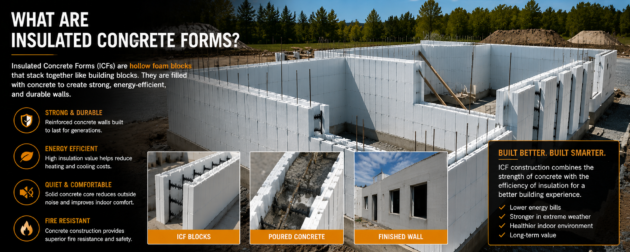
An insulated concrete form (ICF) wall is a sandwich: two layers of rigid foam insulation on the outside, a poured concrete core in the middle, and steel rebar tied through it for strength. The foam stays in place permanently as part of the wall; the concrete cures inside it. That one design solves four problems at once – thermal performance, structural strength, sound dampening, and moisture control – which is why ICF has become the go-to wall system for energy-conscious builds across Ontario’s cold climate.
This is the hub for everything ICF: what it costs, how it performs, how it compares to wood and SIPs, and how it gets built. Use the quick answers below, then jump into the detailed guides. Planning a build? Start with our cost to build a house in Ontario guide.
1What ICF is
2Cost + payback
3R-value + energy
4Every ICF guide
ICF at a glance (2026 Ontario)
R-22 to R-25+
Effective wall insulation
30-60%
Less heating and cooling energy
7-12 yrs
Typical payback on the premium
An ICF wall delivers about R-23 of continuous insulation versus roughly R-13 in a typical 2×6 wood wall – and because ICF has no thermal bridging and is far more airtight, its real-world performance is higher still (independent testing has shown an ICF wall providing meaningfully greater effective R-value and energy savings than wood frame). In Ontario’s climate, that translates to 30 to 60% lower heating and cooling energy, a smaller HVAC system, and a home that stays comfortable through a February cold snap.
What ICF actually does (the four jobs at once)
| Property | What ICF delivers |
|---|---|
| Thermal performance | Continuous R-23 insulation, no thermal bridging, very airtight – 30 to 60% less heating and cooling energy. |
| Structural strength | A reinforced concrete core – far stronger than stick frame, and highly wind and impact resistant. |
| Fire resistance | Concrete does not burn; ICF walls are rated for fire resistance up to about 4 hours, versus roughly 1 hour for wood frame with drywall. |
| Sound + moisture | The concrete-and-foam mass dampens exterior noise dramatically, and the assembly manages moisture better than a framed wall. |
Why it matters in Ontario: long heating seasons, hard freeze-thaw cycles, hotter summers, and high moisture loads all play to ICF’s strengths. The continuous insulation kills thermal bridging, the concrete core adds thermal mass that flattens temperature swings, and the wall is airtight by design.
ICF wall components: what you are actually looking at
Think of ICF as a stay-in-place concrete mold. The foam mold becomes permanent insulation; the concrete inside provides the structure. You build the insulation and the structure at the same time, in one assembly.
| Wall layers (outside to inside) | Key structural characteristics |
|---|---|
| Exterior cladding (siding, stucco, brick, stone) | Monolithic reinforced concrete core throughout |
| Exterior EPS foam insulation (2-4 in) | Continuous insulation on both sides |
| Reinforced concrete core (4-8 in) | Integrated air barrier – no gaps |
| Interior EPS foam insulation (2-4 in) | Permanent stay-in-place formwork |
| Interior finish (typically drywall) | No thermal bridging through studs |
The foam forms
EPS foam forms typically measure 16 inches high by 48 inches long and interlock vertically and horizontally. The concrete core comes in common 4, 6, and 8-inch widths, with foam adding width on each side. Plastic or metal ties hold the two foam faces at consistent spacing and provide attachment points for drywall and exterior cladding. See the best ICF brands in Ontario for a breakdown of the main systems.
The concrete core
Standard ready-mix at roughly 25 to 30 MPa (about 3,600 to 4,350 psi) fills the cavity between the foam faces. For most residential walls a 6-inch core gives ample strength; thicker cores are used for multi-storey or high wind and seismic loads.
The steel reinforcement
Rebar is what lets ICF walls resist hurricane-force winds, seismic activity, and impacts that would destroy wood framing. Engineers set the size and spacing for the loads; typical residential builds use #4 or #5 rebar vertically every 12 to 24 inches and horizontally at regular intervals.
How ICF is built, step by step
- 1. Foundation prep – footings must be level and dimensioned for ICF. Many builds use ICF for the foundation too, creating a continuous insulated structure from footing to roof; others combine ICF above grade with a conventional poured foundation.
- 2. Stacking forms – crews stack the forms course by course like large blocks (just 2-4 lbs per sq ft), checking constantly for plumb and level. Corner forms and window bucks handle openings.
- 3. Reinforcement – horizontal rebar threads through the foam channels and vertical rebar is tied at intersections into a full grid, exactly per the engineering plans.
- 4. Bracing – non-negotiable before the pour. Inadequate bracing is the most common cause of ICF failures, which is exactly why an experienced ICF crew matters.
- 5. Concrete placement – pumped from the top in 3 to 4 foot lifts so the forms stabilize, and vibrated to remove voids. A residential basement pours in about 3 to 6 hours.
- 6. Curing and finishing – 3 to 7 days to cure (the foam actually helps it cure, even in cold weather). Drywall attaches to furring strips embedded in the foam; exterior finishes attach to the foam face.
Where ICF is used in Ontario
Basement foundations are ICF’s most common residential use here – warm, dry, finished-quality spaces far better than cold, damp poured walls. Many homeowners choose ICF just for the foundation, even with wood frame above; see the ICF foundation cost guide.
Full above-grade walls – foundation through exterior walls – deliver the complete benefit, and the gap over wood frame is largest when ICF runs throughout the envelope.
Hybrid builds use ICF for the foundation and first floor with wood frame above, optimizing performance where it matters most while managing cost – see timber-frame and ICF hybrids.
The benefits, and the honest limitations
What ICF does well
- Energy – continuous R-22+ with no thermal bridging; heating and cooling often 40 to 50% lower than code-minimum, and it allows a smaller HVAC system. Pairs perfectly with hydronic radiant floor heating.
- Durability – reinforced concrete resists rot, insects, and moisture; ICF homes routinely last 100+ years.
- Fire – 4+ hour fire ratings, and many insurers discount premiums for it.
- Sound – STC 50+; noticeably quieter inside, especially near roads, rail, or flight paths.
- Comfort – thermal mass flattens temperature swings, in winter and increasingly hot summers.
When ICF is NOT the right call
- A rock-bottom budget with no payback horizon.
- Projects you expect to modify often – cutting reinforced concrete to move a window or door is a real job, not a weekend.
- No experienced ICF crew available or hired – a poorly built ICF wall can underperform good wood frame.
- Ultra-curved or highly complex geometry, which adds forming cost.
What does ICF cost?
ICF costs more up front than wood frame – typically 5 to 15% more depending on how much of the home is ICF (foundation only vs full above-grade walls). On a typical Ontario custom home in 2026, full ICF adds roughly $25,000 to $55,000 over conventional framing. But the premium usually pays back in 7 to 12 years through lower energy bills, a smaller HVAC system, reduced maintenance, and often lower insurance – and the walls outlast the rest of the building. Dig into the numbers in our ICF foundation cost guide and run your own project through the ICF cost calculator.
Building new with ICF? Don’t leave the HST rebate on the table
An ICF home is a new build – and the whole project qualifies for Ontario’s enhanced HST rebate, up to $130,000. It is the easiest six figures to leave behind, and the window is closing.
Ontario HST Rebate | Deadline April 1, 2027
You Could Lose Up To $106,000 If You Don’t Start Before April 2027
Ontario’s enhanced HST rebate puts up to $130,000 back in a new-home builder’s pocket – but only if your build contract is signed before April 1, 2027. Miss that window and you fall back to the standard $24,000 rebate. On a typical ICF build, that’s a six-figure swing – so it belongs in your budget from day one.
$0
Contract signed before Apr 1, 2027
$24,000
Signed after the deadline
$900,000
Miss the deadline and you forfeit
$0
Estimate based on Ontario’s 2026 enhanced HST rebate (Bill 114). Final eligibility for a custom / owner-built home is confirmed by a licensed rebate specialist – that’s what the free check is for. Full HST rebate details
The enhanced HST rebate applies to new home construction. Final eligibility is confirmed by a licensed rebate specialist - use the HST rebate calculator to check your number.
Is ICF worth it in Ontario?
For most custom homes in our climate, yes - the energy savings, comfort, durability, and quiet usually outweigh the upfront premium over the life of the home. ICF makes the strongest case when you plan to stay long enough to enjoy the lower operating costs, when comfort and a healthy, quiet home matter to you, and when you are building to the tougher 2026 Ontario Building Code energy requirements (which ICF meets comfortably). It is a weaker fit on a rock-bottom budget with no payback horizon, or for ultra-curved designs. Weigh it properly in our ICF pros and cons and is an ICF home worth it guides.
Want to build with ICF in Simcoe County or Georgian Bay?
We are a certified, Tarion-backed ICF custom-home builder - ICF since 1995, 7-year structural warranty on every build. Call 705-533-1633.
The complete ICF guide library
Every detailed ICF guide, organized. Start with cost and the comparisons, then dig into building details:
Cost and calculators
ICF vs other systems
Should you build with ICF?
Brands, blocks and DIY
Design and details
Frequently asked questions
What are insulated concrete forms (ICF)?
ICF is a wall system made of hollow rigid-foam blocks or panels that stack like building blocks, are reinforced with steel rebar, and are filled with poured concrete. The foam stays in place permanently as insulation on both sides of a solid concrete core. The result is a wall that is strongly insulated, structurally robust, airtight, and quiet.
How much does ICF cost compared to wood frame in Ontario?
Typically 5 to 15% more up front, depending on whether you use ICF for the foundation only or the full above-grade walls. On a typical Ontario custom home in 2026, full ICF adds roughly $25,000 to $55,000 over conventional framing - and usually pays back in 7 to 12 years through energy and other savings.
What is the R-value of an ICF wall?
An ICF wall provides about R-23 of continuous insulation, versus roughly R-13 for a typical 2x6 wood wall. Because ICF has no thermal bridging and is very airtight, its real-world (effective) performance is higher still, and it can be pushed higher with added exterior insulation.
How much energy does an ICF home save?
ICF homes in Ontario typically use 30 to 60% less energy for heating and cooling than comparable wood-frame homes, thanks to continuous insulation, thermal mass, and airtightness. They also allow a smaller HVAC system.
Is ICF worth it in Ontario?
For most custom homes in our climate, yes. The energy savings, comfort, durability, fire and sound performance, and often lower insurance usually outweigh the upfront premium over the life of the home - especially if you plan to stay long term.
How long until ICF pays for itself?
Typically 7 to 12 years, through lower energy bills, a smaller mechanical system, reduced maintenance, and often lower insurance premiums. After that, the savings are money in your pocket, and the walls outlast the rest of the building.
Is ICF fire resistant?
Yes. Concrete does not burn, and ICF walls are rated for fire resistance of up to about 4 hours depending on the system and wall thickness - far better than the roughly 1-hour rating of wood frame with drywall. That durability is also why some insurers offer better premiums.
Does ICF reduce noise?
Significantly. The mass of the concrete core plus foam dampens exterior sound, so an ICF home is noticeably quieter than a framed home - a real benefit near roads, railways, or busy areas.
Can you build any house design with ICF?
Most designs, yes - including complex custom homes. ICF is less ideal for ultra-curved or highly irregular shapes, which add forming complexity and cost. For most rectangular and gently angled designs, ICF works well from foundation to roofline.
Does ICF meet the 2026 Ontario Building Code?
Comfortably. ICF's continuous insulation and airtightness meet the tougher 2026 energy requirements (SB-12 tiers) without much effort, which is one reason it has become popular for code-driven and high-performance builds in Ontario.
Disclaimer: ICF figures are 2026 planning ranges and vary by system, wall thickness, design, and builder. Performance and cost depend on your specific project. This is educational, not professional or engineering advice.
More on structure and icf
Sources and further reading
Reviewed and updated October 2026. Costs on this site are Ontario ranges, not quotes; code references are to the Ontario Building Code in force at the date above.
Latest posts
Fresh guides, calculators & real-world advice
More from BuildersOntario - scroll to explore.
Loading latest posts...
Tip: shift + mousewheel works great