Ontario's Plain-English Guide to Custom Home Building📞 705-533-1633 | ☎️ 1-866-868-6606 | ✉️ info@icfhome.ca

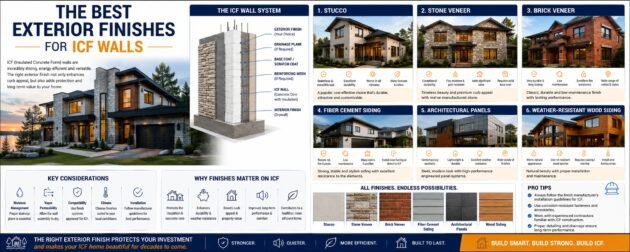
The Best Exterior Finishes For ICF Walls
Ontario – ICF finishes
8 options compared
2026 costs
The Best Exterior Finishes for ICF Walls (Without Looking Like a Bunker)
An ICF home gives you exceptional energy efficiency and durability in Ontario’s climate – and from the curb it can look like any beautiful home, not a concrete fortress. The exterior finish is the decision that gets you there. It is not just about looks: the right finish has to protect the foam, shed Ontario’s driving rain, survive brutal freeze-thaw cycles, and give you the curb appeal you want. There is no single right answer, but there are clearly better options depending on your budget and your site. Here is the honest, Ontario-focused rundown.
1Why ICF is different
28 finishes compared
3Real 2026 costs
4What to avoid
Why ICF walls need special consideration
An ICF wall is expanded polystyrene (EPS) foam forms filled with steel-reinforced concrete. That gives you tremendous thermal mass, air-tightness, and strength – but the outer foam layer cannot simply be left exposed. It needs protection from UV, physical damage, and moisture, and not every cladding attaches to it the same way. Get this wrong and you invite exactly the “renovation nightmare” you built ICF to avoid.
Any good ICF exterior finish has to check five boxes:
- Weather resistance: it must form a barrier that keeps moisture out of the foam.
- Breathability: while shedding water, it should allow some vapour permeability so moisture is not trapped in the assembly.
- Attachment: it must fasten securely – to the ICF’s internal plastic webs, not just the foam – without creating thermal bridges.
- Compatibility: it must be chemically compatible with EPS foam and not degrade it.
- Thermal performance: ideally it maintains or adds to the wall’s already strong R-value.
The single biggest mistake is treating ICF like any other wall when choosing a finish. The exterior foam cannot be painted directly or left bare, and the attachment system – fasteners that reach the webs, furring for a rainscreen gap, proper flashing – is what separates a 40-year finish from a five-year problem. Start with our overview of exterior siding types, then match one to your ICF build below.
Eight exterior finishes for ICF, compared
Most popular
Acrylic stucco (synthetic / EIFS)
A multi-layer system – base coat over the foam, fibreglass mesh, then a coloured acrylic finish coat – that applies directly to ICF with no separate framing. Slightly flexible (handles minor movement without cracking), seamless, available in nearly unlimited colours, and cost-effective.
ICF note: applies right to the foam, which is fast. In Ontario’s freeze-thaw, spec an elastomeric finish coat and good-grade mesh, and flash every penetration carefully.
Time-tested
Traditional cement stucco
The centuries-old three-coat system (scratch, brown, finish). More impact-resistant than acrylic, easy to patch, naturally breathable, and it ages with a distinctive texture and patina.
ICF note: needs metal lath fastened into the ICF webs (not just the foam) with ICF-specific fasteners, a drainage plane behind it, control joints, and a freeze-thaw-appropriate mix. More labour than acrylic.
Premium
Adhered stone veneer
Thin (1 to 2 inch) natural or manufactured stone adhered to the wall for a high-end look, in countless stone types and patterns. Extremely durable and a strong resale draw.
ICF note: the make-or-break is a proper drainage plane – drainage mat or air gap, metal lath to the webs, scratch coat, then stone. Trapped moisture behind stone is a serious problem, so this is not a job for a general crew.
Versatile
Fiber cement siding
Cement, sand, and cellulose in lap, panel, shingle, or board-and-batten styles. Highly fire-resistant, low-maintenance, insect-proof, and available in countless factory or field colours – it lets an ICF home blend into any Ontario neighbourhood.
ICF note: installs on treated wood or PVC furring strips fastened to the webs, which creates an ideal rainscreen gap. Add a weather-resistant barrier over the foam first.
Classic
Brick veneer
The timeless Ontario look, especially in Toronto, Ottawa, and older neighbourhoods. Lasts generations, excellent fire and sound performance, and fired-clay colour never fades.
ICF note: installed with an air gap and ICF-specific brick ties into the webs, needs foundation support (a brick ledge), weep holes, and expansion joints. Plan it from the foundation up.
Natural look
Engineered wood siding
Wood fibre with resins and waxes for the warmth of wood with better rot and insect resistance. Lighter than fibre cement, workable with standard tools, and cheaper than natural cedar.
ICF note: like fibre cement, it goes on furring strips to the webs with a rainscreen gap and a weather-resistant barrier. Keep it well off the ground and flash every transition.
Budget
Vinyl siding
Not going to win architecture prizes, but it is practical, low-maintenance, and reliable – and the most affordable option. It stays flexible in deep Ontario cold and comes in hundreds of colours and profiles.
ICF note: furring at 16-inch centres to the webs, generous expansion allowance (vinyl moves a lot between a -30 and +30 degree day), and a heavier gauge (0.044 inch or more) for durability.
Top premium
Natural stone veneer
The highest-end option – real full-thickness or thick-cut stone for a substantial, timeless facade that suits Georgian Bay and rural estate builds. Effectively permanent when done right.
ICF note: the most complex and costly install, with the same drainage-plane and web-attachment discipline as adhered stone, plus structural support. Use a mason who has done stone on ICF.
What each finish costs in Ontario (2026)
Installed cost ranges in Canadian dollars, from most affordable to premium. These are 2026 Ontario planning figures – material prices have climbed 8% to 15% since 2024, and the GTA and remote regions run higher than smaller cities.
| Finish | Typical 2026 cost (CAD, installed) |
|---|---|
| Vinyl siding | $6 to $12 per sq ft |
| Acrylic stucco / EIFS | $11 to $18 per sq ft |
| Engineered wood siding | $12 to $22 per sq ft |
| Traditional cement stucco | $14 to $24 per sq ft |
| Fiber cement siding | $14 to $26 per sq ft |
| Manufactured stone veneer | $22 to $32 per sq ft |
| Brick veneer | $24 to $38 per sq ft |
| Natural stone veneer | $30 to $48 per sq ft |
One ICF advantage on cost: the flat, even foam surface can speed up direct-applied systems – stucco can go on noticeably faster than on framed walls with sheathing, which helps offset higher material prices. When you budget, weigh lifetime cost, not just install cost: brick and stone cost more up front but need almost no maintenance and last generations, while cheaper claddings may need refreshing sooner. As the saying goes, buy once. Check current provincial energy rebates too, since a high-performance envelope can qualify.
Matching the finish to Ontario conditions
Ontario throws three main challenges at an exterior wall, and different finishes handle each better.
Deep cold and freeze-thaw (most of the province)
From the Prairies-cold of the northwest to the swings of a Barrie or Ottawa winter, freeze-thaw is the enemy. Acrylic stucco with an elastomeric finish and fibre cement both handle repeated expansion and contraction well. Traditional cement stucco can work too, but only with a freeze-thaw-appropriate mix and proper control joints. Paired with ICF, a well-chosen finish means a wall that barely notices a minus-30 night.
Driving rain and humidity (Great Lakes and Georgian Bay)
Near the lakes and on the Bay, wind-driven rain and humidity make drainage the priority. Rainscreen systems shine here: fibre cement or engineered wood on furring strips gives the wall a ventilation gap so it can dry, which is the best insurance against long-term moisture problems.
Urban heritage streets (Toronto, Ottawa, older towns)
Where the streetscape is brick, brick veneer over ICF lets your home blend in while quietly outperforming its neighbours. You get the traditional appearance and heritage fit with a modern, super-efficient wall behind it – see how our ICF homes are built.
Common mistakes to avoid
- Skimping on the attachment system: too few fasteners, or fasteners that grip only foam instead of the ICF webs, eventually fail. Gravity is patient.
- Poor flashing details: whatever the finish, flashing at penetrations, transitions, and terminations is what keeps water out. Water is relentless and unforgiving.
- Ignoring the rainscreen gap: on any siding product, the ventilation gap behind it is what lets the wall dry. Skip it near the lakes and you will regret it.
- Choosing on looks alone: appearance matters, but performance for your site and climate should lead. Water damage costs far more than the finish ever did.
- Hiring a crew with no ICF experience: the most common failures trace straight back to installers who did not understand ICF’s specific attachment and drainage requirements. Pay for the crew that has done it before.
Planning an ICF build and not sure which finish fits your site and budget?
Book a call
That is exactly the conversation we have with every client before the walls go up. We design and build energy-efficient custom ICF homes across Simcoe County and Georgian Bay and will steer you to the finish that performs for your climate and neighbourhood. Call 705-533-1633 or reach info@icfhome.ca.
ICF exterior finishes: frequently asked questions
What is the best exterior finish for an ICF home in Ontario?
There is no single best finish – it depends on your budget, site, and neighbourhood. For most Ontario ICF homes, acrylic stucco (popular, seamless, and applies straight to the foam) and fibre cement (versatile and rainscreen-friendly) are the sweet spot. Brick veneer suits heritage urban streets, and stone veneer suits premium and rural estate builds. The common thread is proper attachment to the ICF webs and good flashing, whatever you choose.
Can you leave ICF foam exposed or just paint it?
No. The exterior EPS foam must be covered by a proper finish – it is not UV-stable, it is vulnerable to physical damage and pests, and paint alone will not protect it. After one Ontario winter, exposed or merely painted foam degrades badly. Every ICF wall needs a real cladding or stucco system with weather protection and correct attachment.
How do you attach siding to an ICF wall?
Lap and panel sidings (vinyl, fibre cement, engineered wood) install on furring strips fastened into the ICF’s internal plastic webs, which also creates a rainscreen gap for drainage and drying. Stucco applies directly to the foam (acrylic) or over metal lath fastened to the webs (traditional). Brick and stone use ICF-specific ties and a drainage plane. The key in every case is fastening into the webs, not just the foam, without creating thermal bridges.
How much does an ICF exterior finish cost in Ontario?
In 2026 Ontario dollars, installed: vinyl runs about $6 to $12 per sq ft, acrylic stucco $11 to $18, engineered wood $12 to $22, traditional cement stucco $14 to $24, fibre cement $14 to $26, manufactured stone $22 to $32, brick veneer $24 to $38, and natural stone $30 to $48. The GTA and remote regions run higher. Weigh lifetime maintenance too – brick and stone cost more up front but last generations with little upkeep.
Is stucco or siding better for an ICF home?
Both work well; it comes down to look, budget, and site. Acrylic stucco applies directly to the foam, is seamless and cost-effective, and suits many Ontario builds. Siding on furring strips gives you a rainscreen gap that is excellent near the Great Lakes and Georgian Bay where driving rain and humidity are a concern. If impact resistance matters, traditional cement stucco and fibre cement outperform acrylic. There is no wrong answer, only the right match for your conditions.
Do exterior finishes affect an ICF home’s energy performance?
The ICF wall does the heavy lifting on energy performance, so the finish choice mostly affects durability and looks rather than R-value. That said, some systems add a little insulation (for example insulated vinyl or certain stucco assemblies), and proper installation protects the foam so the wall keeps performing. Choose the finish for weather protection, maintenance, and appearance – the energy savings are already built into the ICF.
Note: costs and specifications here are general 2026 Ontario planning figures, not a quote, and vary with product, wall design, and installer. Confirm compatibility, attachment, and flashing details with the finish manufacturer and an ICF-experienced installer for your specific build.
Related guides
More on structure and icf
NEW: The whole exterior finishes section, priced wall by wall
This page covers the eight finishes on an ICF wall. The new section prices every one of them per square foot of net wall, with the tearoff, the flashing, the stucco details by the foot and the eaves, and a calculator that measures your walls.
Exterior finishes hub · Stucco on ICF homes · Exterior cladding cost calculator
Sources and further reading
Reviewed and updated October 2026. Costs on this site are Ontario ranges, not quotes; code references are to the Ontario Building Code in force at the date above.
Latest posts
Fresh guides, calculators & real-world advice
More from BuildersOntario – scroll to explore.
Loading latest posts…
Tip: shift + mousewheel works great

Great the best exterior finishes for ICF (Insulated Concrete Form) walls combine durability, weather resistance, and aesthetic appeal. Popular options include stucco, fiber cement siding, brick veneer, and synthetic stone—each offering long-lasting protection while enhancing curb appeal and complementing energy-efficient ICF construction.