Ontario's Plain-English Guide to Custom Home Building📞 705-533-1633 | ☎️ 1-866-868-6606 | ✉️ info@icfhome.ca

Nine Alternative Wall Systems For Your New Home
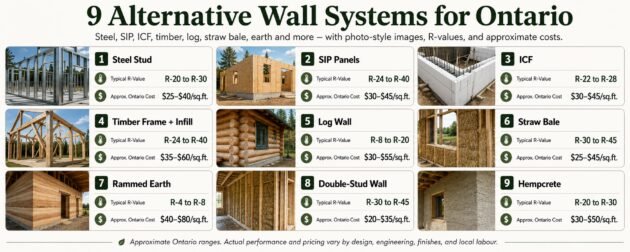
Ontario – wall systems
9 compared
Honest builder take
Nine Alternative Wall Systems for Your New Home
The exterior wall is the single biggest decision in how your home will feel, perform, and cost to run – and there are far more ways to build one than most people realize. Here are nine wall systems used in North America, from cold-formed steel to straw bale, each with a real photo, an honest look at how it performs in Ontario’s climate, and who it actually suits. At the end you get a side-by-side comparison and a builder’s plain verdict on which ones are worth your money.
1How each performs
2Pros & drawbacks
3Who it suits
4Side-by-side table
One idea to carry through all nine: in Ontario’s climate, what makes a wall great is continuous insulation with no thermal bridging, plus airtightness and moisture control. Some systems below deliver that beautifully. Others look green on paper but leak heat through the frame, or rely on thermal mass that does not actually insulate. Keep that lens on as you read.

Lightweight steel framing
Cold-formed galvanized steel C-sections replace wood studs, joists, and rafters. Gauge and depth are matched to the load, so walls stay dead straight and square, and the steel will not warp, twist, rot, or feed termites. Much of it is recycled content and offcuts are recyclable.
Watch: steel is a powerful thermal bridge. An R-19 batt in a steel-stud wall can drop to roughly R-7 effective – so it only performs with continuous exterior insulation over the studs.

Structural insulated panels (SIPs)
A rigid foam core is bonded between two structural skins (usually OSB), and the sandwich carries the load while the foam insulates continuously. Panels go up fast and produce very straight, airtight walls ready for finishes. Effective R-values commonly run from about R-16 to R-65 depending on core thickness.
Watch: concentrated loads can need extra detailing, rain-screen moisture protection is wise, and crews need proper training. See ICF vs SIPs.

Insulated concrete forms (ICF)
Hollow foam forms stack like big blocks, take steel reinforcing, and are filled with concrete. The foam stays put, wrapping the wall in continuous insulation with no thermal bridging. The result is energy-efficient, quiet (about STC 50), fire-resistant (up to a 4-hour rating), and extremely durable – our pick for Ontario.
Watch: costs a few percent more than wood frame (about 5% to 10%), and the heavier wall can call for larger footings. See ICF concrete homes.

Post and beam (timber frame)
Vertical posts and horizontal beams form the structure, usually left exposed inside for that warm, dramatic look. Because the frame carries the loads, you get wide-open, load-bearing-wall-free interiors. It is beautiful and long-lived.
Watch: the timber is structure, not insulation – it must be wrapped in SIPs or another high-performance shell. Wood shrinkage can cause movement, and the frame needs an engineer. See post and beam homes.
Log
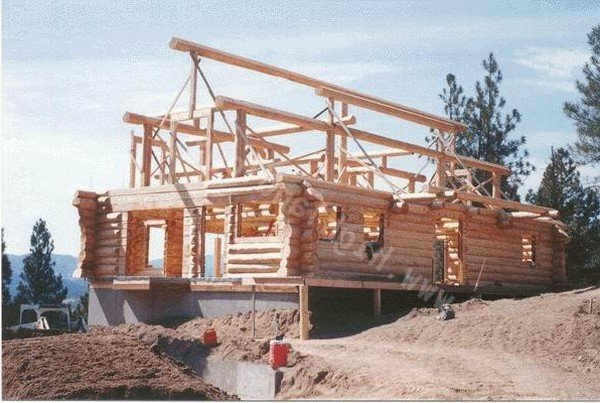
Once weekend cabins, log homes are now built for full-time year-round living, which means larger, more sophisticated structures. With a good foundation and wide overhangs to shed moisture, a log home is durable and can last generations, and the aesthetic is hard to beat.
Watch: building one takes real skill and time, it is not low-cost, logs settle, and it needs far more ongoing maintenance (sealing, chinking) than sided homes. Best for skilled, patient owner-builders.
Stackwall (cordwood masonry)
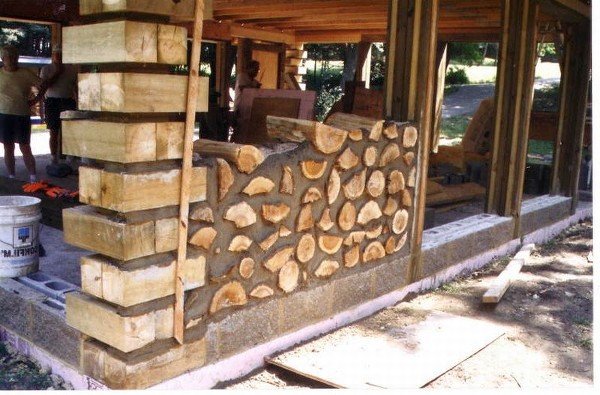
Short logs are stacked like firewood, mortared at each face, with insulation filling the middle. The log-ends set the wall thickness and show inside and out. A 16-inch cordwood wall lands around R-25. It is resource-efficient and can cost far less than wood frame when you supply the labour.
Watch: extremely labour-intensive and slow, and detailing matters. Mostly the domain of dedicated, budget- and eco-minded owner-builders.
Straw bale
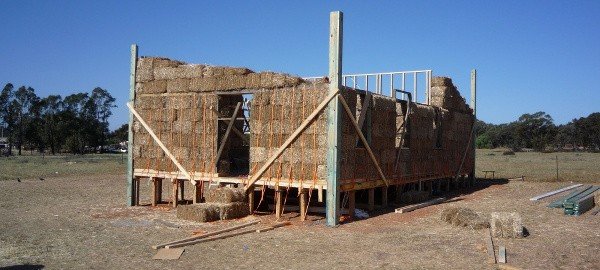
Baled straw is stacked into walls and coated in plaster, either as infill in a post-and-beam frame or as load-bearing walls. Straw runs about R-2.5 per inch, so a thick bale wall can reach roughly R-33 – genuinely well-insulated, from an annually renewable, low-cost material.
Watch: moisture is the enemy – damp bales grow fungi and rot inside the wall, so detailing must be flawless. Code officials, warranty programs, and insurers can be hesitant. Usually owner-built.
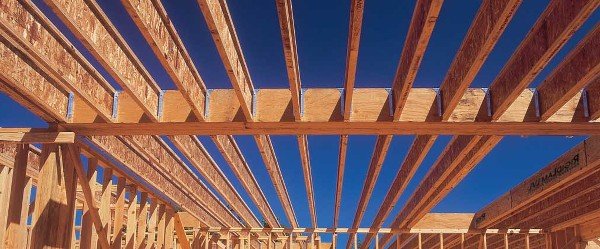
Manufactured wood
Conventional framing, but with engineered studs and members – I-joists, finger-jointed studs, laminated strand lumber (LSL), and parallel strand lumber (PSL). The material is uniform and strong, so walls stay straight and will not warp or twist over time, and LSL handles tall walls and combined axial and wind loads.
Watch: cost. Engineered studs can run up to double the price of standard dimensional lumber. It behaves like wood frame thermally, so continuous insulation still helps.

Earth (rammed earth, adobe, cob)
An ancient family of methods: damp cement-stabilized soil rammed into formwork, compressed earth blocks, adobe, or cob. The walls are thick, beautiful, fire- and sound-resistant, pest-proof, and very durable, with a low-embodied-energy, indigenous-materials appeal.
Watch: mass is not insulation. A rammed-earth wall stores heat but does not resist its flow, so in a cold Ontario climate it needs added insulation to perform, and upfront cost runs higher than wood frame.
The nine systems side by side
A quick-scan comparison. “Insulation” here means how well the wall itself resists heat flow in Ontario’s climate without bolt-on fixes; a low rating is not a judgment on the material, just a reminder of what it needs to perform up north.
| System | Insulation in cold climate | Relative cost | Build effort | Best suited to |
|---|---|---|---|---|
| Lightweight steel | Poor without exterior CI (bad thermal bridging) | Moderate | Pro trade | Pro builders wanting stable, non-combustible framing |
| SIPs | Excellent (continuous) | Moderate to high | Trained crew | Fast, airtight high-performance builds |
| ICF | Excellent (continuous, no bridging) | ~5-10% over wood | Pro trade | Ontario comfort, quiet, fire, durability |
| Post and beam | From the enclosure, not the frame | High | Pro + engineer | Exposed-timber character with a SIP/ICF shell |
| Log | Moderate (mass + some R) | High | Skilled, slow | Skilled owner-builders wanting the log look |
| Stackwall | Good (~R-25 at 16 in.) | Low material | Very high labour | Budget, eco owner-builders with time |
| Straw bale | Good (~R-33) if kept dry | Low material | High, detail-critical | Eco owner-builders, dry detailing |
| Manufactured wood | Like wood frame | Higher than lumber | Pro trade | Very straight, strong conventional walls |
| Earth (rammed/adobe/cob) | Mass, not insulation – needs added R | High | Specialized | Warm-dry climates or mass-plus-insulation designs |
General planning comparison, not a quote. Every system can be built well or badly; details, crew skill, and climate decide the outcome.
A builder’s honest verdict for Ontario
All nine can make a fine home in the right hands. But if your priorities are comfort, low heating bills, quiet, fire safety, and a wall that still performs in 40 years, the systems that win in Ontario are the ones with continuous insulation and no thermal bridging – SIPs and, our top choice, ICF. The natural systems (straw bale, stackwall, earth, log) are wonderful for the right owner-builder with time and skill, but they demand flawless moisture detailing and can run into code, warranty, and insurance friction. Steel and manufactured wood are excellent framing materials, but they still need continuous exterior insulation to perform up here.
Our take: spend the decision energy on the envelope. Whatever system you choose, aim for continuous insulation, airtightness, and real moisture control – that is what separates a warm, quiet, cheap-to-run home from an expensive lesson. For most Ontario families building new, ICF delivers all three out of the box. Compare it head to head in ICF vs wood frame.
Want to feel the difference a wall system makes?
Visit the showhome
Our demonstration showhome is built in super-insulated ICF with radiant in-floor heat, and it costs about $100 a month to heat even in the coldest part of an Ontario winter. Come stand in it, feel the quiet and the even warmth, and ask us anything about wall systems and cost. No charge, no pressure.
How to actually decide
Do your homework before you commit to an alternative wall system. Read the full technical literature for any system you are drawn to, then go further than the brochure: visit a build in progress, talk to the crews installing it, and ask homeowners who live in one about the good and the bad. Confirm that your municipality, your warranty program, and your insurer will accept the system before you fall in love with it. And whatever you choose, get a builder involved early so the wall, the structure, the mechanicals, and the moisture strategy are all designed together rather than argued about on site.
Alternative wall systems: frequently asked questions
What is the best wall system for a home in Ontario?
For Ontario’s cold climate, the best-performing wall systems are the ones with continuous insulation and no thermal bridging: structural insulated panels (SIPs) and insulated concrete forms (ICF). Both give you an airtight, well-insulated, quiet, and durable wall. ICF adds a 4-hour fire rating and exceptional sound control, which is why we build most homes with it. Other systems can work well but usually need extra insulation or very careful detailing to match this performance up north.
Is steel framing more energy efficient than wood?
No, not on its own – the opposite. Steel conducts heat hundreds of times faster than wood, so steel studs create severe thermal bridging. An R-19 cavity batt in a steel-stud wall can drop to roughly R-7 effective, a loss of over 60%. Steel is strong, straight, non-combustible, and dimensionally stable, but to be energy efficient it must have continuous insulation added over the outside of the studs.
Do rammed earth and cob walls insulate well?
Not by themselves. Earth walls provide thermal mass, which stores and slowly releases heat, but mass is not the same as insulation and does not resist heat flow. In a warm climate with big day-night temperature swings that mass is a real advantage, but in a cold Ontario winter a rammed-earth or cob wall needs added insulation to keep a home warm and efficient. The walls do offer excellent fire resistance, sound control, and durability.
Are straw bale homes a good idea in a cold, wet climate?
They can be well-insulated – a thick straw bale wall reaches around R-33 – and straw is renewable and inexpensive. The catch is moisture. Damp bales can grow fungi and decompose inside the wall, so straw bale demands flawless moisture detailing, wide overhangs, and breathable plasters, which is harder in a cold, wet climate. Code officials, warranty programs, and insurers may also be cautious, so confirm acceptance before you build.
How much more does ICF cost than a wood-frame wall?
Building the shell in insulated concrete forms typically adds about 5% to 10% to the construction cost of a comparable wood-frame home, and the heavier wall can require larger footings. In return you get continuous insulation with no thermal bridging, a 4-hour fire rating, roughly STC 50 sound control, and much lower heating and cooling costs, so a large share of the premium comes back over the life of the home.
Which alternative wall systems are best for owner-builders?
The natural, low-material-cost systems – stackwall (cordwood), straw bale, and earth construction – are the ones most often built by dedicated owner-builders, because much of the cost is your own labour and the materials can be local and inexpensive. They reward skill, patience, and careful detailing. Log homes also suit skilled, fit owner-builders. ICF, SIPs, steel, post and beam, and manufactured wood are generally installed by professional crews.
Note: R-values, costs, and code acceptance are general planning figures and vary with the specific product, wall assembly, and detailing. Confirm performance and approval for your system with the manufacturer, a licensed designer or engineer, your municipality, and your insurer before you build.
Related guides
More on structure and icf
Sources and further reading
Reviewed and updated October 2026. Costs on this site are Ontario ranges, not quotes; code references are to the Ontario Building Code in force at the date above.
Latest posts
Fresh guides, calculators & real-world advice
More from BuildersOntario – scroll to explore.
Loading latest posts…
Tip: shift + mousewheel works great
Autoclaved aerated concrete (AAC) and cellular lightweight concrete (CLC)are two more alternative wall systems for the home. Greentec Construction Technologies is one company I know of that makes molds and equipment for CLC products. Using their SupaBlok molds (https://greentecct.com/block-molds/), interlocking dry stacked blocks can actually be made on site without the need for electricity.
I’m glad you talked about different construction materials and their features. Recently, my wife and I started to think about our dream house. We want to build it from the ground up, so we’ll definitely need to learn about construction supplies, and your article will help us with that. Thanks for the information on concrete blocks and how their installation process.
I like how you mentioned that it is important to consider durability when planning. My cousin mentioned to me last night that he is hoping to find a reliable earth home builder for their desired home layout and asked if I have any idea what is the best option to do. Thanks to this informative article and I’ll be sure to tell him that he can consult a trusted earth home builder as they can answer all his inquiries.
How about prefabricated, uniform, 48″ x 48″ x 6″ (of 2×6 lumber) wooden “crates” finished on 1 side with OSB or T-111 plyood siding? The matrix created by these boxes would result in grid pattern of sistered 2×6 lumber ready to accept wiring and 2 pieces of 24″ insulation.
1 man could erect that in a hurry on a concrete pad. Glue/screws each unit, each floor a stack of 3 tiers of units *(12 feet).
Doors and windows would require a “shorty” or rectangular box to avoid square/short windows.
Does this have a name? Thanks for posting.