Ontario's Plain-English Guide to Custom Home Building📞 705-533-1633 | ☎️ 1-866-868-6606 | ✉️ info@icfhome.ca

Minor Variance in Ontario: When Your Build Doesn’t Quite Fit Zoning
Minor variance
Committee of Adjustment
Ontario 2026
Minor Variance in Ontario: When Your Build Doesn’t Quite Fit Zoning
Sometimes the home you want is almost allowed – it’s a metre too close to the side line, a touch too tall, or a hair over lot coverage. That’s exactly what a minor variance is for: a small, formal exception from the zoning by-law, granted by your municipality’s Committee of Adjustment. It’s routine, but it’s not automatic – it has to pass four tests, it takes a couple of months, and on a lot you’re buying it can be a real risk if the build only “works” with one. Here’s when you need a variance, the new 2025 setback rule that may mean you don’t, and how the process works. From 45 years building across Simcoe County and Georgian Bay.
What a minor variance is (and isn’t)
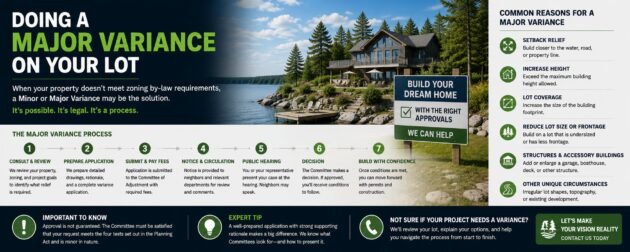
A minor variance is a small relaxation of a specific zoning rule for your property – the use stays the same, you just need slightly different numbers than the by-law allows. Common reasons:
- Setback – the house, deck, or garage is closer to a property line than the minimum
- Height – a roofline slightly above the limit
- Lot coverage – the buildings cover a bit more of the lot than allowed
- Frontage or lot area – the lot is a little smaller or narrower than the minimum
- Accessory structures – a garage or shop that’s larger, taller, or closer than permitted
Variance vs severance – don’t confuse them. A severance (consent) creates a new lot. A minor variance bends a rule on an existing lot. Both go to the Committee of Adjustment, but they answer different questions. If your plan needs both, that’s two applications.
New for 2025: the 10% as-of-right setback rule
You may not need a variance at all. As of a late-2025 provincial regulation, small setback encroachments – generally within 10% of the required setback – can be permitted “as-of-right,” meaning no minor-variance application is needed for that small amount. So if your house lands just slightly inside a side-yard setback, you may be covered automatically rather than waiting months for a hearing.
This is a meaningful, money-and-time-saving change, but it has limits and conditions and is applied locally – confirm with your municipality whether your specific encroachment qualifies before you assume it’s covered.
The two books that take you from lot to keys
Make sure your home fits the zoning (or knows when it needs relief), then pull the permit yourself. Each $29.99, or get both below and save.
Before you buy – start here
The Ontario Lot-Buying Bible
Prove a lot is buildable – before you spend a dollar.
$200+ of pro advice$29.99one-time
The 28-page step-by-step: zoning and the building envelope, legal-lot and severance, the invisible site-cost budget, septic and well feasibility, financing and the HST rebate – plus printable worksheets and offer-condition clauses.
- How to read zoning and spot when you’d need a variance
- Offer-condition clauses for zoning and approvals
- The 10-minute go/no-go test and printable scorecard
- Bonus chapters: DIY trades, wells, easements, negotiation
30-day money-back guarantee.
Get the Lot Bible – $29.99 →
Secure checkout – download in 2 minutes – yours forever
After you buy
The Ontario Building Permit Bible
Pull your permit yourself – without the guesswork.
$10,000$29.99one-time
Everything a builder does to coordinate a permit – the order of operations, the complete-application checklist that keeps it from bouncing, real fees, who to hire, and how to never fail an inspection.
- The complete-application checklist, so the file doesn’t bounce
- Real 2026 permit fees and development charges
- Who to hire to draw it, in what order, and what to pay
- How to never fail an inspection – and the costliest mistakes
30-day money-back guarantee.
Get the Permit Bible – $29.99 →
Secure checkout – download in 2 minutes – yours forever
Buying a lot and building on it? Get both Bibles.
The complete journey – prove the lot is buildable, then pull the permit without the guesswork.
Before you buy
The Ontario Lot-Buying Bible
Prove a lot is buildable – and what it will really cost – before you spend a dollar.
$29.99 on its own
+
After you buy
The Ontario Building Permit Bible
Pull your Ontario building permit yourself – the order of operations, the checklist, and how to never fail an inspection.
$29.99 on its own
$59.98 Both for $49.99
Get both Bibles →
The four tests (it must pass all of them)
The Committee of Adjustment can only approve a minor variance if it satisfies a four-part test set out in the Planning Act. Fail one, and it’s usually refused.
Is it minor?
The variance has to be small in scope and impact – not a back-door rezoning.
Does it meet the intent of the Official Plan?
It must fit the municipality’s broader land-use vision for the area.
Does it meet the intent of the zoning by-law?
The reason behind the rule (light, privacy, spacing, drainage) still has to be respected.
Is it desirable and appropriate for the use of the land?
It should be a reasonable, appropriate development of the property.
What helps you pass: a small ask, no real impact on neighbours, a clear reason (lot shape, grade, an existing constraint), and a tidy application. What hurts: a big ask dressed up as “minor,” or strong neighbour objections.
The process, cost & timeline (2026)
| Item | Typical 2026 | Notes |
|---|---|---|
| Where it’s decided | Committee of Adjustment | A local, independent (quasi-judicial) committee appointed by council. |
| Application fee | ~$1,200 – $2,700 | Varies by municipality (big cities higher). Extra variances added later can cost more. |
| Timeline to a decision | ~2 – 3 months | Prep, public notice, a hearing, then the decision and appeal period. |
| Public notice | To nearby neighbours | Neighbours can comment or object at the hearing. |
| Appeal | To the Ontario Land Tribunal | A refusal (or the conditions, or a neighbour) can appeal within the set window. |
Process steps: pre-consultation, submit the application with drawings, public notice, the hearing, the decision (often with conditions), then the appeal period before it’s final.
Not sure if your home fits the zoning? Let us check before you buy or draw.
We’ll overlay your home on the lot’s zoning envelope, tell you whether it fits, whether a small encroachment is covered by the new 10% rule, or whether you’d need a minor variance – and what that adds in time and risk. Catch it before you’ve paid for final drawings. Quick paid consult: we scope it on a call and send a secure payment link, so you only pay once you know what you are getting.
Buying a lot that only “works” with a variance? Be careful
If a lot or a plan only fits the zoning if you get a variance, that’s a risk to price in – not a sure thing. A variance can be refused, attached with conditions, or appealed by a neighbour, and even a clean one adds a couple of months. Protect yourself:
- Don’t assume – confirm with planning whether your home fits, or what variance you’d realistically need.
- If a variance is essential, consider making the deal conditional on obtaining it, and build the time into your schedule.
- Remember the two-year design clock and seasonal building windows – a delayed approval can cost a build season.
The expensive version: buy the lot, pay for final drawings, then discover the home needs a variance that gets refused. Now you’re redesigning. Confirm fit before you commit – it’s the cheapest insurance there is.
We design to fit the envelope – and handle the variance if you need one.
We design the permit-ready set to sit inside the zoning envelope wherever possible, and when a variance makes sense we prepare and present the application so it has the best shot at the four tests – then build the home.
Related guides on this site
Minor variance in Ontario: frequently asked questions
What is a minor variance in Ontario?
A minor variance is a small, formal exception from a specific rule in your municipality’s zoning by-law, granted by the Committee of Adjustment. The use of the land stays the same – you just need slightly different numbers than the by-law allows, such as a reduced setback, a bit more height or lot coverage, or a slightly smaller lot frontage. It is meant for minor relief, not for fundamental changes, which would require a rezoning instead. Because it is decided at a public hearing against a four-part test, it is routine but not automatic, and it takes time, so it is worth knowing early whether your plan needs one.
When do I need a minor variance to build?
You need one when your proposed building does not quite meet a numerical zoning rule and the gap is too large to be allowed automatically. Common triggers are a house, deck, or garage closer to a property line than the minimum setback, a roof slightly above the height limit, buildings that cover a bit more of the lot than the coverage rule permits, or a lot that is a little under the minimum frontage or area. As of a late-2025 provincial rule, small setback encroachments within about 10% of the required setback may be allowed as-of-right without a variance, so confirm with your municipality whether your specific situation needs an application at all.
What are the four tests for a minor variance?
Under the Planning Act, the Committee of Adjustment can only approve a minor variance if it meets all four tests: it must be minor in scope and impact, it must meet the intent of the municipality’s Official Plan, it must meet the intent of the zoning by-law, and it must be desirable and appropriate for the use of the land. Failing any single one of the four usually means the application is refused. In practice you improve your odds with a small ask that does not really affect neighbours, a clear reason such as an awkward lot shape or grade, and a clean, well-prepared application.
How much does a minor variance cost and how long does it take?
The application fee varies by municipality but commonly falls in the range of about $1,200 to $2,700, with larger cities at the higher end and extra variances added after circulation sometimes costing more. The timeline from preparing the application to a final decision is commonly about two to three months, which includes the municipal review, public notice, a hearing, and the appeal period. Costs also depend on whether you need drawings prepared and whether you hire a planner to present the application. Confirm the current fee with your local committee of adjustment, since fees change and differ across municipalities.
What’s the difference between a minor variance and a severance?
They solve different problems even though both go to the Committee of Adjustment. A severance, also called a consent, creates a new, separate lot by dividing a parcel of land. A minor variance does not create a lot at all – it grants a small exception from a zoning rule on an existing property, such as a reduced setback. If your project both creates a new lot and needs relief from a zoning rule, you may need both a consent and a variance, which are two separate applications. Knowing which one you actually need keeps you from applying for the wrong thing and losing time.
Can a minor variance be refused or appealed?
Yes. The Committee of Adjustment can refuse a variance if it fails any of the four tests, and it can also approve one with conditions. After a decision, the applicant, a neighbour, or the municipality can appeal to the Ontario Land Tribunal within the set window, which adds time and uncertainty. Strong neighbour objections, or an ask that is really too big to be minor, are the usual reasons a variance runs into trouble. This is exactly why you should not treat a needed variance as a sure thing, especially when you are buying a lot whose build only works if the variance is granted.
Should I buy a lot that needs a variance to build my plan?
You can, but treat the variance as a risk to manage rather than a formality. Confirm with the planning department whether your home actually fits the zoning, or precisely what relief you would need, before you commit. If a variance is essential, consider making your offer conditional on obtaining it and build the two-to-three-month timeline into your schedule, keeping seasonal building windows in mind. The expensive mistake is buying the lot, paying for final drawings, and only then discovering the plan needs a variance that gets refused, which forces a redesign. Checking fit before you commit is the cheapest insurance there is.
Note: general guidance, not legal or planning advice. Minor-variance rules, fees, the as-of-right setback allowance, and how they are applied vary by municipality and change over time. Confirm with your local planning department and committee of adjustment before you rely on anything here or waive a condition.
More on land and site
Reviewed and updated October 2026. Costs on this site are Ontario ranges, not quotes; code references are to the Ontario Building Code in force at the date above.
Latest posts
Fresh guides, calculators & real-world advice
More from BuildersOntario – scroll to explore.
Loading latest posts…
Tip: shift + mousewheel works great