
Concrete Curing Explained: Why Concrete Cracks, Scales, and Fails Over Time
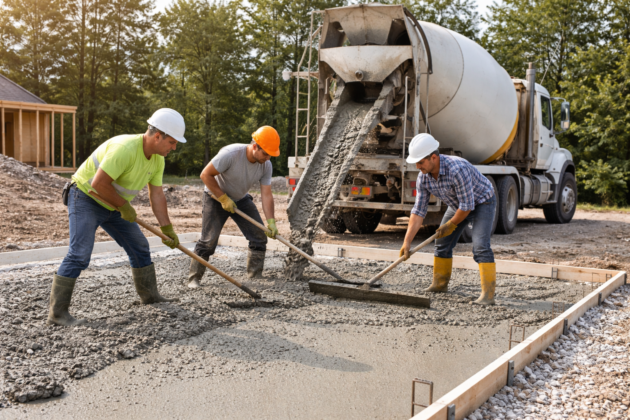
What Every Builder (and Homeowner) Should Know About Concrete Curing
A plain-English explanation of the most misunderstood material in residential construction
Concrete is everywhere in residential construction. Footings, foundations, basement floors, garage slabs, porches, steps, walkways — we rely on concrete more than almost any other material. And yet, for something so common, it is also one of the most abused, misunderstood, and underestimated materials on a job site.
Homeowners tend to think of concrete as something simple: grey, hard, permanent. Builders often treat it as routine: order the truck, place it, finish it, move on. Engineers see it as numbers on drawings. Inspectors see it as a checklist.
The problem is that concrete remembers everything you do to it — and it has a long memory. Most concrete failures don’t show up the day of the pour. They don’t even show up the year after. They show up five, ten, or fifteen years later, when the original decisions are long forgotten and the blame lands squarely on the builder.
This article exists to explain what concrete actually is, how it really behaves, and why so many concrete problems are self-inflicted. If you’re a homeowner, this will help you understand what you’re paying for and why shortcuts matter. If you’re a builder, this is the knowledge that separates routine pours from concrete that actually lasts.
Concrete Is Not a Solid — It Is a Chemical Process
The single biggest misunderstanding about concrete is the idea that it “dries.”
Concrete does not dry to become hard. It hardens because of hydration, which is a chemical reaction between cement and water. When cement particles come into contact with water, they begin forming microscopic crystalline structures. These crystals interlock, grow, and fill space over time. That growth is what creates strength.
This distinction matters because drying and hydration are opposites. Drying removes moisture. Hydration needs moisture.
When concrete loses moisture too early, hydration slows down or stops in those areas. Once hydration stops, it does not restart just because the concrete later gets wet. Lost hydration is lost strength and lost durability — permanently.
This is why concrete that looks fine on day one can end up dusty, weak, cracked, or scaled years later. The damage often happens in the first few days, quietly and invisibly.
Concrete is not forgiving. It doesn’t announce mistakes right away. It waits.
The 28-Day Myth and Why It Refuses to Die
Almost everyone has heard that concrete “cures in 28 days.” This idea is so widespread that even people in the industry repeat it without questioning it. Unfortunately, it’s only half true — and the half that’s missing causes a lot of damage.
The 28-day number comes from testing standards, not chemistry. Concrete mixes are typically designed and tested for compressive strength at 28 days because that provides a consistent benchmark. By that point, concrete has achieved most — but not all — of its long-term strength.
What 28 days does not mean:
- It does not mean concrete stops curing
- It does not mean hydration is complete
- It does not mean curing before or after doesn’t matter
In reality, concrete continues to hydrate and gain strength well beyond 28 days, especially if moisture is available. In some cases, strength gain continues for months or even years.
The more important takeaway is this: the most critical curing period is not day 28 — it’s the first 48 to 72 hours. That’s when hydration is fastest and concrete is most vulnerable to moisture loss. If concrete dries out during that window, no amount of waiting later will fix it.
The 28-day myth encourages complacency. Good concrete performance depends far more on what happens in the first few days than on how long someone waits to say it’s “cured.”
Water: The Most Important and Most Dangerous Ingredient
Water is essential to concrete. Without it, hydration cannot happen. But water is also the easiest way to ruin concrete.
The water–cement ratio controls nearly everything that matters about concrete:
- Strength
- Porosity
- Shrinkage
- Cracking
- Durability
- Resistance to freeze–thaw cycles
When extra water is added to a mix, it increases workability and slump. That makes placement and finishing easier in the moment, which is why it’s so tempting. But every extra bit of water also increases the amount of empty space left behind once hydration is complete. Those tiny voids are pathways for moisture, salts, and air — exactly what you don’t want in a cold climate.
This is why adding water at the truck is such a common cause of long-term concrete problems. The slab may look great the day it’s finished. The damage doesn’t show up until years later, when the surface starts to scale, dust, or crack more than expected.
High-slump concrete is not automatically bad. Many mixes are intentionally designed to flow better using plasticizers or superplasticizers. The difference is that these admixtures improve workability without increasing water content. A hose at the truck does not.
From a responsibility standpoint, this is important: once water is added on site, the builder owns the consequences. Not the driver. Not the batch plant. The builder.
Slump Measures Workability, Not Quality
Slump is one of the most misunderstood tests in concrete.
Slump tells you how workable the mix is — how easily it flows. It does not tell you how strong, durable, or long-lasting the concrete will be. A low-slump mix can be excellent or terrible. A high-slump mix can be excellent or terrible. What matters is how the slump was achieved and how the concrete is handled afterward.
Many arguments about concrete quality revolve around slump, but most of those arguments miss the real issues. Poor concrete performance is usually caused by one or more of the following:
- Excess water
- Poor consolidation
- Poor curing
- Poor finishing timing
Slump is just one variable. Treating it as a proxy for quality leads to the wrong conclusions and the wrong fixes.
Strength (MPa): Why Higher Is Not Always Better
Concrete strength is usually specified in megapascals (MPa). Higher numbers sound better, safer, and more durable — but in residential construction, that assumption is often wrong.
Higher-strength mixes generally:
- Cost more
- Contain more cement
- Shrink more
- Crack more if not carefully managed
Many residential concrete failures have nothing to do with compressive strength. They are durability failures, not strength failures. Scaling, surface dusting, and freeze–thaw damage are far more common than concrete crushing under load.
A well-designed, properly cured 25 MPa mix can easily outperform a poorly cured 35 MPa mix in real-world conditions. Durability comes from the right mix design for the exposure, proper air entrainment, good placement, careful finishing, and proper curing — not from chasing higher strength numbers.
Over-specifying strength is often a substitute for understanding how concrete actually behaves.
Concrete Shrinks — Whether You Like It or Not
Concrete shrinkage is not a defect. It is a physical reality.
Concrete shrinks for several reasons:
- Plastic shrinkage as water evaporates from the surface
- Drying shrinkage as moisture leaves hardened concrete
- Thermal contraction as concrete cools
- Long-term volume changes as hydration continues
Because concrete is restrained — by soil, by reinforcement, by walls, by changes in thickness — that shrinkage creates internal stresses. When those stresses exceed the concrete’s tensile strength, cracking occurs.
This is why the idea of “crack-free concrete” is unrealistic. The goal is not to prevent cracking. The goal is to control where cracks occur and how wide they become.
Reinforcement: What Steel Really Does (and Doesn’t)
Rebar, wire mesh, and fibers are often misunderstood.
Steel reinforcement does not prevent concrete from cracking. What it does is:
- Control crack width
- Hold cracked concrete together
- Distribute stresses more evenly
Wire mesh only works if it is properly positioned. Too often it ends up at the bottom of slabs, where it does very little. Fiber reinforcement helps reduce plastic shrinkage cracking and improves toughness, but it does not replace structural steel in most residential applications.
Crack control is achieved through a combination of:
- Proper joint layout
- Proper reinforcement
- Proper curing
- Managing restraint
Steel is part of the solution, not the solution.
Control Joints: Planned Cracks Done Right
Control joints are one of the builder’s most effective tools — and one of the most commonly mishandled.
Concrete will crack at predictable locations:
- Re-entrant corners
- Door openings
- Changes in thickness
- Points of restraint
Control joints create weakened planes that encourage cracks to form where you want them, rather than randomly. Poorly spaced or poorly timed joints allow cracks to form elsewhere first, rendering the joints useless.
Saw-cut timing is critical. Cut too early and the edges ravel. Cut too late and the concrete has already cracked internally. There is no universal timing — it depends on temperature, mix, and conditions — which is why experience matters.
Placement: Where Most Concrete Is Quietly Ruined
Concrete placement is not just about getting material into forms. It’s about managing segregation, flow, and consolidation.
Common placement mistakes include:
- Dropping concrete from excessive height
- Pouring too fast in walls
- Allowing aggregate separation
- Ignoring rebar congestion
- Creating cold joints through poor sequencing
Concrete does not flow like water. It must be guided and consolidated to ensure it fully surrounds reinforcement and fills voids.
In wall systems, especially ICF, placement rate and lift height matter. Too fast increases pressure and blowout risk. Too slow can create cold joints. Concrete placement is a process that requires attention from start to finish.
Consolidation and Vibration: Necessary, But Easy to Get Wrong
Vibration removes trapped air and helps concrete flow around reinforcement. Used correctly, it improves strength and appearance. Used incorrectly, it causes problems.
Under-vibration leaves voids and honeycombing. Over-vibration causes segregation, bringing excess paste to the surface and weakening the concrete locally.
External vibration is often safer and more forgiving for ICF walls. Internal vibration requires experience and restraint. The goal is consolidation, not liquefaction.
Finishing: Where Good Concrete Goes to Die
Finishing mistakes are responsible for a large percentage of surface failures.
Finishing too early traps bleed water beneath the surface, weakening the top layer. Over-troweling brings paste and water to the surface, increasing the risk of dusting and scaling. Steel troweling air-entrained exterior concrete is a classic mistake that keeps repeating itself.
Finishing should respond to the concrete — not the clock.
Curing: The Step Everyone Skips and Then Regrets
Curing is simply keeping concrete moist long enough for hydration to continue. And yet, it is one of the most neglected steps in residential construction.
Concrete that dries out early:
- Stops gaining strength
- Becomes more porous
- Loses surface durability
Proper curing methods include wet curing, curing compounds, and protective coverings. What does not count as curing is “it rained once” or “the forms were still on.”
Curing is not optional if long-term performance matters.
Cold-Weather Concrete: The Ontario Reality
Cold temperatures slow hydration. Freezing stops it entirely. If concrete freezes before it gains sufficient strength, the damage is permanent.
Cold-weather pours require planning: appropriate mix design, protection, and patience. Removing protection too early can undo everything.
Hot-Weather Concrete and Plastic Shrinkage
Hot, windy conditions increase evaporation. When evaporation exceeds bleed water replacement, plastic shrinkage cracks form — often within hours.
Preventing this requires controlling evaporation, adjusting timing, and starting curing early.
Exterior Concrete Lives in a Hostile World
Exterior slabs face freeze–thaw cycles, saturation, de-icing salts, and temperature swings. Garage slabs are especially aggressive environments due to road salt and meltwater.
Air entrainment, proper finishing, and curing are essential. Exterior concrete almost always fails from the surface downward.
Code Compliance vs Long-Life Concrete
Building codes establish minimum standards. They do not guarantee durability or longevity. Passing inspection means requirements were met on that day — nothing more.
Builders who aim for minimums get minimum performance. Builders who aim for durability build reputations.
The Builder Owns the Concrete
In practice, the builder owns the concrete:
- The mix selection
- The placement
- The curing
- The protection
Concrete failures rarely blame weather or suppliers. They blame the builder. Understanding concrete is not academic — it’s financial and reputational protection.
Final Thoughts: Concrete Rewards Respect
Concrete is honest. It reflects the care — or neglect — it receives.
Handled properly, it lasts generations. Handled carelessly, it fails quietly and expensively.
Concrete does not fail suddenly.
It fails patiently.
And by the time it shows, the decisions that caused it are long past.
1. American Concrete Institute (ACI) – Guide to External Curing of Concrete (ACI 308R-16)
https://www.concrete.org/portals/0/files/pdf/previews/308r_16_preview.pdf The definitive industry standard guide from ACI Committee 308 covering fundamental principles, methods, and best practices for concrete curing. Addresses topics including internal curing, elevated temperatures, sustainability, and new monitoring techniques. ACI is the leading authority worldwide for concrete standards.
2. ASTM International – Standard Practice for Making and Curing Concrete Test Specimens (ASTM C31/C31M)
https://www.astm.org/Standards/C31.htm Official ASTM standard covering standardized procedures for making and curing cylinder and beam specimens from fresh concrete. Widely used for concrete acceptance testing and quality control in construction projects. Referenced by contractors, engineers, and testing labs globally.
3. American Cement Association (Cement.org)
https://www.cement.org/ Premier organization representing America’s cement manufacturers (formerly Portland Cement Association after 109 years). Provides research, education, and technical resources on concrete materials, including curing best practices. Their “Design and Control of Concrete Mixtures” has been the industry’s primary guide for over 85 years.
4. National Institute of Standards and Technology (NIST) – Internal Curing Resources
https://www.escsi.org/internal-curing/ Comprehensive resource on internal curing techniques backed by NIST research. Includes references to ACI reports, ASTM standards, and peer-reviewed research on how internal curing improves hydration, reduces cracking, and enhances durability. Features work by leading researchers Dale Bentz and Jason Weiss.
5. Giatec Scientific – Curing Techniques for Compressive Strength
https://www.giatecscientific.com/education/curing-techniques-for-measuring-the-compressive-strength-of-concrete/Technical educational resource covering practical curing methods (ponding, spraying, membrane curing, steam curing) and modern concrete maturity testing approaches. Provides real-world applications for contractors and explains how curing affects concrete strength development and durability.
Tarion Warranty