
Detached Garage Permit Ontario: What You Can Build, What Triggers Delays, and What Costs More Than It Should
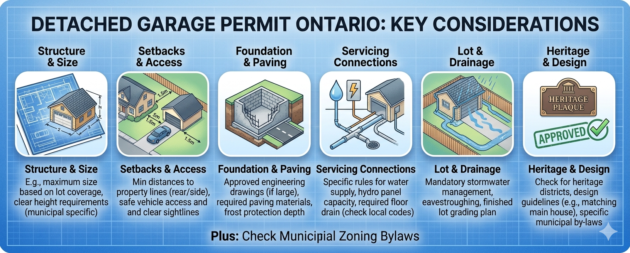
Ontario Detached Garages: The Permit Rules That Sneak Up on Homeowners
Keyword focus: detached garage permit Ontario — permit triggers, setbacks, size limits, slab versus footing questions, heated garages, inspections, and the small assumptions that turn a “simple garage” into a slower and more expensive project.
- 🚗 Accessory garage rules
- 📏 Setbacks + height
- 🧱 Slab vs footing
- 🔥 Heated garage details
People say “it’s just a garage” right up until the municipality asks for a site plan, setbacks, distance to the house, foundation details, roof framing, service trench locations, and a permit application that suddenly feels much more serious than a weekend project should. That is the real detached-garage story in Ontario.
This guide explains what usually triggers a permit, why detached garages get tangled up in zoning faster than homeowners expect, how slab-on-grade and footing designs change the conversation, what happens when you decide the garage should be heated, and which mistakes slow approvals or cost more money than they should.
If you are here because you are still at the “can I even do this?” stage, good. That is the right time to ask.
Biggest myth
“It’s detached, so the rules are lighter.” Sometimes. But not nearly as light as people hope.
Most common delay
Site plan and zoning issues, not the garage framing itself.
Best first move
Check setbacks, size, access, and intended use before picking a slab or roof design.
First, when does a detached garage actually need a permit?
This is where people get confused because Ontario homeowners hear two numbers and assume the system is contradicting itself. Municipal building departments commonly say an accessory structure greater than 10 m² needs a building permit. They also commonly note a narrow exemption for a one-storey detached storage shed 15 m² or less, ancillary to the house and without plumbing. The important part is the word storage shed.
That is why most real detached garages need permits. They are usually:
- bigger than the narrow exemption anyway,
- intended for vehicle storage rather than just garden tools,
- often serviced with power,
- and almost always large enough that the municipality wants drawings and zoning review.
So if you are asking whether your planned 20′ × 24′ detached garage needs a permit, the practical answer is yes. Treat it like a permit project from day one and life gets easier. Treat it like a big shed and life gets educational.
Builder truth: if a car fits in it, the permit conversation usually fits too.
Detached garage approvals are really two approvals hiding inside one project
Homeowners often think a garage permit is just a Building Code issue. It is not. It is usually two conversations happening at the same time:
- Zoning: where the garage can go, how big it can be, how tall it can be, how close it can sit to lot lines, and how it relates to the main house and total lot coverage.
- Building permit: how it is actually built — foundation or slab, framing, anchorage, roof structure, openings, services, and inspections.
This is why some garage permits slow down even when the garage itself is structurally simple. The problem is often not the building. It is the site. The municipality wants to know where the structure sits, how far it is from the house, whether the setbacks work, whether there are overhead conductors, whether services need to be trenched, and whether the zoning numbers add up.
If you need the broader permit refresher, read how to obtain a building permit in Ontario. It is the same basic reality here: paperwork matters because the site matters.
Setbacks are where a lot of garage dreams start to wobble
Detached garages are accessory structures, which means the lot does not get to forget the main house exists. Your municipality will usually care about rear-yard setback, side-yard setback, height, total accessory coverage, and distance to the dwelling. That is why the garage that “fits fine” in your head often does not fit the by-law nearly as well.
The usual detached-garage trouble spots are:
- rear-yard depth: enough room for the garage footprint plus required setbacks,
- side-yard width: especially if access to the rear is tight,
- height: especially once you choose a steeper roof pitch or dream about attic storage,
- lot coverage: because decks, sheds, porches, pools, and old structures still count in the bigger picture,
- distance to the house: which matters more than people expect.
Barrie’s current residential accessory-structure checklist is a good example of how municipalities think: it asks for property lines, driveway width to the rear yard, all existing decks/sheds/pools, setbacks to side and rear yards, distance to the dwelling, service trench location, and then tells you to check the zoning by-law for height, setback, and coverage. That is a very Ontario sentence if there ever was one.
If you want the deeper setback discussion, go to detached garage setbacks in Ontario. That page is where the geometry gets less polite.
What you can usually build without making the project weird
Most homeowners are not trying to build anything exotic. They want a straightforward detached garage for vehicles, storage, and maybe a workbench. That kind of garage is usually the easiest to permit when it stays within normal accessory-building expectations:
| Garage type | Why it is simpler | What starts making it harder |
|---|---|---|
| Cold detached garage | Simple use, simpler envelope, simpler mechanical story, often easier slab design. | Oversized footprint, loft ideas, service trench complexity, or tight setbacks. |
| Heated detached garage | Still manageable, but more details need to be shown and coordinated. | Insulation, heated slab decisions, equipment location, future-finish expectations, and added cost. |
| Garage with plumbing or washroom | Possible on some sites, but now services and layout get more serious. | Plumbing, drainage, venting, inspections, and stronger site-servicing questions. |
| Garage planned for future suite or livable space | This is no longer “just a garage” in anyone’s eyes. | Zoning, fire separation, exits, servicing, parking, and a much bigger approval discussion. See garage suite Ontario. |
The smarter the owner is about intended use on day one, the smoother the permit process tends to be. Trouble starts when the drawings say “simple detached garage” and the budget conversation says “heated workshop now, maybe loft later, maybe washroom, maybe future living space.” Municipalities get suspicious when buildings start developing ambitions.
Slab on grade versus footing: this is where “simple” can still get technical
Many Ontario detached garages are built on slab-on-grade, and for good reason. A well-detailed slab can be efficient, durable, and cost-effective for the right garage on the right site. Barrie’s current accessory-structure checklist specifically allows slab-on-grade details for detached accessory structures and notes a maximum permitted size of 55 m² for that local slab-on-grade pathway.
That does not mean every garage should automatically be slab-on-grade. The right foundation approach depends on things like:
- garage size and loads,
- soil and compaction conditions,
- slope and drainage,
- whether the slab is heated,
- whether the garage is expected to stay cold or become semi-conditioned,
- and how tolerant you are of future cracking, frost movement, and regrets.
Ottawa’s accessory-building checklist is also useful here because it asks applicants to show either footings and foundation walls or slab-on-grade detailing, and also to show foundation depth in cross-section. That tells you exactly how municipalities think: the slab decision is not a casual note. It is part of the structural design they want to review.
If the garage is small, simple, well-supported, and staying unheated, slab-on-grade often makes sense. If the garage is larger, more complex, on questionable soils, or part of a bigger plan, footing and foundation logic becomes more important. The foundation decision is one of those places where trying to save a little can cost a lot later.
A cheap slab that moves is not cheaper. It is just an installment plan on future annoyance.
Heated garages cost more for reasons that go beyond the heater
The moment a homeowner says, “Actually, we want it heated,” the garage stops being a simple cold box. Now you are no longer just talking about walls, roof, and slab. You are talking about comfort, slab insulation, edge conditions, vapour control, heat source, equipment location, service capacity, and sometimes more permit detail than people expected.
That is why heated garages almost always cost more than people budget. The added cost usually comes from:
- a better slab build-up,
- more insulation and air sealing,
- more careful door and opening choices,
- power or mechanical requirements,
- and the fact that owners usually want a nicer finish once the garage becomes a conditioned space.
If you are pricing that path, see heated garage slab cost in Ontario and also radiant heated garage slabs in Ontario. A heated slab is one of those luxuries that can feel excessive until February explains it to you.
What inspections usually happen on a detached garage permit
People think permits are mainly about approval at the start. They are not. They are also about inspections during construction. Ottawa’s residential accessory-building checklist lays this out clearly and it mirrors the normal Ontario rhythm pretty well.
Typical detached-garage inspections often include:
- excavation: before concrete footings are placed,
- foundation: before backfill,
- framing and rough mechanical: once structure and applicable rough-ins are in place,
- insulation/vapour barrier: where applicable,
- final inspection: when the building is complete.
Where plumbing is part of the project, that adds inspection points too. Electrical is also its own conversation because those inspections are handled through the Electrical Safety Authority, not by pretending your cousin’s workshop wiring should be considered a design standard.
The point is simple: if you bury work before the right inspection, the municipality can make you uncover it. Drywall looks much less cheerful when it is being cut open for the second time.
Why “it’s just a garage” usually turns into permit trouble
Because homeowners say “garage” when they really mean one of five different projects:
- a cold storage garage,
- a workshop,
- a heated hobby space,
- a future pool house with ideas,
- or a garage that may quietly become part of a future suite conversation.
The problem is not the dream. The problem is pretending all five are the same permit. They are not. The more use, services, heat, finish quality, and future adaptability you build into the plan, the more carefully the municipality will want the drawings and site reviewed.
This is also where cost drifts upward. A straightforward garage can already be a meaningful investment once you include permit drawings, site prep, slab or footing design, framing, roofing, doors, services, and finishing. A more ambitious garage gets expensive faster than most people expect. That is why our cost guide at detached garage cost in Ontario exists — because the sticker shock is rarely just about lumber.
The most common homeowner mistakes
- Assuming the detached garage is exempt because it is “not part of the house.” Detached does not mean permit-free.
- Picking a garage size before checking setbacks and lot coverage. The site gets a vote.
- Ignoring service trench planning. Power and future heat do not teleport themselves to the garage.
- Choosing slab-on-grade because it sounds cheaper, without checking site conditions. Cheap on paper can be expensive in real life.
- Adding heat late in the game. That decision affects more than a heater purchase.
- Forgetting distance to the house and overhead wires. Municipal site plans do not forget.
- Designing a garage that is really a future suite in disguise. See garage suite Ontario before you wander into that.
If you are in Simcoe County and want builder-side help rather than a thousand browser tabs, see detached garage builder support in Simcoe County. If you are leaning toward ICF construction, ICF garage builder support in Ontario is worth a look too.
What to do before you spend on drawings
The smartest detached-garage projects usually follow this sequence:
- confirm setbacks, height, and lot coverage first,
- decide honestly whether the garage is cold or heated,
- pick the likely foundation strategy based on actual site conditions,
- figure out whether services are needed now or only roughed in for later,
- and only then finalize the drawings.
It sounds simple because it is simple. The expensive version is doing those steps in reverse.
Next steps: how to keep a detached garage from becoming a permit mess
Do these four things first and the project usually gets much smoother:
- Check setbacks, height, and lot coverage before choosing the building size.
- Decide whether the garage is truly unheated or whether you are building for future comfort.
- Price the slab or footing path honestly instead of assuming the cheapest foundation is the smartest one.
- Apply for the permit based on what the garage really is, not what you think sounds simpler.
For the current provincial framework, review the 2024 Ontario Building Code. It is not a page-turner, but it does get the last word.
Ontario FAQ: detached garage permit Ontario
Do I need a permit for a detached garage in Ontario?
In most real-world cases, yes. Detached garages usually need permits because they are typically larger than the narrow one-storey small-shed exemption and still have to satisfy zoning and building requirements. Municipalities commonly ask for site plans, setback information, foundation or slab details, framing information, and other permit documents before construction starts. Treat a detached garage like a permit project from the beginning and you will avoid a lot of backtracking later.
What size detached garage can I build without a permit in Ontario?
The common municipal language is that accessory structures over 10 m² need a permit, while a very narrow exemption may apply to a one-storey detached storage shed 15 m² or less with no plumbing. That exemption is not something most normal detached garages comfortably fit into. If your project is intended to store vehicles, includes services, or is anything more than a very small simple outbuilding, assume a permit is required unless your municipality confirms otherwise.
Do detached garage setbacks stay the same across Ontario?
No. Setbacks are one of the most local parts of the whole conversation. Your municipality controls how far the garage must be from side and rear lot lines, how much distance it needs from the main dwelling, how height is measured, and how total lot coverage is calculated. That is why copying your neighbour’s garage dimensions is not a planning strategy. The lot may look similar and still be governed differently or fail because of other site constraints.
Can I build a detached garage on a slab-on-grade in Ontario?
Often yes, but it depends on the municipality, the garage size, and site conditions. Many detached garages are built on slab-on-grade, especially where the site is straightforward and the building is relatively simple. Municipal checklists often ask for slab-on-grade details or footing/foundation details as part of the permit application. The right choice depends on soil, drainage, loads, size, whether the garage is heated, and how much movement risk you are willing to accept over time.
When should I use footings instead of a slab-on-grade?
Footings and more traditional foundation details become more attractive when the garage is larger, heavier, built on questionable soils, tied into more complicated grade conditions, or intended to do more than basic cold storage. If the garage is heated, contains plumbing, or may someday become part of a more ambitious use, the foundation decision deserves more thought. The cheaper option is not always the smarter option if it creates movement or performance issues later.
Does heating a detached garage change the permit conversation?
Usually yes. A heated garage tends to bring more design attention because the project is no longer just an unconditioned accessory structure. Owners often need better slab and envelope details, more service planning, and sometimes additional information on the permit documents where applicable. Heating also changes the budget because insulation, slab design, and the expected level of finish usually improve along with the heat source. It is one of the easiest ways a “basic garage” becomes a more serious project.
What inspections are usually required for a detached garage?
Typical inspections often include excavation before concrete footings, foundation before backfill, framing and applicable rough-ins, insulation where applicable, and final inspection. If plumbing is involved, that adds more inspection points. Electrical is usually inspected through the Electrical Safety Authority rather than through the municipal building inspector. The exact list varies by project and municipality, but the big rule is universal: do not cover work that has not been inspected if it required inspection.
Can I put plumbing in a detached garage?
Sometimes, yes, but that is where the garage starts moving away from “simple accessory structure” territory. Plumbing affects service layout, inspections, and often the broader discussion around intended use. A garage with a washroom or more ambitious servicing needs more careful permit drawings and may raise additional zoning or building questions depending on what else is planned for the structure. It is much easier to permit honestly than to pretend the washroom somehow appeared by accident later.
Can I build a loft or future living space over a detached garage?
You can explore it, but then you are no longer dealing with “just a detached garage.” A future suite, loft, or habitable space changes the zoning, building, fire-safety, servicing, and sometimes parking conversation in a major way. If that is where your mind is going, read about garage suites before locking in a normal garage design. It is far better to plan for the actual end goal than to design a garage first and discover later that the structure or approvals no longer suit the real project.
Why do detached garage permits get delayed so often?
Because owners tend to underestimate the site review. The garage itself is often straightforward. The delays usually come from missing setback information, poor site plans, unaddressed lot coverage problems, unclear service trench planning, overhead-wire concerns, and changes in intended use that should have been decided earlier. Municipalities want to understand the whole site, not just the box you want to build at the back of it.
What makes a detached garage cost more than it should?
The classic cost-creep triggers are changing from cold to heated late in the process, underestimating sitework, choosing the wrong foundation approach, ignoring service trench costs, oversizing the building relative to the lot, and pretending the garage might maybe someday become something else without pricing or designing for that reality. The cheapest-looking garage is often the one with the most expensive unanswered questions sitting underneath it.