Ontario's Plain-English Guide to Custom Home Building📞 705-533-1633 | ☎️ 1-866-868-6606 | ✉️ info@icfhome.ca
Home Energy Audit Ontario: EnerGuide, Rebate Eligibility, and How Heat Loss Calculations Differ From Audits
Ontario Homeowner Guide · 2026
Home Energy Audit Ontario: What It Covers, What It Costs, and When You Actually Need One
Plain-English answers on EnerGuide audits, the 2026 Ontario rebate game, and why a home energy audit is not the same thing as a CSA F280 heat loss calculation — written by a working builder, not a marketing department.
Almost every week, somebody emails us asking what a “home energy audit” actually is, whether they need one before they call a contractor, and why the rebate websites keep mentioning EnerGuide ratings and pre-retrofit assessments and CSA F280 calculations as if those are all the same thing.
They’re not the same thing. Not even close. And the difference matters — because if you mix them up, you can spend money on the wrong report and watch your rebate cheque disappear before it ever lands.
So here’s the honest version. No marketing fluff. No “save thousands today!” pitch. Just what a home energy audit in Ontario actually is, what it costs in 2026, how it differs from the heat loss calculations builders deal with on the permit side, and whether you actually need one.
Quick note before we start: no honest builder can promise you a specific rebate amount. The programs change. The funding runs out. The rules get rewritten between when we publish this and when you read it. We’ll give you accurate numbers and live program details as of writing, but check the official program pages before you commit to anything.
What a home energy audit actually is
In Ontario, when people say “home energy audit,” they almost always mean an EnerGuide home evaluation — the federal standard administered by Natural Resources Canada (NRCan). It’s a top-to-bottom inspection of your existing home’s energy performance, performed by a Registered Energy Advisor.
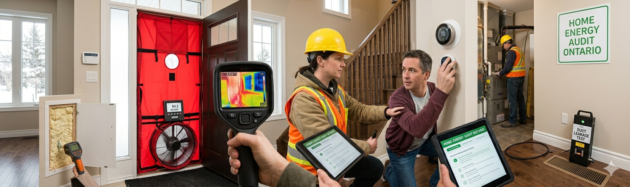
Here’s what actually happens during one. The advisor shows up with a clipboard, a tape measure, and a piece of equipment called a blower door — basically a big fan that mounts in your front door opening and depressurizes your house. The fan pulls air out of the house at a calibrated rate. The leakier your house, the harder the fan has to work to maintain that pressure difference. The reading from that fan gives you your air change rate at 50 pascals — known as ACH50, which is just a fancy way of saying “how many times per hour the entire volume of air in your house gets sucked out through cracks, gaps, and bad seals.”
That single number tells the advisor more about your house than a hundred eyeball inspections.
While the blower door is running, the advisor also documents:
- Insulation R-values in the attic, walls, and basement (or what’s probably in them, since they can’t usually see inside the wall cavities)
- Window and door type, age, and condition
- Furnace, water heater, AC, and ventilation equipment — make, model, age, efficiency rating
- Heating fuel and approximate annual usage from your gas and hydro bills
- Air leakage paths they find by feel and by infrared camera — cold spots around pot lights, rim joists, attic hatches
All of that data goes into a software program called HOT2000, which spits out your EnerGuide rating plus a renovation upgrade report telling you exactly which improvements would give you the biggest energy savings for the money. The full process and official rules are documented on the NRCan EnerGuide home evaluation page.
The whole visit takes about two to three hours. You should plan to be home, give them access to your attic and crawl space, and have your gas and hydro bills handy.
What it costs in Ontario in 2026
As of 2026, here’s what you’re looking at for the audit itself — before you touch the rebate side:
| Audit type | Typical cost in Ontario (2026) | Reimbursement available? |
|---|---|---|
| Pre-retrofit EnerGuide evaluation | $400 – $700 | Yes, partial |
| Post-retrofit EnerGuide evaluation | $300 – $400 | Yes, partial |
| Total typical out-of-pocket (before reimbursement) | $700 – $1,100 | — |
| HRSP bundled-path audit reimbursement | Up to $600 back | Once full program completed |
A few cost realities most people miss:
- The advisor doesn’t sell you anything. They report on what they see. (Good ones, anyway. A few try to upsell. Don’t pick one of those.)
- The cost is roughly the same whether your house is 1,000 sq ft or 4,000 sq ft. It’s labour, not square footage.
- Rural and Northern Ontario homeowners often pay a small premium because there are fewer Registered Energy Advisors out there and travel time gets added.
EnerGuide audit vs. CSA F280 heat loss calculation — the question we get most
People confuse these two reports constantly, and the cost of confusing them is real. A CSA F280-12 heat loss calculation is a completely different document from an EnerGuide audit. F280 is the Canadian engineering standard used to size heating and cooling equipment for new construction. It’s required by the Ontario Building Code before a permit can be issued on a new home. We cover the F280 side of the equation in our heat loss calculator and F280 guide.
Here’s how the two compare side-by-side:
| EnerGuide audit | CSA F280-12 heat loss calc | |
|---|---|---|
| Purpose | Rate existing home’s energy use; qualify for rebates | Size HVAC equipment for permit-ready new construction or major renovation |
| Who performs it | NRCan-Registered Energy Advisor | BCIN-registered HVAC designer |
| Software | HOT2000 | HRAI-style room-by-room calc tools (HRAI, RHVAC, etc.) |
| Includes blower door test | Yes | No |
| Required by Ontario Building Code | No | Yes, for new home permits |
| Typical use case | Older home renovation, rebate application | New home build, major addition, mechanical replacement at permit stage |
| Output | EnerGuide rating + Renovation Upgrade Report | BTU/h heat loss room-by-room, stamped for permit |
An EnerGuide audit doesn’t size your equipment. A heat loss calc doesn’t qualify you for rebates. They use different software, different methodology, and different professionals. If you’re building new, you need an F280. If you’re renovating an existing house for rebates, you need an EnerGuide audit. If you’re doing both — say, a major addition with full renovation — you need both.
Builder Truth
The Registered Energy Advisor isn’t a building inspector and isn’t a permit engineer. Three different people, three different qualifications, three different software stacks. We’ve seen homeowners pay for an EnerGuide audit hoping to use it for their permit application — that’s not what it does, and the building department will reject it.
When you actually need an audit — and when you don’t
Here’s the honest split:
You need an EnerGuide audit if
- You’re claiming rebates under the Home Renovation Savings Program bundled path (two or more upgrades). The audit is mandatory.
- You’re applying for a low-interest municipal energy loan like Toronto’s HELP program or Kingston’s Better Homes program. Most require an EnerGuide rating.
- You’re selling your home and want the EnerGuide label as a marketing asset. Some buyers care a lot.
- You genuinely want a prioritized list of where your home is losing energy — not a wishlist, an actual ranked plan.
You probably don’t need one if
- You’re only doing a single upgrade (smart thermostat, one heat pump, an ENERGY STAR appliance) and the HRSP single-upgrade path applies.
- You’re building a brand-new home. You need an F280 for the permit; you don’t qualify for retrofit rebates.
- You’re spending under $5,000 total on upgrades. The audit cost can eat the rebate.
- Your home was built or fully retrofitted in the last 5 years — there’s usually not much for the audit to find.
The 2026 Ontario rebate landscape — what’s actually active
Quick reality check on what’s not available in 2026:
- The federal Canada Greener Homes Grant is closed. New applications stopped February 2024. Final paperwork deadline was December 31, 2025.
- The federal Canada Greener Homes Loan closed October 1, 2025.
- The federal Oil to Heat Pump Affordability Program closed January 20, 2026.
So when somebody on the internet tells you about “the Greener Homes Grant,” they’re either three years out of date or selling something.
What’s actually active in Ontario right now is the Home Renovation Savings Program (HRSP) — launched January 2025, confirmed through November 2026, delivered jointly by Enbridge Gas (gas-heated homes) and Save on Energy / IESO (electrically heated homes) with provincial backing. Up to roughly $10,000 in rebates, sometimes more depending on the upgrade mix. The official program page is homerenovationsavings.ca, and we maintain a complete walkthrough of the program rules in our Home Renovation Savings Program Ontario 2026 guide.
HRSP has two paths, and choosing the wrong one is how rebates die:
| Path | Requires audit? | What it covers | Typical rebate ceiling |
|---|---|---|---|
| Bundled path | Yes — pre and post EnerGuide audits | Insulation, air sealing, heat pumps, windows, doors, solar + battery — two or more upgrades together | Up to $10,000+ depending on mix |
| Single-upgrade path | No | One eligible item — smart thermostat, certain heat pumps, ENERGY STAR appliances | Smaller per-item rebates ($200–$3,000 range) |
Sample bundled-path rebates worth knowing about (always verify current amounts on the official program page before committing):
- Attic insulation upgrade — up to about $1,600
- Air sealing / draft proofing — up to about $1,300
- Air-source heat pump — around $500 per ton for gas-heated homes, $1,250 per ton for non-gas homes
- Heat pump water heater — variable, ENERGY STAR required
- Solar panels with battery storage — up to about $10,000 combined
- ENERGY STAR appliances (fridges, freezers, laundry machines) — up to $200 each, paid roughly 60 days after approval
Builder Truth
Most homeowners think the rebate amount is the thing that matters most. It isn’t. The thing that matters most is the order of operations. We’ve watched people lose $3,000+ in rebates because their contractor showed up before the pre-retrofit audit was done — and the program rules don’t grant exceptions for an honest mistake.
The rule is simple: audit first, work second, second audit third, rebate cheque fourth. Reorder it and the money doesn’t come.
The correct sequence — don’t reorder these
If you’re going the bundled path, follow this exact order. Skip a step and you may forfeit the entire rebate:
- Register for the Home Renovation Savings Program online before you do anything else. This puts you in the funding queue.
- Book your pre-retrofit EnerGuide evaluation. Wait times can be a few weeks, especially in spring and fall.
- Receive your audit report listing recommended upgrades — this is your menu of eligible work.
- Get contractor quotes. Confirm equipment is on NRCan’s qualified products list and ENERGY STAR-certified where required.
- Complete the work. Keep every receipt and every model number. Photos help.
- Book your post-retrofit audit. It must happen within 180 days of the pre-retrofit audit.
- Submit your final paperwork through the program portal. Expect 8 to 12 weeks for the rebate cheque.
How to pick a good energy advisor
Three rules for picking an advisor
One — they must be NRCan-registered. This is non-negotiable. If they’re not registered, the report isn’t valid and no rebate program will accept it. Verify in the NRCan service organization directory before you book.
Two — they should be advisor-only, not selling installations. Some companies do both, and the conflict of interest is real. The best advisors give you a prioritized upgrade list and stay out of contractor selection entirely.
Three — confirm the post-retrofit timing in writing. Some advisors get backed up in late spring and fall. If you can’t get the follow-up audit done within the 180-day window, your rebate dies. Lock the return appointment when you book the first one.
One more thing — if you’re building new, this changes
If you’re building new instead of retrofitting an existing home, most of the audit-and-rebate machinery doesn’t apply to you. A well-built new home — properly air-sealed, insulated to current standards, with mechanical ventilation and right-sized heating — already performs at the level a retrofit is trying to reach. You skip the audit-rebate dance entirely.
What you do need is the CSA F280 heat loss calculation for the permit, code-compliant insulation and air sealing during the build, and a builder who understands envelope detailing. If you’re considering an ICF (insulated concrete form) build for serious energy performance, we cover the full ICF side at ICFhome.ca for homeowners and at ICFpro.ca for contractors and subtrades. For the planning side of a new build, our 10 Steps to Building a New Home guide is a good starting point.
For everyone else with an existing home that’s costing too much to heat or cool, an EnerGuide audit is the cheapest, most honest first step you can take. Around $500. Three hours of your time. A report that tells you exactly where the money’s leaking out of your house. And — if you play your cards right — most of the audit cost reimbursed when you finish the work.
That’s the whole story. For more context on how energy-efficient construction approaches compare for new builds, see our older but still-relevant piece on energy-efficient home building in Ontario, and for ongoing ICF industry insights you can browse the ICFpro insights archive as well.
Building new in Ontario? We can help you skip the audit-and-rebate dance entirely.
If you’re planning a new custom home in Simcoe County, Georgian Bay, Collingwood, or surrounding areas — and you want an envelope that doesn’t need retrofits five years from now — talk to us.
Frequently asked questions
Is the Canada Greener Homes Grant still available in Ontario in 2026?
No. The federal Canada Greener Homes Grant closed to new applicants in February 2024, and the final documentation deadline passed on December 31, 2025. The Canada Greener Homes Loan closed October 1, 2025, and the Oil to Heat Pump Affordability Program closed January 20, 2026. Anyone telling you otherwise is either misinformed or selling something. The active program in Ontario right now is the Home Renovation Savings Program (HRSP), delivered jointly by Enbridge Gas and Save on Energy with provincial backing — confirmed through November 2026, though program terms always allow earlier cancellation.
How much does a home energy audit cost in Ontario in 2026?
A pre-retrofit EnerGuide audit in Ontario typically runs $400 to $700, and the post-retrofit follow-up runs $300 to $400. Under the Home Renovation Savings Program bundled path, you can get up to $600 reimbursed once you complete the program — meaning your real out-of-pocket cost for the two audits is often closer to $100–$500. Rural and Northern Ontario homeowners sometimes pay a small premium because of advisor travel time, and prices vary slightly between service organizations across the province.
What’s the difference between an EnerGuide audit and a CSA F280 heat loss calculation?
An EnerGuide audit is for existing homes, used to qualify for retrofit rebates and assess overall energy performance. A CSA F280-12 heat loss calculation is for new construction or major renovations and is required by the Ontario Building Code before a permit will be issued. EnerGuide uses HOT2000 software and a blower door test, performed by an NRCan-Registered Energy Advisor. F280 is an engineering calculation performed by a BCIN-registered HVAC designer to size heating and cooling equipment. They are completely different documents for completely different purposes, and you can’t substitute one for the other.
Can I get Ontario rebates without doing an EnerGuide audit?
Yes. The Home Renovation Savings Program has a single-upgrade path that doesn’t require an audit. It covers things like smart thermostats, certain qualifying heat pumps, ENERGY STAR appliances, and a handful of other items. The rebates are smaller per item — typically $200 to $3,000 — but the application is faster and simpler. If you’re only doing one upgrade, this is often the right choice. If you’re doing two or more, the bundled path with the audit almost always pays back more in total, even after the audit cost.
What happens if I start work before the pre-retrofit audit?
You lose the bundled-path rebates. The program rules require the pre-retrofit audit first, the report issued in writing, and only then can work begin. There are no exceptions, even for an honest scheduling mistake. This is the single most common reason homeowners get rebate applications rejected, and it’s completely avoidable — but only if you and your contractor understand the rule before the first installer shows up. Tell every contractor on the job: nobody starts anything until the pre-retrofit audit report is in your hands.
What’s the EnerGuide rating and what’s a good score for an Ontario home?
The EnerGuide rating shows your home’s estimated annual energy use in gigajoules per year (GJ/year). Lower is better. A typical older Ontario home rates somewhere around 100 to 180 GJ/year. A code-built new home rates closer to 70 to 100 GJ/year. A high-performance home — well-insulated, air-sealed, with efficient mechanicals — can come in below 60 GJ/year. The lower the number, the more comfortable, quieter, and cheaper to run the house is. The rating appears on a label affixed to your electrical panel and increasingly shows up on real estate listings in some Ontario markets.
Do brand-new homes in Ontario need an EnerGuide audit?
Not for rebates. Most new homes don’t qualify for retrofit rebates because they’re already built to current energy efficiency standards. New construction requires the CSA F280 heat loss calculation instead, for HVAC sizing and permit approval. If you’re building new and want an EnerGuide rating for marketing or eventual resale purposes, you can request a voluntary EnerGuide for New Houses evaluation — but it’s optional, not required to occupy the home. Builders who go for higher performance ratings often do so to attract buyers who specifically care about energy bills.
How long does an EnerGuide audit take and what do I need to prepare?
Plan for two to three hours on-site, with one Registered Energy Advisor working through your house top to bottom. You should be home for the duration. Before the visit, clear a path to the attic hatch, basement, mechanical room, and any crawl space access. Pull out 12 months of gas, hydro, and propane bills if you have them. Don’t run a wood-burning fireplace or stove for at least 24 hours before the appointment — warm flues and fresh ash will mess with the blower door reading. The legal homeowner needs to be present to sign documents.
Can I do the audit myself, or hire a regular home inspector instead?
No. Only a Registered Energy Advisor licensed by Natural Resources Canada can produce a valid EnerGuide report that qualifies you for any rebate program. A home inspector — even a very good one — can’t generate the report. The blower door equipment, the HOT2000 software licence, and the certification process all sit with the advisor and the service organization that employs them. Save yourself a wasted trip and check the NRCan service organization directory before booking anyone who claims they can do a “home energy audit” for rebate purposes.
How long is the pre-retrofit EnerGuide audit valid for the rebate application?
The pre-retrofit audit must be followed by a post-retrofit audit within 180 days. That means you have roughly six months to complete all the work, book and pay for the follow-up evaluation, and submit your final paperwork. Plan the project timeline accordingly — including contractor availability, equipment lead times, and seasonal factors. Don’t book your audit in March if you don’t have contractors lined up until July, because the 180-day clock starts ticking the day the first audit is completed, not the day you actually break ground on the work.
Which equipment qualifies for HRSP rebates in 2026?
Eligibility depends on the upgrade category. Heat pumps must appear on Natural Resources Canada’s qualified products list — not every heat pump qualifies, even from name-brand manufacturers. Windows, doors, and heat pump water heaters must be ENERGY STAR-certified models. Insulation must meet specific R-value thresholds depending on the application (attic, wall, foundation, exposed floor). Always confirm the exact model number against the qualified products list before signing a contract or paying a deposit — getting the equivalent-but-different model installed by mistake is another common way rebates get rejected.
Who actually delivers the rebate program in Ontario, and who do I deal with?
The Home Renovation Savings Program is co-delivered by Enbridge Gas (for natural gas-heated homes) and Save on Energy / IESO, which is the Independent Electricity System Operator (for electrically heated homes). The Ontario government provides program backing. You’ll register through the homerenovationsavings.ca portal, and your application gets routed to whichever utility delivers the program based on your heating fuel. Rebate cheques come from the program administrator, not from your contractor or your auditor — never pay a contractor extra in exchange for “handling the rebate for you.”
If you’re planning a renovation, a new build, or just trying to figure out whether your existing house is bleeding money, the smart first move is usually the cheapest one. Existing home? Book an EnerGuide audit. New build? Get a proper CSA F280 done before you start picking finishes. Either way, do it in the right order. — Harvey, on behalf of the crew.