Ontario's Plain-English Guide to Custom Home Building📞 705-533-1633 | ☎️ 1-866-868-6606 | ✉️ info@icfhome.ca
Ontario Housing Market 2026: The Truth About Buying or Building
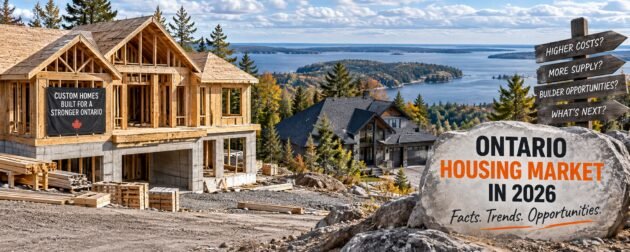
Ontario | 2026
Housing market
Custom homes
Buy vs build
The Truth About Ontario’s Housing Market in 2026: Should You Buy, Build or Wait?
If you have been reading the news about the Ontario housing market in 2026, you could be forgiven for being confused.
One headline says housing is in trouble. Another says new-home sales are recovering. Another says housing starts are falling. Then you look a little deeper and discover that detached housing starts are actually rising in some parts of Ontario.
The short answer:
Ontario housing is neither booming nor collapsing. It is resetting.
Resale is soft, condominiums remain under serious pressure, but detached and ground-oriented
new housing has performed considerably better. For somebody thinking about building a
custom home, the difference matters.
First, there is no single “Ontario housing market” anymore
After more than 45 years in the construction business, I have learned something about housing statistics: you can take a perfectly accurate number and use it to tell a fairly inaccurate story.
Condominiums are behaving differently from detached homes. Toronto is behaving differently from Barrie. Resale homes are competing with new homes. A subdivision house is different again from a one-off custom home on five acres outside Midland.
And somewhere in the middle of all this are real people trying to answer a much simpler question: does it make sense to build a house in Ontario in 2026?
If that is the decision you are facing, our complete guide to building a custom home in Ontario explains the entire process, while this article concentrates on whether today’s market makes sense.
Builder translation:
there is no useful answer to “How is housing doing?” until you ask:
what kind of housing, where in Ontario, at what price, and for what buyer?
The Ontario housing market in 2026 at a glance
13,620
Ontario MLS residential sales in August 2026
“`
+20%
Ontario single-detached starts in July versus July 2025
+40%
Barrie CMA single-detached starts, Jan–July year-over-year
“`
| Indicator | Latest 2026 information | What it means |
|---|---|---|
| Ontario resale sales | 13,620 in August — lowest August total in 25 years | Resale buyers have considerably more negotiating power. |
| Single-family resale benchmark | $826,900, down 3.4% year-over-year | Prices have softened rather than collapsed. |
| Ontario resale inventory | 5.2 months | Far more choice than during the pandemic boom. |
| Single-detached starts, Jan–July | 5,221, down only 2% | Detached construction has held up surprisingly well. |
| Single-detached starts, July | Up 20% year-over-year | Detached housing is behaving differently from total housing starts. |
| Barrie detached starts | Up 40% Jan–July | Simcoe-area detached construction is healthier than many GTA markets. |
| GTA new single-family sales, July | 781 — 50% above the 10-year July average | Demand for ground-oriented homes did not disappear. |
| GTA new condo sales, July | 237 — 80% below the 10-year average | The condo market is in a completely different situation. |
| Bank of Canada overnight rate | 2.25% | Financing is easier than at the peak, but money is certainly not free. |
| Toronto construction price index | Only 0.1% higher year-over-year in Q2 | The post-pandemic explosion in construction inflation has largely stopped. |
Ontario’s resale housing market is definitely weak
Let us start with something that is not particularly debatable.
The Ontario resale market is soft.
According to CREA and the Ontario Real Estate Association, 13,620 residential properties changed hands through Ontario MLS systems in August 2026. That was 6% below August 2025 and the lowest August sales total in 25 years.
Sales were also 22.6% below the 10-year average for August. Ontario’s single-family benchmark price was $826,900, down 3.4% from a year earlier.
At the end of August there were 70,483 active residential listings across Ontario, 41.5% above the 10-year average for the month.
Ontario had 5.2 months of inventory versus a long-term August average of only 3.1 months.
Translation into builder English:
there are more houses for sale, fewer people fighting over them and sellers have considerably
less power than they did a few years ago.
Anyone who remembers 2021 and early 2022 will appreciate the difference. Back then you could apparently put a broom closet on MLS, hold offers until Tuesday and expect several people to waive the home inspection.
That market is gone.
For a custom-home builder, this matters because an existing house is the first competitor to every new house we build.
A customer may love the idea of building new, but if he can buy a reasonably good existing home for substantially less money and move in next month, a builder had better explain why the new home is worth doing.
But detached home construction is not collapsing
This is where the story becomes more interesting.
CMHC reported that Ontario centres with populations above 10,000 recorded 35,941 housing starts from January through July 2026, up 7% from the same period in 2025.
Within those numbers were 5,221 single-detached starts compared with 5,340 during the first seven months of 2025.
That is a decline of only 2%.
Then look at July by itself.
| Housing type | July 2025 | July 2026 | Change |
|---|---|---|---|
| Single-detached | 928 | 1,111 | +20% |
| All other housing | 5,368 | 3,530 | -34% |
| Total | 6,296 | 4,641 | -26% |
Think about that table.
A newspaper could write “Ontario housing starts fall 26%.”
Completely true.
Another could write “Ontario single-detached housing starts jump 20%.”
Also completely true.
Same month. Same province. Same CMHC report.
Welcome to housing statistics.
This matters if you are deciding whether to build.
Do not make a million-dollar construction decision because a broad housing headline says
“starts are down.” Find out which part of housing is actually down.
Ontario is not one market: Barrie and Toronto tell two different stories
Location matters just as much as housing type.
Between January and July 2026, CMHC recorded 129 single-detached housing starts in the Barrie CMA compared with 92 during the same period in 2025.
That is a 40% increase.
Toronto went the opposite way. Toronto CMA single-detached starts fell about 21%. Hamilton was down about 30%. Guelph was down about 31%. Kitchener-Cambridge-Waterloo was roughly flat to modestly higher.
If you are planning to build in Simcoe County, Georgian Bay, Tiny, Tay, Midland, Penetanguishene, Wasaga Beach, Collingwood, Barrie or surrounding areas, Toronto statistics are interesting.
They are not your market.
People still leave the GTA looking for more land, more privacy and a different lifestyle. Some want a bungalow. Some want a workshop. Some want a three-car garage. Some simply want enough distance between houses that opening the kitchen blinds does not constitute meeting the neighbours.
Anyone considering that move should first read our 49 things to check before buying a building lot in Ontario. The market can be favourable and the lot can still be terrible.
Something very important happened in April 2026
The first few months of 2026 were ugly for Ontario’s new-home industry.
In January, only 269 new homes sold in the GTA. That was roughly 80% below the 10-year January average.
Only 184 were single-family homes.
February recorded 531 total new-home sales, including 360 single-family homes. March improved, but the overall market remained far below historical levels.
Then April arrived.
Ontario’s enhanced HST relief took effect and GTA single-family sales jumped sharply. The details of Ontario's enhanced HST rebate are on OntarioHSTRebates.ca, a site that covers nothing but Ontario HST rebates.
| 2026 month | New single-family sales | Compared with 10-year average |
|---|---|---|
| January | 184 | 68% below |
| February | 360 | 57% below |
| April | 901 | 21% above |
| May | 830 | 26% above |
| June | 902 | 36% above |
| July | 781 | 50% above |
Did the HST program single-handedly cause that increase?
I would not make that claim.
Prices had also fallen. Financing conditions had improved from their peak. Inventory was available. There was pent-up demand.
But the timing is difficult to ignore.
The lesson I take from it:
the buyer did not disappear. The buyer became extremely price sensitive.
Make the numbers work better and buyers come back.
The condo market and detached market have split apart
July gives us one of the clearest examples.
GTA single-family new-home sales were 50% above their 10-year July average.
New condominium sales were approximately 80% below their 10-year average.
That is not a small difference.
It is almost two different economies.
For clarity, the industry’s “single-family” category includes detached houses, semi-detached homes, linked houses and traditional townhouses.
It does not mean 781 custom houses were sold.
That would be a very convenient statistic for a custom builder to quote. Unfortunately it would also be nonsense.
What it does tell us is that ground-oriented housing is performing dramatically better than the condominium sector.
The 2026 HST rebate can materially change a custom-home budget
This may be the single most important financial change affecting somebody building a new house in Ontario this year.
The temporary Ontario enhanced new-housing rebate applies to qualifying homes under specific timing and eligibility rules.
Importantly for custom-home clients, eligible owner-built homes can qualify. That includes circumstances where you own the property and hire a contractor to construct the home for you.
$80,000
Potential enhanced Ontario provincial portion
$50,000
Potential additional federal-related relief/payment depending on eligibility
$130,000
Potential combined maximum for an eligible home
Notice the repeated word potential.
Whenever the government says “up to $130,000,” pay attention to the first two words.
Eligibility depends on timing, property value, occupancy, HST paid and the interaction between the available programs.
We have a separate Ontario new-home HST guide and calculator that goes through the numbers in considerably more detail.
For the right custom-home client, however, this is real money.
A six-figure tax difference can turn “maybe next year” into “where do we sign?”
New-home prices have already adjusted
The GTA benchmark price for a new single-family home in July 2026 was about $1.36 million, roughly 8.5% below one year earlier.
In Simcoe County, the July weighted average new single-family price was roughly $1.04 million.
Do not confuse either number with the cost to build a custom home in Ontario.
A subdivision selling price includes land, development costs, financing, overhead and the developer’s business model. A custom house on a lot you already own is a different calculation.
But the direction matters.
Builders and developers have had to become competitive.
That is healthy.
For several years construction pricing seemed to have only one direction: north. Eventually every market discovers that customers also own calculators.
Construction costs have stopped exploding
One misconception I hear is that because the housing market slowed, construction should suddenly be cheap again.
No.
We are not going back to 2019 labour rates, 2019 municipal charges and 2019 material pricing.
But the rate at which construction costs are increasing has changed dramatically.
Statistics Canada’s Residential Building Construction Price Index increased about 2.3% year-over-year across the metropolitan areas it measures in Q2 2026.
Toronto was essentially flat year-over-year and actually recorded a quarterly decline.
That does not mean every electrician, framer and concrete contractor cut his price.
It means the extraordinary inflationary period has cooled.
For somebody planning a build, that is useful because stable pricing makes estimating, tendering and scheduling easier.
For current numbers, see our 2026 cost-per-square-foot guide for Ontario.
Current planning reality:
construction is still expensive. What changed is that costs are no longer jumping every
few months the way they did during the worst post-pandemic period.
So what does it actually cost to build in Ontario in 2026?
Based on the current ranges we use for planning, a professionally built custom home in much of Ontario generally falls somewhere around $340 to $575 per square foot for construction, before land.
A mid-range custom project commonly falls around $375 to $500 per square foot, depending heavily on location, design complexity and finish level.
The GTA can run substantially higher. Rural Ontario can have cheaper building labour but considerably greater site costs.
If you want the full breakdown, start with our 2026 guide to the cost of building a house in Ontario.
We also have specific guides for two of the most common house sizes:
Or, if you want to put in your own size, location and finish level, use the Ontario Custom Home Building Calculator.
Do not confuse house cost with project cost.
Land, excavation, driveway, well, septic, hydro, permits, engineering, financing,
landscaping and HST can sit outside the simple “per square foot” number.
The lot can change the entire calculation
This deserves more attention than it normally gets.
Suppose two vacant lots each cost $250,000.
Lot A is level, has easy access, good soil, hydro at the road and a straightforward septic location.
Lot B has a beautiful view.
Unfortunately, Lot B also has 500 feet of driveway, rock six inches below grade, awkward drainage, expensive hydro service and a septic system that needs an advanced design.
They are both “$250,000 lots.”
They are most certainly not the same cost.
Before buying land, work through our Ontario building-lot checklist.
I would rather spend money investigating a property before buying it than spend considerably more money discovering what is wrong with it afterward.
Interest rates are better, but borrowing money is still not free
The Bank of Canada held its overnight policy rate at 2.25% on September 2, 2026.
Recent Bank of Canada data also show conventional mortgage borrowing costs far below the worst levels of the recent rate cycle.
That helps.
But custom-home financing has another complication.
A construction mortgage is not necessarily the same as obtaining a conventional mortgage on a completed resale home.
Construction financing can involve land equity, progress draws, appraisals, holdbacks and inspections.
My advice:
work out the financing before you fall in love with the final house plans.
Architectural drawings become considerably less romantic when the bank says no.
Ontario’s population story has changed
For several years the simplest Ontario housing argument went something like this:
Population is exploding, therefore housing demand must keep exploding.
The first half of that equation has changed.
Statistics Canada estimated Ontario’s population at about 16.1 million on April 1, 2026, slightly below the January estimate.
The number of non-permanent residents declined during the quarter and permanent immigration was considerably lower than one year earlier.
Ontario still has more than 16 million people.
We have not suddenly run out of people who need homes.
But extraordinary population growth should no longer be treated as an automatic explanation for every future housing forecast.
The impact on custom housing may also be smaller than on rental and condominium housing.
A custom-home customer generally builds because he has land, accumulated equity, a changing family situation or a particular long-term home in mind.
Development charges are finally part of the affordability conversation
Builders have complained about development charges for years.
For good reason.
You can negotiate with a lumber supplier.
Municipal fee schedules are somewhat less open to negotiation.
Ontario’s Development Charge Reduction Program is encouraging participating municipalities to reduce residential development charges substantially in exchange for infrastructure funding.
That could make a meaningful difference in participating municipalities.
But do not read that sentence as “development charges are now 50% cheaper everywhere in Ontario.”
They are not.
Charges vary enormously by municipality, housing type, services and project circumstances.
They belong in the full project budget from day one.
Our full cost of building a house in Ontario guide covers many of the costs that disappear when someone quotes only a construction price.
Is it cheaper to buy an existing home or build a custom home?
This is probably the most useful practical question in the entire article.
And the truthful answer is:
If all you want is a house, buying an existing house will often be cheaper.
That should not offend custom builders.
It is mathematics.
An existing home may have been built with yesterday’s land price, yesterday’s labour rates, yesterday’s development charges and yesterday’s material costs.
A custom home has to be built today.
| Buying an existing home | Building a custom home |
|---|---|
| Usually lower immediate purchase cost | Designed around your family and property |
| Move in quickly | Modern structure and building envelope |
| Established neighbourhood | Choose orientation, views and site placement |
| May require substantial renovations | Everything starts new |
| Older mechanical systems are common | Modern heating, cooling and ventilation |
| Somebody else’s floor plan | Your floor plan |
| Unknown energy performance | Can be designed for very low operating costs |
| Future repair costs can be significant | Major components begin with their full service life |
This is why I would never compare a custom home only against the sticker price of a resale home.
Compare the house you are likely to own after ten years.
If you buy a 25-year-old house and then spend $150,000 changing the kitchen, bathrooms, windows, basement and mechanical systems, the “cheap house” was not quite as cheap as it looked.
On the other hand, building because you think a custom home is automatically cheaper than buying existing is normally the wrong reason to build.
Build because you want the advantages of building.
What the statistics cannot tell us about custom homes
There is one problem with almost every article claiming to tell you how the custom-home market is performing.
There is no clean government statistic called “Ontario custom home starts.”
CMHC counts single-detached starts.
Municipalities issue permits.
Tarion records warranty information.
Industry groups record new-home sales.
None neatly separates a one-off ICF home on a rural acreage from every other detached house.
So I am not going to tell you “custom home construction is up 20%.”
We do not have the data to prove that.
What we can say is that detached construction has held up better than many headlines suggest, Barrie-area detached starts have increased substantially and new low-rise demand responded strongly when affordability improved.
Those are the facts.
My interpretation is that there remains plenty of demand for good detached housing.
Who should seriously consider building in 2026?
“`
1
People who already own the lot
Land has already been removed from the immediate purchase equation, and today’s more
competitive construction environment may work in your favour.
2
People with substantial home equity
Selling a long-owned GTA property can still create enough equity to fund a meaningful
portion of a new home farther outside Toronto.
3
Empty nesters building the final home
A properly designed bungalow can provide main-floor living, accessibility and lower
operating costs without renovating somebody else’s house.
4
Multigenerational families
A custom house can be designed properly for parents and adult children rather than
trying to convert a conventional house afterward.
5
People who care about energy efficiency
High-performance walls, proper air sealing, radiant floors and efficient mechanical
systems are easier to build in than retrofit later.
6
People eligible for the 2026 HST relief
Tens of thousands of dollars of legitimate tax relief can materially change the project economics.
“`
If you fit one of those groups, the step-by-step guide to building a custom home in Ontario is a good next read.
Who should probably wait?
Building is not the right decision for everybody.
- If your employment situation is uncertain, wait. A custom home is not the ideal place to discover that your income was less secure than expected. “`
- If the project only works if rates fall another 1%, wait. Build the budget around today’s reality, not tomorrow’s hoped-for interest rate.
- If you have no contingency, wait. A construction budget with zero contingency is not really a budget. It is optimism in spreadsheet form.
- If you found a cheap rural lot and have not investigated it, stop. Check zoning, access, septic suitability, water, hydro, conservation restrictions and soil conditions first. “`
A $150,000 lot can become a $300,000 problem remarkably quickly.
Sometimes the trees are the least expensive thing growing on it.
The strange advantage of building during a slower market
This sounds backwards, but some of the better times to build are not necessarily the hottest housing markets.
During a boom, everybody is busy.
Excavators are busy. Concrete crews are busy. Framers are busy. Electricians are busy. Suppliers are busy. Inspectors are busy.
And the customer learns that “Tuesday” occasionally means any Tuesday between now and Christmas.
In a slower market, good contractors still have work, but there is generally more competition for the next project.
That can help pricing, scheduling and attention to detail.
I am not recommending spending a million dollars because the plumber may answer his phone faster.
But construction-market conditions are part of the calculation.
What I expect for the rest of 2026 and into 2027
Nobody knows exactly what happens next.
Anyone who tells you otherwise should probably also give you Saturday night’s lottery numbers.
Rather than pretending to have a crystal ball, I would watch three realistic scenarios.
| Scenario | What could cause it | Likely effect on custom building |
|---|---|---|
| Base case | Rates stay reasonably stable, economy grows slowly and resale remains soft | Steady custom demand and reasonable opportunity for buyers with land and equity |
| Stronger market | Confidence improves, financing gets easier and tax incentives continue stimulating new construction | More starts, tighter trade availability and eventual renewed price pressure |
| Weaker market | Employment deteriorates, trade problems worsen or borrowing costs rise | Fewer buyers but more competitive construction pricing for financially secure clients |
My base case is not a return to the craziness of 2021.
I expect buyers to remain price conscious.
I expect poor projects and overpriced properties to sit.
I expect well-located detached housing to remain desirable.
And I expect custom building to continue being driven less by speculation and more by people who actually intend to live in the house.
Frankly, I prefer that market.
My view after more than four decades of building homes
I have been through enough housing cycles to know that the words “this time is different” should be handled carefully.
Markets become too hot.
Then they become too cold.
Eventually buyers and sellers discover each other again.
I believe that is what Ontario is doing in 2026.
Resale prices have corrected.
Inventory has improved.
Construction inflation has cooled.
Financing is more manageable than it was.
And governments have finally acknowledged that taking enormous amounts of tax and development charges from a new house and then wondering why houses are expensive may not have been the finest plan ever devised.
Most importantly, the rebound in new single-family sales tells us that people still want houses.
They simply need the numbers to make sense.
For the financially prepared custom-home buyer, I think that creates an unusual opportunity.
I would not call 2026 a bargain.
Building a quality home in Ontario is expensive.
I would not call it risk-free either.
Nothing involving excavation, concrete, lumber, banks and municipal government is entirely risk-free.
But I also would not sit on a good building lot for three years waiting for construction prices to return to 2019.
I do not believe they will.
My conclusion:
if you have the land, financing, contingency and a long-term need for the house,
2026 may actually be one of the more sensible times in recent years to plan a custom build.
Not because the housing market is booming. Because it isn’t.
And that may be part of the opportunity.
FAQ: Ontario Housing Market 2026
Is the Ontario housing market crashing in 2026?
No. Ontario resale activity is weak and prices have softened, but a province-wide crash does not accurately describe the data. Single-detached construction has remained considerably more resilient than the condominium market, and low-rise new-home sales improved sharply during the spring and summer.
Are Ontario home prices falling?
Yes, in many categories and markets, but generally by much less than the word “crash” implies. Ontario’s single-family resale benchmark was down year-over-year in August 2026, while new GTA single-family benchmark pricing was also lower than a year earlier.
Is custom-home building slowing down in Ontario?
There is no reliable government statistic separating custom homes from all other detached homes. Ontario single-detached starts were down only slightly through July 2026, while Barrie-area detached starts were significantly higher year-over-year.
Is 2026 a good time to build a house in Ontario?
For a financially prepared buyer, it can be. Construction-cost inflation has cooled, trade availability is generally better than during the boom and qualifying new homes may receive substantial HST relief. The decision still depends on the lot, financing, total project budget and how long you intend to own the house.
How much does it cost to build a custom home in Ontario in 2026?
A reasonable planning range for professionally built custom construction in much of Ontario is roughly $340 to $575 per square foot before land, with many mid-range projects falling around $375 to $500 per square foot. See our complete Ontario construction-cost guide for the full breakdown.
Can a custom home qualify for Ontario’s 2026 HST rebate?
Yes. Qualifying owner-built homes can be eligible, including situations where the owner hires a builder to construct the house on land the owner owns or leases. Eligibility depends on timing, value, occupancy and other program requirements. Use our Ontario HST rebate guide and calculator for more detail.
Should I buy an existing house or build a custom home?
If obtaining the most house for the lowest immediate cost is the only objective, an existing house often wins. Custom construction makes more sense when layout, energy performance, building quality, site, accessibility, comfort and long-term ownership justify the extra investment.
Will Ontario house prices go up in 2027?
Nobody knows. Employment, interest rates, population, inventory, government policy and consumer confidence will all matter. I would never recommend building a home primarily because somebody predicts its value will be higher next year.
Should I wait for construction prices to fall?
I would not base a long-term project on that assumption. Construction inflation has slowed substantially, but labour, municipal costs, code requirements and material costs remain well above pre-pandemic levels. Stable costs are more realistic to plan around than a return to 2019 pricing.
Bottom line
The true Ontario housing story in 2026 is more complicated than “good market” or “bad market.”
Ontario resale sales are weak.
Buyers have more choice.
Prices have softened.
The condominium business remains under serious pressure.
At the same time, detached housing has performed considerably better. Ontario single-detached starts were only slightly lower through July, July itself was up 20%, Barrie-area detached starts were up about 40%, and GTA new single-family sales moved above long-term seasonal averages in the spring and summer.
Construction inflation has slowed.
Financing is more manageable than at its recent peak.
Temporary HST relief can change the economics of an eligible new house by tens of thousands of dollars.
That does not mean everybody should build.
It means the decision deserves considerably more thought than reading a headline saying the housing market is down.
If you already own a good lot, have adequate financing, intend to live in the home for many years and want something substantially better than the average resale house, I would take a serious look at building now.
And before you buy the land, price the whole project.
The house is usually the easy part to see.
It is the driveway, well, septic, hydro, permits, development charges, excavation, engineering and the piece of Canadian Shield hiding six inches under the topsoil that occasionally has other plans.
Thinking about building in Ontario?
Start with the complete custom-home guide, then run the numbers through the 2026 calculator.
“`
Custom Home Guide
“`
Start with the complete custom-home guide, then run the numbers through the 2026 calculator.
Want a rough project number?
Enter your size, location, construction type and finish level.
“`
Calculate My Build
“`
Enter your size, location, construction type and finish level.
Primary data sources: Canada Mortgage and Housing Corporation; Statistics Canada; Bank of Canada; Canadian Real Estate Association; BILD GTA; Canadian Home Builders’ Association; and Canada Revenue Agency.
Data note: This article uses major housing and economic releases available as of September 14, 2026. Housing statistics are revised periodically, and later releases may change individual numbers.
Planning disclaimer: This article is general market and construction information, not financial, legal or tax advice. HST rebate eligibility, financing and individual construction budgets should be confirmed for the specific project before making a commitment.
Building in Georgian Bay or Simcoe County?
Talk to a builder who has done it 250+ times.
BuildersOntario.com is run by ICFHome.ca — ICF custom-home specialists since 1995. Straight answers on budget, permits, and ICF. No pressure.
Get a Ballpark Estimate →Book a 30-Min Call