Ontario's Plain-English Guide to Custom Home Building📞 705-533-1633 | ☎️ 1-866-868-6606 | ✉️ info@icfhome.ca

Radiant Floor Heating Ontario: The Smart Way to Heat a Home
Radiant 101 – the honest version
How it works | worth it | controls | problems
Part of: Radiant & In-Floor Heating in Ontario · What it costs
Radiant Floor Heating in Ontario: How It Works, Whether It’s Worth It, and How to Get It Right
Here’s the whole thing in one sentence you could say to your mom: radiant floor heating turns your floor into one big, gentle, low-temperature heating pad – warm even comfort you feel through your socks, not a hair dryer in your face. This is the plain-English, builder-real guide: how radiant actually works, whether it’s worth it, how the controls make it effortless, and where it goes wrong (and how we keep it from going wrong). After 30+ years designing and installing radiant in our own ICF homes, this is the version with the truths the brochures skip.
Set & forget
In a home you live in
25-50 yr
PEX tubing life
2 in 30 yrs
Leaks we’ve seen
Lowest dust
Heat you can buy
How radiant floor heating works (no engineering degree required)
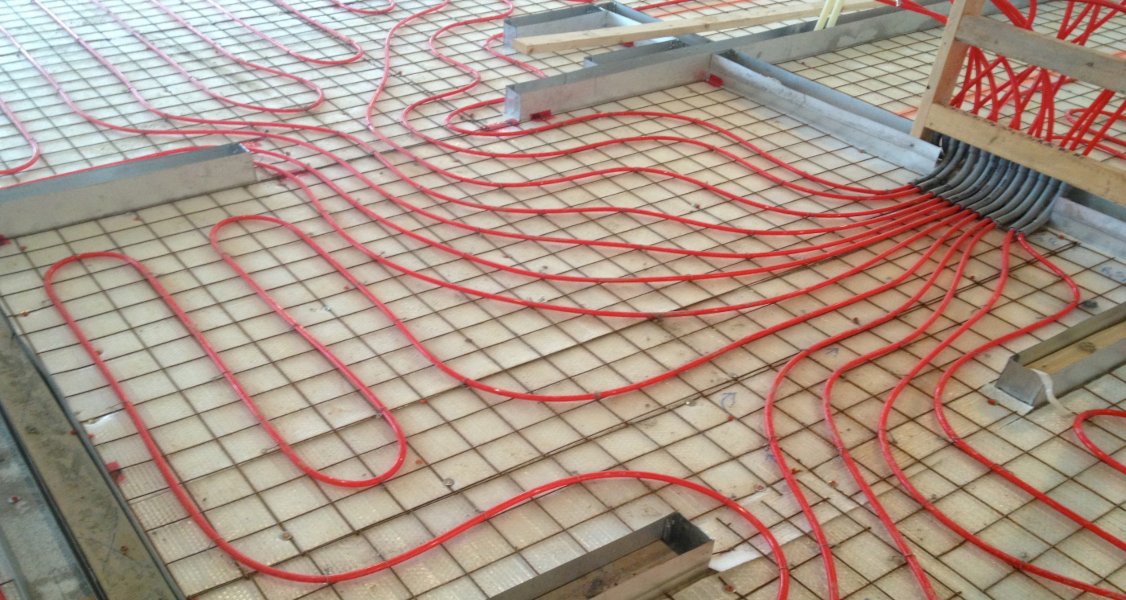
Radiant warms a home from the floor up. Instead of heating air and blowing it around, it warms the surfaces and the people in the room directly – which is why radiant comfort feels different: steadier, quieter, and comfortable at a slightly lower thermostat setting. If you’ve ever stood by a sunny window on a cold day, you’ve felt the idea: warmth on you, without the air having to be roasted. There are two families. Hydronic runs warm water through PEX tubing embedded in a slab or a 1.5 in concrete topping – that’s the whole-home solution. Electric uses cables or mats under the finish floor – usually the best-bathroom-upgrade-you-ever-did solution. The honest builder truth: “radiant” isn’t a product, it’s a system, and it’s only as good as its design – heat loss, tubing layout, insulation details, zoning, and control logic. Get those right and it disappears into the background; get them wrong and you get “why are my floors lukewarm?” For the head-to-head on the two families, see electric vs hydronic floor heating, and for system methods and build-up details, in-floor heating.
1 Warm water (not boiling)
A boiler, on-demand combi, or heat pump makes warm water – low temperature, nothing scary.
2 Tubing in the floor
It circulates through PEX in the slab, a concrete topping, or staple-up under the subfloor.
3 The floor becomes the radiator
The floor warms slightly and radiates comfort upward – even heat, no drafts, no noise.
Is radiant floor heating worth it?
After thirty years and more repeat clients than I can count, the pattern is simple: once people live with radiant, they don’t go back to a furnace. It’s the calmest, most even, quietest, lowest-dust heat you can buy. There’s no blower noise, no airplane-takeoff when the furnace kicks on, and no forced-air “house confetti” blowing dust and allergens around – which is why it’s easier on anyone with allergies or asthma. Homes that list “heated floors” tend to sell faster and recoup a big share of the cost, too. If your single priority is the lowest possible sticker price, a basic forced-air system wins that narrow fight – but most people who choose radiant aren’t chasing cheapest, they’re chasing the best daily living experience for the money. We put the full comfort-versus-cost case, and the honest “where it isn’t the best fit,” on radiant heat vs forced air.
Usually worth it when
- You’re building new – especially slab, basement, or garage
- Your envelope is efficient (good windows, insulation, air sealing)
- You value even, quiet comfort over fast warm-up blasts
- You want to pair with a high-efficiency heat source
Maybe not when
- You need the lowest upfront cost, period
- You want fast temperature swings (radiant is slow and steady)
- You’d retrofit without doing major flooring work anyway
- The design isn’t locked in and there are lots of unknowns
Wondering if it can carry your whole house through a cold Ontario winter? That’s its own guide: will radiant heat my house. And for what it all costs, see the Ontario radiant cost page.
Controls and response: why ours is truly “set and forget”
The biggest myth about radiant is that it’s slow and fussy – that you’ll freeze while it “catches up.” In a home you actually live in, it’s the opposite: it’s set and forget at one steady temperature. Our own ICF homes with radiant sit at one setting all year; my house holds 24°C with no air conditioning, and even in a summer heat wave the interior never climbs past 25°C because the envelope is tight.
The one time you notice a lag is bringing a radiant home up from cold – the thermal mass takes about six hours to go from 10 to 20 degrees, and that happens in a well-insulated house too. It’s the mass doing its job, not a flaw. So for a seasonal place like a cottage you only visit, you put in a Wi-Fi thermostat and raise it about six hours before you arrive, and it’s perfect. In a home you live in – where you never let it go cold – there’s no lag at all. The mistake people make is treating radiant like a furnace with big nightly setbacks; with radiant you pick a comfortable temperature and leave it.
The controls that make it effortless: outdoor reset (automatically nudges the water temperature to match the weather – one of the biggest comfort upgrades there is), a sensible mixing strategy to keep floor temperatures safe, floor sensors under temperature-sensitive finishes, and smart zoning. Zoning is how comfort stays even across sunny rooms, shaded rooms, basements, and bedrooms – but it has to be smart. Too many tiny zones cause short-cycling; too few cause complaints. The sweet spot is zones that match how the home is actually used. The heat source side of controls – manifolds, actuators, water temperatures – lives on hydronic heating.
Problems, leaks, and maintenance (the honest part)
The number one fear with hydronic is a leak buried in concrete you can’t reach. Here’s the truth from three decades of doing it: it is rare with a properly installed, pressure-tested loop. In 30+ years I’ve seen it twice – once a concrete crew clipped a pressurized pipe with a wheelbarrow (outside the pour area; we swapped the whole length in an hour) and once an electrician nailed through an exposed pipe in a basement wall (easy fix). Both times it showed up instantly, because the tubing is always under pressure during the pour exactly so any hit announces itself before the concrete covers it. That pressure test is your insurance, and you only get to pour once – so it’s non-negotiable. Quality PEX lasts 25 to 50 years and doesn’t lose strength sitting in a slab.
Beyond leaks, radiant is low-maintenance. The usual real-world issues are a cold loop or two (air trapped in the lines – you bleed it), a system that won’t reach setpoint (almost always a sizing or insulation shortcut, not the radiant itself), or a garage loop that needed glycol and didn’t get it. Annual maintenance is light: check system pressure, purge any air, and keep an eye on the mechanical-room components. The most common “radiant disappointment” isn’t the radiant at all – it’s a shortcut around it: no under-slab insulation (so you’re heating the dirt), too many zones, or no commissioning. Do those right and it just works.
Good radiant starts with numbers, not brochures.
Get the heat-loss + radiant design that makes it effortless
Every “set and forget” radiant system starts with a CSA F280-12 heat-loss calculation – it sizes the equipment, sets the loop spacing and water temperatures, and prevents the short-cycling and lukewarm-floor problems people complain about. It’s also the BCIN-stamped paperwork your Ontario permit requires (the loop layout can’t be designed until that number exists). Upload your plan and our engineer emails you a price. More: do I need a heat-loss calculation?
Flooring, heat source, and special cases
What you put over radiant changes how it feels and how much heat the floor can deliver. Tile and stone are radiant heaven; engineered hardwood works beautifully when it’s designed and controlled for; vinyl and laminate are fine with proper temperature limits; carpet works if it’s thin enough not to insulate the heat away. Solid hardwood gets a bad rap but works if it’s acclimatized inside the climate-controlled house for about a month first – the catch is nobody wants to wait a month. The full flooring guide is radiant floor heating and flooring. On the heat-source side, radiant’s superpower is that anything which heats water can run it – boiler, air-to-water heat pump, geothermal, or solar; on most of our jobs we use a combi on-demand unit with two loops, one potable and one radiant, so you never run out of shower hot water. See hydronic heating, solar radiant, and solar thermal vs PV. Two special cases get their own pages: heated garage and shop floors (one of the most practical upgrades in Ontario) and radiant floor cooling in summer.
The myths your relatives repeat at dinner
A few keep coming up, so here’s the short version. “It’s slow and you’ll freeze until it catches up” – in a lived-in home it holds one steady temperature; the only lag is firing a cold slab, which is the thermal mass, not a flaw. “It’ll leak and wreck the house” – rare with a pressure-tested loop; most “radiant problems” are design or install shortcuts, not the concept. “You can’t have wood floors” – you can, with the right temperatures, subfloor, and an acclimatized product. “Radiant means no air system at all” – radiant heats, but an Ontario home still needs ventilation, so radiant is paired with an HRV or ERV, and cooling is handled separately. That’s the whole myth list, retired.
Get a radiant in-floor heating quote
We’ve designed and installed radiant in our own ICF homes for 30+ years. Tell us about your project and we’ll call you back – usually within one business day – with a real plan and price. No cost, no obligation.
OK
You’re on the list!
Thanks – we’ll call you within one business day to talk through your radiant project and pricing.
Want a one-on-one radiant consult?
System design, heat-source choice, a second opinion on a quote, or troubleshooting an existing system. We scope it on a quick call and send a secure payment link – you only pay once you know what you’re getting.
Building new? The HST rebate can cover a big slice
If radiant is going into a new build, that home likely qualifies for Ontario’s enhanced HST rebate – up to $130,000 back if your build contract is signed before the deadline. Check your number before you commit.
Ontario HST Rebate | Deadline April 1, 2027
You Could Lose Up To $106,000 If You Don’t Start Before April 2027
Ontario’s enhanced HST rebate puts up to $130,000 back in a new-home builder’s pocket – but only if your build contract is signed before April 1, 2027. Miss that window and you fall back to the standard $24,000 rebate.
$0
Contract signed before Apr 1, 2027
$24,000
Signed after the deadline
$900,000
Miss the deadline and you forfeit
$0
Estimate based on Ontario’s 2026 enhanced HST rebate (Bill 114). Final eligibility is confirmed by a licensed rebate specialist – that’s what the free check is for. Full HST rebate details
Radiant pairs best with ICF
An ICF home loses less heat, so the radiant system runs at lower water temperatures - smaller, cheaper equipment, lower bills, quieter operation. It's the combination we build into our own homes. See what ICF is, browse our ICF house plans (every one offered with the ICF + radiant package), run the ICF cost calculator, or check code with the OBC Code Navigator.
All radiant guides
Radiant & in-floor hub
Radiant cost in Ontario
Electric vs hydronic
Radiant vs forced air
In-floor systems & methods
Hydronic heating
Solar radiant heating
Solar thermal vs PV
Radiant + flooring
Will radiant heat my house?
Do I need a heat-loss calc?
Heated garage & shop floors
Radiant floor cooling
Heat-loss calculator
Radiant floor heating: frequently asked questions
Is radiant floor heating worth it in Ontario?
For most people who choose it, yes. It's the calmest, most even, quietest, lowest-dust heat you can buy, easier on allergies and asthma than forced air, and homes with heated floors tend to sell faster and recoup a good share of the cost. It's especially worth it in basements, slab-on-grade builds, bathrooms, and garages. After 30+ years and many repeat clients, once people live with radiant they don't go back to a furnace.
Do heated floors feel warm underfoot, or just not cold?
A well-designed radiant floor isn't hot - it's a room that's consistently comfortable, with the floor pleasantly neutral to slightly warm underfoot. If the floor feels genuinely hot, that's usually a control problem (no floor sensor, water temperature too high), not a heating problem. Tile and stone read warmest underfoot because they conduct heat best.
Does radiant floor heating take forever to warm up?
In a home you live in, no - it's set and forget at one steady temperature. The only lag is bringing a radiant home up from cold: the thermal mass takes about 6 hours to go from 10 to 20 degrees, and that happens in a well-insulated house too - it's the mass, not a flaw. For a seasonal place like a cottage, use a Wi-Fi thermostat and raise it about 6 hours before you arrive. Don't run nightly setbacks with radiant.
Should I use a nighttime thermostat setback with radiant?
No. Radiant runs best at a steady state. Setting it down at night and recovering it in the morning leaves the system chasing its own tail and can overshoot. Set a comfortable temperature and leave it, and let outdoor reset adjust the water temperature to the weather automatically. Setbacks are a forced-air habit that works against radiant.
How long does radiant PEX tubing last, and what if it leaks?
Quality PEX lasts 25 to 50 years and doesn't lose strength in a slab. Leaks are rare with a properly installed, pressure-tested loop - in 30+ years we've seen it twice, both during construction and both caught instantly because the tubing is pressurized during the pour. That pressure test, before the concrete covers the loop, is your insurance.
What maintenance does a radiant system need?
Very little. Check system pressure, purge trapped air if a zone runs cold, keep glycol in garage and shop loops, and watch the mechanical-room components. Most problems trace to a design shortcut - no under-slab insulation or no commissioning - rather than the radiant itself.
Why won't my radiant floor reach the set temperature?
Usually one of three things: the system was undersized because nobody did a proper heat-loss calculation, there's no insulation under the slab so heat goes into the ground, or the water temperature and zoning aren't set right. Air trapped in a loop can leave one zone cold - a quick bleed. The fix starts with the heat-loss numbers, not with cranking the thermostat higher.
Is radiant more comfortable and healthier than forced air?
Most people find it more comfortable - even warmth, no drafts, no blower noise, comfortable at a slightly lower air temperature. Because it doesn't blow air around, it doesn't circulate dust, pollen, and pet dander the way forced air can, which is easier on allergy and asthma sufferers. The full comparison is on radiant heat vs forced air.
Can radiant floor heating be my only heat source?
Yes - in a correctly sized, reasonably insulated home, hydronic radiant is regularly the primary and only heat. The key is a proper heat-loss calculation and good zoning. One note: radiant doesn't provide ventilation, so an Ontario new home still needs mechanical ventilation (an HRV or ERV) as a separate, coordinated system.
Do I need a heat-loss calculation and permit for radiant?
For a new home, yes. Ontario Building Code 9.33 requires a CSA F280-12 room-by-room heat-loss calculation stamped by a BCIN-registered designer, plus mechanical drawings when you have radiant and an HRV. The radiant loop layout can't be designed until that heat-loss number exists. We can produce the heat-loss and mechanical paperwork.
Latest posts
Fresh guides, calculators & real-world advice
More from BuildersOntario - scroll to explore.
Loading latest posts...
Tip: shift + mousewheel works great