Ontario's Plain-English Guide to Custom Home Building📞 705-533-1633 | ☎️ 1-866-868-6606 | ✉️ info@icfhome.ca
Residential Solar Panels in Ontario (2026): Cost, Payback, and the Rebate vs Net Metering Choice
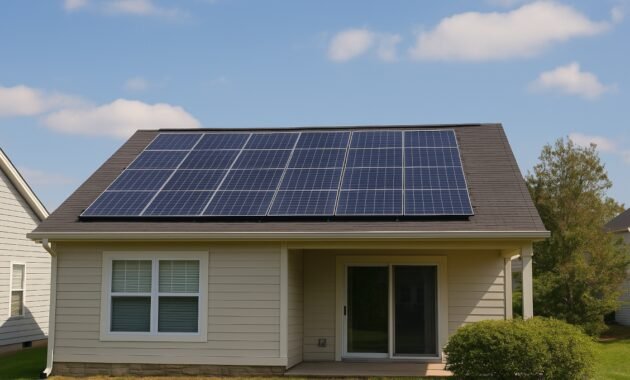
Ontario – 2026 update
HRS rebate up to $10,000
Net metering vs rebate
Residential Solar Panels in Ontario: Is It Worth It in 2026?
Ontario is not Arizona, but it gets about 1,900 to 2,100 hours of sunshine a year – plenty to run a home and cut your hydro bill. The bigger news for 2026 is that the incentive map has completely changed: the old federal $5,000 Greener Homes Grant is gone, and Ontario’s own Home Renovation Savings Program now puts up to $10,000 back on solar and a battery. But there is a catch that decides your whole payback – you have to choose between the rebate and net metering. Here is the clear-eyed, current version of whether solar is worth it, what it costs, and how to get the money.
12026 costs + payback
2HRS rebate vs net metering
3PV vs thermal
4Sizing your system
What changed for 2026 (read this first)
If you read a solar article written before 2025, its incentive advice is probably out of date. Here is the current, verified picture for Ontario homeowners:
The federal grant is gone. The Canada Greener Homes Grant closed to new applicants in early 2024, and final reimbursements ended December 31, 2025. The interest-free Greener Homes Loan closed in October 2025. Do not budget around the old “$5,000 federal grant” – it no longer exists for new projects.
Ontario’s Home Renovation Savings Program (HRS) is now the headline. It offers up to $10,000 in stackable rebates on solar – roughly $5,000 toward rooftop solar PV and $5,000 toward battery storage. You must get pre-approved before installation begins; retroactive applications are not accepted. See the details in our Home Renovation Savings Program guide.
One more correction: the federal Clean Technology Investment Tax Credit (30%) that some articles mention is for taxable corporations and REITs only – individual homeowners cannot claim it. For a home, your real levers are the HRS rebate and net metering, described below.
The decision that sets your payback: rebate vs net metering
This is the single most important 2026 choice, and it trips people up. In Ontario you generally pick one path, not both:
Path A
HRS rebate + load displacement
Take the up-to-$10,000 HRS rebate on solar and a battery. The rebated system is set up for load displacement (and pairs well with a battery on the ultra-low-overnight electricity rate). A rebated solar PV system is not allowed to participate in net metering.
- Big upfront rebate
- Battery adds resilience + overnight arbitrage
- Often the higher 25-year return for most homes
Path B
Net metering (no HRS rebate)
Skip the rebate and enrol in net metering under Ontario Regulation 541/05: every kWh you export earns a 1:1 credit at the full retail electricity rate, and you can build a larger system (up to a 12 kW AC cap, raised from 10 kW in 2024).
- 1:1 retail-rate export credits
- Allows a bigger system
- Credits offset the electricity charge only, not delivery/regulatory/HST, and reset after 12 months
The rule of thumb for 2026: for most Ontario homes, the HRS rebate plus load displacement (plus a battery on the ultra-low overnight rate) produces a higher 25-year return than net metering alone – even though net metering lets you build a bigger system. But it depends on your usage pattern, so get both numbers modelled before you sign. And remember: the rebate needs pre-approval before you install.
PV vs thermal solar – what is the difference?
Most people mean photovoltaic (PV) when they say “solar panels,” but thermal solar is a different tool. Some homes benefit from both.
Electricity
Photovoltaic (PV)
Converts sunlight directly into electricity to power anything in the home, works (at reduced output) on cloudy days, has no moving parts, and typically lasts 25 to 30 years. A typical Ontario home system is 5 to 12 kW. This is what the HRS rebate and net metering apply to.
Heat
Thermal solar
Captures the sun’s heat with fluid-filled collectors, mainly to heat domestic hot water, a hydronic heating loop, or a pool. It is efficient even in cold, sunny weather and costs less upfront – a residential hot-water system runs roughly $7,000 to $12,000 installed. It cuts gas or propane, not electricity.
Quick pick: choose PV if you want to cut electricity bills, heat with electricity, or plan to add a battery or EV. Choose thermal if you use a lot of hot water or heat with a hydronic system and want to cut gas/propane. Consider both only if you have the roof space, the demand, and the budget for a phased install.
What solar costs in Ontario (2026)
Installed PV runs about $2.42 to $3.50 per watt in 2026. Here is the range for common system sizes, before and after the HRS solar rebate.
| System size | Before incentives | After HRS solar rebate | Rough annual production |
|---|---|---|---|
| 5 kW | $12,000 – $17,500 | $7,000 – $12,500 | ~5,500 – 6,500 kWh |
| 7.5 kW | $18,000 – $26,000 | $13,000 – $21,000 | ~8,500 – 9,500 kWh |
| 10 kW | $24,000 – $35,000 | $19,000 – $30,000 | ~11,000 – 13,000 kWh |
A battery adds cost but qualifies for its own up-to-$5,000 HRS rebate and enables overnight arbitrage on the ultra-low overnight rate. Add roughly $10,000 to $18,000 for a home battery before that rebate.
Payback
Payback in Ontario now typically lands in the 7 to 12 year range, depending on the path: roughly 8 to 9 years with the HRS rebate plus a battery, and closer to 12 to 13 years on net metering alone. Panels last 25 to 30 years with matching warranties, so after payback you are effectively generating low-cost electricity for another decade or more, while hydro rates keep climbing. Solar also tends to add a few percent to home value.
How many panels do you need?
The average Ontario household uses about 9,500 kWh of electricity a year, but it varies a lot with house size, heating source, occupants, and habits. Pull your last 12 hydro bills for your real annual total, then size from there. A simple planning method:
- Take your annual use (say 9,500 kWh) and divide by about 0.80 to allow for system losses, giving roughly 11,900 kWh to generate.
- Divide by Ontario’s usable sun equivalent (about 1,150 kWh per kW of panels per year) – that points to roughly an 10 to 11 kW system.
- At 400 W panels, that is about 25 to 28 panels; each panel needs about 17 to 20 sq ft, so plan on roughly 450 to 550 sq ft of good roof (about a two-car-garage footprint).
Real-world sizing: a small efficient home often needs 15 to 20 panels (6 to 8 kW), an average single-family home 20 to 30 (8 to 12 kW), and a large or electrically-heated home 30 to 40+ (12 kW and up). Many homeowners deliberately offset only 50 to 75% of usage to fit the roof and maximize return. Note the net-metering cap is 12 kW AC, which limits the largest systems.
The ideal roof faces south (southeast or southwest is fine), sits at a 30 to 45 degree pitch, and is shade-free from about 9 a.m. to 3 p.m. Micro-inverters and modern panels make east/west roofs workable at somewhat reduced output.
Do These First, or the Panels Pay for the Leak
We have put solar on houses since the days when the province paid 80 cents a kilowatt-hour for it. Those days are gone and the panels are a third of the price, but one thing has not changed: a kilowatt-hour you do not use is cheaper than any kilowatt-hour you make. Solar on a leaky house with an oversized furnace is a very sunny way of paying for the leak.
The order I give people:
- Air sealing and insulation. The attic plane, the basement rim and the penetrations first. What air sealing costs and why you seal and insulate before you buy equipment.
- The heating system, sized from a real heat loss. A cold-climate heat pump turns one unit of electricity into two to three units of heat; the panels then feed that. Size it from a heat loss, not from the old furnace sticker.
- Lighting, appliances and the water heater. A heat pump water heater cuts hot-water energy by more than half; see tankless vs heat pump water heaters.
- Then size the solar to what is left. A tight ICF house with radiant floors on a heat pump and a modest array can get close to net zero without a roof full of panels.
Solar hot water: still worth it?
Solar thermal collectors heat water directly and do it well, 50 to 80 percent of a household’s hot water over a year, and on a radiant floor system the surplus can go into the slab in the shoulder seasons. We have installed evacuated tube systems that paid back in five to seven years when fuel was expensive. The catch in 2026 is that a heat pump water heater costs a third as much, needs no roof penetrations or glycol loop, and gets most of the saving. Solar thermal makes sense for big hot-water loads (large families, in-floor heat, a pool) and for people who want the technology. Solar water heating in southern Ontario has the details.
Roofs, permits and resale
- Put solar on a roof with 15 years of life left, or re-roof first; taking panels off to re-shingle costs thousands. See roofing.
- A roof-mounted array usually needs a building permit (structural load) and always an ESA electrical inspection. Your installer should pull both.
- Ground mounts cost more but let you choose the angle and skip the roof question; rural lots suit them.
- Buy outright or finance; avoid lease and power-purchase arrangements that complicate a resale.
- Orientation and shade decide more than brand. The installer’s production estimate should show kWh per year by month, and you should hold them to it.
- Prices move with panel supply and the dollar, so get three written quotes with the module and inverter named. A price per watt well under the range is usually a smaller system or a thinner warranty.
So – is it worth it in 2026?
For the right home, yes. Solar makes strong sense if your annual hydro bills top about $1,200, you have suitable south-facing roof space with good exposure, you plan to stay 7 to 10+ years, and you are willing to work through the HRS pre-approval or the net-metering setup. It makes less sense if your roof needs replacing within five years, you have heavy unavoidable shade, you are moving soon, or your electricity use is already very low.
Good fit
Solar likely pays off if
- Hydro bills over ~$1,200/year
- Good south-facing, unshaded roof
- Staying 7+ years
- Roof in good shape (no reroof due soon)
Reconsider
Think twice if
- Roof needs replacing within 5 years
- Heavy tree or building shade you cannot remove
- Moving within 5 years
- Already very low electricity use
Practical notes for Ontario: grid-tied systems need an ESA (Electrical Safety Authority) permit and a licensed installer, utility connection can take weeks so build slack into your timeline, winter output drops with short days and snow, and the microFIT program that used to pay a premium for exports ended years ago – net metering replaced it.
Building new? The cheapest solar is a low-energy house.
Talk to a builder
We build custom ICF homes across Simcoe County and Georgian Bay with tight, high-performance envelopes that shrink the heating and cooling loads – so a smaller, cheaper solar array does more. Tell us about your build and we will help you plan the roof, the electrical, and the solar-ready details. No charge to ask.
Residential solar in Ontario: frequently asked questions
Is there still a $5,000 solar rebate in Canada in 2026?
Not the federal one. The Canada Greener Homes Grant, which offered up to $5,000, closed to new applicants in early 2024 and finished paying out at the end of 2025, and the Greener Homes Loan closed in October 2025. In Ontario, the current equivalent is the provincial Home Renovation Savings Program, which offers up to about $5,000 toward rooftop solar PV plus another $5,000 toward battery storage. It requires pre-approval before you install.
Should I take the HRS rebate or use net metering?
You generally have to choose one. The HRS solar rebate is for a load-displacement system and a rebated system cannot participate in net metering. Net metering (no rebate) gives you 1:1 retail-rate credits for exported power and allows a larger system, up to a 12 kW AC cap. For most Ontario homes in 2026, the HRS rebate plus a battery on the ultra-low overnight rate delivers a higher 25-year return than net metering alone, but it depends on your usage, so have both modelled before you commit.
How much do solar panels cost in Ontario in 2026?
Installed PV runs about $2.42 to $3.50 per watt. A 5 kW system is roughly $12,000 to $17,500 before incentives, a 7.5 kW system about $18,000 to $26,000, and a 10 kW system about $24,000 to $35,000. The HRS solar rebate can knock up to $5,000 off, and a battery qualifies for its own up-to-$5,000 rebate. Costs vary with roof complexity, panel and inverter choice, and installer.
What is the payback period for solar in Ontario?
Typically 7 to 12 years in 2026: roughly 8 to 9 years with the HRS rebate plus a battery, and closer to 12 to 13 years on net metering alone. Panels last 25 to 30 years, so after payback you get many more years of low-cost power while grid rates keep rising. Rising electricity prices and the rebate both shorten the payback compared with a few years ago.
How does net metering work in Ontario?
Under Ontario Regulation 541/05, every kWh your system exports to the grid earns a 1:1 credit at the full retail electricity rate, applied against the electricity you draw. The credit offsets the electricity commodity charge only – not delivery, regulatory charges, or HST – and unused credits reset after 12 months. The maximum system size is 12 kW AC, raised from 10 kW in 2024. A net-metered system cannot also take the HRS solar rebate.
How many solar panels do I need for my home?
It depends on your annual usage. As a guide, a small efficient home needs about 15 to 20 panels (6 to 8 kW), an average single-family home 20 to 30 (8 to 12 kW), and a large or electrically-heated home 30 to 40 or more. Pull your last 12 hydro bills for your real total, divide by about 0.80 for losses, then by roughly 1,150 kWh per kW to size the system. Each 400 W panel needs about 17 to 20 sq ft of roof.
Do solar panels work in Ontario winters?
Yes, though output drops in winter from shorter days and snow cover, and snow usually slides or melts off tilted panels. Cold, clear days are actually efficient for the panels themselves. Ontario systems are sized against annual production, so strong spring, summer, and fall output offsets the lean winter months. Sizing to offset 100% of annual use accounts for the seasonal swing.
Do I need a permit for home solar in Ontario?
Yes. Grid-tied residential solar requires an Electrical Safety Authority (ESA) permit and must be installed by a licensed contractor and connected through your local utility. A reputable installer handles the permit, inspection, and utility connection paperwork, and the utility connection step can take several weeks, so plan your timeline accordingly.
Disclaimer: costs, rebate amounts, and program rules are 2026 figures that change frequently and depend on your specific home and utility. This article is general information, not financial or engineering advice. Always confirm current program terms with the Home Renovation Savings Program, your local utility, and a qualified licensed solar installer before you commit.
Related guides
NEW: What a heat pump really costs, and whether it beats gas for you
Cold-climate ducted units, mini-splits and dual fuel priced for Ontario in October 2026, why quotes for the same job are thousands of dollars apart, and a calculator that runs your own bills and hydro rate.
Heat pump cost in Ontario · Heat pump vs gas calculator · Heat pump rebates by heating fuel
More on heating and efficiency
Sources and further reading
Reviewed and updated October 2026. Costs on this site are Ontario ranges, not quotes; code references are to the Ontario Building Code in force at the date above.
Latest posts
Fresh guides, calculators & real-world advice
More from BuildersOntario – scroll to explore.
Loading latest posts…
Tip: shift + mousewheel works great

You need to update this article – the Greener Homes Grant has not been available for over a year!