Ontario's Plain-English Guide to Custom Home Building📞 705-533-1633 | ☎️ 1-866-868-6606 | ✉️ info@icfhome.ca
How to Verify an Ontario Contractor Before Signing
Before you sign
Ontario contractor verification
New homes + renovations
How to Verify an Ontario Contractor Before Signing the Contract
A website, wrapped truck and polished quotation do not prove that the company is licensed for the work, properly insured, financially stable or using the same legal entity that will receive your money. Verify the company, the people behind it and the project documents before paying a deposit.
12Verification steps
2Different paths: new home or renovation
3Names to search: company, trade name and operator
1Rule: verify independently
Do not ask the contractor to “send proof” and stop there.
A certificate, licence number or company name can be expired, altered, borrowed from a related business or issued to a different legal entity. Compare it against the official source and the name on the contract.
Verify the contractor and then verify the contract
A legitimate company can still offer an incomplete or one-sided agreement.
Free Contract Scan
Free
A quick first look at the documents you upload.
- Your top 1–2 red flags
- The exact questions to ask
- Delivered by email
Full Contract Review
$99.99
A complete builder-reviewed report, not an unedited AI answer.
- Clause-by-clause analysis
- 10-category completeness score
- Company, scope and payment risks
- Questions ready to send
Ontario Lawyer Review
from $499.99
An independent Ontario construction lawyer reviews the legal issues.
- Separate lawyer-client retainer
- Legal opinion on flagged clauses
- Wording and negotiation advice
- Billed directly by the lawyer
The Free Scan and Full Review assess construction completeness and commercial risk. They are not background investigations, credit reports or legal advice.
Start with the correct verification path
New home or contract home
Ontario builders and vendors of new homes must be licensed by the Home Construction Regulatory Authority.
- Search the Ontario Builder Directory.
- Confirm the exact legal entity and licence status.
- Review related companies, directors, officers and regulatory activity.
- Confirm the specific home’s Tarion warranty status or enrolment process.
Renovation, addition or repair
Ontario does not use one general province-wide contractor licence for every renovation company.
- Check the legal business and operating name.
- Confirm municipal and trade licences where required.
- Verify insurance, WSIB status and references.
- Search consumer, court and insolvency records using the company and operator names.
Do not reject a renovation contractor merely because it is not in the HCRA directory. HCRA licensing is the new-home licensing system. Ordinary renovation contractors still need the licences, registrations and qualifications that apply to their actual work.
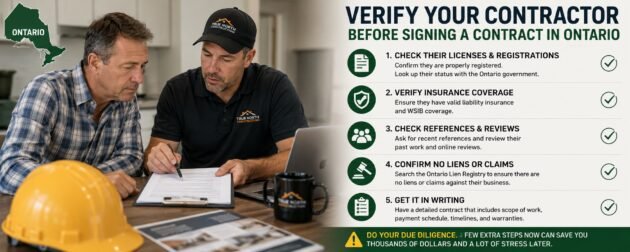
The 12-step Ontario contractor verification process
1
Identify the exact legal company
Start hereCompare: quotation, contract, invoice, insurance certificate, HST number, website footer, e-transfer recipient and cheque payee. They should not casually switch between different corporations or individuals.
Warning: “Smith Homes” is only a brand. The contract must identify the actual person, corporation or partnership responsible.
2
Search the Ontario Business Registry
Free basic searchConfirm: that the legal name exists and obtain available basic public information. For higher-risk projects, order an appropriate profile report or certificate of status.
Search all variants: legal name, numbered company, operating name and any corporation named on the deposit instructions.
3
For a new home, search the Ontario Builder Directory
Mandatory checkReview: licence status, expiry, licence conditions, years active, homes built, principals, directors, officers, related companies, properties, notices, orders, discipline, court charges or convictions and Tarion warranty metrics.
Stop: The company is not listed, is not licensed, is expired, is refused or the contract uses a different entity from the licensed company.
4
Check related companies and the people behind them
Do not skipSearch: the names of principals, directors and officers—not only the current company. HCRA related-company pages show businesses sharing common leadership.
Look for a pattern: repeated short-lived companies, expired licences, insolvency notices or the same operator using a new company after prior problems.
5
Confirm Tarion status for the actual home
Project-specificConfirm: whether the home is eligible, who will enrol it, the HomeID or registration process, deposit protection, the applicable Warranty Information Sheet and whether the address appears in the directory when it should.
Stop: The builder says Tarion is optional for an eligible new home or asks the homeowner to pose as an owner-builder to avoid licensing and warranty obligations.
6
Verify WSIB clearance or a valid exemption
Project-specificFor construction work: a principal generally must obtain a valid clearance before work begins and keep it current. A limited exception applies where an occupying householder directly hires a contractor for exempt work on an existing private residence.
Ask: If the homeowner exemption applies, who obtains clearances from subcontractors? The contractor becomes the principal when it hires subs.
7
Verify liability and construction insurance
Project-specificRequest: current commercial general liability certificate showing the correct legal company, policy dates, limits, broker and insurer. Ask who carries course-of-construction or builder’s-risk coverage and how the owner, lender and contractors are protected.
Do not rely on: a screenshot, expired certificate or policy issued to a related company. Ask the broker or insurer listed on the certificate to confirm status, with the insured’s authorization where required.
8
Check Consumer Beware and enforcement information
Search both namesSearch: the legal company, operating name and business operator. Ontario recommends searching the Consumer Beware List and recent consumer-protection charges and convictions.
Interpret carefully: Absence from the list is not a government endorsement. The list covers specified recent consumer-protection matters, not every complaint or dispute.
9
Search court and insolvency records
Higher-risk projectsSearch: the exact legal company and principal names. Ontario provides online court-case search routes, while the federal Office of the Superintendent of Bankruptcy provides bankruptcy, proposal and CCAA records.
Do not overread the result: A lawsuit or lien allegation does not prove wrongdoing, and no search captures every dispute. Have a lawyer interpret relevant records.
10
Verify recent and older references
Speak directlyAsk for: projects similar in type, size, location and completion stage. Ontario recommends both recent and older references because some defects do not appear immediately.
Verify authenticity: Speak to the owner, confirm the address and project type, and ask permission before viewing private documents or visiting.
11
Inspect completed work and project administration
Beyond photographsLook for: workmanship, water management, exterior details, mechanical organization, deficiency completion and document quality. Ask how the builder handled changes, delays, invoices and warranty calls.
Photographs are not verification: Confirm the contractor actually performed the claimed scope and did not merely supply one trade or use another builder’s project.
12
Compare the verification results with the contract
Final checkMatch: legal company, licence, insurance, payment recipient, warranty obligations, subcontracting structure, project address and scope. Add representations that matter to the signed agreement.
Stop: The builder passes the background checks but refuses a detailed written contract, objective payment milestones or statutory holdback.
A clean company search does not make a weak contract safe.
Upload My Documents
Upload the contract, quotation, allowance schedule and payment terms. The Free Scan identifies the biggest issue; the Full Review is $99.99.
Questions to ask every reference
Was the final price close to the signed price?Ask what changed it: owner choices, allowances, site conditions, omissions or builder increases.
Were change orders priced before work?Ask whether credits, markups and schedule effects were explained.
Did invoices match completed work?Ask whether payments ran ahead of construction or lender advances.
Were subcontractors paid?Ask about lien notices, supplier calls and payment disputes without requesting confidential details.
How accurate was the schedule?Ask about written updates, unexplained stoppages and delay notices.
Who supervised the site?Confirm whether the person selling the project remained involved.
How were deficiencies handled?Ask how quickly the builder responded and whether repeated calls were required.
Did problems appear after a winter?Ask about water, grading, heating, drafts, cracking and exterior work.
Were documents complete?Ask about drawings, permits, warranties, manuals, inspection reports and closeout.
Would you hire the same legal company again?Ask why—not merely yes or no.
References supplied by the contractor are selected references. They are useful, but they do not replace official searches, document verification or independent inspection.
Financial and operating warning signs
!
Large unexplained depositThe contractor cannot connect the money to mobilization, design, permits or identified long-lead materials.
!
Payment to a person or different companyThe payee does not match the legal contracting party.
!
Urgent advance requestsThe builder repeatedly needs money before the contractual milestone.
!
Deeply underpriced bidThe quote is substantially below comparable bids without a clear scope explanation.
!
Supplier account problemsTrades ask the owner for payment, materials are held back or deliveries require owner credit cards.
!
Frequent entity changesThe company name, directors, payee or licence changes during negotiation.
!
Unavailable recordsThe builder cannot provide current insurance, WSIB status, permit responsibility or project references.
!
Pressure to bypass protectionsThe owner is asked to avoid permits, Tarion, holdback, HST invoices or written changes to “save money.”
None of these alone proves insolvency or dishonesty. Several together justify stopping the signing process and obtaining independent advice.
What each search proves—and what it does not
| Source | What it can confirm | What it cannot prove |
|---|---|---|
| Ontario Builder Directory | New-home licence status, related companies, activity, regulatory actions and Tarion warranty information shown in the profile. | That every future project will be well managed or dispute-free. |
| Ontario Business Registry | Basic public business information and paid search products such as profile reports or certificates of status. | Financial strength, workmanship or that the company has no undisclosed liabilities. |
| WSIB clearance | That the named business is in good standing for WSIB clearance purposes during the clearance period. | Insurance against defective work or proof of every subcontractor’s status. |
| Insurance certificate | Evidence of stated coverage for the named insured and policy period, subject to confirmation and policy terms. | The complete policy, every exclusion or automatic coverage for the owner’s project. |
| Consumer Beware List | Specified recent consumer-protection charges, convictions, compliance notices or unresolved complaint-response issues. | Every complaint, lawsuit, workmanship problem or private settlement. |
| Court search | Available case information through the applicable Ontario portal. | That an allegation is true, the final result in every matter or all disputes involving the company. |
| Insolvency search | Bankruptcy, proposal and included CCAA filing records under the federal systems. | Current cash flow or whether a company will become insolvent later. |
| References and site visits | How selected clients describe communication, price, schedule, quality and warranty response. | An unbiased sample of all projects or hidden technical conditions. |
Copy-and-send verification request
Send this before paying a deposit. Ask the contractor to answer using the same legal company that will sign the agreement.
1. Confirm your full legal company name, operating name, address and HST number.
2. Identify the person authorized to sign the contract.
3. Provide your HCRA licence number and Tarion process where this is a new home.
4. Provide current commercial liability insurance evidence.
5. Explain who carries course-of-construction insurance.
6. Provide a current WSIB clearance or explain the applicable exemption.
7. List municipal or trade licences required for your scope.
8. Provide three recent and three older comparable references.
9. Identify the site supervisor and major subcontracted scopes.
10. Confirm the account name that will receive deposits and progress payments.
11. Provide your standard change-order and payment documents.
12. Confirm that all representations above will form part of the signed agreement.
Contract Centre and related guides
Contractor verification FAQ
Does every Ontario contractor need an HCRA licence?
No. HCRA licences builders and vendors of new homes. Renovation and repair contractors may instead be subject to municipal, trade, business, safety and consumer requirements applicable to their work.
What if the builder’s HCRA licence says “licensed with conditions”?
Read the conditions and related notices rather than treating the status as automatically acceptable or unacceptable. Contact HCRA when the effect on the proposed project is unclear.
Does an active licence guarantee good workmanship?
No. Licensing is an important threshold check, not a guarantee of price, schedule, quality, solvency or future performance.
Do homeowners always need a WSIB clearance?
No. A limited exemption applies when an occupying householder directly hires a contractor for exempt work on an existing private residence. Other construction arrangements and subcontracting relationships may still require clearances.
Can I verify a contractor using online reviews?
Use reviews only as one input. Confirm the reviewer’s project where possible and rely more heavily on official records, direct references, documents and site visits.
Should I search for construction liens against the contractor?
Liens normally attach to specific improved properties and must be interpreted in context. Search relevant court records and have your lawyer conduct project-specific title searches rather than treating an allegation or lien as proof of misconduct.
Is a certificate of insurance enough?
It is evidence, not the entire policy. Confirm the named insured, dates, limits and project insurance responsibilities and ask the broker or insurer to verify status where appropriate.
What is the biggest warning sign?
The legal company, licence, insurance, payee and contract do not match—or the contractor pressures you to pay before those inconsistencies are resolved.
The company you researched must be the company that signs and receives the money
After verification, upload the contract, quotation, allowances, exclusions and payment schedule. Start with the Free Scan. The complete builder-reviewed Full Report is $99.99, and an independent Ontario construction lawyer can review legal issues from $499.99.
Upload My Contract for the Free ScanPlanning a custom ICF home in Simcoe County or Georgian Bay?
ICFhome can review the plans, prepare a realistic ballpark range and discuss the company credentials, insurance, contract documents and construction process before the project begins.
Reviewed July 29, 2026. General educational information only. Search results can be incomplete, delayed or misunderstood. This page is not a background investigation, credit report, legal opinion, insurance confirmation or guarantee of contractor performance.
More on builders and contracts
Reviewed and updated October 2026. Costs on this site are Ontario ranges, not quotes; code references are to the Ontario Building Code in force at the date above.