Ontario's Plain-English Guide to Custom Home Building📞 705-533-1633 | ☎️ 1-866-868-6606 | ✉️ info@icfhome.ca

What Should a Good Construction Contract Include?
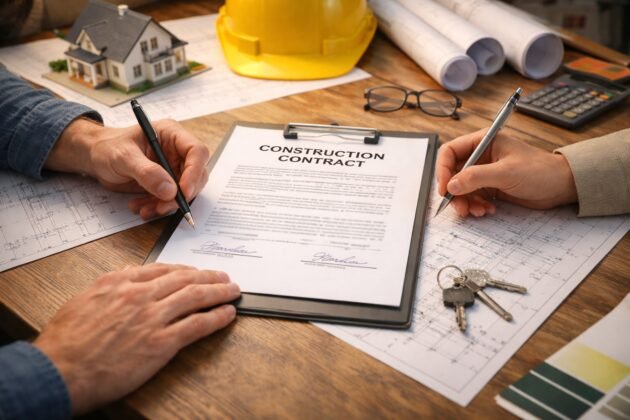
What Should a Good Construction Contract Include? The Ontario Homeowner Checklist (So Nothing “Magically Appears” Later)
A solid construction contract isn’t there because you don’t trust your builder. It’s there because memory is terrible, projects evolve, and vague scope is how budgets get ambushed.
Below is a practical, Ontario-specific checklist for what a good construction contract should include—whether you’re building a custom home, doing an addition, or tackling a major renovation.
- Scope + drawings
- Allowances + selections
- Change orders
- Payments + holdback basics
- Schedule + delays
- Warranty + dispute plan
Already have a contract in front of you?
Do not stop at the checklist. Upload the actual contract, quotation, drawings and schedules before you sign.
Free Contract Scan
Free
A quick first look at the documents you upload.
- Your top 1–2 red flags
- The exact questions to ask
- Delivered by email
Full Contract Review
$99.99
A complete builder-reviewed report—not a raw AI answer.
- Clause-by-clause analysis
- 10-category completeness score
- Scope, allowances and payment risks
- Questions ready to send
Ontario Lawyer Review
from $499.99
An independent Ontario construction lawyer reviews the legal issues.
- Legal opinion on flagged clauses
- Arranged after the Full Review
- Billed directly by the lawyer
The Free Scan and Full Review examine construction completeness and commercial risk. They are not legal advice.
Important note: This is practical construction information, not legal advice. Review the contract together with the quotation, drawings, specifications, allowances, payment schedule and every attached schedule. Start at the Ontario Construction Contract Centre, or upload the actual documents to the Ontario Construction Contract Checker.
1) The “who, what and where” basics
The contract should clearly identify the people, company and property involved. It should state:
- Every owner’s legal name, not only the person managing the project.
- The contractor’s complete legal name, business address and authorized signer.
- The project address and legal description where useful, particularly for rural or newly severed land.
- The type of project: custom home, addition, renovation, foundation, construction management or defined trade package.
- The people authorized to approve selections, costs, changes and schedule extensions.
Compare the legal name in the agreement with the quotation, insurance certificate, invoices and the account receiving payment. For a new home, confirm the builder through the HCRA Ontario Builder Directory. A builder constructing a custom or contract home on land owned by the homeowner must hold the appropriate builder and vendor licences.
2) Scope of work: describe the house or renovation being purchased
The scope is the heart of the agreement. “Build according to plans” or “complete the renovation” is rarely enough. Plans do not normally identify every temporary service, finish, responsibility, exclusion or construction procedure.
1
List every contract document by title, date and revision: drawings, specifications, quotation and schedules.
2
Describe what is included, stage by stage and system by system.
3
Describe what is excluded, including important site, permit, utility and finishing costs.
4
Identify who supplies what, including owner-supplied products and separately hired trades.
5
Add an order-of-precedence clause saying which document controls if the plans, specifications and quotation conflict.
Compare your agreement with what is typically included and excluded in a builder’s estimate.
Planned detailed guide: Construction Scope of Work (page not published yet).
3) Contract price: fixed price, cost-plus or hybrid
The contract should explain how the price is calculated, not merely display a total. Each pricing model needs different protections:
| Type | What it means | What must be clear |
|---|---|---|
| Fixed price | One price for a defined scope | Scope, exclusions, allowances, escalation rights and every event that permits the price to change. |
| Cost-plus | Reimbursable costs plus a fee | What counts as cost, labour and equipment rates, invoice support, reporting, markup and any maximum price. |
| Hybrid | Some fixed and some variable work | Which portions use each method and how movement between categories is approved. |
A contract described as fixed price can still permit increases for owner changes, allowance differences, concealed conditions, escalation clauses or other defined events. Read the entire agreement.
It should also state whether HST is included or additional and identify builder fees, overhead, profit, delivery, equipment, travel, permit charges and markups.
Planned detailed guides: Fixed Price vs. Cost-Plus and Construction Price Escalation Clauses (pages not published yet).
4) Allowances and selections: where the budget often changes
Allowances are placeholders for products or work not fully selected or priced when the agreement is signed. Each allowance should state:
- The exact category and dollar amount.
- Whether the allowance covers supply only or supply and installation.
- Whether it includes HST, delivery, waste, accessories and builder markup.
- How overages and unused amounts are calculated.
- The selection deadline and the effect of a late selection on cost and schedule.
Reality check: a $25,000 “kitchen allowance” is meaningless until the contract says whether it covers cabinets only or also design, delivery, installation, hardware, counters, HST and markup.
Read Understanding Builder Allowances, What Is an Allowance and Why Do Builders Use Them?, and The Real Cost of Upgrades. The two allowance articles should eventually be combined into one definitive spoke.
5) Change orders: define exactly how changes happen
Every custom project changes. The contract should say who may request and authorize a change, what information the change document contains and how it affects price and schedule.
- Description: what is being added, removed or revised.
- Price: a fixed amount or a clearly defined pricing method.
- Markup and credits: how overhead, profit and deleted work are handled.
- Schedule: additional days, lead time or sequencing consequences.
- Approval: the owner and contractor representatives authorized to sign.
Ontario’s guidance for renovation businesses says proposed scope changes should be documented and communicated in writing, including their effect on price, scheduling and completion dates, and the changed agreement should be signed.
Practical rule: obtain written approval before changed work starts whenever possible. Do not assume an unsigned change can never matter; emails, texts, conduct and urgent site instructions can create expensive disputes.
Planned detailed guides: Construction Change Orders and Verbal, Email and Text Change Orders (pages not published yet).
6) Deposits, progress payments, holdback and liens
The payment section should state:
- The deposit amount, what it pays for and whether any portion becomes non-refundable.
- Progress milestones, invoice requirements and supporting documents.
- Inspection or lender conditions required before a draw is due.
- Payment deadlines, interest and a process for disputed amounts.
- Ontario statutory holdback, including how it is calculated, shown and released.
Ontario consumer guidance recommends keeping a renovation deposit to 10% and paying the balance in stages or on completion. That recommendation is not a universal legal maximum for every custom-home contract.
If a home renovation or repair contract worth $50 or more is signed in the consumer’s home, Ontario says the consumer generally has a 10-calendar-day cooling-off period. Read Ontario’s official renovation guidance.
Ontario’s Construction Act requires a basic holdback equal to 10% of the price of services or materials as they are actually supplied. Mandatory annual holdback-release procedures took effect January 1, 2026, subject to notice, lien and transitional rules. Read the current Construction Act.
Use the Home Construction Loan Draw Schedule, Construction Lien in Ontario homeowner guide, Construction Act 2026 update, and the older Construction Lien Act article that should later be consolidated.
Planned detailed guides: Construction Deposits in Ontario, Ontario Construction Holdback, Can a Subcontractor Lien My Home?, and Final Payment and Deficiencies (pages not published yet).
Does your payment section actually say all of this?
Upload My Contract
The Free Scan identifies the most important gaps in the contract you upload. The complete builder-reviewed report is $99.99.
7) Schedule and delays: define how time is measured
A useful contract separates a proposed start date from the conditions required before construction begins. These may include:
- permit issuance and required approvals;
- financing and lender conditions;
- deposit and insurance documents;
- owner selections and design information;
- site access, utilities and temporary services.
The agreement should define milestone dates, the target completion stage, legitimate delay events, written-notice requirements and whether a delay creates only extra time or also extra cost.
It should also address owner-caused delays, late selections, remobilization, storage, weather, strikes, utility delays, inspections and unavailable products.
Planned detailed guides: Construction Delay Clauses and What Does Substantial Completion Mean? (pages not published yet).
8) Permits, inspections and required corrections
The agreement should say:
- Who prepares and revises the permit documents.
- Who submits the application and pays each fee.
- Who schedules inspections.
- Who corrects failed work.
- Who pays when the municipality requires a change because of contractor work, owner information, concealed conditions or a newly identified requirement.
Read How to Obtain a Building Permit in Ontario and Ontario’s official building permit guide.
9) Insurance, WSIB, site safety and property protection
A good contract identifies who carries each risk and what evidence is required:
- Commercial general liability insurance, policy limits and renewal.
- Course-of-construction or builder’s-risk insurance, including who buys it and who pays the deductible.
- Damage to existing structures, neighbouring property, roads and landscaping.
- Theft, vandalism and stored materials.
- Site safety, owner access and separately hired trades.
Do not rely on “fully insured.” Ask for current evidence and understand what operations and parties the policy actually covers.
WSIB clearance obligations depend on the work. WSIB’s policy generally requires a principal directly retaining a contractor for construction work to obtain a clearance, but it contains an exemption for certain householder-retained home-renovation work on a private residence. Read the current WSIB clearance policy.
10) Warranties, deficiencies, occupancy and final payment
Even on a well-built project, deficiencies occur. The contract should distinguish:
- substantial performance under the Construction Act;
- substantial completion as defined by the contract;
- municipal occupancy approval;
- possession for Tarion purposes;
- final completion and correction of deficiencies.
State when the walkthrough occurs, how deficiencies are documented, how quickly the contractor must respond and which manuals, warranties, certificates and commissioning records must be delivered before final payment.
For an Ontario contract home, confirm that the builder is properly licensed and the home is enrolled where required. Tarion warns that if the landowner exercises significant construction control or supplies essential elements such as the foundation, framing, electrical, rough plumbing, HVAC or building envelope, the home may be considered owner-built and ineligible for statutory warranties. Read Tarion’s Contract Homes guidance.
Planned detailed guides: Construction Deficiencies and Warranty and Owner-Supplied Materials (pages not published yet).
11) Suspension, default, termination and disputes
A contract should include a clear process for problems before they become a complete breakdown:
- Written notice describing the alleged default.
- A reasonable opportunity to correct where appropriate.
- Rules for suspending work for non-payment, unsafe conditions or owner delay.
- Termination rights, including payment for completed work and materials.
- Project handover: permits, keys, drawings, records, warranties and site security.
- Dispute steps: meeting, mediation, adjudication, arbitration or court as applicable.
Important: do not cancel or terminate a substantial construction agreement based only on an online article. Obtain advice from an Ontario construction lawyer first.
Read What If the Builder Goes Out of Business Mid-Project?.
Planned detailed guides: Construction Contract Termination Clauses, Contractor Abandoned the Project, and Construction Contract Dispute Resolution (pages not published yet).
12) The clauses that prevent the largest surprise bills
When reviewing a contract, pay special attention to the clauses below. They usually determine whether the final cost remains understandable:
1
Excavation and site conditions: rock, groundwater, excess soil, imported granular, compaction and winter conditions.
2
Owner-supplied items: storage, compatibility, missing parts, warranty, installation and delays.
3
Allowances: supply versus installation, taxes, delivery, waste, accessories, overages and credits.
4
Change-order pricing: labour rates, material costs, equipment, markup, credits and schedule effects.
5
Product substitutions: owner approval, equivalency standards and credits for lower-cost products.
6
Exclusions: driveways, landscaping, utilities, permit fees, design, engineering, cleanup and seasonal work.
7
Final payment: occupancy, deficiencies, warranties, manuals, certificates and remaining seasonal work.
Planned detailed guides: Unknown Site Conditions, Product Substitution Clauses, and Final Payment and Deficiencies (pages not published yet).
Related pages in the Ontario Construction Contract Centre
1
Ontario Construction Contract Centre — main hub.
2
Ontario Construction Contract Checker — upload the actual agreement.
4
Construction Contract Red Flags — page not published yet.
5
Questions to Ask Before Signing — page not published yet.
6
Do I Need a Lawyer to Review the Contract? — page not published yet.
7
Verify a Builder or Contractor Before Signing — page not published yet.
FAQ: Construction contracts in plain English
QCan a one-page construction contract be enough?
For a very small and simple project, a short agreement with a detailed attached quotation may be enough. A custom home, addition or major renovation normally requires drawings, specifications and several schedules. Completeness matters more than page count.
QDoes “fixed price” mean the price can never change?
No. A fixed-price agreement can permit changes for owner requests, allowances, concealed conditions, escalation clauses and other defined events. Read the entire agreement and every schedule.
QMust every change order be signed before the work starts?
Written approval before work begins is the safest procedure whenever practical. However, emails, texts, conduct and urgent instructions can produce disputes about authorization. The contract should define the normal process and a separate process for emergency protective work.
QCan the owner keep the statutory 10% holdback until every deficiency is corrected?
Not simply because it is convenient. The statutory holdback is governed by the Construction Act and is not automatically a permanent warranty fund. Deficiency and final-payment provisions should be addressed separately and reviewed legally.
QDoes Tarion cover every custom home?
No. Coverage may depend on whether the project qualifies as a contract home rather than an owner-built home. Significant owner control or owner-supplied essential work can affect statutory warranty eligibility.
QShould an Ontario construction lawyer review the agreement?
For a custom home or major renovation, legal review is sensible. A builder can identify missing construction scope and impractical administration. A lawyer advises on legal rights, enforceability, liens, cancellation, default and termination.
Do not sign a vague construction contract
Start with the Free Contract Scan. Your top red flags and questions are emailed to you. The complete builder-reviewed Full Report is $99.99. Where a legal opinion is needed, an independent Ontario construction lawyer can review the flagged clauses from $499.99.
Reviewed July 29, 2026. This article is educational and general in nature, not legal, accounting, insurance or engineering advice. Ontario laws, Construction Act procedures, HCRA licensing, Tarion coverage and WSIB obligations depend on the project and can change. Have an Ontario construction lawyer review the actual agreement before signing, cancelling or terminating it.
More on builders and contracts
Reviewed and updated October 2026. Costs on this site are Ontario ranges, not quotes; code references are to the Ontario Building Code in force at the date above.
Latest posts
Fresh guides, calculators, and “don’t-do-that” tips
Scroll sideways to see more. Cards stay the same height (no messy uneven rows).
Loading latest posts…
Tip: shift + mousewheel works great