Ontario's Plain-English Guide to Custom Home Building📞 705-533-1633 | ☎️ 1-866-868-6606 | ✉️ info@icfhome.ca

Ontario Construction Act: Liens, Holdback and Prompt Payment
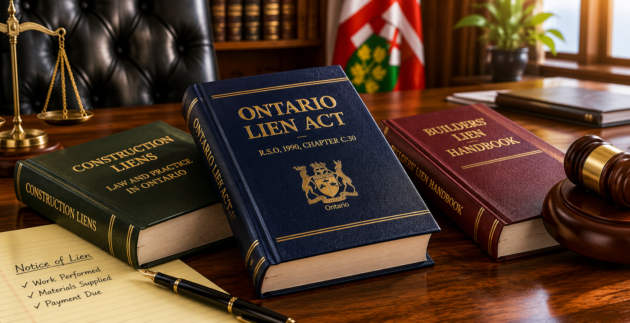
Ontario construction law
Liens + holdback + payment
Current January 1, 2026 regime
Ontario Construction Act: Liens, Holdback, Prompt Payment, Trust Funds and Adjudication
Many people still search for the “Construction Lien Act,” but Ontario’s current statute is the Construction Act. It covers much more than liens. It regulates statutory holdback, trust funds, proper invoices, prompt-payment deadlines and interim construction adjudication.
1Current name: Construction Act
2Lien preservation and perfection
310% statutory holdback
428-day prompt payment
5Interim adjudication
SEO and redirect decision:
This is the broad Construction Act overview. Publish it at /construction-act-ontario/. Redirect both older “Construction Lien Act” URLs to this clean page. Keep /construction-lien-in-ontario/ as the separate detailed lien-and-deadlines guide.
Legal warning: this article explains the framework but does not calculate a lien, holdback, prompt-payment or adjudication deadline. Transition rules, contract dates and statutory triggers matter. Contact an Ontario construction lawyer immediately when money, title or a deadline is involved.
The Act works through the contract, invoices and payment records
Upload the contract, payment schedule, quotation, invoices and change orders before a payment problem becomes a lien or adjudication.
Free Contract Scan
Free
A quick first look at the documents you upload.
- Your top 1–2 red flags
- The exact questions to ask
- Delivered by email
Full Contract Review
$99.99
A complete builder-reviewed report, not an unedited AI answer.
- Clause-by-clause analysis
- 10-category completeness score
- Payment, holdback and change risks
- Questions ready to send
Ontario Lawyer Review
from $499.99
An independent Ontario construction lawyer reviews the legal issues.
- Legal opinion on flagged clauses
- Arranged after the Full Review
- Billed directly by the lawyer
The Free Scan and Full Review assess construction completeness and commercial risk. They do not preserve a lien, issue a statutory notice or provide legal advice.
“Construction Lien Act” or “Construction Act”?
The current name is the Construction Act. Ontario’s reforms changed the statute’s name and modernized lien and holdback rules. Prompt-payment and adjudication provisions came into force on October 1, 2019. Further amendments came into force on January 1, 2026.
The older name remains a useful search phrase, but the page should not imply that a separate “Construction Lien Act 2025” remains in force.
LiensSecurity for qualifying unpaid services and materials
Holdback10% retained under Part IV
Prompt paymentProper invoice and payment deadlines
Trust fundsRestricted use of project money
AdjudicationFast interim-binding dispute process
Official sources: Ontario Construction Act, O. Reg. 304/18 and Ontario Dispute Adjudication for Construction Contracts.
Which rules apply to your contract?
Three sets of rules are in play, and the date of the main contract (owner and GC) — or when its procurement started — decides which one governs, even for a sub who signed later:
- Before July 1, 2018: the old Construction Lien Act — 45-day lien deadlines, no prompt payment, no adjudication.
- July 1, 2018 to December 31, 2025: the Construction Act — 60 days to preserve, 90 to perfect; prompt payment and adjudication for contracts procured from October 1, 2019.
- January 1, 2026 onward: the amended Act — mandatory annual holdback release, tighter proper-invoice rules, a 90-day adjudication window after completion, and lien and trust claims combined in one action.
Owed money under the Act? The trade’s side of each part, in plain English: prompt payment · trust claims against the directors · adjudication · registering a lien · start here if you’re not paid.
1. Construction liens
A person who supplies qualifying services or materials to an improvement may have a lien under the Act. The lien can operate as a charge against statutory holdback and certain unpaid contract amounts, and it may attach to an interest in the land.
60 daysModern general period to preserve after the applicable statutory trigger
90 daysGeneral perfection period after the last possible preservation date
Not an invoice clockThe triggering date can arise from several statutory events
Transition mattersOlder improvements may remain under an earlier regime
The deadline differs by claimant and can be affected by substantial performance, completion, abandonment, termination, last supply, subcontract certification and annual holdback-release notices.
Use the dedicated guide: Construction Lien in Ontario explains preservation, perfection, homeowner exposure, title problems and vacating a lien. It remains separate from this broad Act overview.
2. The 10% statutory holdback
Each payer under a contract or subcontract where a lien may arise must retain a basic holdback equal to 10% of the price of services or materials as they are actually supplied. The obligation applies whether the agreement uses progress payments or one payment at completion.
| Illustrative invoice | Basic holdback | Amount before other deductions | What still requires checking |
|---|---|---|---|
| $100,000 before HST | $10,000 | $90,000 | HST, deficiencies, prior payments, written lien notices and lender reserves |
The statutory holdback is not simply a permanent deficiency fund. Contract rights for incomplete or deficient work should be addressed separately.
3. Mandatory annual holdback release
Under the current regime, the owner must address accrued basic holdback after each anniversary of the date the contract was entered into.
Notice
Within 14 days after the anniversary
The owner publishes the prescribed notice of annual release of holdback, Form 6, stating the amount intended to be paid and the intended payment date.
Publication
Construction trade news website
O. Reg. 304/18 requires the notice to be published on a construction trade news website.
Owner payment
At least 60 and no later than 74 days
The owner pays the accrued holdback for the preceding year within the statutory window after publication, unless a preserved or perfected lien prevents release.
Downstream
Contractor and subcontractor payments follow
The Act establishes corresponding downstream holdback-payment deadlines.
Transition rules are technical. Contracts and project agreements already in progress when the new provisions came into force can be affected by section 87.4 and O. Reg. 384/25. Do not assume every pre-2026 contract follows an identical first-anniversary procedure.
4. Proper invoices and prompt payment
Where the prompt-payment provisions apply, a proper invoice starts the statutory payment process. The Act identifies required invoice information and permits contracts to require additional accounts-payable information within statutory limits.
7 daysFrom receipt to identify a deficient invoice in writing under the 2026 deeming rule
14 daysOwner’s deadline to give a prescribed notice of non-payment for a disputed proper invoice
28 daysOwner’s general deadline to pay the undisputed proper-invoice amount
7 daysGeneral contractor-to-subcontractor payment deadline after receiving corresponding payment
From January 1, 2026, an invoice that does not meet the proper-invoice requirements is deemed proper unless the owner identifies the deficiency and what is needed to correct it in writing within seven days after receipt.
The downstream rules are more detailed when the owner pays only part of the invoice or does not pay. Contractors and subcontractors may need prescribed notices and, in some circumstances, adjudication.
Contract clause to check: identify where proper invoices are delivered, who receives them, what additional information is required, whether invoices are monthly or milestone-based and who must issue a notice of non-payment.
Does the contract use the correct invoice and payment process?
Upload My Documents
Upload the contract and payment schedule. The Free Scan identifies the biggest problem; the complete builder-reviewed report is $99.99.
Owed money on a job? Get a builder on your side.
A builder’s handbook you can download right now, a review of your own paperwork, or a lawyer when it’s lawyer’s work. Written by an Ontario builder — not legal advice.
Instant download
The Ontario Lien Handbook
$29.99
File a lien yourself — or get one off your title.
- Step by step: your deadline, the parcel register, the amount, the claim for lien
- What you can do yourself and what needs a lawyer — so you pay for less of it
- Lien on your house or job? Your real exposure, a validity checklist and 8 ways out
- 6 letters, 4 worksheets and a numbers card to tape on the wall
Most complete
Builder Payment Review
$99.99
A builder goes through your own paperwork and tells you where you stand.
- The Ontario Lien Handbook included
- Your deadlines worked out from your own dates
- Every document rated line by line: what you can prove and what you can’t
- The excuse you were given, tested against what the Act requires of them
- The amount you can defend claiming — extras, holdback, interest
- Every route ranked by what it would net you, and a 14-day plan
- A two-page brief a lawyer can quote from in one call
Deadline close?
Talk to a construction lawyer
The lawyer bills you directly
When it’s lawyer’s work, go straight to a lawyer.
- Your lien deadline is inside two weeks
- A lien or claim has been registered against you
- You want to go after the directors personally
- We point you to an independent Ontario construction lawyer — and take no referral fee
✓ Written and checked by Harvey Juric, Ontario builder since 1979✓ Current to October 2026✓ Not a law firm — we tell you when you need one
5. Construction trust funds
The Act’s trust provisions are separate from lien rights. In general terms, certain amounts received or owing on account of an improvement are trust funds for the benefit of contractors, subcontractors and suppliers who remain unpaid.
Owner trust
Project funds cannot be used inconsistently
Amounts received by an owner for financing an improvement, subject to statutory deductions, can constitute a trust for the contractor.
Contractor trust
Money is held for unpaid downstream parties
Amounts owing to or received by contractors and subcontractors on account of the project can constitute trust funds.
Records
Accounting matters
Contractors and subcontractors have statutory recordkeeping duties relating to trust funds.
2026
Holdback amounts expressly included
The current provisions expressly address holdback amounts owed to or received by contractors and subcontractors.
A party can lose the lien remedy and still face or pursue a contract or trust claim. They are different legal routes with different proof and limitation issues.
6. Interim construction adjudication
Adjudication provides a faster, interim-binding process for eligible construction disputes. It is administered by ODACC, Ontario’s authorized nominating authority.
Disputes that may be referred can include:
- valuation of services or materials;
- payment under the contract or subcontract;
- approved, disputed or proposed change orders;
- notices of non-payment;
- set-off and holdback issues identified by the current Act;
- other matters agreed by the parties or prescribed.
Interim-binding does not mean meaningless. The decision binds the parties unless the matter is later determined by a court or arbitration, or resolved by written agreement. It can be enforced while the underlying project continues.
The January 1, 2026 regime includes current rules for registry adjudicators and private adjudicators under the Act and O. Reg. 264/25.
7. What an owner should have in the construction contract
- Complete scope, exclusions, allowances and contract-document list
- Proper-invoice delivery address and required information
- Payment dates aligned with lender draw timing
- Statutory holdback shown separately on invoices
- Annual holdback notice and administration responsibility
- Written change-order pricing and schedule procedure
- Evidence supporting each progress payment
- Trust, records and statutory-declaration requirements where appropriate
- Adjudication, court, arbitration and negotiation clauses that do not attempt to waive the Act
- Separate deficiency, set-off, final-payment and warranty provisions
See What Should a Good Construction Contract Include? and Home Construction Loan Draw Schedule.
Two existing books for planning the project before the money moves
Both downloads remain available at their current prices. Unsupported comparison values have been removed.
Run the process
The Ontario Building Permit Bible
Permits, documents, consultants and inspections.
$29.99one-time
A practical guide to the application order, complete-document requirements, municipal review and inspection preparation.
- Complete-application checklist
- Who to hire and in what order
- Permit-fee planning
- Inspection preparation
30-day money-back guarantee.
Get the Permit Bible — $29.99 →
Secure Stripe checkout · digital download
Budget the build
The Ontario Lot-Buying Bible
Plan the property, site costs and complete budget.
$29.99one-time
A 28-page guide covering buildability, site work, financing, HST, allowances and contingency.
- Site-cost planning worksheets
- Complete-project budget categories
- Buildable-lot checklist
- Go/no-go scorecard
30-day money-back guarantee.
Get the Lot Bible — $29.99 →
Secure Stripe checkout · digital download
Buying land and building on it? Get both.
Plan the property and budget, then work through the permit and inspection process.
$59.98 Both for $49.99
Get both Bibles →
Contract Centre and related guides
Ontario Construction Act FAQ
My contract is from 2017. Which rules apply?
If the contract or procurement started on or before June 30, 2018, the old Construction Lien Act: shorter lien deadlines, and no prompt payment or adjudication.
What is prompt payment?
Ontario's rules setting hard payment deadlines down the construction chain. They apply where the prime contract was made, or procurement began, on or after October 1, 2019.
Can my contract opt out of prompt payment?
No. The Act applies despite any agreement to the contrary, and contracts are deemed amended to comply.
What is construction adjudication?
A fast, mostly paper-based process run through ODACC. An adjudicator decides a payment dispute about 30 days after receiving the claimant's documents.
What is a construction trust?
Money a contractor or sub receives — or is owed — on account of its contract is held in trust for those who supplied to that job, until they're paid.
Not legal advice. This page is a plain-language overview. Always confirm the current statute, regulations, transitional rules and project-specific deadlines with an Ontario construction lawyer.
Check the payment clauses before the Act checks them for you
Upload the contract, payment schedule, invoices and change orders. Start with the Free Scan. The complete builder-reviewed report is $99.99, and an independent Ontario construction lawyer can review legal issues from $499.99.
Upload My Documents for the Free Scan
Planning a custom ICF home in Simcoe County or Georgian Bay?
ICFhome can review the plans, prepare a realistic ballpark range and build the complete high-performance home with clear scope and payment administration.
Ready to get paid? Pick the help that fits.
Start with the handbook — it walks you through filing a lien, or fighting one, step by step. Want a builder to go through your own paperwork? The Builder Payment Review comes back within two business days.
Instant download
The Ontario Lien Handbook
$29.99
File a lien yourself — or get one off your title.
- Step by step: your deadline, the parcel register, the amount, the claim for lien
- What you can do yourself and what needs a lawyer — so you pay for less of it
- Lien on your house or job? Your real exposure, a validity checklist and 8 ways out
- 6 letters, 4 worksheets and a numbers card to tape on the wall
Most complete
Builder Payment Review
$99.99
A builder goes through your own paperwork and tells you where you stand.
- The Ontario Lien Handbook included
- Your deadlines worked out from your own dates
- Every document rated line by line: what you can prove and what you can’t
- The excuse you were given, tested against what the Act requires of them
- The amount you can defend claiming — extras, holdback, interest
- Every route ranked by what it would net you, and a 14-day plan
- A two-page brief a lawyer can quote from in one call
Deadline close?
Talk to a construction lawyer
The lawyer bills you directly
When it’s lawyer’s work, go straight to a lawyer.
- Your lien deadline is inside two weeks
- A lien or claim has been registered against you
- You want to go after the directors personally
- We point you to an independent Ontario construction lawyer — and take no referral fee
✓ Written and checked by Harvey Juric, Ontario builder since 1979✓ Current to October 2026✓ Not a law firm — we tell you when you need one
Reviewed July 29, 2026. General educational information only. This page does not issue notices, calculate deadlines, preserve liens, commence adjudications or provide legal advice.
More on builder problems and liens
Reviewed and updated October 2026. Costs on this site are Ontario ranges, not quotes; code references are to the Ontario Building Code in force at the date above.
Latest posts
Fresh guides, calculators & real-world advice
More from BuildersOntario – scroll to explore.
Loading latest posts…
Tip: shift + mousewheel works great
