Ontario's Plain-English Guide to Custom Home Building📞 705-533-1633 | ☎️ 1-866-868-6606 | ✉️ info@icfhome.ca
Do You Need a Survey Before Buying a Lot in Ontario?
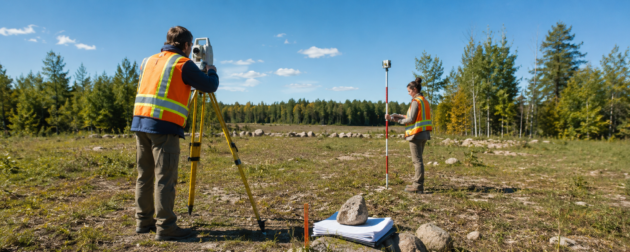
Land survey
Ontario 2026
Before you buy
Do You Need a Survey Before Buying a Lot in Ontario?
A listing shows you a pretty boundary on a map. It does not show you where the lines actually are on the ground, whether the neighbour’s fence sits three feet inside them, or whether a hidden easement clips the only spot you wanted the house. A current survey does. For a few hundred dollars – and a condition in your offer – you find out exactly what you’re buying before you own it, instead of discovering a boundary problem after closing when it’s expensive to fix. Here’s why a survey matters so much on vacant land, what it reveals, and how to use it – from 45 years building across Simcoe County and Georgian Bay.
Why a survey, and why before you buy
Without a current survey, you genuinely may not know the extent of the property you’re buying. A survey shows exactly where the property lines lie, and just as importantly it can reveal unknown easements, encroachments, and boundary issues that cause problems – and cost money – later. On vacant land you plan to build on, that matters even more, because everything you design depends on knowing precisely where your lines are.
The principle: a few hundred dollars on a survey now saves disputes, delays, and costly corrections later. It’s the cheapest insurance in the whole purchase – and the one most buyers skip.
What a survey reveals
The standard document is a Surveyor’s Real Property Report (SRPR) – a plan showing boundaries, buildings, fences, easements, and encroachments. Only an Ontario Land Surveyor, licensed to perform legal boundary (cadastral) surveys, can produce one.
What you learn
- Where the property lines actually are on the ground
- The true lot dimensions and area – not the listing’s estimate
- Registered easements and rights-of-way crossing the lot
- Encroachments – a fence, shed, or driveway over the line
Why it changes your decision
- The buildable area can be smaller than it looks
- An encroachment can mean a dispute you inherit
- The survey feeds your zoning buildable envelope
- It tells your designer exactly where the house can sit
New to reading these plans? Our guide on how to read an Ontario survey walks through the bearings, distances, and symbols line by line.
The two books that take you from lot to keys
Know exactly what you’re buying before you buy – then pull the permit yourself. Each $29.99, or get both below and save.
Before you buy – start here
The Ontario Lot-Buying Bible
Prove a lot is buildable – before you spend a dollar.
$200+ of pro advice$29.99one-time
The 28-page step-by-step: how to read a survey and title, find easements and the buildable envelope, budget the invisible site costs, sort financing and HST, and confirm zoning and legal-lot status – plus printable worksheets and offer-condition clauses.
- The survey & title chapter: know what you’re really buying
- The site-cost budgeting worksheet to compare lots all-in
- The 10-minute go/no-go test and printable scorecard
- Bonus chapters: DIY trades, wells, easements, negotiation
30-day money-back guarantee.
Get the Lot Bible – $29.99 →
Secure checkout – download in 2 minutes – yours forever
After you buy
The Ontario Building Permit Bible
Pull your permit yourself – without the guesswork.
$10,000$29.99one-time
Everything a builder does to coordinate a permit – the order of operations, the complete-application checklist that keeps it from bouncing, real fees, who to hire, and how to never fail an inspection.
- The complete-application checklist, so the file doesn’t bounce
- Real 2026 permit fees and development charges
- Who to hire to draw it, in what order, and what to pay
- How to never fail an inspection – and the costliest mistakes
30-day money-back guarantee.
Get the Permit Bible – $29.99 →
Secure checkout – download in 2 minutes – yours forever
Buying a lot and building on it? Get both Bibles.
The complete journey – prove the lot is buildable, then pull the permit without the guesswork.
Before you buy
The Ontario Lot-Buying Bible
Prove a lot is buildable – and what it will really cost – before you spend a dollar.
$29.99 on its own
+
After you buy
The Ontario Building Permit Bible
Pull your Ontario building permit yourself – the order of operations, the checklist, and how to never fail an inspection.
$29.99 on its own
$59.98 Both for $49.99
Get both Bibles →
The risk of buying with no survey
Skip the survey and you’re trusting a fence line, a mowed edge, or the seller’s word for where your land ends. That’s where the expensive surprises live.
What can go wrong
- You own less – or a different shape – than you assumed
- A neighbour’s structure encroaches and becomes your dispute
- Your own future build accidentally crosses a line or setback
- An unknown easement sterilizes the spot you wanted to build
What it costs to ignore
- Boundary disputes, legal fees, and stalled projects
- Tearing out or moving work that ended up in the wrong place
- A permit held up because the lot fabric isn’t clear
- A resale headache when the next buyer asks the same questions
Small errors, big bills: even minor inaccuracies in where a line sits can create encroachments that lead to disputes, delays, or costly corrections. The survey is how you catch them while you can still walk away or renegotiate.
Not sure what the lot really includes? Send it over – we’ll read the survey with you.
Send us the address and any survey or listing you have, and we’ll help you understand the boundaries, flag easements or encroachments that affect where you can build, and tell you whether your home fits the real lot – before you remove conditions. Quick paid consult: we scope it on a call and send a secure payment link, so you only pay once you know what you’re getting.
Existing survey vs a new one – and what it costs
| Existing survey | New SRPR | |
|---|---|---|
| What it is | A survey done in the past, if one exists on file. | A fresh survey by an Ontario Land Surveyor. |
| Reliability | Useful, but may be outdated – fences, structures, and even rules can have changed. | Current and accurate to today’s ground conditions. |
| Cost | Cheap or free if available; often a copy fee. | Priced by location, lot size, and number of lines marked. |
| Timeline | Immediate if it exists. | Typically about one to three weeks. |
| Best for | A first look and a starting point. | Vacant land you’re going to build on – the safe choice. |
The rule of thumb: ask for any existing survey up front, but for vacant land you intend to develop, a current SRPR from an Ontario Land Surveyor is the tool you want – and it’s worth making your offer conditional on a satisfactory one.
Survey in hand? We’ll design the home to the real lines.
We use the survey to place the house, garage, and septic exactly within your boundaries, setbacks, and easements, draw the permit-ready set, and build the energy-efficient ICF home – with our own site-work crew getting the lot ready.
Related guides on this site
Land surveys before buying a lot in Ontario: frequently asked questions
Do I really need a survey to buy vacant land in Ontario?
It is strongly recommended, and on vacant land you intend to build on it is close to essential. Without a current survey you may not actually know the extent of the property, where the boundaries sit on the ground, or whether there are easements and encroachments that affect it, and those are exactly the things that cause expensive problems later. A survey shows precisely where your lines are and can reveal issues that a listing and even a title search will not put on a map for you. Because everything you design and build depends on knowing your boundaries, the modest cost of a survey is some of the best protection money you can spend in the whole purchase. Many buyers skip it to save a few hundred dollars and then pay far more to resolve a boundary or encroachment dispute after closing, which is the situation a survey is meant to prevent.
What is a Surveyor’s Real Property Report (SRPR)?
A Surveyor’s Real Property Report, or SRPR, is a plan prepared by an Ontario Land Surveyor that shows the property’s boundaries together with the buildings, fences, easements, and any encroachments that affect it. In other words, it puts the legal description onto a clear drawing of what is actually on and around the land, so you can see where your lines run and whether anything crosses them. Only an Ontario Land Surveyor who is licensed to perform legal boundary, or cadastral, surveys can produce this report, which is part of why it carries weight with lawyers, lenders, and municipalities. For someone buying a lot, the SRPR is the document that turns a vague sense of the property into a precise picture, and it is the natural starting point for working out your buildable area and where a future home can sit.
How much does a land survey cost in Ontario?
The price of a new survey depends on the property, mainly its location, the size of the lot, and the number of property lines that have to be located and marked, so a small urban lot and a large or irregular rural parcel will not cost the same. As a general sense, it is typically a matter of a few hundred dollars and up rather than a major expense, and that cost is modest set against the price of the land and the risk it protects you from. There is a well-worn line in the industry that a few hundred dollars on a survey now saves disputes later, and it holds true. If an acceptable existing survey is already on file, you may be able to use it for far less, often just a copy fee, though for vacant land you plan to develop a current survey is usually the safer choice. Ask an Ontario Land Surveyor for a quote on the specific lot.
How long does it take to get a survey done?
A new survey generally takes in the range of about one to three weeks, depending on the surveyor’s workload, the complexity of the lot, and the time of year, since survey crews are busier in the warmer months. That timeline matters when you are buying, because if you intend to make your offer conditional on obtaining a satisfactory survey you need to allow enough time within your conditional period for the surveyor to do the work and for you to review the result. The practical step is to line up an Ontario Land Surveyor early and ask about their current turnaround before you set your condition dates, so you are not forced to waive the condition simply because the survey has not come back yet. If an existing survey is available and still reliable, you can of course have that information immediately, which is one reason to ask the seller for any survey they hold at the outset.
What is an encroachment and why does it matter?
An encroachment is when a structure or improvement sits over a property line, so that something on one parcel intrudes onto the neighbouring one. Common examples are a fence built a little inside or outside the true line, a shed or garage that overhangs the boundary, or a driveway that crosses onto the adjoining lot. It matters because an encroachment can lead to disputes, delays, and costly corrections, and if you buy without a survey you can unknowingly inherit one, either where a neighbour’s structure intrudes on your land or where something on your new lot intrudes on theirs. Even small inaccuracies in where a line actually sits can create these problems. A survey is how they come to light, ideally while you are still in your conditional period and can renegotiate, ask the seller to resolve it, or walk away, rather than after closing when fixing or litigating it becomes your problem and your expense.
Does a title search replace a survey?
No, they do different jobs and you generally want both. A title search, done by your lawyer, tells you who owns the land and what is registered against it, such as easements, rights-of-way, restrictive covenants, mortgages, and liens. A survey, done by an Ontario Land Surveyor, tells you where the boundaries physically are on the ground and shows the structures, fences, and any encroachments relative to those lines. Title tells you what binds the property in law; the survey tells you what that looks like on the actual parcel. An easement can appear on title, for example, but only a survey shows you exactly where it crosses the lot and whether it hits the spot you wanted to build. Because of that, the title search and the survey are complementary tools, and relying on one without the other leaves a real gap in your understanding of a lot you are about to buy.
Should I make my offer conditional on a survey?
On vacant land you intend to build on, it is well worth considering, because the survey can change what the lot is worth to you or even whether you want it at all. Making your offer conditional on obtaining and being satisfied with a current survey gives you a defined window to confirm the boundaries, the true dimensions, and any easements or encroachments before you are committed, so that an unwelcome finding lets you renegotiate or walk away rather than absorb it after closing. Pair the survey condition with your other due-diligence conditions on title, zoning, water, septic, and access, since these checks work together to tell you whether a lot is genuinely buildable as you imagine. Your agent and lawyer can word the condition and set sensible timelines, but do ask the seller for any existing survey at the very start, since that can save time and money and may even satisfy your needs on its own.
Note: general guidance, not legal advice. Survey needs, costs, and what a plan reveals vary by lot – engage an Ontario Land Surveyor and your real estate lawyer for your specific property before you rely on anything here or waive a condition.
Latest posts
Fresh guides, calculators & real-world advice
More from BuildersOntario – scroll to explore.
Loading latest posts…
Tip: shift + mousewheel works great