Ontario's Plain-English Guide to Custom Home Building📞 705-533-1633 | ☎️ 1-866-868-6606 | ✉️ info@icfhome.ca

OBC Radon Requirements Ontario: What New Home Builders Need to Know
Ontario Building Code • Radon Rough-In • New Homes
OBC Radon Requirements: What Ontario Homeowners and Builders Need to Know Before the Slab Is Poured
Radon is one of those building code items that can look simple on paper and still cause headaches on site. It is invisible, odourless, tasteless, and very good at showing up after the concrete is already poured — which is exactly when fixing it becomes more annoying and more expensive.
✅ Part 9 residential focus
✅ Radon rough-in explained
✅ Permit drawing checklist
✅ Ontario builder perspective
The short answer
The OBC radon requirements are meant to reduce the chance of radon and other soil gases entering new homes, additions, and other applicable Part 9 residential buildings. In practical terms, that usually means a continuous soil-gas barrier, sealed penetrations, proper detailing at wall and floor junctions, granular material below the slab, and a rough-in for a future subfloor depressurization system.
The rough-in is not the same as a complete radon mitigation system. Think of it as putting the plumbing sleeve in the wall before the drywall goes on. You may not need the full system later, but if you do, you will be very glad somebody had the sense to prepare for it.
What Is Radon, and Why Is It in the Building Code?
Radon is a naturally occurring radioactive gas that comes from the breakdown of uranium in soil, rock, and groundwater. That sounds dramatic, but the important part for homeowners is simple: radon can move through the ground and enter a building through cracks, gaps, sump pits, slab openings, pipe penetrations, crawl spaces, and poorly sealed foundation details.
You cannot smell it, see it, taste it, or wave your hand around and say, “Yes, definitely a bit radon-y in here today.” The only reliable way to know the radon level in a home is to test for it.
Health Canada’s indoor radon guideline is 200 becquerels per cubic metre, usually written as 200 Bq/m³. If a long-term test shows the average annual radon concentration is above that level in a normal occupancy area, Health Canada recommends taking corrective action.
Builder truth: the code rough-in is not a magic force field. It is a practical construction measure that makes future radon mitigation easier, cleaner, and cheaper if post-occupancy testing shows elevated radon.
What Do the OBC Radon Requirements Actually Require?
For Ontario homeowners, builders, designers, and owner-builders, the most important thing to understand is that the radon requirement has two sides: soil-gas control and radon rough-in preparation.
Soil-gas control is the basic building envelope work that helps stop gases from leaking into the home from below. This includes the air barrier or soil-gas barrier under slabs, sealed laps, sealed penetrations, sealed sump pits where applicable, and proper continuity where the slab meets the wall.
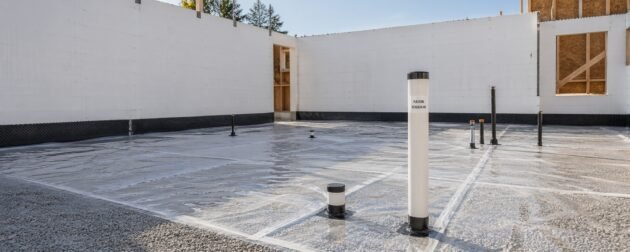
The radon rough-in is the prepared pathway that allows a future active subfloor depressurization system to be connected if the home later tests high. A typical rough-in includes a pipe connection point below the slab or within the granular layer, an airtight cap, and labeling so nobody confuses it with a mystery pipe and cuts it off later because it was “in the way.”
🧱
Soil-gas barrier
A continuous barrier under the slab helps reduce soil gas movement into the house.
🔧
Sealed penetrations
Plumbing, sump, electrical, and slab openings should be sealed to maintain continuity.
🏠
Radon rough-in
A capped, labelled rough-in allows future connection to a fan-assisted mitigation system if needed.
Many Ontario municipalities now expect permit drawings to show radon rough-in details. That is not a bad thing. It is much easier for the designer, builder, inspector, and homeowner when the plan clearly shows what is happening before excavation, underslab plumbing, stone, insulation, poly, and concrete all start happening at the same time.
Where Do the OBC Radon Rules Apply?
This is where people get mixed up. Ontario’s Building Code has long had specific “designated areas” under Article 9.1.1.7 related to radon concentration limits. Those areas are generally understood as Elliot Lake, the Township of Faraday, and the geographic Township of Hyman.
However, the newer OBC soil-gas and radon rough-in requirements are not something you should ignore just because your project is not in one of those three named areas. The 2024 OBC approach has expanded the practical expectations for new Part 9 residential construction, especially around rough-ins for subfloor depressurization and protection from soil gas ingress.
The safest working assumption for a new house, garden suite, addition with a new foundation, or other Part 9 residential project is this: your designer should address radon and soil-gas control on the permit drawings, and your builder should know how it will be installed before the slab is poured.
| Project Type | Radon / Soil-Gas Expectation | Practical Builder Note |
|---|---|---|
| New detached house | Typically requires soil-gas control and radon rough-in details under the applicable OBC provisions. | Plan it before underslab plumbing and stone placement. |
| New basement addition | Often reviewed as part of the new foundation/slab work. | Detail the tie-in between old and new foundation areas carefully. |
| Garden suite or secondary dwelling | May require radon rough-in depending on foundation type and municipal review. | Do not assume small building means no radon detail. |
| Crawl space | May require air barrier and soil-gas control detailing. | Crawl spaces are often where sloppy sealing comes back to haunt people. |
| Garage | Depends on use, occupancy, enclosure, and local interpretation. | A simple garage slab is not the same as living space above or attached conditioned space. |
Local building departments can have their own drawing checklist and inspection preferences. That is why it is always smart to review the requirements with the municipality early, especially if the project has a basement, crawl space, slab-on-grade living space, garden suite, or unusual foundation condition.
The Difference Between a Radon Rough-In and a Full Radon Mitigation System
A radon rough-in in Ontario is preparation. A full mitigation system is the finished active system that actually depressurizes the soil below the slab and vents radon safely away from the building.
The rough-in usually includes the under-slab collection point and capped pipe location. If post-occupancy testing shows high radon, a certified radon professional can convert that rough-in into an active system by adding the fan, exhaust routing, electrical connection, and proper termination.
This is similar to roughing in plumbing for a future basement bathroom. You still do not have a finished bathroom. You have made the future work less destructive. Nobody enjoys cutting finished concrete, opening ceilings, chasing mystery pipes, or explaining to the homeowner why the “small fix” now involves dust, noise, and a bill that feels like it ate lunch at an airport.
Important: a code-compliant rough-in does not prove the home is below 200 Bq/m³. The home still needs to be tested after occupancy to know the actual radon level.
What Should Be Shown on Permit Drawings?
If you are submitting drawings for a new home or addition in Ontario, the radon detail should not be treated as an afterthought. Building departments increasingly expect to see how the rough-in and soil-gas control will be constructed.
A good permit set should show enough information that the builder, inspector, and homeowner understand the basic system. The drawings do not need to turn into a 400-page engineering textbook, but they should clearly show what is under the slab, where the pipe is located, how the barrier is sealed, and how the rough-in is labelled.
📐
Plan location
Show where the rough-in pipe or collection point is located in relation to the slab and foundation.
🧩
Section detail
Show granular fill, air barrier or soil-gas barrier, slab, insulation if used, and sealing details.
🏷️
Cap and label
Show the capped and labelled termination point so it can be identified later.
If you are already preparing a full permit package, this should be coordinated with the architectural drawings, foundation details, mechanical layout, and any required energy or HVAC documents. For homeowners trying to understand the broader permit process, our guide on how to obtain a building permit in Ontario is a good companion article.
What Inspectors Are Usually Looking For
Inspectors are not trying to make your life miserable. Well, not usually. They are trying to verify that the system shown on the drawings is actually being built before it disappears under concrete.
The most important inspection moment is before the slab is poured. Once concrete is placed, it is very difficult to confirm whether the barrier was continuous, whether penetrations were sealed, whether the granular layer was correct, or whether the rough-in was properly located.
| Inspection Item | Why It Matters | Common Mistake |
|---|---|---|
| Granular layer below slab | Allows soil gas movement toward the collection point if mitigation is needed later. | Using poor fill, uneven stone, or not coordinating with under-slab services. |
| Soil-gas barrier continuity | Reduces leakage paths from soil into the building. | Loose laps, tears, wrinkles, and missing tape or sealant at penetrations. |
| Pipe rough-in | Provides future connection point for mitigation. | Pipe placed where it gets buried, cut off, unlabeled, or boxed behind finishes. |
| Sump and penetrations | Openings through the slab are common radon entry points. | Leaving gaps around pipes, sump lids, backwater valves, and sleeves. |
| Final cap and label | Helps future owner or radon professional identify the rough-in. | No label, loose cap, or cap hidden behind finished walls. |
In real construction, the problem is usually not one giant mistake. It is twenty little gaps that nobody owns. The plumber cuts the poly. The electrician pokes through it. The labourer folds it back. Somebody steps on it. The sump lid gets treated like an optional suggestion. By the time the slab is poured, everyone assumes someone else sealed it. That is how buildings get into trouble.
Radon and Basements: Why Ontario Homes Need Special Attention
Ontario homes often have basements, and basements are naturally where radon concerns show up. They are below grade, surrounded by soil, and affected by pressure differences between the home and the ground. When the house is heated, exhausted, and mechanically ventilated, it can create pressure conditions that draw soil gas inward.
This does not mean every basement has high radon. It means every basement deserves proper construction and testing. A finished basement with bedrooms, an office, gym, rec room, or basement apartment is a normal occupancy area where people may spend many hours. That is exactly the kind of space where radon should not be ignored.
This is also one reason we like building high-performance foundations properly from the start. A well-built foundation is not just concrete and insulation. It is drainage, waterproofing, air sealing, mechanical planning, slab detailing, and future serviceability. For related foundation planning, see our article on ICF foundation cost in Ontario.
Does ICF Construction Help With Radon?
ICF construction can help with overall foundation performance because the walls are solid reinforced concrete with continuous insulation. Properly built ICF foundations can be very airtight, durable, and thermally stable. That said, radon does not care what brand of block you used or how nice the basement feels on your feet.
Radon usually enters through openings, cracks, penetrations, sumps, and poorly sealed slab details. So even with an ICF foundation, the slab and under-slab detailing still matter. The best wall system in the world cannot make up for a sloppy hole around a pipe.
If you are planning an ICF home, the radon rough-in should be coordinated with the foundation, underslab plumbing, radiant heating if used, sump system, and mechanical layout. On full custom homes, this is why we prefer to think through the whole assembly instead of treating each trade like a separate island. You can learn more about high-performance ICF construction at ICFhome.ca’s custom ICF home construction page and about ICF foundation work at ICFPro.ca.
Radon Testing After Occupancy: The Part People Forget
The OBC rough-in is only part of the story. The real answer comes after the home is occupied and tested. Health Canada and C-NRPP recommend long-term testing for at least three months, preferably during the heating season, because radon levels can change from day to day and week to week.
A short-term test can be useful as a quick snapshot, but it should not be treated as the final word. A home can have a low reading one week and a higher long-term average over the season. That is why the long-term test matters.
Testing should be done in the lowest lived-in level of the home, such as a finished basement family room, office, bedroom, or apartment. An unfinished storage room that nobody uses is not the same thing as a basement bedroom where someone sleeps every night.
For homeowner-friendly guidance, Health Canada’s radon information is available at Canada.ca’s radon resource page, and certified professionals can be found through the Canadian National Radon Proficiency Program.
What Happens If the Home Tests High?
If a long-term radon test comes back above the Health Canada guideline of 200 Bq/m³, the next step is mitigation. In most homes, the most common approach is active sub-slab depressurization. That means a fan is used to draw soil gas from below the slab and exhaust it safely outdoors before it can enter the house.
If the home already has a properly installed radon rough-in, the job is usually easier. The radon professional has a place to connect. The system can often be completed with less cutting, less guessing, and less disruption.
If the home has no rough-in, mitigation can still be done, but it may involve coring the slab, routing piping through finished spaces, finding a suitable exhaust path, and dealing with existing finishes. That is where the “we saved a few dollars during construction” decision can become a “why is there plastic over my furniture?” renovation moment.
Common Mistakes With OBC Radon Rough-Ins
The radon requirement is not difficult, but it does require coordination. The most common mistakes are simple ones, and simple mistakes are the ones that happen when everyone is rushing to pour concrete before lunch.
❌
Treating poly like decoration
The barrier has to be continuous and sealed. Tossing it down loosely is not good enough.
❌
Ignoring penetrations
Every pipe, sleeve, sump, and service opening is a potential soil-gas pathway.
❌
Hiding the rough-in
If nobody can find the capped pipe later, the rough-in has not helped much.
❌
No drawing detail
If the permit drawings do not show the system, the site crew may improvise badly.
❌
Wrong timing
Radon details need inspection before the slab is poured, not after the basement is finished.
❌
Assuming new means safe
New homes can still have elevated radon. Testing after occupancy is still needed.
How This Fits Into the Bigger Permit Package
Radon is just one part of a complete Ontario permit package. A good set of drawings may also need site planning, foundation details, structural notes, energy compliance, HVAC design, ventilation, septic information, grading, and municipal forms.
If the project is a new custom home, this is where coordination matters. Radon rough-ins can conflict with underslab drains, plumbing, insulation, radiant floor heating, sump pits, footings, thickened slabs, and mechanical room layouts. It is much easier to solve those conflicts on paper than while the concrete truck is idling in the driveway.
If you are planning a new home, it is also worth reviewing Ontario Building Code changes for 2025, heat loss calculations for a new home, and septic system requirements in Ontario if you are building outside municipal services.
For high-performance custom homes, related building systems such as radiant floor heating, Nudura ICF installation, and whole-home envelope planning should be considered early. Radon is not a separate little checkbox. It is part of the building envelope and mechanical planning conversation.
Practical Radon Rough-In Checklist for Ontario Permit Sets
Here is a practical checklist to discuss with your designer, builder, or building department before the permit set is submitted and definitely before the slab is poured.
| Checklist Item | What to Confirm |
|---|---|
| Applicable OBC provisions | Confirm the project’s Part 9 scope and local municipal expectations for radon and soil-gas control. |
| Designated area or known radon concern | Check whether the project is in a designated area or an area identified locally as having radon concerns. |
| Under-slab granular layer | Confirm material type, placement, and continuity below the slab. |
| Soil-gas barrier | Show barrier material, laps, sealing, and continuity at edges and penetrations. |
| Rough-in pipe | Show location, size, cap, label, and future connection intent. |
| Sump pit detailing | Confirm sealed lid and penetrations where applicable. |
| Crawl space detailing | Show air barrier and sealing details if the project includes crawl spaces. |
| Inspection timing | Coordinate inspections before concrete placement and final verification of cap and label. |
| Owner testing note | Advise homeowner to complete long-term radon testing after occupancy. |
Planning a New Home or Addition in Ontario?
Radon details are easiest to get right before the slab is poured. If you are planning a custom home, ICF foundation, basement addition, or owner-builder project, make sure your permit drawings and site work are coordinated before construction starts.
FAQ: OBC Radon Requirements in Ontario
What are the OBC radon requirements for new homes in Ontario?
The OBC radon requirements generally involve protection from soil-gas ingress and a rough-in for future radon extraction in applicable Part 9 residential construction. In practical terms, that means the building should include a continuous soil-gas barrier, sealed penetrations, proper slab and wall interface detailing, and a capped, labelled rough-in that can be connected to a full mitigation system if post-occupancy testing shows elevated radon.
Does every new Ontario house need a radon rough-in?
Many new Part 9 residential projects are now expected to include radon rough-in provisions under the 2024 Ontario Building Code approach. Local interpretation can vary depending on project type, foundation type, occupancy, and municipal checklist requirements. The best practice is to show radon and soil-gas control details on the permit drawings and confirm expectations with the local building department before construction starts.
What are the designated radon areas in the Ontario Building Code?
The designated radon areas commonly referenced under OBC Article 9.1.1.7 are the City of Elliot Lake, the Township of Faraday, and the geographic Township of Hyman. Buildings in those areas are subject to specific radon concentration design requirements. However, homeowners should not assume radon is only a concern in those three areas. Elevated radon levels have been found in many parts of Ontario, and newer soil-gas control expectations are broader than the old designated-area discussion.
Is a radon rough-in the same as a radon mitigation system?
No. A radon rough-in is preparation for a future mitigation system. It usually includes under-slab collection provisions and a capped, labelled pipe or connection point. A complete active mitigation system includes a fan, exhaust piping, electrical connection, proper termination, and commissioning by a qualified person. The rough-in makes future mitigation easier, but it does not guarantee the home will test below Health Canada’s guideline.
When should radon be tested in a new home?
Radon should be tested after the home is occupied and normal living conditions are established. Health Canada and C-NRPP recommend long-term testing for at least three months, preferably during the heating season. Short-term tests can give a snapshot, but they can be misleading because radon levels change with weather, pressure, ventilation, and seasonal conditions.
What radon level is considered too high in Canada?
Health Canada’s indoor radon guideline is 200 Bq/m³. If a long-term test shows the average radon concentration is above that level in a normal occupancy area, corrective action is recommended. The higher the radon level, the sooner action should be taken. Even below 200 Bq/m³, Health Canada notes there is no level of radon exposure that is considered completely risk-free.
Can an inspector check radon levels during construction?
No, not in the way homeowners usually mean. An inspector can check whether the required rough-in, barrier, sealing, and construction details are installed according to the approved drawings and applicable code provisions. Actual radon concentration inside the home can only be confirmed by testing after occupancy. Construction compliance and indoor radon testing are related, but they are not the same thing.
Do additions need radon rough-ins?
Additions can trigger radon and soil-gas control requirements, especially where there is new foundation or slab work connected to conditioned space. The exact requirement depends on the design, foundation type, use of the space, and local building department interpretation. If the addition includes a basement, crawl space, or slab-on-grade living area, radon detailing should be reviewed early in the permit design process.
Do garages need radon rough-ins?
A basic unconditioned garage may be treated differently from living space, but garages are not all the same. An attached garage, heated garage, garage with living space above, or garage connected to conditioned areas may receive closer review. Local building departments may look at occupancy, enclosure, air sealing, and connection to the dwelling. It is better to ask early than to assume the garage is automatically exempt.
Who is responsible for radon testing after the house is built?
In most cases, the homeowner is responsible for testing after occupancy. The builder’s role is to construct the home according to the approved drawings and applicable code requirements, including the radon rough-in and soil-gas control details. The code rough-in prepares the home for easier mitigation if needed, but the homeowner still needs to perform a proper long-term test to know the actual radon level.
Can I install the rough-in myself as an owner-builder?
An owner-builder may be involved in construction, but the rough-in still needs to meet the applicable Ontario Building Code requirements and local inspection expectations. The challenge is not just putting a pipe under the slab. The air barrier, sealed penetrations, granular layer, sump detailing, cap, label, and inspection timing all matter. If you are not experienced with foundation and slab detailing, this is a good place to get qualified help.
What is the biggest mistake homeowners make with radon?
The biggest mistake is assuming a new home is automatically safe because it passed building inspection. The inspection confirms construction requirements, not the final indoor radon concentration. The second biggest mistake is waiting until the basement is beautifully finished before testing. If mitigation is needed, it is much easier to complete when the rough-in is accessible and before every wall, ceiling, and cabinet is in the way.
This article is general information for Ontario homeowners and builders. Always confirm the current code interpretation, permit drawing requirements, and inspection process with the local building department for your specific project.