Ontario's Plain-English Guide to Custom Home Building📞 705-533-1633 | ☎️ 1-866-868-6606 | ✉️ info@icfhome.ca
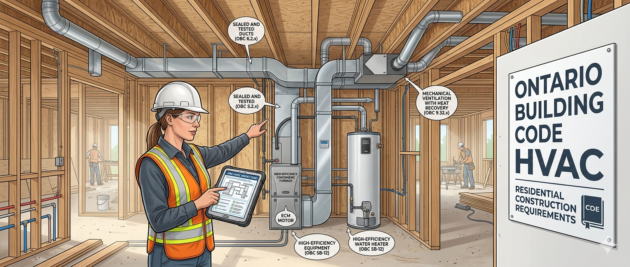
Ontario Building Code HVAC Requirements: The 2026 Plain-English Guide to Sections 9.32, 9.33, and SB-12
Ontario Builder Guide · 2026
Ontario Building Code HVAC Requirements: What OBC 2024 Demands From Every New Home Mechanical System
A plain-English walk through Sections 9.32 (Ventilation), 9.33 (Heating & Air Conditioning), and Supplementary Standard SB-12 (Energy Efficiency) — written for homeowners and self-builders who need to know what their permit package must actually contain in 2026.
If you applied for a new-home building permit in Ontario before April 2025 and you’re still working off that same paperwork, there’s a fair chance some of it doesn’t comply anymore. The Ontario Building Code changed in a big way on January 1, 2025, with a short grace period until March 31, 2025. Every new permit since then has to be to the 2024 Ontario Building Code — not the 2012 edition that the entire industry got used to over the last 13 years.
For HVAC specifically, the changes are real. House Types I, II, III, and IV are gone. Heat recovery ventilation is now effectively mandatory. The Mechanical Ventilation Design Summary is no longer optional documentation in your permit package. And the heat loss calculation that some builders quietly skipped or copy-pasted from the last house? That doesn’t fly anymore either.
This is the plain-English version of what OBC 2024 actually requires for HVAC in new residential construction. No legalese. No marketing pitch. Just what your permit package needs to contain, why each piece is there, and where homeowners and self-builders most commonly get it wrong.
One honest disclaimer before we start: the Code is a moving target. Municipalities interpret some sections slightly differently, supplementary standards get updated, and individual building departments can ask for documentation that goes beyond the strict minimum. What follows is accurate as of writing and reflects the OBC 2024 as filed under O. Reg. 163/24. Always confirm specifics with your local building department.
What changed in OBC 2024 — the short version
The 2024 Building Code came into force January 1, 2025, with a transition window until March 31, 2025 for designs already in progress. Since April 1, 2025, every new residential permit must comply with the 2024 edition. The province describes it as the largest harmonization with the National Building Code in Ontario history — roughly 1,730 technical variations removed.
For HVAC and energy compliance, the substantive changes sit in three places: Section 9.32 (Ventilation), Section 9.33 (Heating and Air Conditioning), and the supplementary standard known as SB-12 (Energy Efficiency for Housing). The official Ontario.ca page on the 2024 Building Code has the regulatory background. We’ll walk through each of the three sections that matter for HVAC below.
Section 9.32 — Ventilation (the biggest changes)
If you only read one part of OBC 2024 before talking to your designer, make it this one. Section 9.32 was reorganized from the ground up.
Under the old 2012 Code, houses were classified into ventilation Types I through IV based on fuel type and venting arrangement — whether you had a gas furnace with a chimney, a direct-vent appliance, electric heat only, and so on. Those four house types are gone. The 2024 Code does not classify houses by type at all anymore. If your designer’s permit package still references “House Type II ventilation requirements,” they’re still working from the 2012 Code and your permit will get bounced.
The new structure splits ventilation into two operating modes:
- Heating-season mechanical ventilation (Subsection 9.32.2) — how the house gets fresh air during winter, when windows stay shut and air leakage is at its annual minimum.
- Non-heating-season ventilation (Subsection 9.32.3) — how the house gets fresh air during shoulder seasons and summer, when natural ventilation can do part of the job.
Each mode has its own requirements for principal exhaust, supplemental exhaust, and make-up air. The Code also adds 15 pages of appendix notes (starting around A-9.32.1.2.(2)) showing acceptable arrangements of mechanical ventilation equipment.
The practical changes you need to know about:
- Heat or energy recovery is effectively mandatory. An HRV (heat recovery ventilator) or ERV (energy recovery ventilator) is now built into the assumed ventilation strategy for every new home. Skipping one is no longer a realistic compliance path under Section 9.32.
- A Mechanical Ventilation Design Summary (MVDS) is required in the permit package. The MVDS must follow CAN/CSA-F326, document the ventilation system design, and accompany the application. Most municipalities now require this on the cover sheet of any HVAC submittal.
- Principal exhaust at a minimum 100 CFM is required in every kitchen.
- Supplemental bathroom exhaust at a minimum 50 CFM per bathroom.
- Make-up air is now prescriptive (Subsection 9.32.3.8) when there are exhaust devices in the home that, combined, would exceed certain thresholds — or when fuel-fired appliances aren’t direct-vent or mechanically vented.
Section 9.33 — Heating and Air Conditioning
This is where the heat loss calculation requirement lives. Section 9.33 was also expanded in OBC 2024, picking up residential duct system requirements that used to sit in Subsection 6.2.4 of the old Code.
The core requirement most homeowners don’t realize is in Sentence 9.33.2.2: the heating system in a new home must be sized using a calculated heating load, not a contractor’s gut feel. The recognized standard for that calculation is CSA F280-12 — the Canadian engineering standard that uses your actual wall assemblies, actual window specs, actual glazing area, and the design temperature for your specific Ontario municipality.
“We sized it like the last house we built” is not a compliant answer. Neither is “we used an online calculator.” The F280-12 calculation must be stamped by a BCIN-registered designer and submitted with the permit application. For more on how the heat loss calc works and what your designer should be producing, see our companion guide to the Ontario heat loss calculator.
Section 9.33 also covers:
- Duct sizing and layout for forced-air systems (now per HRAI calculation methodology)
- Combustion air for fuel-fired appliances
- Clearances around equipment
- Venting requirements for natural-draft, induced-draft, and direct-vent appliances
- Hydronic system requirements where applicable (boilers, radiant floors)
Three different reports — don’t mix them up
Homeowners constantly confuse the three energy-related documents that show up around a new home build. Here’s how they differ:
| Document | Where it lives in OBC | What it does | Who produces it |
|---|---|---|---|
| CSA F280-12 heat loss calc | Section 9.33.2.2 | Sizes the heating system using real assemblies and design temperatures | BCIN-registered HVAC designer |
| Mechanical Ventilation Design Summary (MVDS) | Section 9.32 / CAN-CSA-F326 | Documents the whole-home ventilation strategy and equipment sizing | BCIN-registered HVAC designer |
| Energy Efficiency Design Summary (EEDS) | OBC Part 12 / SB-12 | Documents how the home meets SB-12 energy efficiency requirements | BCIN-registered designer (architect, engineer, or owner-builder in some cases) |
| EnerGuide home audit | Not in OBC — federal NRCan program | Rates existing homes for rebate eligibility, not for permits | NRCan-Registered Energy Advisor |
We covered the EnerGuide side in detail in our guide to Ontario home energy audits. The other three live inside the building permit world.
Builder Truth
A permit package built for the 2012 Code will get rejected today. If your designer hasn’t updated their templates — we’ve seen this on packages dated as recently as mid-2025 — you’ll discover the problem at the worst possible time, after you’ve paid for drawings and submitted for review.
Check three things on any permit package before submission: does the MVDS exist, is the F280-12 calc stamped and current, and does the EEDS reference SB-12 (not the older 2017 version)? If any answer is no, send it back to the designer.
SB-12 — The energy efficiency side
Supplementary Standard SB-12 is the document that translates OBC Part 12 (Resource Conservation and Environmental Integrity) into actual prescriptive requirements for new housing. It sits beside the main Code as a supplementary standard, and it applies to every new residential building within the scope of Part 9.
SB-12 gives builders three compliance paths:
| Path | What it requires | Best for |
|---|---|---|
| Prescriptive (Subsection 3.1.1) | Conform to one of seven compliance packages in Tables 3.1.1.2 (Zone 1) or 3.1.1.3 (Zone 2). Specifies minimum R-values, window U-values, heating equipment efficiency, and HRV specifications. | Standard residential builds where you don’t want to do energy modelling |
| Performance (Subsection 3.1.2) | Energy-model the house against the prescriptive reference design. Requires HOT2000 modelling and a blower-door test at completion (often 2.5 ACH @ 50 Pa for detached, 3.0 for attached). | Custom homes with unusual designs, large window areas, or builders pursuing better-than-Code performance |
| Other acceptable methods (Subsection 3.1.3) | Including the ENERGY STAR for New Homes pathway and the R-2000 standard. | Builders already certified to ENERGY STAR or R-2000 |
Ontario is split into two climate zones for SB-12 purposes. Zone 1 covers Southern Ontario — Toronto, Hamilton, London, Ottawa, Niagara, and most of the populated south. Zone 2 covers Northern Ontario — areas with significantly higher heating degree days, which means higher minimum R-values and tighter mechanical requirements.
For airtightness, SB-12’s performance path references targets of 2.5 air changes per hour at 50 pascals (ACH50) for detached homes and 3.0 ACH50 for attached homes — with airtightness credit available if you beat those numbers and test as-built. These are not blanket requirements under the prescriptive path, but they become real numbers when you submit blower-door results for any project pursuing the airtightness credit.
What your permit package must contain for HVAC compliance
Pull these together before you submit, and your permit review goes faster:
- A CSA F280-12 heat loss calculation, room-by-room, stamped by a BCIN-registered HVAC designer, using the design temperature for your municipality.
- A Mechanical Ventilation Design Summary (MVDS) per CAN/CSA-F326, documenting principal and supplemental exhaust, fresh air intake, HRV/ERV sizing and capacity, and ductwork.
- Mechanical drawings showing equipment placement, duct routing, intake and exhaust locations, and clearances.
- An Energy Efficiency Design Summary (EEDS) form referencing the SB-12 compliance path you’re using (prescriptive, performance, or other), with the specific table and package identified.
- Heat pump or furnace specifications matched to the calculated load — not oversized “to be safe.” Oversizing causes short-cycling and is increasingly flagged by reviewers.
- For cold-climate heat pumps, manufacturer documentation showing capacity at the local design temperature (often -22°C to -30°C in Southern Ontario), and balance-point calculations if a hybrid system is proposed.
- A BCIN registration number for the designer, listed on every drawing and form. No BCIN, no acceptable design submission.
Common mistakes that get permits rejected
Things that will get your package bounced
- Permit cover sheet still references “House Type II” or any other 2012-Code ventilation type
- No MVDS in the submittal package
- F280-12 calculation uses a generic design temperature instead of your actual municipality
- Heat pump on the drawings isn’t on Natural Resources Canada’s qualified products list
- Wrong climate zone applied (Zone 1 R-values used on a Zone 2 project, or vice versa)
- Designer’s BCIN number missing or expired
- EEDS form references SB-12 2017 instead of the current SB-12
What good submissions look like
- BCIN-stamped F280-12 with room-by-room loads in BTU/h
- MVDS that names the actual HRV/ERV model and shows its SRE rating
- Mechanical drawings to scale, with duct sizes labelled
- EEDS form completed, signed, and matched to the prescriptive table being used
- Equipment selected at 70–105% of design load (per NRCan heat pump guidance)
- Climate zone, design temperature, and degree-days all stated explicitly
- One designer’s BCIN responsible for the whole HVAC package
Builder Truth
BCIN registration is not optional. The Building Code requires designers who provide compliance information to be BCIN-registered, with limited exemptions for architects, engineers, and owner-builders designing their own homes. If your HVAC contractor hands you a quote with no BCIN-stamped F280 attached, they’re not the right partner for a permit submission — they’re the right partner for the equipment install after the permit is in hand.
What inspectors actually check
The HVAC items inspectors flag most often during framing and pre-drywall
One — HRV/ERV installation matches the MVDS. They’ll verify the model number on the unit matches what was submitted, confirm balanced supply/exhaust, and check that intake and exhaust terminations meet separation distances.
Two — combustion air, where required. For naturally aspirated and induced-draft appliances, a make-up air duct sized to the appliance is checked. Direct-vent appliances usually don’t need one, but the installation has to match the spec.
Three — clearances around equipment. Service space, combustion air openings, and code-required clearances to combustibles all get measured.
Four — air-sealing details at penetrations, rim joists, and the attic plane. Even if you’re on the prescriptive path with no blower-door test required, inspectors look at sealing during pre-insulation inspections.
Five — duct sealing. Mastic or UL-181 tape on duct seams; not just stretched aluminum tape over loose joints.
One more thing — ICF and high-performance builds
If you’re building with insulated concrete forms, you tend to crush SB-12’s prescriptive requirements without trying. ICF walls deliver continuous insulation, near-zero thermal bridging, and air tightness numbers that make blower-door tests look easy. That doesn’t exempt you from the paperwork — you still need the F280-12 heat loss calc, the MVDS, the EEDS form, and the BCIN designer — but it does mean your envelope side is sorted before you even start. The contractor side of ICF work is covered at ICFpro.ca for builders and subtrades, and our ICFpro insights archive goes deeper on the building science.
If you’re at the planning stage of a new home and trying to wrap your head around the whole permit-to-occupancy sequence, our 10 steps to building a new home in Ontario walks through it from the homeowner’s side. And if you’re combining new construction with energy upgrades and trying to navigate rebates at the same time, the Home Renovation Savings Program guide covers the active 2026 programs.
For the full text of the HVAC-specific OBC 2024 changes, the Heating, Refrigeration and Air Conditioning Institute (HRAI) maintains a detailed comparison document available through the HCRA’s OBC HVAC update page — worth bookmarking if you’re going to be inside this code for more than one project.
Planning a new home in Ontario and want OBC 2024 handled properly from day one?
We build high-performance custom homes throughout Simcoe County, Georgian Bay, Collingwood, and surrounding areas — with the HVAC, ventilation, and energy compliance paperwork built into the project from the planning stage. No 2012-Code surprises.
Frequently asked questions
When did the 2024 Ontario Building Code come into effect?
The 2024 Ontario Building Code came into force on January 1, 2025, under O. Reg. 163/24. The province granted a three-month transition window until March 31, 2025 for designs that were already substantially in progress, so a small number of permits submitted in that window could still be processed under the 2012 Code. From April 1, 2025 onward, every new residential permit application in Ontario must comply with the 2024 edition. The province describes it as the largest harmonization with the National Building Code in Ontario’s history, removing roughly 1,730 technical variations.
Is an HRV or ERV mandatory in new Ontario homes under OBC 2024?
For all practical purposes, yes. Section 9.32 of OBC 2024 requires heat or energy recovery as part of the principal whole-home ventilation strategy in new construction. The previous House Types I through IV classification, which sometimes allowed simpler ventilation paths, has been eliminated. Combined with SB-12’s energy efficiency requirements, every realistic compliance path for a new home now includes an HRV or ERV. The choice between HRV and ERV depends on your climate zone and humidity goals — ERVs are often preferred in Southern Ontario for summer humidity management.
What is a Mechanical Ventilation Design Summary (MVDS) and why does my permit package need one?
The MVDS is a one- to two-page document that summarizes the whole-home mechanical ventilation design for a new house. It documents principal exhaust capacity, supplemental exhaust per bathroom and kitchen, fresh air intake, HRV/ERV model and sensible recovery efficiency rating, duct routing, and intake/exhaust terminations. Under OBC 2024 and CAN/CSA-F326, the MVDS must accompany the permit application for any new residential construction within Part 9 scope. If your designer’s submittal package doesn’t include one, the building department will request it before issuing the permit.
What’s the difference between OBC Section 9.32 and Section 9.33?
Section 9.32 covers ventilation — how outside air enters the house, how stale air leaves, and how the two are balanced. Section 9.33 covers heating and air conditioning — how the house is heated and cooled, how heating equipment is sized using CSA F280-12, and how ducts and combustion air work. They overlap in practice because most modern systems combine both functions, but they are separate Code sections with separate requirements. A complete HVAC permit package must address both.
Do I need a BCIN-registered designer for my HVAC permit submission?
In nearly all cases, yes. The Ontario Building Code requires designers who provide compliance information to be registered under the Building Code Identification Number (BCIN) system. Architects and professional engineers are exempted under their own licensing regimes, and homeowners designing their own homes have limited exemptions in some circumstances. For everyone else, the F280-12 heat loss calculation, the MVDS, and the EEDS must be prepared by a BCIN-registered designer whose number appears on the documents.
How does SB-12 differ from the main Building Code?
SB-12 (Supplementary Standard SB-12, Energy Efficiency for Housing) is a separately published standard referenced by Part 12 of the main Building Code. It contains the detailed prescriptive packages, performance modelling requirements, and alternative compliance paths for new residential buildings. The main Code says “your building must be energy efficient”; SB-12 says exactly what R-values, window U-values, HRV efficiencies, and airtightness numbers count as compliant. They work together — you can’t meet the Code without satisfying one of SB-12’s compliance paths.
What is the airtightness target for new homes under SB-12?
SB-12 references airtightness targets of 2.5 air changes per hour at 50 pascals (2.5 ACH50) for detached houses and 3.0 ACH50 for attached houses such as townhomes. These numbers apply when builders choose the performance path or want to claim the airtightness credit on the prescriptive path. They are not blanket mandatory targets for every new home, but they become hard requirements when you submit blower-door results. Hitting them is typical of well-built modern homes; ICF construction often achieves significantly lower numbers without effort.
What climate zones does SB-12 use for Ontario?
SB-12 divides Ontario into two climate zones. Zone 1 covers Southern Ontario, including Toronto, Hamilton, London, Niagara, Kitchener-Waterloo, Ottawa, and most of the populated south. Zone 2 covers Northern Ontario, where heating degree days are significantly higher and the prescriptive R-value requirements are correspondingly higher. The Compliance Package tables in SB-12 are split by zone — Tables 3.1.1.2 series for Zone 1 and Tables 3.1.1.3 series for Zone 2 — so picking the right zone for your municipality is a first step the designer can’t skip.
Do I need a CSA F280 heat loss calculation for a new home permit in Ontario?
Yes. Sentence 9.33.2.2 of OBC 2024 requires the heating system to be sized using a calculated heating load, and CSA F280-12 is the recognized Canadian standard for that calculation. The calc must use actual wall assemblies, actual window specifications, actual glazing area, and the correct design temperature for the municipality where you’re building. A generic estimate, a previous-house copy, or an online calculator output is not compliant. The F280-12 calculation must be stamped by a BCIN-registered HVAC designer and submitted with your permit package.
Can I use my own designer or does the HVAC contractor have to do it?
You can use any BCIN-registered HVAC designer. Some homeowners hire their HVAC contractor’s in-house designer, others use an independent firm. The advantage of an independent BCIN designer is no conflict of interest with equipment selection — they specify what the calc actually requires rather than what’s sitting in their warehouse. Whichever way you go, confirm the designer’s BCIN is current and their stamp will appear on the F280-12, the MVDS, and the EEDS.
What happens if my permit submission doesn’t include the MVDS or F280?
The building department will reject the application or place it on hold and request the missing documents. This typically adds two to six weeks to your permit timeline depending on the municipality’s review queue. In some cases, a missing F280-12 can result in your equipment selection being challenged during inspection, which can force re-work in framing or rough-in. The cheapest path is to get the documents right before submission; the most expensive path is to fix them after work has started on site.
Does OBC 2024 apply to renovations and additions, or only new homes?
OBC 2024 applies to renovations and additions as well, but the specific requirements differ by scope. SB-12 Table 3.1.1.11 deals with additions and major renovations, with separate R-value and HVAC efficiency requirements than new construction. Smaller renovations may fall under Part 11 of the Code (Renovation), which has its own compliance alternatives. A material addition almost always triggers a new heat loss calc, updated mechanical drawings, and SB-12 documentation; a minor renovation may not. Your designer should confirm which sections apply to your specific scope before submission.
If you’re at the planning stage of a new home in Ontario, the cheapest moment to get the HVAC compliance right is now — before drawings get finalized and certainly before crews show up. Get a BCIN designer on the F280 and the MVDS, confirm your SB-12 compliance path early, and don’t accept a permit package built from a 2012-Code template. — Harvey, on behalf of the crew.
Need the documents this page describes?
Ontario Heat Loss produces the complete BCIN-stamped package — CSA F280 heat loss, duct design, MVDS and Schedule 1 — in 48 hours.
Ontario permit HVAC requirements guide · Full HVAC design & mechanical drawings — $695 · Certified CSA F280 heat loss report — $395, 48h