Ontario's Plain-English Guide to Custom Home Building📞 705-533-1633 | ☎️ 1-866-868-6606 | ✉️ info@icfhome.ca
Do You Need a Permit for a Shed in Ontario?
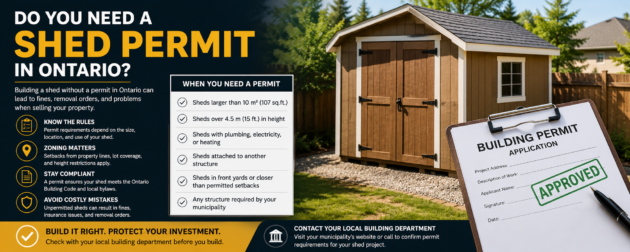
Shed permit
The size threshold
Zoning still applies
Do You Need a Permit for a Shed in Ontario? The Size Rule, the Zoning Trap
Here is the short version: a one-storey detached storage shed of about 15 square metres (roughly 161 sq ft) or less, with no plumbing, usually does not need a building permit in Ontario. Go bigger than that, add wiring, plumbing, or heat, or make it anything other than simple storage, and you are into permit territory. But there is a trap people fall into – “no building permit” does not mean “no rules.” Zoning setbacks, lot coverage, and where you can put it apply to every shed, permit or not. We have placed a lot of these across Simcoe County and Georgian Bay – here is how to do it right and avoid the order to move it.
If your shed does need a permit, two ways to get it
Do it yourself with the step-by-step PDF, or hand us the drawings. Either way, you skip the guesswork.
Best value – the $10,000 builder roadmap
The Ontario Building Permit Bible
Your permit, done yourself – without the guesswork.
$10,000$29.99one-time
Everything a builder does to coordinate a permit – the same playbook whether it is a shed, a garage, or a house. Good anywhere in Ontario.
- When a structure needs a permit – the size and use thresholds
- The complete-application checklist, so it does not get bounced
- How to read your zoning: setbacks, coverage, height, location
- Real fees, and the mistakes that cost the most
30-day money-back guarantee.
Get instant access – $29.99 →
Secure checkout – download in 2 minutes – yours forever
Done for you
We draw your shed or garage set
A permit-ready set your city will accept.
Building a bigger shed, a workshop, or stepping up to a garage? We draw the scaled, code-compliant set with the structural details, and check your zoning. Anywhere in Ontario.
- Site plan with setbacks, floor plan, elevations, and sections
- Drawn by a BCIN-registered designer; engineering where needed
- We confirm setbacks, coverage, and height before you submit
- 45 years, 300-plus buildings – drawings the counter accepts
Free quote, no obligation.
A real person gets back to you within one business day
Want the exact threshold for your municipality?
Shed sizes and exemptions follow the Building Code plus your local by-law. Ask our OBC Code Navigator your exact question – the first two are free, and you can grab the OBC PDF there too.
The size rule: when a shed needs a building permit
Ontario’s Building Code exempts a small detached storage shed from needing a building permit, as long as it stays simple. The common threshold is a one-storey detached shed of about 15 square metres (roughly 161 sq ft) or less, used only for storage, not attached to anything, and with no plumbing. Some municipalities still reference the older 10 square metre figure, so the exact number is worth confirming locally – but the principle holds: small, simple, detached, storage-only.
Usually NO building permit
- One storey, detached (not attached to the house or garage)
- About 15 m² (161 sq ft) or under – confirm your town’s number
- Used for storage only – no living space, no workshop with services
- No plumbing, and no permanent electrical wiring
Permit REQUIRED once you cross a line
- Bigger than the exemption (then it is treated like any accessory building)
- Any plumbing – a sink, a hose bib plumbed in, a bathroom
- Permanent electrical wiring (and that also needs an ESA notification)
- Heating, insulation for occupancy, a loft, or a second storey
- Attached to the house or garage, or used as living space
The line that catches people: the moment a “shed” gets power, water, or heat – or grows into a workshop, studio, or bunkie – it stops being an exempt storage shed and needs a permit, no matter how small it is. A 10 by 10 shed with a subpanel and a sink is a permitted building.
The zoning trap: “no permit” does not mean “no rules”
This is where most shed problems actually come from. Even when your shed is small enough to skip the building permit, your municipal zoning by-law still applies – and a zoning officer can order a non-compliant shed moved or removed even if it never needed a permit. Before you place it, check:
Setbacks
Minimum distance from your side and rear lot lines – often around 0.6 to 1.2 m, but it varies by zone. Too close to the line is the single most common shed violation.
Lot coverage & size limits
Your by-law caps how much of the lot all buildings can cover, and may cap accessory-building size and how many you can have.
Location on the lot
Accessory buildings usually are not allowed in the front yard, and there can be rules near easements, water, or septic beds.
Height
There is normally a maximum height for accessory structures – taller “barn” or loft sheds can trip it.
Our zoning decoder breaks down setbacks, coverage, and height so you can place the shed where it will not become a problem. On a waterfront or rural lot, also watch for conservation authority rules near water.
Building bigger than a storage shed? We’ll draw the permit set.
A workshop, studio, bunkie, or anything with power, water, or heat needs a permit – and a proper drawing set. We design sheds, accessory buildings, and garages with the structural details and zoning checked, so it passes the first time. Tell us what you are building.
If your shed needs a permit, here’s the path
Check zoning first
Confirm setbacks, coverage, height, and where it can go with the zoning decoder – before you design or buy a kit.
Get a drawing set
A site plan with setbacks, a floor plan, elevations, and a section showing the structure and footing/foundation. See what permit drawings need to show, or have us draw it.
File the application
The form, fee, and drawings as one complete package – see the permit application guide.
Add ESA for any wiring
Running power to the shed needs an ESA notification and inspection, separate from the building permit. Here is what you can wire yourself on your own property.
Inspections, then done
Footing/foundation and a final, typically. Build to the approved drawings and you are finished clean.
Need a level pad, a gravel base, or grading before the shed goes down? That is sitework – Georgian Bay Siteworks handles pads, grading, and drainage across the region.
Shed, or really a garage?
If what you are picturing has a vehicle door, a slab foundation, or you want power and a workbench, you are probably building a detached garage, not a shed – and a garage always needs a permit because of its foundation and size. The good news is the process is the same one on this page, just with a bit more drawing and structure. If you are not sure which side of the line you are on, the do-I-need-a-permit guide walks through both project by project.
Related permit guides on this site
Shed permits in Ontario: frequently asked questions
What size shed can I build without a permit in Ontario?
Generally a one-storey detached storage shed of about 15 square metres (roughly 161 sq ft) or less, used only for storage and with no plumbing, does not need a building permit. Some municipalities still use the older 10 square metre figure, so confirm your town’s exact number. Above the threshold – or any shed with plumbing, permanent wiring, heat, or a use beyond storage – needs a permit regardless of size.
Do I need a permit for a 10×10 or 10×12 shed?
A 10×10 (about 9.3 m²) and usually a 10×12 (about 11 m²) fall under the storage-shed exemption in most municipalities, so no building permit if it is one storey, detached, storage-only, and has no plumbing. But two things still apply: zoning setbacks and lot coverage, and the services rule – add power or a sink and even a small shed needs a permit. Always confirm the threshold and setbacks with your municipality before you place it.
Does a shed with electricity need a permit?
Yes. The moment you run permanent electrical wiring to or in a shed, it needs a building permit – and the electrical work itself needs an ESA notification of work and inspection, which is separate from the building permit. On your own property you may be able to do the wiring yourself, but the ESA permit and inspection are mandatory either way. A shed with power is no longer a simple exempt storage shed.
Do I still have to follow zoning if my shed doesn’t need a permit?
Yes – this is the part people miss. Zoning by-laws apply to every shed, permit or not. Setbacks from your lot lines, lot coverage limits, height limits, and where on the lot you can place it all still apply, and a zoning officer can order a non-compliant shed moved or removed even though it never needed a building permit. Check setbacks and coverage before you decide where it goes.
How far from the property line does a shed have to be?
It depends on your zone, but many Ontario municipalities require roughly 0.6 to 1.2 metres from side and rear lot lines, and accessory buildings are usually not allowed in the front yard. There can also be rules near easements, water, and septic beds. Because it varies, confirm the exact setback for your property with your municipality or check your zoning by-law – placing a shed too close to the line is the most common shed violation.
Do I need a permit to turn my shed into a workshop or studio?
Usually yes. Once a shed is insulated, heated, wired, or used as a workshop, studio, office, or bunkie rather than plain storage, it is no longer an exempt storage shed and needs a building permit – and a second unit or sleeping space brings its own Code requirements. If that is the plan, design it as a permitted accessory building from the start; it is far cheaper than legalizing it later.
Can you draw the plans for my shed or garage?
Yes – that is one of the things we do. We prepare permit-ready drawing sets for larger sheds, workshops, accessory buildings, and detached garages, with the structural details and the zoning checked, and we arrange engineering where it is needed. We have done it across Simcoe County and Georgian Bay for 45 years. Use the “Get your plans drawn” button and tell us what you are building.
Note: this is general guidance, not a ruling on your project. Shed thresholds, setbacks, and accessory-building rules vary by municipality, and zoning is checked separately from the Building Code. Confirm the exact numbers with your municipality before you build – or have us check it for you.
More on permits and code
Reviewed and updated October 2026. Costs on this site are Ontario ranges, not quotes; code references are to the Ontario Building Code in force at the date above.
Latest posts
Fresh guides, calculators & real-world advice
More from BuildersOntario – scroll to explore.
Loading latest posts…
Tip: shift + mousewheel works great