Ontario's Plain-English Guide to Custom Home Building📞 705-533-1633 | ☎️ 1-866-868-6606 | ✉️ info@icfhome.ca

Building Without a Permit in Ontario: Consequences and How to Make It Right
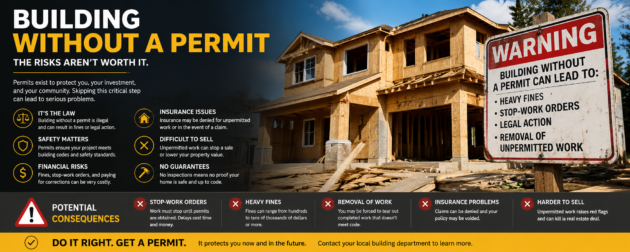
Building without a permit
The real consequences
How to make it right
Building Without a Permit in Ontario: The Real Consequences (and How to Make It Right)
Whether you are thinking about skipping the permit, you already built something and lost sleep over it, or you just got a stop-work order taped to your door – here is the straight version. Building without a permit is a real risk, not a paperwork formality: stop-work orders, fines up to $50,000, a work-without-permit surcharge, an order to uncover or even remove the work, a voided insurance claim, and a sale that falls apart. The good news is most of it can be made right with a retroactive permit, and we do that all the time. We have pulled and fixed permits across Simcoe County and Georgian Bay for 45 years – here is what actually happens and how to get out of it cleanly.
However you got here, there’s a clean way out
Already built it or got an order? We will help you make it right. Starting fresh? Do it the easy way with the step-by-step PDF.
Already built / got an order
We help you make it right
Stop-work order, order to comply, or unpermitted work at sale.
We prepare the as-built drawings, file the retroactive permit, and deal with the building department so you can close the file and move on. Anywhere in Ontario.
- As-built drawings and the retroactive permit application
- We talk to the building department and sort the path to compliance
- Buying or selling a home with unpermitted work? We sort the paper
- 45 years, 300-plus homes – we have untangled a lot of these
Free quote, no obligation.
A real person gets back to you within one business day
Doing it right from the start
The Ontario Building Permit Bible
Your permit, done yourself – without the guesswork.
$10,000$29.99one-time
Everything a builder does to coordinate a permit – so you never end up on this page for the wrong reason. Good anywhere in Ontario.
- The step-by-step to file your own permit – who to hire, in what order
- The complete-application checklist, so it does not get bounced
- Real fees, development charges, and design costs
- How to never fail an inspection – and the mistakes that cost the most
30-day money-back guarantee.
Get instant access – $29.99 →
Secure checkout – download in 2 minutes – yours forever
Not sure if your project even needed a permit?
Before you panic, check whether the work was permit territory at all. Ask our OBC Code Navigator your exact question – the first two are free, and you can grab the OBC PDF there too.
What actually happens when you build without a permit
It usually starts when someone notices – a neighbour complains, an inspector drives by, or it surfaces during a sale. From there the municipality has a clear set of tools, and they escalate:
1. Stop-work order
The first move. All construction halts immediately until you get a permit – even the parts that were fine. Ignoring it makes everything that follows worse.
2. Order to comply
A formal order to apply for the permit and bring the work up to Code, with a deadline. It can be registered on title, so it follows the property until it is resolved.
3. Uncover or remove
Covered work that should have been inspected may have to be opened back up so it can be seen – drywall off, finishes out. If it cannot be made compliant or it is unsafe, the city can order it removed at your expense.
4. Charges and fines
If you do not comply, the municipality can prosecute under the Building Code Act. That is where the big fine numbers live – and they are real.
The fines, in plain numbers
Under Ontario’s Building Code Act, the maximum penalties for building without a permit (or ignoring an order) are:
An individual
Up to $50,000 for a first offence, and up to $100,000 for a subsequent offence.
A corporation
Up to $500,000 for a first offence, and up to $1,500,000 for a subsequent offence.
Reality check: those are the maximums, used for serious or repeat cases. A typical first-time homeowner is more often looking at a fine in the low thousands – plus a work-without-permit surcharge (many municipalities add roughly 50% of the permit fee, some more), the normal permit fee, and the cost of making the work compliant. The fine is rarely the expensive part. The tear-outs, after-the-fact engineering, and lost time are.
The quieter costs that hurt more than the fine
Your insurance
If unpermitted work causes or contributes to a loss – a fire from DIY wiring, a flood from a moved drain – your insurer can deny the claim. You could lose far more than any fine, and the home with it.
Your sale
Open or missing permits scare buyers and their lawyers. Deals fall through, or close at a discount. In Ontario you have disclosure obligations, and a buyer who finds unpermitted work after closing can come after you.
After-the-fact engineering
To legalize hidden structural work, an engineer often has to inspect and certify it – sometimes by opening it up or X-raying it. That costs far more than designing it right on paper the first time.
The redo
Work that does not meet Code has to be corrected. “Already finished” is not a defence – it just means you are paying to undo and redo it.
Already built it, or holding an order? Let’s make it right.
This is fixable more often than people think. We will look at what was built, prepare the as-built drawings, file the retroactive permit, and deal with the building department for you – so the file gets closed instead of growing. Quick paid consult – we scope it on a call and send a secure payment link, so you only pay once you know the plan.
How to fix it: the retroactive permit
If the work is already done – or you bought a house with unpermitted work – you usually cannot un-ring the bell, but you can bring it into compliance with a retroactive (after-the-fact) permit. The path:
Stop, and do not hide it
If there is a stop-work order, respect it. Continuing or covering up makes it a worse file and a bigger fine. Find out exactly what the municipality is asking for.
Get as-built drawings
Someone has to document what was actually built, to scale, so the city can check it against the Code. This is where we come in – we prepare the as-built set. See what permit drawings need to show.
File the retroactive permit application
Same package as a normal permit application – form, fees (often with the surcharge), drawings, and any engineering needed to certify hidden work.
Expose and inspect what has to be seen
The inspector may need to see covered work – which can mean opening finishes back up. Plan and budget for it; it is the price of legalizing hidden work.
Correct, pass, and close the permit
Fix whatever does not meet Code, pass the inspections, and get the permit closed. Now it is legal, insurable, and sellable – the open file is gone.
Need as-built or legalizing drawings? We draw them.
To get a retroactive permit you need a proper drawing set of what is actually there – and engineering where the structure needs certifying. We prepare as-built and permit-ready sets for everything from a deck or basement to a garage or addition. Tell us what was built.
“But I heard some work doesn’t need a permit”
That is true – plenty of small, cosmetic, like-for-like jobs are genuinely permit-free, and you are not breaking any rule by doing them. The danger is assuming your project is in that bucket when it is not: a wall you thought was non-structural, a basement bedroom without a real egress window, a deck up in the air, a shed with plumbing. “Probably fine” is exactly how people end up on this page.
So before you skip the permit, confirm the work actually does not need one – project by project – on our do I need a building permit guide. And if you are doing the work yourself, here is what an owner-builder is allowed to self-perform (and the one thing – gas – you can never DIY).
Related permit guides on this site
Building without a permit: frequently asked questions
What is the fine for building without a permit in Ontario?
Under the Building Code Act, an individual can be fined up to $50,000 for a first offence and up to $100,000 for a subsequent one; a corporation up to $500,000, then up to $1,500,000. Those are the maximums for serious or repeat cases. In practice a first-time homeowner is more often fined in the low thousands – but on top of that come the normal permit fee, a work-without-permit surcharge (many municipalities add about 50% of the permit fee), and the cost of making the work meet Code, which is usually the bigger bill.
What happens if I get caught building without a permit?
The municipality typically issues a stop-work order halting construction, then an order to comply requiring you to apply for the permit and bring the work up to Code. Covered work may have to be uncovered for inspection, and anything that cannot be made compliant – or is unsafe – can be ordered removed at your expense. If you ignore the orders, they can prosecute under the Building Code Act, which is where the large fines apply. Co-operating early almost always costs less than fighting it.
Can I get a permit after the work is already done?
Usually yes – it is called a retroactive or after-the-fact permit. You document what was built with as-built drawings, file the permit application (often with a surcharge), and let the inspector verify it, which can mean opening covered work back up. Anything not to Code gets corrected, then the permit closes. It costs more and is more hassle than doing it up front, but it is the clean way to make unpermitted work legal, insurable, and sellable. We handle these.
Can the city make me tear down work I already built?
They can, but it is the last resort, not the first. The usual path is a permit and corrections to bring the work up to Code. Removal is ordered when the work cannot be made compliant or it poses a safety risk – for example, structural work that cannot be certified, or a building that violates zoning setbacks. The way to avoid demolition is to engage early, document what is there, and fix what needs fixing rather than ignoring the order.
Does unpermitted work void my home insurance?
It can. If unpermitted work causes or contributes to a loss – a fire traced to DIY wiring, water damage from a moved drain – your insurer can deny the claim, and you could lose far more than any fine. Even without a loss, undisclosed unpermitted work can be a problem at renewal or sale. Closing out the work with a retroactive permit and inspection is what restores your standing.
I’m buying a house with unpermitted work – what should I do?
Find out exactly what was done without a permit before you close, because once you own it, the problem and the cost to fix it become yours. Options include making the purchase conditional on the seller obtaining a retroactive permit, negotiating a price reduction to cover the fix, or budgeting to legalize it yourself after closing. Either way, get as-built drawings and a realistic estimate to bring it to Code first – we can assess it and tell you what it will take.
Is it ever legal to build without a permit?
Yes – genuinely minor, cosmetic, like-for-like work is permit-free: painting, flooring, swapping a fixture in the same spot, small non-structural repairs. The trouble is assuming your project qualifies when it does not. Structural changes, new or moved plumbing or wiring, decks above a certain height, second units, and anything touching a life-safety item need a permit. Confirm project by project on our do-I-need-a-permit guide before you decide to skip it.
Note: this is general guidance, not legal advice or a ruling on your project. Penalties, surcharges, and enforcement vary by municipality and by the specifics of the work. Confirm with your municipality – or book a consult and we will assess your situation and lay out the path to compliance.
More on permits and code
Reviewed and updated October 2026. Costs on this site are Ontario ranges, not quotes; code references are to the Ontario Building Code in force at the date above.
Latest posts
Fresh guides, calculators & real-world advice
More from BuildersOntario – scroll to explore.
Loading latest posts…
Tip: shift + mousewheel works great